What you'll learn
- What Bowlby meant by attachment, monotropy, the critical/sensitive period, and the internal working model.
- How Bowlby explained the possible effects of maternal deprivation.
- How to apply Bowlby’s theory to child-care scenarios.
- How to evaluate Bowlby using research evidence, methodology, ethics, and real-world applications.
Starting point: what is attachment?
In A-Level Psychology, attachment is about a strong emotional bond between an infant and a caregiver. It is not just “liking” someone: it involves wanting to stay close to them, using them for comfort, and becoming distressed when separated from them.
Attachment
An attachment is a close, two-way emotional bond between an infant and a caregiver, shown through behaviours such as proximity-seeking, separation distress, and comfort-seeking.
A caregiver is the person who provides consistent care for the child. Bowlby often wrote about the “mother”, but for modern exam answers it is better to say mother figure or primary caregiver, because the key issue is the role, not biological sex.
Bowlby’s background: why early bonds matter
John Bowlby was a British psychiatrist and psychoanalyst. A psychoanalytic approach emphasises the importance of early childhood experiences for later emotional development. Bowlby also drew on ethology, the study of animal behaviour, especially ideas about instinctive behaviours that help survival.
Bowlby argued that attachment is evolutionary. This means it developed because it helped infants survive. Human babies are vulnerable for a long time, so staying close to a protective adult would increase the chance of survival.
Bowlby’s core idea
Attachment is not just learned through feeding or rewards. Bowlby argued it is an innate survival system that keeps infants close to protective caregivers.
Social releasers: behaviours that trigger caregiving
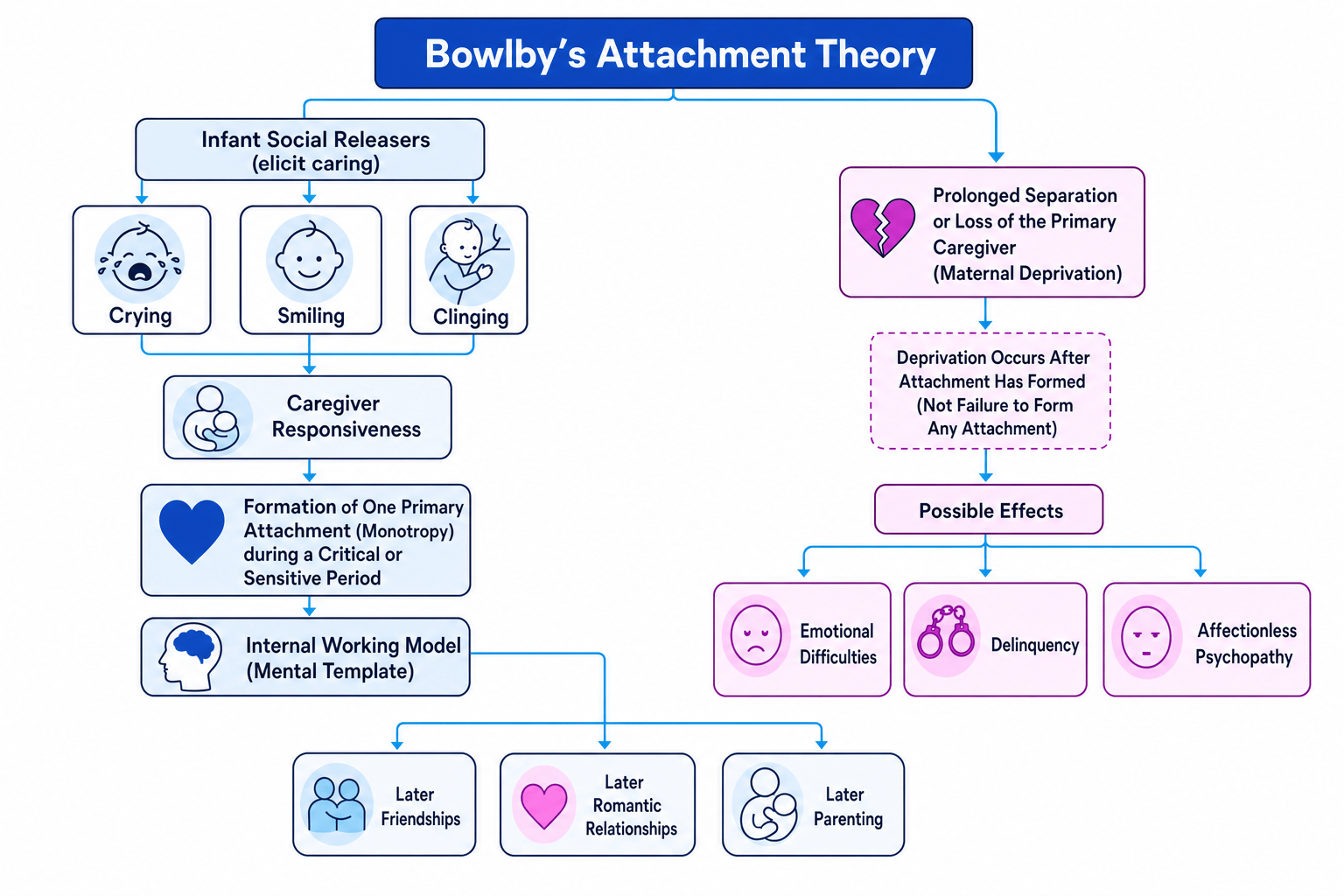
Bowlby suggested babies are born with social releasers: behaviours that encourage adults to care for them. These include crying, smiling, clinging, and making eye contact.
Social releasers
Social releasers are infant behaviours, such as crying and smiling, that encourage caregiving responses from adults.
These behaviours help form attachment because they make the caregiver more likely to respond, hold, feed, soothe, and protect the infant.
Monotropy: one especially important attachment
One of Bowlby’s most famous ideas is monotropy.
Monotropy
Monotropy is Bowlby’s idea that infants have an innate tendency to form one special, primary attachment, usually with the person who provides the most consistent care.
Bowlby did not mean children only have one attachment. He accepted that children can form several attachments, but he believed one attachment is usually the most important. This primary relationship acts as a foundation for emotional development.
The diagram below pulls together Bowlby’s main claims: social releasers help attachment form, a primary attachment becomes especially important, and the child develops expectations about relationships.
Monotropy does not mean only one bond
Do not write that Bowlby believed children can attach to only one person. A stronger answer says he believed one attachment is primary and especially important, while other attachments may also form.
The critical period and sensitive period
Bowlby argued there is a critical period for forming attachments. A critical period is a limited time window when development must happen, or later development may be seriously affected.
In Bowlby’s work, the first 30 months, around two and a half years, were seen as especially important. Some accounts extend the period of risk up to about age five. Modern psychologists often prefer the term sensitive period, because it suggests early attachment is easier during this time, but later recovery is still possible.
Critical period
A critical period is a biologically important time window when an attachment should form for healthy emotional development.
Sensitive period
A sensitive period is a time when attachment formation is especially likely or easier, but later development is still possible.
Internal working model: a mental template for relationships
Bowlby believed the first attachment creates an internal working model.
Internal working model
An internal working model is a mental template based on early attachment experiences, shaping what a child expects from themselves, other people, and relationships.
For example, a child whose caregiver is warm and reliable may develop the expectation: “I am worthy of care, and other people can be trusted.” A child whose caregiver is frightening or rejecting may develop the expectation: “Other people are unsafe, and I should not depend on them.”
This links to the continuity hypothesis: the idea that early attachment experiences continue to influence later friendships, romantic relationships, and parenting.
Applying the internal working model
A scenario says: A child is usually comforted quickly when upset. As a teenager, they find it fairly easy to trust close friends and ask for support.
- Identify the early attachment experience. The caregiver is responsive, so Bowlby would say the child is likely to develop expectations that others are reliable.
- Link this to the internal working model. The child’s early relationship becomes a mental template for later relationships.
- Apply the continuity hypothesis. The teenager’s ability to trust friends can be explained as continuity from early secure caregiving to later social confidence.
Maternal deprivation: separation after attachment has formed
Bowlby’s maternal deprivation hypothesis argued that prolonged separation from the mother figure during the critical period could cause emotional, social, and intellectual difficulties, especially if no good substitute care is provided.
Maternal deprivation
Maternal deprivation is the prolonged loss of emotional care from the primary caregiver after an attachment has already formed.
This is different from privation.
Privation
Privation is the failure to form any attachment in the first place, often because the child has not had a consistent caregiver.
So, if a child had a loving attachment but was then separated for a long time, that is deprivation. If a child never had the chance to form a stable attachment at all, that is privation.
Distinguishing deprivation and privation
A scenario says: Child A lived with a stable foster carer for two years, then was separated for several months. Child B spent early life in an institution with many changing staff and no consistent caregiver.
- Check whether an attachment had formed. Child A had a stable foster carer, so an attachment probably formed. Child B had no consistent caregiver, so attachment formation was less likely.
- Classify the experience. Child A fits deprivation because a bond was disrupted. Child B fits privation because a stable bond may never have formed.
- Apply Bowlby carefully. Bowlby would predict greater risk of later difficulties, but you should add that outcomes depend on factors such as the quality of later substitute care.
Bowlby’s predicted effects of deprivation
Bowlby argued that serious, prolonged maternal deprivation could lead to:
- emotional problems, such as depression or anxiety
- difficulties forming relationships
- intellectual delay
- delinquency, meaning antisocial or criminal behaviour
- affectionless psychopathy, Bowlby’s term for a lack of guilt, empathy, or deep affection
Affectionless psychopathy
Affectionless psychopathy is Bowlby’s term for a pattern of behaviour involving little guilt, empathy, or affection, which he linked to early deprivation and delinquency.
Be careful with this term. It is Bowlby’s historical wording, not a label you should casually apply to real people.
Bowlby’s 44 juvenile thieves study
Bowlby (1944) studied 44 adolescents who had been referred to a child guidance clinic for stealing. He compared them with 44 other clinic patients who had emotional problems but were not thieves.
He classified 14 of the thieves as “affectionless psychopaths”. Of these 14, many had experienced long early separations from their mothers; a commonly reported figure is 12 out of 14. Bowlby used this as evidence for a link between early separation, affectionless traits, and delinquency.
This study is useful for AO1 because it shows where Bowlby’s maternal deprivation ideas came from. However, it is also important for AO3 because it has serious methodological limitations.
AO3 evaluation: strengths of Bowlby’s work
Real-world impact
Bowlby’s work had major real-world applications. It influenced hospital visiting policies, children’s homes, fostering, adoption, and childcare. Before this, children in hospital could be separated from parents for long periods. Bowlby’s ideas encouraged professionals to value emotional care, not just physical care.
This is a strong application because psychological theory changed practice in ways that may reduce harm to children.
Support from animal research
Lorenz (1935) found that goslings imprint on the first moving object they see during a critical period. Harlow (1959) found that infant monkeys preferred a soft “contact comfort” mother to a wire mother that provided food. These studies support Bowlby’s view that attachment is biologically important and not simply based on feeding.
However, animal studies are limited because human attachments are more complex and involve language, culture, and conscious relationships.
Support for early relationship templates
Later attachment research, such as Ainsworth’s work on caregiver sensitivity and attachment types, supports the idea that early caregiving quality is linked to later patterns of relating. This gives some support to Bowlby’s internal working model.
AO3 evaluation: weaknesses and debates
Monotropy may be too narrow
Schaffer and Emerson (1964) found that many infants form multiple attachments, including attachments to fathers, grandparents, and siblings. This challenges the idea that one bond is always overwhelmingly more important than all others.
A strong evaluation point is that Bowlby may have underestimated the role of wider family networks and cultural differences in caregiving.
Maternal deprivation evidence is correlational
Bowlby’s 44 thieves study cannot prove cause and effect. The children who experienced separation may also have experienced poverty, family conflict, trauma, institutional care, or other disadvantages. These factors could contribute to later difficulties.
It was also a retrospective study, meaning it relied on looking back at earlier experiences. This can reduce accuracy because memories and records may be incomplete.
Researcher bias
Bowlby himself carried out interviews and assessments, so his expectations may have influenced how he interpreted the children’s histories. This weakens objectivity.
Rutter’s challenge: separation is not always damaging
Rutter (1981) argued that Bowlby confused deprivation, privation, and separation. Rutter suggested that separation itself is not necessarily harmful if the child receives good substitute emotional care. The quality of replacement care matters a lot.
This makes Bowlby’s original theory look too deterministic. Deterministic means it suggests one early event will inevitably lead to later outcomes. Modern psychology tends to see development as more flexible.
How to make evaluation balanced
Avoid saying “Bowlby was wrong”. A better evaluation is: Bowlby was influential and partly supported, but his original claims were probably too strong because later outcomes depend on substitute care, individual differences, and wider social factors.
Ethics and social implications
Bowlby’s work raises ethical issues because it can be interpreted as blaming mothers for children’s later problems. This is especially important historically, because Bowlby’s ideas were used in debates about whether mothers should work outside the home.
A modern ethical answer should avoid blaming individual caregivers. It should recognise social context: poverty, war, illness, bereavement, and lack of support can all affect families.
If Bowlby’s 44 thieves study were conducted today, it would need to follow the BPS Code of Ethics and Conduct (2009), including informed consent, right to withdraw, confidentiality, protection from harm, and debriefing. Extra care would be needed because the participants were young people referred for emotional or behavioural difficulties.
Pulling it together for essays
For AO1, describe Bowlby’s theory clearly: attachment is innate and adaptive; infants use social releasers; one primary attachment is especially important; attachment should form during a critical/sensitive period; the internal working model affects later relationships; deprivation can have harmful effects.
For AO2, apply the theory to the details of the scenario. Ask yourself: Has an attachment formed? Is there separation or loss? How long did it last? Was there good substitute care? What later behaviour is being explained?
For AO3, evaluate using evidence and limitations: Bowlby’s work was influential and supported by some research, but monotropy may be overstated, deprivation evidence is correlational, and later psychologists such as Rutter showed that outcomes are not inevitable.
In the exam
- Separate the concepts clearly: attachment, deprivation, and privation are not the same thing.
- Use precise AO1 terms: monotropy, social releasers, critical/sensitive period, internal working model, and maternal deprivation.
- Evaluate with balance: credit Bowlby’s real-world impact, then challenge determinism, methodology, and the assumption that the mother must be the sole caregiver.
Check yourself
- What is the difference between deprivation and privation?
- How does the internal working model explain later relationships?
- Why might Rutter’s ideas weaken Bowlby’s maternal deprivation hypothesis?
