What you'll learn
- How evolution can explain patterns in human development, especially attachment and survival-related behaviours.
- How hormones influence physical, emotional and social development from infancy to adolescence.
- How to separate AO1 description, AO2 application and AO3 evaluation in essay answers.
- Why biological explanations are useful — but should not be treated as “biology is destiny”.
The big picture: development is biological and environmental
Developmental psychology studies how people change over time: physically, cognitively, emotionally and socially. In this content point, you are focusing on two biological influences: evolution and hormones.
Human development
Human development means the changes in behaviour, thinking, emotion, social relationships and the body across the lifespan, especially during infancy, childhood and adolescence.
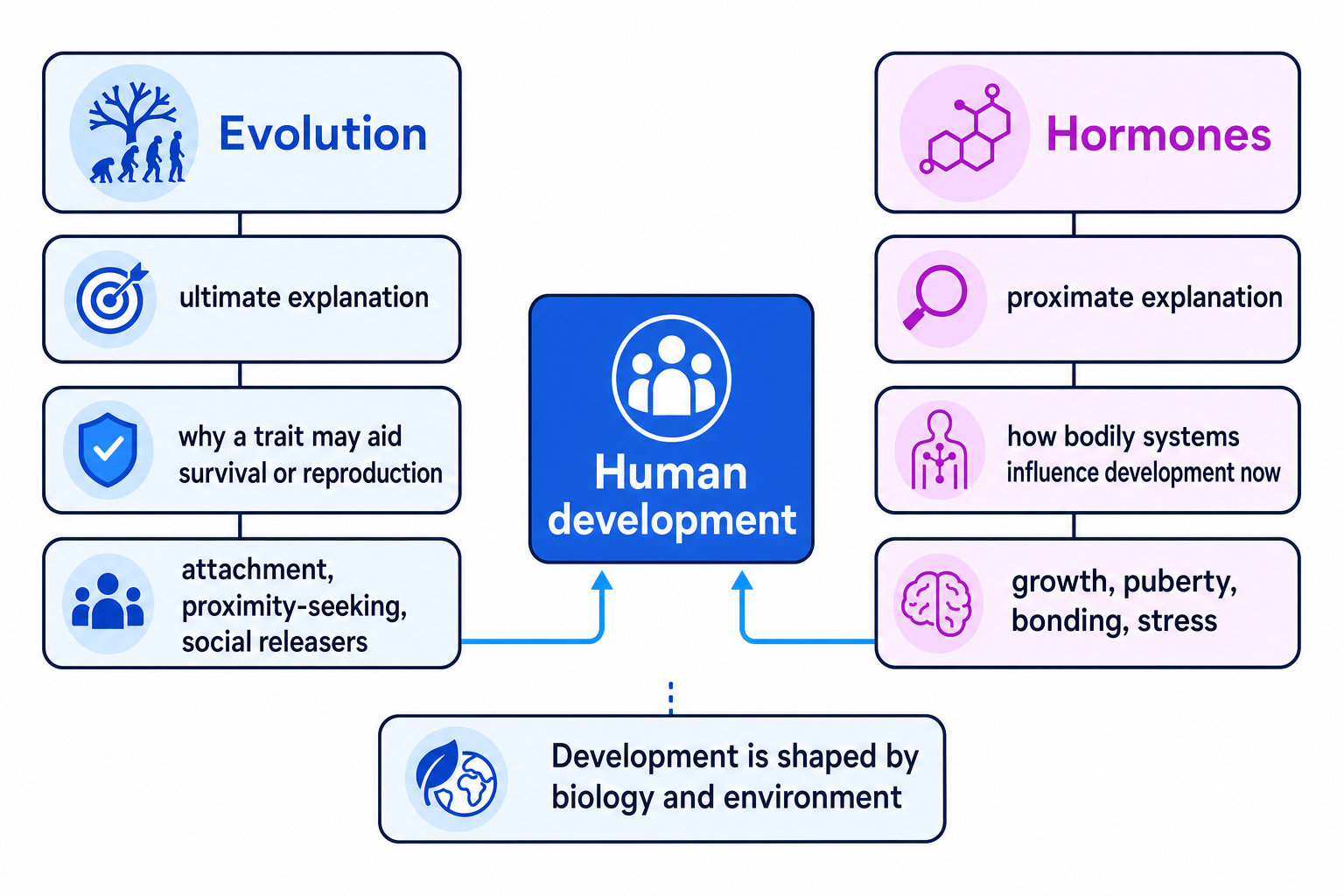
Evolution and hormones explain development at different levels. Evolution often asks why a tendency may have been useful for survival or reproduction. Hormones often explain how bodily systems help produce developmental change now.
Why and how
A strong answer usually treats evolution as an ultimate explanation — why a trait may have been selected — and hormones as a proximate explanation — how development is influenced inside the body.
Prerequisites: genes, environment and maturation
A gene is a section of DNA that contributes to inherited characteristics. The environment means external influences, such as parenting, nutrition, culture, stress and education. Maturation is biologically guided development that unfolds with age, such as puberty or early motor development.
Development is rarely either nature or nurture. It is usually an interaction between biological predispositions and experience.
Biology is not destiny
Do not write as if genes, evolution or hormones directly “cause” a fixed outcome in every child. Biological systems create tendencies and possibilities, but development is shaped by experience too.
The role of evolution in human development
Evolution
Evolution is the gradual change in inherited characteristics in a population over generations. In psychology, evolutionary explanations argue that behaviours or predispositions may exist because they helped ancestors survive or reproduce.
Natural selection and adaptation
Natural selection is the process where characteristics that improve survival or reproductive success become more common over generations. Darwin’s theory of natural selection, published in 1859, is the starting point for evolutionary psychology.
An adaptation is an inherited physical or behavioural characteristic that increased survival or reproductive success in ancestral environments. Fitness means reproductive success — passing genes on — rather than physical strength.
In human development, evolutionary explanations often focus on why infants and children develop in ways that increase survival. Human infants are unusually dependent, so behaviours that keep caregivers close would have been highly useful.
Evolution and attachment
A key application is attachment, which means a close emotional bond between an infant and caregiver. Bowlby (1969) argued that attachment is an evolved system because infants who stayed near protective adults were more likely to survive.
Bowlby suggested infants show social releasers, such as crying, smiling and clinging, which trigger caregiving responses in adults. He also proposed monotropy, the idea that infants form one especially important attachment relationship, and an internal working model, a mental template for future relationships based on early attachment experiences.
This links directly to development: attachment is not just “liking” a caregiver. It may shape emotional security, later relationships and confidence in exploring the world.
Sensitive periods
A critical period is a fixed window of time when a behaviour must develop or it may not develop normally. A sensitive period is a more flexible window when development is especially responsive to experience.
Lorenz (1935) found that goslings showed imprinting, where they followed the first moving object they saw shortly after hatching. This supports the idea that some attachment-like behaviours are biologically prepared and time-sensitive. However, human attachment is more flexible than imprinting in birds, so it is safer to describe human development using the term sensitive period.
Harlow (1959) found that rhesus monkeys preferred a soft cloth “mother” over a wire “mother” that provided food. This challenged the idea that attachment is only about feeding and supported the importance of comfort and contact.
Applying evolution to attachment behaviours
A 9-month-old cries when their caregiver leaves and crawls towards them when a stranger enters the room.
- Classify the behaviours as separation distress and proximity-seeking, because the infant is trying to reduce distance from the caregiver.
- Link the behaviours to survival: in ancestral environments, infants who stayed close to protective adults were more likely to receive warmth, food and protection from danger.
- Explain the evolutionary mechanism: predispositions for crying, clinging and caregiver responsiveness could have been selected because they improved survival and later reproductive success.
- Add a balanced qualification: the infant may be biologically prepared to attach, but the quality of attachment still depends on caregiver sensitivity, culture and wider experience.
Evaluating evolutionary explanations
Evolutionary explanations have strong AO1 value because they give a clear reason why some developmental behaviours may be widespread. Attachment behaviours appear across cultures, and van IJzendoorn and Kroonenberg’s (1988) cross-cultural meta-analysis found secure attachment was the most common classification overall.
However, there are important AO3 limits. Evolutionary explanations can become post hoc, meaning they explain a behaviour after the fact without direct evidence from ancestral environments. Animal research also needs caution: Lorenz’s goslings and Harlow’s monkeys are not the same as human infants.
There are ethical issues too. Harlow’s research caused distress and long-term harm to monkeys, so it would be heavily criticised using modern ethical standards. Human developmental research must follow the BPS Code of Ethics and Conduct (2009), including consent, protection from harm, confidentiality, right to withdraw and debriefing.
AO3 balance
For evolution, a neat evaluation line is: it explains why some developmental patterns are widespread, but it can underplay culture, learning and individual differences.
The role of hormones in human development
Hormone
A hormone is a chemical messenger released by an endocrine gland into the bloodstream. Hormones affect target cells, which are cells with the right receptors to respond.
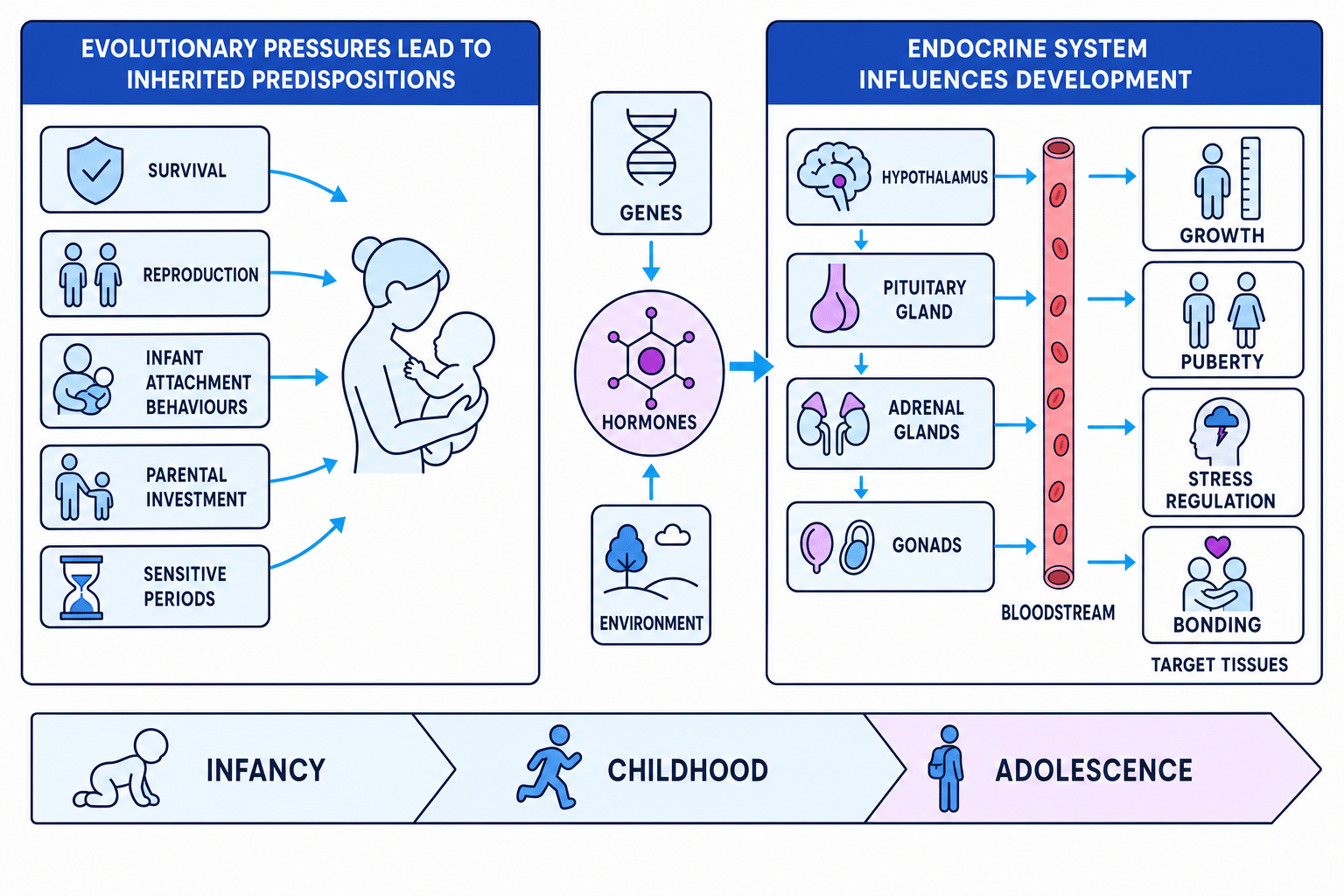
The endocrine system is the body’s hormone system. It includes the hypothalamus and pituitary gland in the brain, plus glands such as the adrenal glands and gonads. The gonads are the ovaries and testes.
Hormones usually act more slowly than neurotransmitters, but their effects can last longer. They are important in growth, puberty, stress regulation and bonding.
Growth and puberty
The pituitary gland releases growth hormone, which helps regulate physical growth. The thyroid gland releases thyroxine, which supports metabolism and brain development.
Puberty is strongly influenced by the hypothalamic-pituitary-gonadal axis, usually shortened to the HPG axis. This is a hormone pathway linking the hypothalamus, pituitary gland and gonads.
During puberty, the hypothalamus releases gonadotrophin-releasing hormone. This stimulates the pituitary gland to release luteinising hormone and follicle-stimulating hormone. These then stimulate the gonads to release sex hormones, including testosterone, oestrogen and progesterone.
These hormones contribute to reproductive development and secondary sex characteristics, which are puberty-related physical features such as voice changes, breast development, body hair and changes in body shape.
Tracing puberty through the HPG axis
A young person begins a growth spurt and develops secondary sex characteristics during adolescence.
- Identify the hormone pathway as the HPG axis, because puberty involves communication between the hypothalamus, pituitary gland and gonads.
- Sequence the mechanism: the hypothalamus releases gonadotrophin-releasing hormone, which stimulates the pituitary gland to release luteinising hormone and follicle-stimulating hormone.
- Link the pituitary to the gonads: these hormones stimulate the ovaries or testes to increase sex hormone production.
- Connect hormones to development: testosterone, oestrogen and progesterone travel in the bloodstream to target tissues, contributing to physical maturation.
- Qualify the explanation: puberty timing and experience also depend on genetics, nutrition, stress, health and social context.
Prenatal hormones and later development
Hormones can also influence development before birth. Androgens are a group of hormones including testosterone. Research into conditions such as congenital adrenal hyperplasia, where prenatal androgen exposure is higher than usual, has been used to study links between early hormones and later behaviour.
Hines et al. (2002), for example, found associations between prenatal androgen exposure and more male-typical toy preferences in girls with congenital adrenal hyperplasia. This supports the idea that hormones may influence aspects of development, but it does not prove hormones are the only cause. Social expectations, parenting and culture also matter.
Hormones, bonding and stress
Oxytocin is a hormone linked with social bonding, childbirth and breastfeeding. Feldman et al. (2007) found that oxytocin levels across pregnancy and the postnatal period were associated with mother-infant bonding behaviours. This suggests hormones can support caregiving and early social development.
Cortisol is a hormone involved in stress. The hypothalamic-pituitary-adrenal axis, or HPA axis, regulates stress responses. Gunnar and Quevedo (2007) reviewed evidence that early stress can affect HPA-axis development. Long-term stress may influence emotional regulation, attention and later vulnerability to anxiety or depression.
Avoid one-hormone explanations
Hormones work in systems. A behaviour such as bonding, risk-taking or emotional regulation cannot be explained by one hormone alone.
Evaluating hormonal explanations
Hormonal explanations are strong because hormones can be measured using blood or saliva samples, making the evidence more objective than self-report alone. They also have useful real-world applications, such as identifying endocrine disorders, supporting puberty education and improving stress-aware care for children.
However, many hormone studies are correlational. If high cortisol is linked with anxiety, this does not automatically prove cortisol caused the anxiety; stress may have raised cortisol, or a third factor may affect both. Hormone levels also fluctuate by time of day, age, context and individual biology.
There are also ethical considerations. When research involves children or sensitive topics such as puberty, sex development or bonding, researchers must gain informed parental consent and the child’s assent where possible. They must protect participants from distress or stigma, keep data confidential, allow withdrawal and provide a clear debrief, in line with the BPS Code of Ethics and Conduct (2009).
Pulling evolution and hormones together
Evolution and hormones are not competing explanations. Evolution can explain why humans developed hormone systems that support growth, bonding, stress responses and reproduction. Hormones then explain how those systems operate in an individual child or adolescent.
A strong essay should therefore avoid choosing one side too simply. Better answers explain that development is shaped by evolved predispositions, hormone mechanisms and environmental experience.
Essay shortcut
Use this structure: evolution explains adaptive purpose, hormones explain biological mechanism, environment explains variation between individuals.
In the exam
- Start AO1 by defining the key term — evolution or hormone — then link it directly to human development, not just behaviour in general.
- Use named evidence selectively: Bowlby (1969), Lorenz (1935), Harlow (1959), Hines et al. (2002), Feldman et al. (2007) or Gunnar and Quevedo (2007).
- For AO3, include at least one strength and one limitation, such as objective hormone measurement, animal extrapolation, correlational evidence, reductionism, ethics or real-world application.
- Avoid deterministic wording. Say hormones and evolution influence, predispose or contribute to development.
Check yourself
- What is the difference between an ultimate evolutionary explanation and a proximate hormonal explanation?
- How can Bowlby’s theory of attachment be used to show the role of evolution in development?
- Why should hormone research in children be evaluated carefully in terms of ethics and causality?