Why do some people experiment with recreational drugs and walk away unscathed, while others quickly spiral into compulsive drug misuse and addiction?
In Health Psychology (Topic 8), you will explore how individual differences—specifically personality, biological predispositions, and social factors—explain this variation. By looking at these factors, psychologists move away from "one-size-fits-all" theories of addiction and towards a more nuanced, personalised understanding of human behaviour.
What you'll learn
- How personality traits, such as impulsivity and sensation-seeking, elevate the risk of drug misuse.
- The biological mechanisms (like dopamine receptors) that create genetic vulnerabilities in certain individuals.
- How social factors (such as peer networks) interact with individual vulnerabilities to trigger addiction.
- How to critically evaluate individual differences as an explanation for drug misuse.
1. Defining Key Concepts
Before examining how individuals differ, we must clarify what we are trying to explain.
Drug misuse
Drug misuse is the use of a chemical substance (legal or illegal) in a way that is harmful, hazardous, or destructive to an individual's physical or mental health, or contrary to directed medical advice.
Individual differences
Individual differences refer to the unique psychological, biological, and environmental characteristics that vary from person to person and explain why different individuals respond differently to the same situation or substance.
2. Personality Factors in Drug Misuse
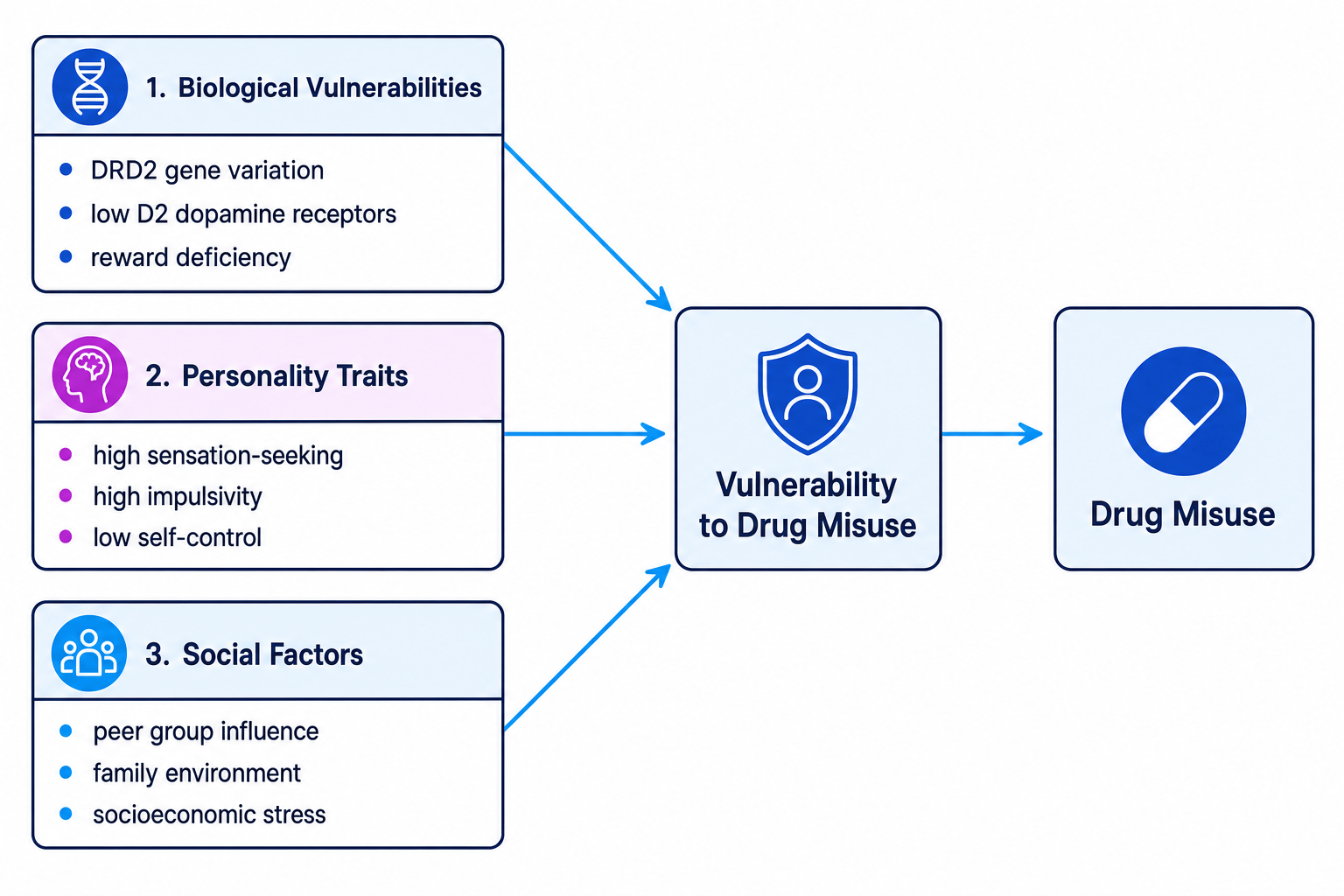
Personality is a stable set of characteristics and behaviours that define an individual. Two specific personality traits have been consistently linked to drug misuse: sensation-seeking and impulsivity.
Sensation-Seeking
Developed by Marvin Zuckerman (1994), sensation-seeking is a personality trait characterised by the pursuit of novel, intense, and complex sensations and experiences, and the willingness to take physical, social, legal, and financial risks for the sake of such experiences.
- The Mechanism: High sensation-seekers find everyday activities boring. They seek out drugs because the chemical rush provides the high level of sensory stimulation their brains crave.
- The Risk: They are much more likely to experiment with illicit drugs, try "harder" substances, and engage in polydrug use (using multiple drugs at once).
Impulsivity
Impulsivity is the tendency to act on a whim, displaying behaviour characterised by little or no forethought, reflection, or consideration of long-term consequences.
- The Mechanism: Impulsivity is linked to a structural or functional deficit in the prefrontal cortex (PFC)—the area of the brain responsible for executive functioning, planning, and self-control.
- The Risk: While sensation-seeking drives the initial search for a high, high impulsivity makes it incredibly difficult for an individual to stop using drugs once they start, even when they are fully aware of the negative consequences.
3. Biological and Genetic Factors
Personality does not exist in a vacuum; it is deeply rooted in our biology.
The Dopamine Hypothesis and DRD2 Gene
The neurotransmitter dopamine is the brain's primary reward chemical. When we eat, drink, or engage in survival-promoting behaviours, dopamine is released in the brain's reward pathway (the mesolimbic pathway), making us feel pleasure.
Some individuals are born with a genetic predisposition that alters this system:
- The DRD2 Gene: This gene codes for the D2 dopamine receptor in the brain.
- The A1 Variant: Individuals carrying the A1 variant of the DRD2 gene have significantly fewer D2 dopamine receptors than average.
- Reward Deficiency Syndrome (RDS): Because they have fewer receptors, these individuals do not experience natural pleasure (from food, relationships, or hobbies) as intensely as others. They live in a state of "reward deficiency".
To compensate for this, they turn to highly stimulative substances—like cocaine, alcohol, or nicotine—which artificially flood the brain with dopamine, temporarily correcting their reward deficit.
4. The Interaction with Social Factors
To paint a complete psychological picture, we cannot ignore the social environment. Individual biological and personality traits interact with social factors to trigger or protect against drug misuse. This is known as a diathesis-stress framework: the "diathesis" is the individual's biological/personality vulnerability, while the "stress" is the environmental trigger.
- Peer Group Influence: An individual high in sensation-seeking is naturally drawn to peer groups that value risk-taking and drug-taking. Once inside this group, social learning theory (Bandura) and conformity pressures accelerate their drug misuse.
- Socioeconomic Environment: Chronic stress from poverty or unstable family dynamics acts as an environmental trigger. An impulsive individual in a highly stressful environment has fewer coping resources and is more likely to use drugs as self-medication.
5. Research Methods: Applying Statistical Tests
When psychological researchers study individual differences in drug misuse, they often collect quantitative data on personality traits and drug use habits to see if there is a relationship. You must be able to identify which inferential statistic is appropriate for analyzing this data.
Selecting the correct statistical test for individual differences
A psychologist wants to see if there is a relationship between scores on Zuckerman’s Sensation-Seeking Scale (scored from 1 to 40, producing ordinal data) and the self-reported frequency of cannabis use per month (ordinal data) in a sample of 50 college students.
Which inferential statistical test should the researcher use to see if there is a significant relationship?
- Identify if the study is looking for a difference or a correlation (relationship): The researcher wants to see if there is a "relationship" between sensation-seeking scores and cannabis use frequency. Therefore, this is a test of correlation, not a test of difference.
- Determine the level of measurement for the variables: The Sensation-Seeking Scale produces a score that is ranked or ranked-interval (ordinal data), and the self-reported frequency of cannabis use is grouped/ordered (ordinal data). Because at least one of the variables is measured at the ordinal level, parametric tests cannot be used.
- Select the appropriate test based on these criteria: According to the Edexcel specification, the inferential test designed specifically for a correlation/relationship using ordinal data is Spearman's rho (rsr_srs). Therefore, the researcher must calculate the Spearman's rho coefficient.
Significance levels
Remember, for a correlation coefficient like Spearman's rho, we test for significance against a critical value table. The default significance level in psychology is p≤.05p \le .05p≤.05. This means there is a 5%5\%5% or less probability that the observed relationship occurred by chance.
6. Evaluation (AO3)
To secure top marks in your essays, you must critically evaluate the individual differences explanation of drug misuse.
Strengths
- Strong Empirical Support: Ersche et al. (2012) conducted brain scans on sibling pairs where one sibling had an addiction and the other did not. They found that both siblings shared structural brain abnormalities (specifically in the fronto-striatal systems linked to impulsivity) compared to healthy, unrelated controls. This strongly suggests a genetic, pre-existing biological and personality vulnerability to drug misuse.
- Practical Real-World Applications: Understanding these individual differences allows for targeted prevention. Instead of generic anti-drug campaigns, school programmes can identify adolescents high in sensation-seeking and channel their energy into healthy, high-stimulation activities (like outdoor rock climbing or competitive sports), preventing drug experimentation before it starts.
Weaknesses
- Methodological Issues (Correlational Data): Much of the research linking personality to drug misuse is correlational. It is incredibly difficult to establish cause and effect. Does a highly impulsive personality cause drug misuse, or does chronic drug misuse damage the prefrontal cortex, leading to increased impulsivity?
- Biological and Environmental Determinism: These explanations can be deterministic. Suggesting that having the DRD2 A1 gene variant or high impulsivity "causes" addiction overlooks an individual's free will and active decision-making. Many individuals with high sensation-seeking never misuse drugs, choosing instead to become firefighters, pilots, or entrepreneurs.
Ignoring the interaction
Do not write about personality and biology as if they exist in isolation. The strongest essays show how they interact. A genetic vulnerability (biology) leads to high sensation-seeking (personality), which leads to choosing a drug-using peer group (social). Always synthesise these factors!
In the exam
- Unpack the scenario (AO2): If the exam question describes a character (e.g., "Liam loves extreme sports and often makes impulsive decisions without thinking"), directly link their behaviour to the key terms: sensation-seeking, impulsivity, and potentially a biological vulnerability like a low density of D2 receptors.
- Use precise biological terms: Don't just say "they have different brains." Refer specifically to the DRD2 gene, the D2 dopamine receptor, the prefrontal cortex, and the concept of Reward Deficiency Syndrome.
- Contrast with other explanations: To show excellent critical thinking (AO3), compare individual differences with other explanations you have studied, such as classical/operant conditioning (learning theories) or social influence.
Check yourself
- Can you explain how Zuckerman's concept of sensation-seeking differs from impulsivity?
- Why does having fewer D2 dopamine receptors make someone more vulnerable to initiating drug use?
- Why is it difficult to establish a clear cause-and-effect relationship between personality traits and drug misuse?
