What you'll learn
- How social interactions during development can increase the risk of drug misuse.
- How social learning theory, operant conditioning, and classical conditioning explain drug-related behaviour.
- How to apply these ideas to family, peer and media influences.
- How to evaluate the explanation for AO3, including research issues and ethics.
8.1.7 Social interactions, development and drug misuse
This content point is about how the people around a young person can shape their attitudes towards drugs, their first experiences of drug use, and whether use becomes repeated or harmful.
The key idea is not that “friends cause addiction” in a simple way. A stronger A-Level answer explains mechanisms: exactly how social interaction changes behaviour through learning, reinforcement, modelling and social norms.
Drug misuse
Drug misuse means using a substance in a harmful, risky, illegal, excessive, or non-medical way. This can include illegal drugs, misusing prescription medication, or using legal substances such as alcohol in a harmful pattern.
Social interaction
A social interaction is any exchange with other people that can influence behaviour, attitudes or emotions. In this topic, important sources include parents or carers, siblings, peers, romantic partners, school groups, online communities and media figures.
Why development matters
Development refers to changes across the lifespan, especially childhood and adolescence. During these periods, young people are still developing their identity, self-control, peer relationships and coping strategies.
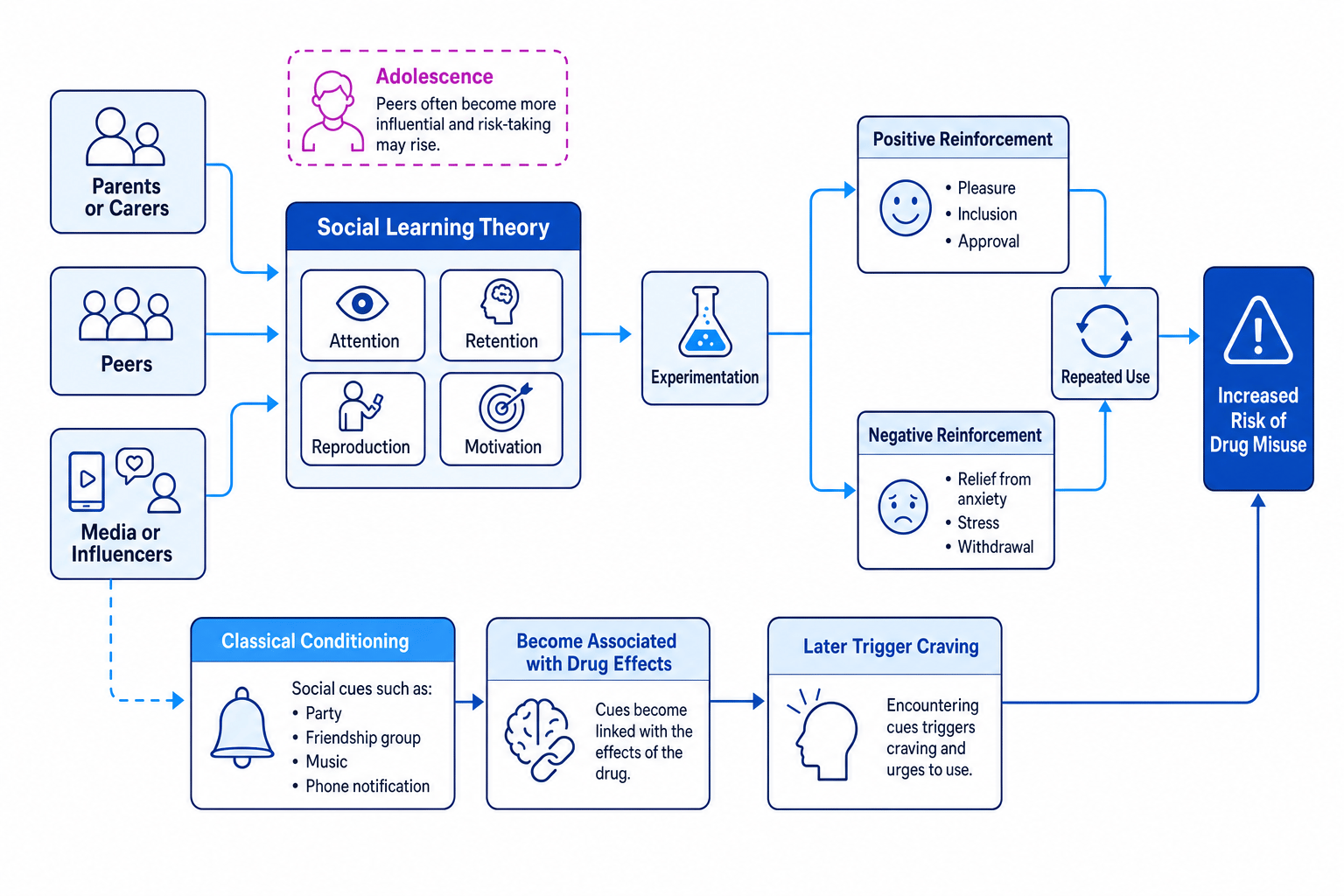
Adolescence is especially important because peers often become more influential, independence from parents increases, and risk-taking may rise. This makes social learning processes particularly relevant to drug misuse.
Developmental risk is probabilistic
Social interactions can increase or reduce risk, but they do not determine behaviour. Two young people can experience similar peer pressure and make different choices because of personality, family support, mental health, culture and access to substances.
AO1: Social learning theory
Social learning theory was developed by Albert Bandura. Bandura argued that people can learn new behaviours by observing others, rather than only through direct reward or punishment.
Social learning theory
Social learning theory is the idea that behaviour is learned through observing and imitating models, especially when those models are liked, high-status, similar to the observer, or rewarded for their behaviour.
In drug misuse, a young person may observe parents drinking heavily, older siblings vaping, peers using cannabis, or influencers presenting drug use as exciting or normal. The young person may then imitate the behaviour if they believe it will bring rewards.
Bandura described key processes:
- Attention: the young person notices the model’s behaviour.
- Retention: they remember what the model did.
- Reproduction: they are able to copy the behaviour.
- Motivation: they expect some reward for copying it.
A classic piece of evidence for observational learning is Bandura, Ross and Ross (1961), where children imitated aggressive behaviour shown by adult models. This was not a drug-use study, but it supports the broader principle that young people can learn behaviour by watching others.
Vicarious reinforcement
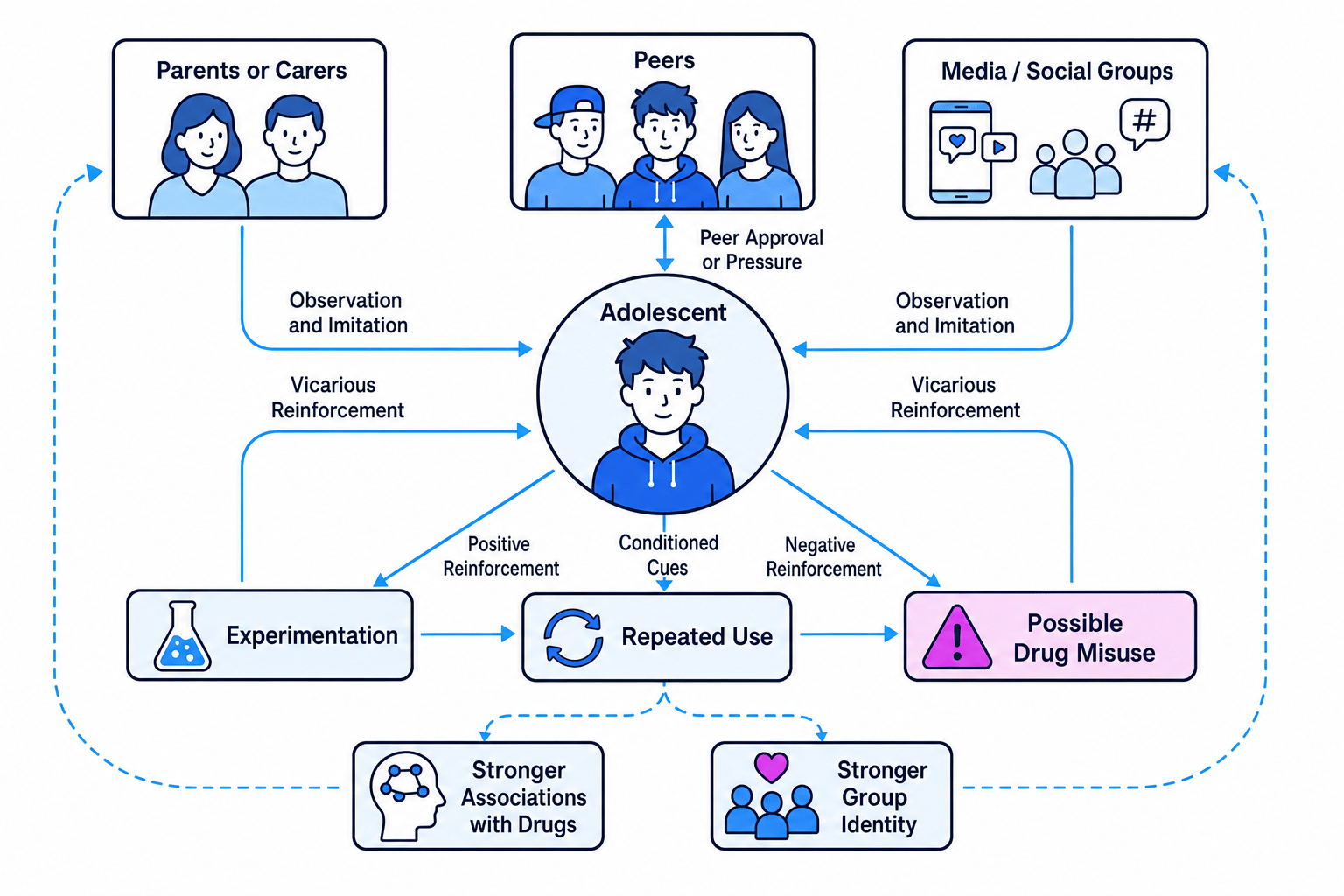
Vicarious reinforcement occurs when someone is more likely to imitate a behaviour because they have seen another person rewarded for it.
For example, if a teenager sees a peer gain popularity after using a substance at a party, the teenager may learn that drug use brings social approval.
The routes can be summarised as a set of social learning loops: models influence expectations, reinforcement strengthens behaviour, and repeated use can create stronger associations with people, places and group identity.
AO1: Operant conditioning
Operant conditioning is learning through the consequences of behaviour. It is associated with B. F. Skinner’s work on reinforcement.
Operant conditioning
Operant conditioning is learning where behaviour becomes more or less likely depending on its consequences, such as reward, relief or punishment.
Drug use may be repeated if it is reinforced.
Positive reinforcement
Positive reinforcement means a behaviour is strengthened because it leads to a pleasant consequence.
In drug misuse, positive reinforcement could include:
- feeling relaxed or euphoric
- gaining approval from friends
- feeling more confident at a social event
- being included in a peer group
Negative reinforcement
Negative reinforcement means a behaviour is strengthened because it removes or reduces an unpleasant feeling.
In drug misuse, negative reinforcement could include:
- using alcohol to reduce social anxiety
- using cannabis to escape stress
- taking drugs to avoid withdrawal symptoms
- using substances to cope with family conflict or low mood
Positive and negative do not mean good and bad
In operant conditioning, positive means something is added, and negative means something is removed. Negative reinforcement is still reinforcement because it increases the behaviour.
AO1: Classical conditioning and drug cues
Classical conditioning is learning by association. It is linked with Pavlov’s research on dogs, where a neutral stimulus became associated with food and triggered salivation.
Classical conditioning
Classical conditioning is learning where a neutral stimulus becomes associated with an automatic response after repeated pairing with another stimulus.
In drug misuse, social settings can become conditioned cues. For example, a particular group of friends, a party location, music, smell, or phone notification may become associated with drug effects. Later, the cue alone may trigger craving.
This helps explain why relapse can occur even after someone has stopped using a substance. Returning to the same social group or environment can reactivate learned associations.
Applying learning explanations to a drug-use scenario
A 15-year-old sees older friends vaping at parties. The friends are admired by others. The teenager tries vaping, feels included, and later craves it whenever they meet the group.
-
The older friends act as models because they are high-status and socially attractive to the teenager.
-
The teenager experiences vicarious reinforcement because the friends appear to gain admiration and approval after vaping.
-
When the teenager tries vaping and feels included, this is positive reinforcement because social approval makes future vaping more likely.
-
If the teenager later vapes to reduce awkwardness or anxiety in the group, this is negative reinforcement because an unpleasant feeling is removed.
-
The party setting and friendship group may become conditioned cues, so meeting the group can trigger craving or expectations of vaping.
Peer influence and social norms
Peers can influence drug misuse through peer pressure, but exam answers should go beyond that phrase.
Peer pressure
Peer pressure is influence from people of a similar age or social group, where someone feels encouraged or pushed to behave in a certain way.
There are two useful types of social influence:
- Normative influence: conforming to be liked, accepted or not rejected.
- Informational influence: copying others because they seem to know what is normal or appropriate.
A young person may think “everyone is doing it”, even if that belief is exaggerated. This perceived norm can increase experimentation.
Peer influence may be strongest when drug use is linked to group identity. If a group treats substance use as a sign of maturity, rebellion or belonging, refusing may feel socially costly.
AO2 application shortcut
When applying this explanation to a scenario, look for: who the model is, what reward is shown, what direct reinforcement occurs, and which cues or settings become associated with use.
Family interactions
Family relationships can also shape drug-related learning.
Parents, carers and siblings may influence risk by:
- modelling substance use or abstinence
- communicating attitudes about drugs
- setting clear or unclear boundaries
- monitoring friendships and whereabouts
- providing emotional support or conflict
- reinforcing coping strategies, healthy or unhealthy
For example, a young person who repeatedly sees a parent use alcohol to cope with stress may learn that substances are an acceptable coping mechanism. However, supportive parenting, clear rules and open communication can be protective.
Social interaction can be protective too
The same learning processes can reduce risk. Young people can observe refusal skills, receive praise for healthy coping, and join peer groups where drug misuse is not valued.
AO3: Strengths of the explanation
It explains both starting and continuing drug use
Social learning theory explains why a young person may first experiment: they observe others and expect rewards. Operant conditioning explains why use may continue: it is reinforced by pleasure, belonging or relief. Classical conditioning explains why craving may be triggered by social cues.
This makes the explanation broad and useful.
It has real-world applications
The explanation supports prevention programmes that target social skills, peer norms and family communication. For example, interventions may teach refusal skills, challenge exaggerated beliefs about how common drug use is, and encourage parents to monitor and communicate effectively.
This is a strength because the theory can be applied to reduce harm.
It fits developmental psychology well
The explanation recognises that influence changes across development. Family modelling may be especially important in childhood, while peer approval may become more powerful during adolescence.
AO3: Weaknesses and limitations
Correlation does not prove causation
Many studies on peer influence and drug use are correlational. If young people who use drugs often have friends who use drugs, this could mean peers caused the behaviour. But it could also mean young people choose friends with similar attitudes.
Do not assume peers always cause drug misuse
Peer groups may influence drug use, but young people may also select peer groups that already match their interests, personality or risk-taking style.
Longitudinal research, which follows people over time, is stronger because it can show whether peer drug use comes before later individual drug use. However, even longitudinal studies cannot control every possible influence.
It may be reductionist
A purely social learning explanation may underplay biological and cognitive factors, such as genetic vulnerability, impulsivity, mental health difficulties, trauma, availability of drugs and poverty.
A balanced essay should argue that social interactions are important, but drug misuse is usually multi-causal.
Ethical issues limit research
Researchers cannot ethically expose young people to drug-taking models to see if they copy them. This means direct experimental evidence is limited.
Research with young people and drug misuse must follow the BPS Code of Ethics and Conduct (2009), including informed consent, confidentiality, right to withdraw, protection from harm and debriefing. With under-16s, parental or guardian consent is usually important, but researchers also need the young person’s own assent.
Confidentiality has limits
In drug-misuse research, confidentiality is important, but it may need to be broken if a young person is at serious risk of harm. Researchers should explain these limits clearly before data is collected.
Building a strong essay paragraph
A strong AO1 paragraph names the learning process and explains it clearly. A strong AO2 paragraph applies the process to a specific social situation. A strong AO3 paragraph evaluates whether the explanation is supported, useful and limited.
For example, you could write:
- AO1: Drug misuse can be learned through observation and reinforcement.
- AO2: A teenager may imitate peers if those peers gain status from using drugs.
- AO3: However, peer influence evidence can be correlational, so it is difficult to know whether peers cause drug misuse or whether young people choose similar friends.
In the exam
-
Use precise learning terms: modelling, imitation, vicarious reinforcement, positive reinforcement, negative reinforcement and conditioned cues.
-
For AO2, apply the theory to the scenario rather than just repeating it. Name the model, reward, social setting and likely learned association.
-
For AO3, avoid one-sided answers. Evaluate using causation problems, self-report issues, ethics, real-world applications and the idea that drug misuse is multi-causal.
Check yourself
-
How is vicarious reinforcement different from direct positive reinforcement?
-
Why might peer drug use and individual drug use be correlated without peer influence being the only cause?
-
How could a social setting become a conditioned cue for craving?