What you'll learn
- What psychologists mean by individual differences in child psychology.
- How temperament can affect attachment type and how attachment influences children.
- How gender and temperament can change the effects of day care.
- How to turn this into strong AO1, AO2 and AO3 essay material.
The big idea: children are not all affected in the same way
In earlier child psychology work, you may have learned about attachment, separation, deprivation and day care as if these experiences affect children in a fairly general way. This section adds an important refinement: children differ from each other, so the same experience may not have the same effect on every child.
For example, two children may both attend day care from an early age. One may become more confident and sociable. Another may become more stressed or aggressive. The difference might not be day care alone — it may be how day care interacts with the child’s temperament, gender, previous attachments and social environment.
Individual differences
Individual differences are the ways in which people vary from one another, such as in temperament, gender, sensitivity to stress, sociability, confidence, emotional regulation and previous experiences.
A useful exam word here is moderator. A moderator is a factor that changes the strength or direction of a relationship between two other variables. In this topic, temperament or gender may moderate the effect of attachment type or day care.
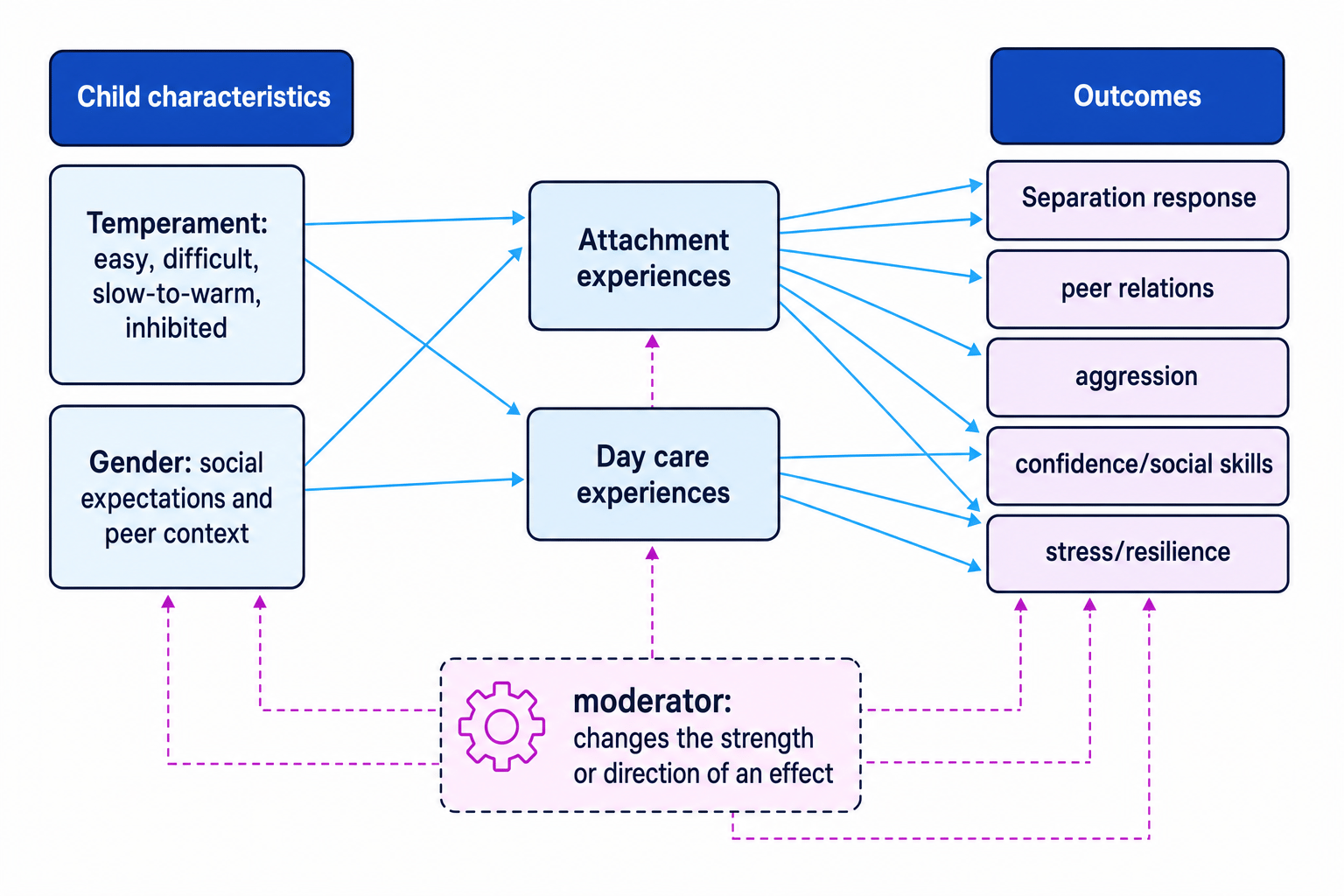
Core takeaway
Attachment and day care do not work like simple “one cause, one effect” systems. A child’s own characteristics can shape both the experiences they receive and the outcomes that follow.
Temperament: the child’s behavioural style
Temperament
Temperament is a child’s typical emotional and behavioural style, often seen in how active, sociable, fearful, adaptable or easily upset they are.
Temperament is usually thought to have a biological basis, although it can be shaped by experience. Classic work by Thomas and Chess (1977) described children as having different temperamental styles, including:
- easy temperament — generally calm, adaptable and positive in mood
- difficult temperament — more intense, irregular, easily distressed or harder to soothe
- slow-to-warm-up temperament — cautious at first, but able to adapt gradually
Later work by Kagan (1994) focused on behavioural inhibition, where some children are naturally more cautious, anxious or withdrawn in unfamiliar situations.
Why temperament matters for attachment
Attachment type is usually explained through the caregiver’s sensitivity and responsiveness. For example, Ainsworth’s work suggested that sensitive caregiving is linked with secure attachment, while inconsistent or rejecting care is linked with insecure attachment.
But individual differences complicate this. A baby with a difficult or inhibited temperament may cry more, resist soothing or appear anxious during separations. This could make them more likely to be classified as insecure in the Strange Situation, even if the caregiver is generally responsive.
Blaming the child
Do not write as if a “difficult” temperament means the child is at fault. Temperament is a descriptive label, not a moral judgement, and caregiver behaviour still matters.
Attachment type can affect individuals differently
Attachment type
An attachment type is a pattern of behaviour shown in close caregiver relationships, especially around separation, reunion and seeking comfort. Common types include secure, insecure-avoidant and insecure-resistant/ambivalent.
A securely attached child usually uses the caregiver as a secure base: they feel able to explore while knowing they can return for comfort. An insecurely attached child may show avoidant, clingy or highly distressed behaviour.
However, the effects of attachment may depend on temperament. For instance, an insecure attachment may be more damaging for a highly anxious child than for a more emotionally resilient child. Equally, a secure attachment may be especially protective for a temperamentally inhibited child because the caregiver provides a safe base for dealing with unfamiliar situations.
Applying temperament as a moderator
A psychologist observes that two children are both classified as insecure-resistant, but only one later shows strong separation anxiety at nursery.
-
Compare the shared factor: both children have the same attachment classification, so attachment type alone cannot fully explain the difference in outcome.
-
Add a possible moderator: one child may have a more inhibited or anxious temperament, meaning unfamiliar settings feel more threatening.
-
Apply the interaction: insecure-resistant attachment plus inhibited temperament could increase clinginess and distress more than insecure-resistant attachment in a calmer, more adaptable child.
-
Reach a balanced conclusion: attachment type may influence later behaviour, but its effect can vary depending on the child’s individual characteristics.
The temperament hypothesis
Some psychologists argue that what looks like an attachment difference may partly be a temperament difference.
This is sometimes called the temperament hypothesis: the idea that children’s attachment behaviours may reflect their innate temperament as well as the quality of caregiving. For example, a child who cries intensely when the caregiver leaves may be showing high emotional reactivity rather than poor attachment security.
This is important when evaluating research such as Ainsworth and Bell (1970). The Strange Situation is useful because it is controlled and allows comparison between children, but it may not fully separate attachment from temperament. A naturally anxious child may appear insecure-resistant even if the caregiver is loving and responsive.
Nature and nurture together
Temperament is not an alternative to attachment theory; it is often better treated as interacting with caregiving. A child’s biology and environment can influence each other.
Day care and individual differences
Day care
Day care is non-parental care provided for children, usually outside the home, such as nurseries, childminders or preschool settings.
Day care can have positive and negative effects. Possible positive effects include:
- better peer interaction
- improved social confidence
- increased independence
- preparation for school routines
- cognitive and language stimulation, especially in high-quality settings
Possible negative effects include:
- increased stress if care is poor-quality or starts very early
- more aggressive behaviour in some children
- insecure behaviour if separations are difficult
- less one-to-one adult attention in some settings
Research evidence is mixed. For example, Belsky and Rovine (1988) linked extensive early non-maternal care with insecure attachment in some cases, while large-scale work by the NICHD Early Child Care Research Network (2003) suggested that quality of care, home environment and child characteristics all matter. The EPPE project by Sylva et al. (2004) found benefits of high-quality preschool for social and cognitive development.
Temperament and day care
Temperament can affect how a child experiences day care. An easy-tempered child may enjoy new toys, adults and peers. A slow-to-warm-up child may need a gradual settling-in period. A difficult or highly reactive child may find noise, transitions and group routines more stressful.
This means day care may be particularly positive for some children and more challenging for others.
For example, a shy child may benefit from sensitive, high-quality nursery care that gently encourages social interaction. But the same child may struggle in a chaotic setting with high staff turnover. So the outcome depends on the match between the child and the environment.
Use the phrase goodness of fit
Goodness of fit means how well the child’s temperament matches the environment. In essays, this helps you avoid overclaiming that day care is simply “good” or “bad”.
Gender and day care
Gender as an individual difference
In this context, gender refers to socially shaped expectations and experiences linked to being seen as a boy, girl or another gender identity. In older research, gender is often treated in binary terms, so evaluate this carefully.
Gender may affect day-care outcomes because adults and peers can respond differently to children. For example, boys may be encouraged into more physically active play, while girls may be encouraged into quieter or cooperative play. These social expectations can affect peer relationships, aggression and confidence.
Some research has suggested that boys may be more vulnerable to stress or behaviour problems in lower-quality day care, while girls may sometimes show stronger verbal or cooperative benefits. However, you should be cautious: gender differences are often small, socially influenced and affected by culture.
Treating gender as destiny
Avoid writing that “boys become aggressive” or “girls become sociable”. Better phrasing: gender may influence the kinds of interactions, expectations and peer experiences children encounter in day care.
Applying this to scenarios
Exam questions may describe a child and ask you to apply individual differences. Look for how the child’s temperament or gender may change the effect of attachment or day care.
Explaining different day-care outcomes
Two children start nursery at 18 months. Child A is outgoing and settles quickly. Child B is cautious, cries during transitions and avoids unfamiliar adults. After three months, Child A has more friends, while Child B still shows distress at drop-off.
-
Identify the relevant individual difference: Child A appears easy or sociable in temperament, while Child B appears inhibited or slow-to-warm-up.
-
Link temperament to day-care experience: the busy nursery environment may provide stimulation and peer opportunities for Child A, but may feel threatening or overwhelming for Child B.
-
Explain the different outcomes: day care may improve Child A’s social confidence, while Child B may need more gradual settling, key-worker support and sensitive routines before benefits appear.
-
Avoid a one-sided conclusion: the difference does not prove day care is good for one child and bad for the other forever; quality of care and adaptation over time also matter.
AO3 evaluation: strengths and limits of this approach
Strength: more realistic than simple cause-and-effect explanations
Individual differences make explanations more realistic. Children are active participants in their development, not passive recipients of care. Temperament may affect how caregivers respond, how children cope with separation and how they interact with peers.
This is useful for real-world settings because nurseries can adapt care to the child, rather than assuming one approach suits everyone.
Strength: supported by mixed research findings
The fact that day-care research often finds mixed results supports the role of moderators. If day care were always harmful or always beneficial, findings would be more consistent. Instead, studies such as NICHD and EPPE suggest that outcomes depend on quality, quantity, family background and child characteristics.
Weakness: difficult to separate temperament from attachment
A major methodological problem is that temperament and attachment behaviours can look similar. Crying, clinging or avoiding may reflect attachment insecurity, temperament, tiredness, illness or unfamiliarity with the setting.
This creates a validity issue: a study may claim to measure attachment type but partly measure temperament.
Weakness: risk of socially biased interpretations
Gender differences can be overinterpreted. Research may reflect adult expectations rather than true psychological differences. For example, adults may label the same behaviour as “confident” in a boy but “bossy” in a girl. This links to wider issues of gender bias in psychology.
Ethics in child research
Research on attachment, temperament and day care often involves observing young children. Under the BPS Code of Ethics and Conduct (2009), researchers should gain parental consent, protect children from harm, respect confidentiality, allow withdrawal where possible and debrief parents or carers. Studies using separation, such as the Strange Situation, must be especially careful because they may cause distress.
Be careful with causation
A correlation between day care and later aggression does not prove day care caused aggression. Family stress, parenting style, temperament, socio-economic factors and quality of care may also contribute.
Building essay-style answers
For AO1, describe the idea that attachment and day care outcomes are affected by individual differences such as temperament and gender.
For AO2, apply this to a child in a scenario. Say how the child’s temperament might make separation, nursery routines or peer interaction easier or harder.
For AO3, evaluate by discussing supporting research, contradictory findings, methodological problems, ethics and real-world applications.
In the exam
-
Define individual differences early, then focus on temperament and/or gender rather than drifting into general day-care description.
-
Use interaction language: write that temperament or gender may moderate the effects of attachment type or day care.
-
For evaluation, avoid all-or-nothing claims. Strong answers say outcomes depend on care quality, family background, measurement issues and the child’s own characteristics.
Check yourself
-
How might an inhibited temperament affect behaviour in the Strange Situation?
-
Why might the same nursery placement benefit one child but distress another?
-
What is one methodological problem when studying temperament and attachment?
