What you'll learn
- How day care can affect children’s attachment, social behaviour and cognitive development.
- How separation, deprivation and privation differ — and why that matters.
- How developmental disorders, especially autism, can influence development.
- How to build AO1, AO2 and AO3 points for essays.
Starting point: development is about change over time
In psychology, development means systematic changes in behaviour, thinking, emotions and relationships across the lifespan. In this section, you are mainly thinking about early childhood because early experiences can shape later outcomes.
Effects on development
An effect on development is a way in which an experience or condition changes, supports or disrupts a child’s social, emotional, cognitive or behavioural development.
A useful exam phrase is: “This is a risk factor, not a guaranteed outcome.” Children are influenced by many interacting factors, including temperament, genetics, parenting, peer relationships, poverty, education and later support.
Risk, not destiny
Developmental psychology rarely says “X always causes Y”. Stronger answers explain how an experience may increase or reduce the likelihood of an outcome.
Effects of day care
Day care
Day care is regular care provided for a child by someone other than the child’s parent or primary caregiver, often in a nursery, preschool or with a childminder.
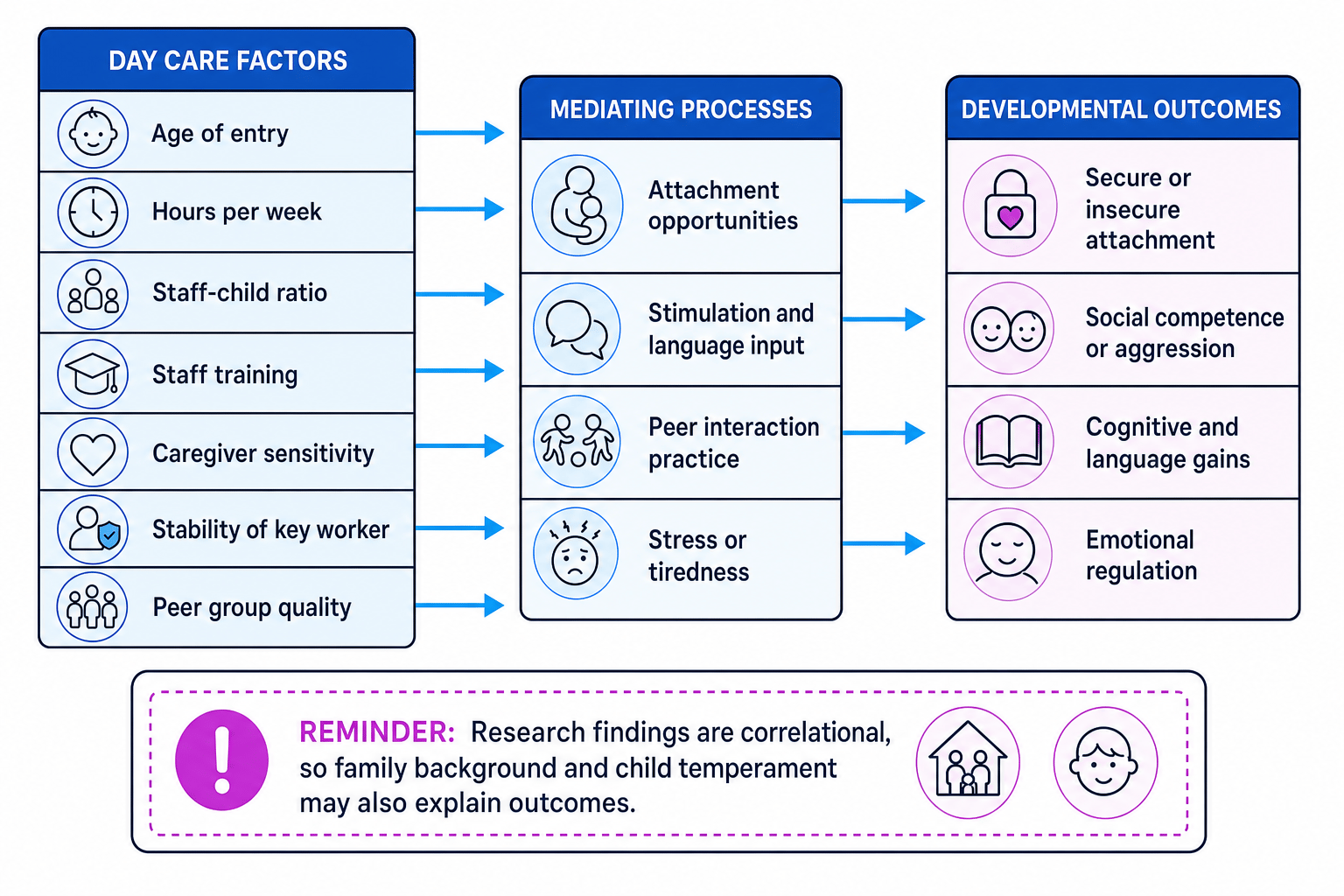
Day care can vary hugely. A high-quality nursery with trained staff, stable key workers, sensitive responses and rich language interaction is very different from overcrowded, inconsistent care.
The main factors psychologists consider are:
- Quality: staff training, warmth, sensitivity, stimulation and safety.
- Quantity: number of hours per week.
- Age of entry: how young the child is when day care begins.
- Stability: whether the child has consistent caregivers.
- Peer interaction: opportunities to practise sharing, turn-taking and conflict resolution.
Possible positive effects
Good-quality day care may support cognitive development, especially language, problem-solving and school readiness. Large-scale research such as the EPPE project by Sylva et al. (2004) found that high-quality preschool was linked to better intellectual and social outcomes, especially for disadvantaged children.
Day care can also improve social development because children practise interacting with peers. For example, Shea (1981) found that children became more sociable over time in nursery settings.
Possible negative effects
Some research suggests that very long hours in day care, especially when started very early and when quality is low, may be linked to insecure attachment or more externalising behaviours such as aggression. Belsky and Rovine (1988) found that infants in day care for over 20 hours per week were more likely to be classified as insecurely attached.
However, this does not prove day care directly caused insecurity. Families using more day care may differ in income, stress, working hours or parenting style.
The NICHD Early Child Care Research Network (1997, 2003) found a balanced picture: high-quality care predicted better cognitive and language outcomes, while very extensive hours were linked to slightly more behaviour problems. Importantly, maternal sensitivity was usually a stronger predictor than day care itself.
Explaining mixed day-care findings
A child starts nursery at 8 months for 40 hours per week. Staff turnover is high and there is little one-to-one interaction. Another child starts preschool at 3 years with a stable key worker and rich play-based learning.
- Compare the quantity and age of entry: the first child has earlier and longer exposure, which may increase stress if care is not sensitive.
- Compare the quality and stability: the second child has consistent adult support, which may promote security and language development.
- Reach a balanced conclusion: day care itself is not simply “good” or “bad”; its effects depend on quality, hours, age and the child’s wider family context.
Saying day care has one simple effect
Avoid writing “day care causes aggression” or “day care improves social skills” as if all day care is the same. Always qualify your point with quality, quantity and family background.
Evaluating day-care research
A strength of day-care research is that many studies are longitudinal, meaning they follow children over time. This helps psychologists look at developmental change rather than just one snapshot.
A weakness is that much evidence is correlational. Researchers usually cannot randomly assign babies to high-quality or low-quality day care because that would be unethical. So cause and effect are difficult to establish.
Ethically, researchers must follow the BPS Code of Ethics and Conduct (2009): parental consent, child assent where possible, right to withdraw, protection from harm, confidentiality and debriefing.
Real-world application is strong. Findings support policies such as staff training, low staff-child ratios, key-worker systems and funding for high-quality preschool.
Effects of attachment interactions
Attachment
An attachment is a strong emotional bond between a child and a caregiver, shown through behaviours such as seeking comfort, distress on separation and pleasure on reunion.
Early attachment interactions include sensitive responsiveness, where the caregiver notices and responds appropriately to the infant’s signals. Bowlby argued that children form an internal working model, which is a mental template for what relationships are like.
Secure attachments are associated with better emotion regulation, confidence exploring the environment and more positive peer relationships. Insecure attachments are not a life sentence, but they may increase vulnerability.
Separation, deprivation and privation
These three terms are easy to confuse, so learn them carefully.
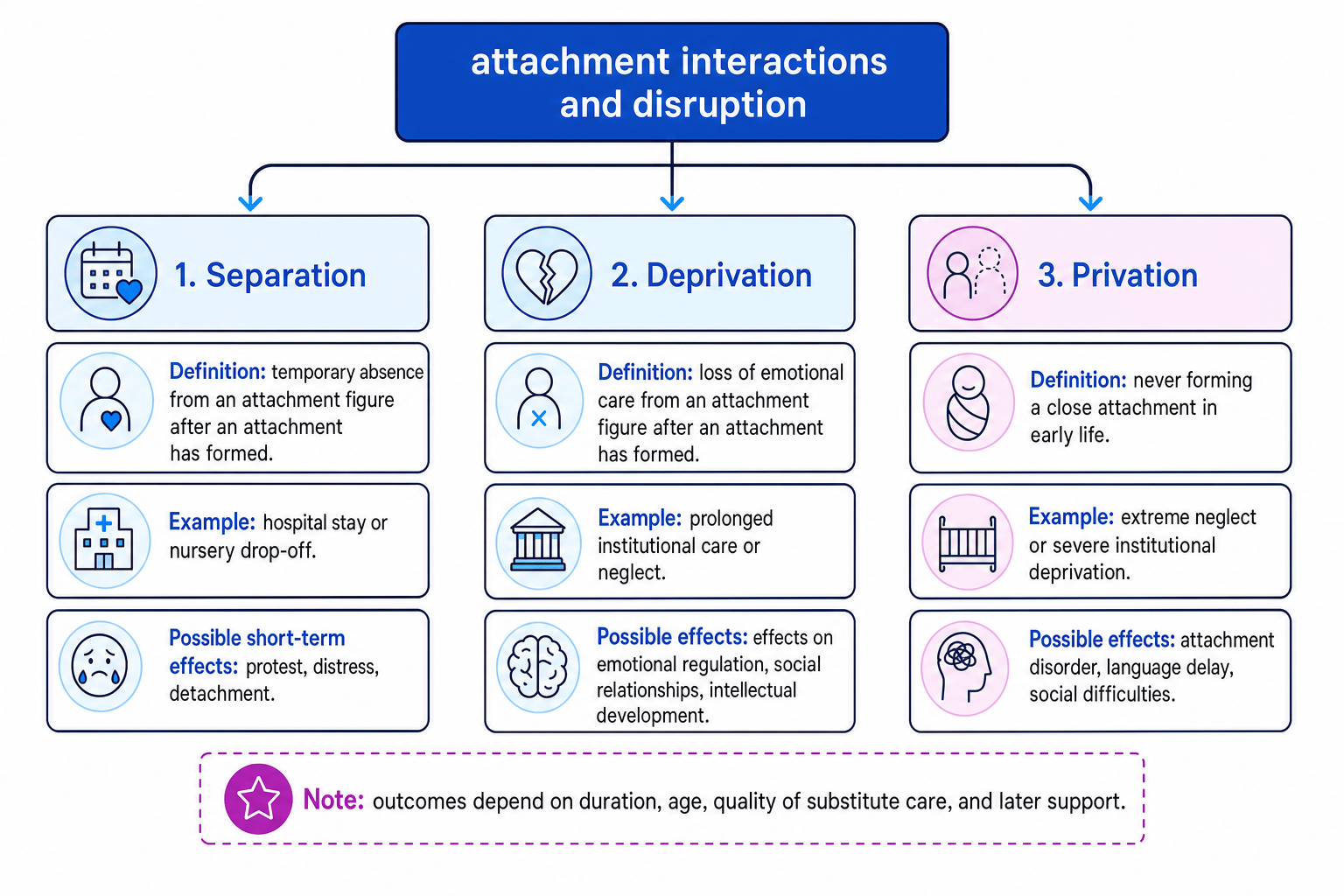
Separation means a temporary absence from an attachment figure after an attachment has formed. For example, a child may be separated from a parent during a hospital stay.
Deprivation means the loss of emotional care from an attachment figure after an attachment has formed. Bowlby’s maternal deprivation hypothesis argued that prolonged disruption to a continuous caregiver relationship during a sensitive period could affect later emotional and social development.
Privation means the child never forms a close attachment in the first place. This may happen in extreme neglect or severe institutional care.
Classifying attachment disruption
A 3-year-old has a strong attachment to her father. He is away in hospital for two weeks, but she is cared for by her grandmother and speaks to him by video call.
- Decide whether an attachment already existed: it did, because she had a strong bond with her father.
- Decide whether care was lost completely: it was not, because her grandmother provided substitute emotional care.
- Classify the case: this is best described as separation, with possible short-term distress, rather than privation or severe deprivation.
Research evidence
Bowlby (1944) studied 44 juvenile thieves and found that many diagnosed as “affectionless psychopaths” had experienced early prolonged separation. This supported the idea that disrupted attachment could affect later emotional development.
However, Bowlby’s study was retrospective and vulnerable to researcher bias. It also risked blaming mothers, which is socially sensitive.
Robertson and Robertson (1967) observed children experiencing hospital separation and described stages such as protest, despair and detachment. This helped change hospital policies so parents could stay with young children.
Rutter et al. (1998, 2011) studied Romanian adoptees who had experienced severe institutional deprivation. Many children adopted before 6 months showed major recovery, while later-adopted children were more likely to show attachment difficulties, cognitive delay and quasi-autistic patterns. This suggests timing matters, but recovery is possible.
Hodges and Tizard (1989) found that children raised in institutions could later form attachments, especially after adoption, but often had difficulties with peers. This challenges the strongest version of Bowlby’s idea that early deprivation always causes permanent damage.
Attachment disruption is moderated
The effects of separation, deprivation and privation depend on age, duration, quality of substitute care, individual resilience and later support.
Evaluating attachment research
A strength is that natural experiments, such as adoption studies, examine real-life severe deprivation that could not ethically be created by researchers.
A weakness is that deprivation and privation often overlap. For example, institutionalised children may have had some care, but not enough stable, sensitive interaction to form secure attachments.
Ethically, research with vulnerable children requires extra care: informed consent from guardians, assent from the child where possible, confidentiality, protection from harm and sensitive debriefing.
Real-world applications include improving adoption processes, supporting foster carers, allowing parents to remain with hospitalised children and training nursery staff in sensitive caregiving.
Blaming the mother
Bowlby used the term “maternal deprivation”, but modern psychology focuses on the quality of care from any consistent attachment figure, not only the biological mother.
Effects of developmental disorders, including autism
Developmental disorder
A developmental disorder is a condition beginning in childhood that affects typical development in areas such as communication, learning, social interaction, behaviour or emotional regulation.
Developmental disorders can affect a child directly, but also indirectly through school experiences, peer reactions, family stress and access to support.
Autism
Autism, or autism spectrum disorder, is a neurodevelopmental condition involving differences or difficulties in social communication and social interaction, alongside restricted or repetitive behaviours, interests or routines.
Autism is a spectrum, meaning autistic people vary greatly. Some have language delay or intellectual disability; others have strong vocabulary and high academic ability but struggle with social communication or sensory overload.
How autism may affect development
Autism can affect social development. A child may find eye contact uncomfortable, struggle with turn-taking in conversation, or interpret language literally. Baron-Cohen et al. (1985) used the Sally-Anne false-belief task and suggested that many autistic children have difficulty with theory of mind, meaning understanding that other people can hold beliefs different from reality.
Autism can affect cognitive development. Some autistic children show strong attention to detail, intense interests or excellent memory, but may find flexible thinking and changes to routine difficult. Explanations such as weak central coherence by Frith and Happé suggest some autistic people may focus more on details than the overall context.
Autism can also affect emotional development. Sensory sensitivity, uncertainty or social demands may increase anxiety. Behaviour that adults label “challenging” may actually be communication of distress, overload or unmet need.
Linking autism characteristics to support
A child has advanced vocabulary about trains, becomes distressed when the timetable changes and rarely joins group play.
- Link the strong train interest and distress at change to restricted interests and preference for routine.
- Link limited group play to possible social communication differences, not simply “naughtiness” or lack of effort.
- Suggest support based on the explanation: visual timetables, predictable transitions, interest-based learning and structured peer interaction.
Evaluating autism explanations and research
A strength of autism research is that it has improved diagnosis, early support and inclusive education. Interventions can help communication, reduce anxiety and adapt environments.
A limitation is that no single explanation fits every autistic person. Theory of mind difficulties may explain some social challenges, but not sensory sensitivity, repetitive behaviours or the strengths many autistic people show.
Diagnosis can also be biased. Girls, ethnic minority children and verbally able autistic people may be underdiagnosed or diagnosed later because they may mask difficulties or not fit stereotypes.
Ethically, research should avoid treating autistic people only as “problems to fix”. Under the BPS Code, psychologists must gain informed consent or assent, protect participants from distress, maintain confidentiality and debrief in accessible language.
Neurodiversity wording
In essays, use respectful phrasing: autism involves developmental differences and support needs. Avoid outdated claims such as “bad parenting causes autism” or “vaccines cause autism”.
Pulling it together for essays
For AO1, describe the concept accurately: day care factors, attachment disruption terms, or autism characteristics.
For AO2, apply the concept to a scenario: identify whether the child is experiencing separation, deprivation or privation; explain whether day-care quality is high or low; link autistic characteristics to likely developmental effects.
For AO3, evaluate with evidence, methodology, ethics and application. The strongest answers are balanced: they avoid deterministic claims and consider alternative explanations.
In the exam
- Define the key term first, especially if the question uses separation, deprivation, privation, day care or autism.
- Use named evidence with years where possible, such as Bowlby (1944), Rutter et al. (1998, 2011), Belsky and Rovine (1988), NICHD (1997, 2003) or Sylva et al. (2004).
- Evaluate by asking: Is the evidence correlational? Are there confounding variables? Are there ethical issues? How can the findings be applied in real life?
Check yourself
- What is the difference between separation, deprivation and privation?
- Why is it too simple to say that day care is either harmful or beneficial?
- How might autism affect social, cognitive and emotional development?
