What you'll learn
- How a self-fulfilling prophecy can help explain the development of anti-social or criminal behaviour.
- How social learning theory explains behaviour learned from role models, rewards and punishments.
- How biological and other causes can add to developmental explanations.
- How to build AO1, AO2 and AO3 points for essay-style answers.
Starting point: what does “developmental” mean here?
In this topic, developmental psychology means the study of how behaviour, thinking and personality can change over time. In criminological psychology, you use it to explain how some people may develop patterns of anti-social behaviour or criminal behaviour.
Criminal and anti-social behaviour
Criminal behaviour breaks the law. Anti-social behaviour harms, intimidates or disrupts others, but it may not always be illegal. For example, repeated bullying is anti-social; theft is criminal.
A developmental explanation does not usually claim that one event “causes” crime by itself. Instead, it looks at pathways: early experiences, social reactions, learning, opportunities and biological vulnerabilities that may increase or decrease risk over time.
Self-fulfilling prophecy
A self-fulfilling prophecy is when an expectation about a person affects how others treat them, and this treatment makes the expected behaviour more likely to happen.
Self-fulfilling prophecy
A self-fulfilling prophecy occurs when a belief or label about someone changes social interactions in a way that leads the person to behave in line with that belief.
This idea is often linked to labelling theory, associated with Becker (1963), which argues that being labelled as “deviant” can affect a person’s identity and opportunities. Merton (1948) also described how false beliefs can become true through their consequences.
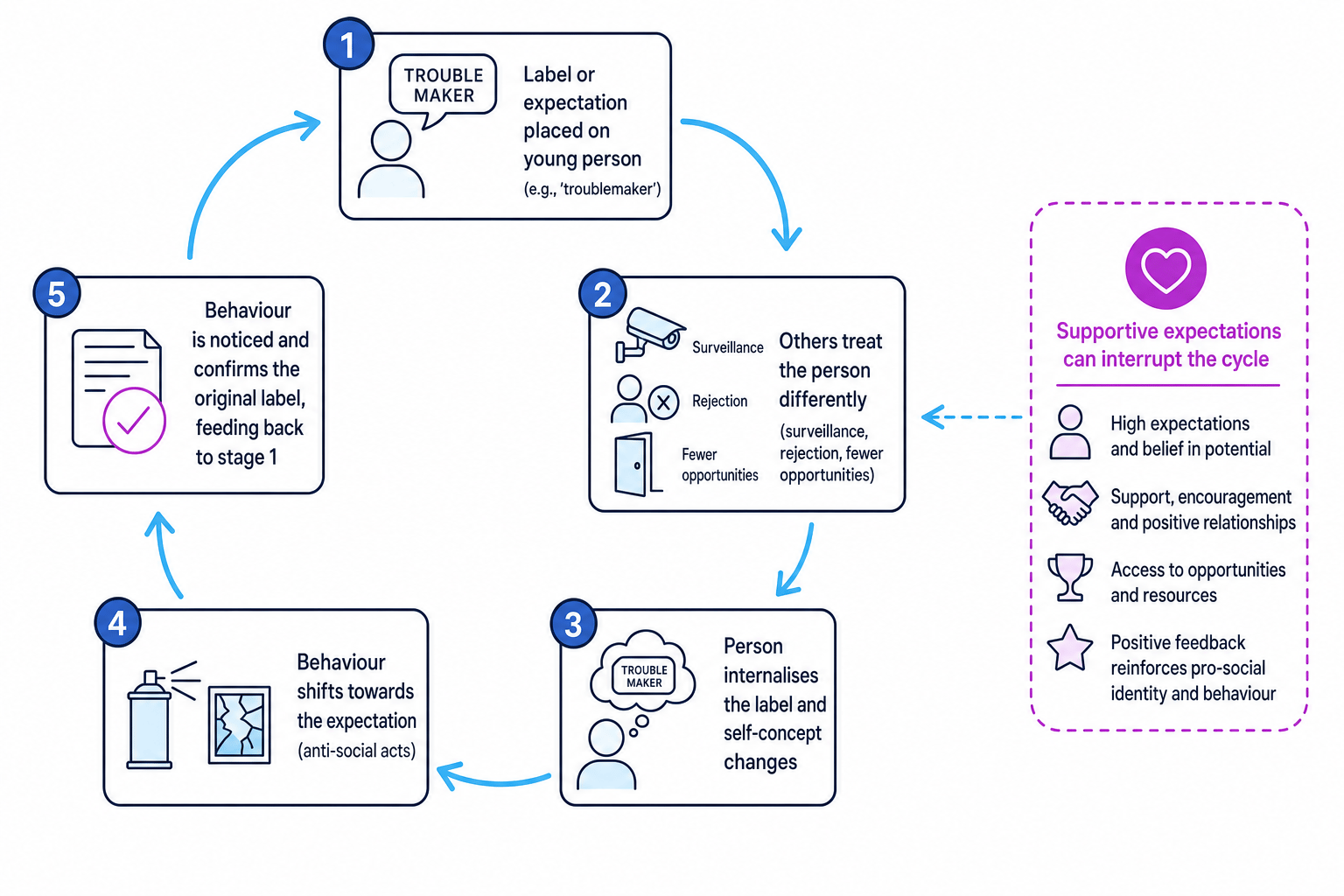
In criminal psychology, the process might look like this:
- A young person is labelled as “trouble”, “aggressive” or “a criminal”.
- Teachers, police, peers or family members treat them with suspicion or rejection.
- The young person has fewer chances to succeed in pro-social roles.
- They may internalise the label, meaning they start to see it as part of their identity.
- Their behaviour may shift towards the label, which then appears to “confirm” the original expectation.
The prophecy is social, not magical
The label does not directly “create” crime. It changes how the person is treated, the opportunities they receive, and how they may come to see themselves.
Applying self-fulfilling prophecy
Applying a self-fulfilling prophecy
A student is repeatedly called a “troublemaker” after a few minor incidents at school.
-
Identify the label: the student is expected to behave badly, so teachers may watch them more closely and interpret ambiguous behaviour more negatively.
-
Trace the social response: the student may be removed from lessons, excluded from activities, or rejected by pro-social peers, reducing chances to build a positive identity.
-
Explain internalisation: over time, the student may think, “Everyone already sees me as bad,” and may seek acceptance from peers who reward anti-social behaviour.
-
Show the confirmation: if the student then vandalises property or becomes aggressive, adults may see this as proof that the original label was correct.
AO3: evaluating self-fulfilling prophecy
A strength is that it explains why criminal or anti-social behaviour can develop gradually. It does not only focus on the individual; it also considers the reactions of schools, families, peers and the justice system.
There is supporting evidence from Rosenthal and Jacobson (1968), who found that teacher expectations affected pupils’ academic progress. Although this was not a crime study, it supports the wider idea that expectations can influence development. Chambliss (1973) also observed how two groups of boys were treated differently by the community, suggesting that social class and reputation can affect whether behaviour is labelled as deviant.
However, a limitation is that the self-fulfilling prophecy may not explain the first act of anti-social behaviour. A person may receive a negative label because they have already behaved aggressively or broken rules. This creates a causality problem: did the label cause the behaviour, or did the behaviour cause the label?
Assuming labels always cause crime
Do not write as if a negative label automatically makes someone criminal. A better answer says labels can increase risk by changing treatment, self-concept and opportunities.
There are also ethical concerns in research or practice. If researchers, teachers or police label young people as “high risk”, they must follow principles similar to the BPS Code of Ethics and Conduct (2009): informed consent where possible, protection from harm, confidentiality, the right to withdraw from research, and careful debriefing if deception is used.
Social learning theory
Social learning theory, developed by Bandura (1977), argues that people can learn behaviour by observing others. This includes pro-social behaviour, such as helping, and anti-social behaviour, such as aggression, theft or vandalism.
Social learning theory
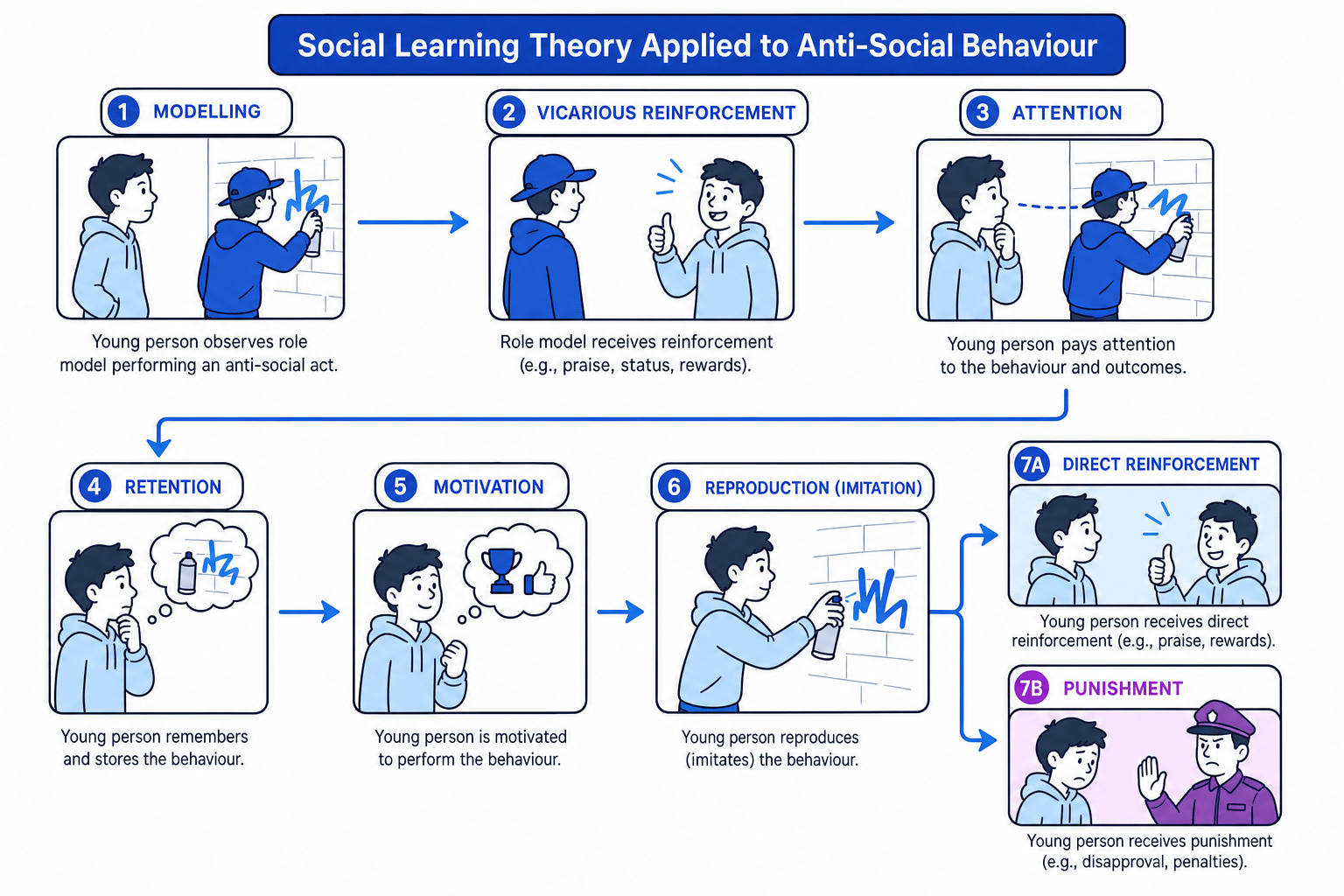
Social learning theory is the idea that behaviour is learned through observing role models, remembering what they do, and being motivated to imitate them, especially when the behaviour appears rewarded.
A role model is someone whose behaviour is observed and may be copied. Modelling means demonstrating behaviour for someone else to observe. Imitation means copying the observed behaviour.
Bandura, Ross and Ross (1961) found that children who watched an adult behave aggressively towards a Bobo doll were more likely to imitate aggressive acts. This is a classic study supporting observational learning, although it studied aggression rather than real criminal offending.
Social learning theory includes four mediational processes, which are mental stages between observing and copying behaviour:
- Attention: noticing the behaviour.
- Retention: remembering it.
- Reproduction: being able to perform it.
- Motivation: wanting to perform it.
It also uses the idea of vicarious reinforcement, where a person is more likely to copy behaviour if they see someone else being rewarded for it. Direct reinforcement occurs when the person themselves is rewarded after performing the behaviour.
Applying social learning theory
Explaining imitation of anti-social behaviour
A teenager sees an older peer shoplift and gain praise from the group.
-
Identify the role model: the older peer may be high-status, similar in background, or admired, making attention more likely.
-
Apply vicarious reinforcement: the teenager sees the peer gain approval, status or material rewards, so the behaviour appears worthwhile.
-
Use the mediational processes: the teenager remembers how the shoplifting was done, believes they can reproduce it, and is motivated by the expected reward.
-
Add direct consequences: if the teenager later shoplifts and gains peer approval without being punished, direct reinforcement may strengthen the behaviour.
AO3: evaluating social learning theory
A strength is that social learning theory explains why anti-social behaviour may run in peer groups, families or gangs without needing a purely biological explanation. It also has real-world applications: interventions can focus on positive role models, parenting programmes, mentoring, and reducing reinforcement for anti-social behaviour.
A limitation is that much supporting evidence, such as Bandura et al. (1961), comes from laboratory research. This gives strong control over variables, but hitting a Bobo doll is not the same as committing a real offence. The study also raises ethical issues because children were exposed to aggressive models, so protection from harm and debriefing are important.
Another limitation is individual differences. Many people observe aggression or crime but do not imitate it. This means social learning theory is stronger when combined with factors such as temperament, moral development, family supervision and biological vulnerability.
Confusing vicarious and direct reinforcement
Vicarious reinforcement is seeing someone else rewarded. Direct reinforcement is being rewarded yourself after doing the behaviour.
Other causes, including biological causes
Developmental explanations are stronger when you recognise that criminal and anti-social behaviour can have multiple causes. These may be biological, social, cognitive or situational.
A biological explanation argues that behaviour is influenced by physical factors such as genes, brain structures, hormones or neurotransmitters.
Biological vulnerability
A biological vulnerability is an inherited or physical factor that may increase risk, but it does not guarantee a criminal outcome.
Examples include:
- Genes: there is no simple “crime gene”, but genetic factors may influence traits such as impulsivity or emotional regulation.
- MAOA: the MAOA gene affects an enzyme involved in breaking down neurotransmitters. Brunner et al. (1993) linked a rare MAOA mutation with impulsive aggression in one family, and Caspi et al. (2002) found that low MAOA activity predicted anti-social behaviour mainly when combined with childhood maltreatment.
- Prefrontal cortex: this brain area is involved in planning, decision-making and impulse control. Raine et al. (1997) found reduced prefrontal activity in murderers pleading not guilty by reason of insanity.
- Amygdala: this brain area is involved in emotion and fear responses. Differences in amygdala functioning may affect empathy, threat detection or emotional learning.
- Neurotransmitters and hormones: low serotonin has been linked with impulsive aggression, while testosterone and cortisol may be involved in dominance, stress and arousal.
Other non-biological causes may include poor parental supervision, abuse, neglect, peer rejection, school failure, poverty, substance misuse, or exposure to criminal role models. These factors do not make crime inevitable, but they may increase risk.
Interaction is usually the strongest explanation
A balanced developmental answer often argues that biology may create vulnerability, while social experiences such as labelling, reinforcement or maltreatment shape whether that vulnerability develops into anti-social behaviour.
Applying an interactionist explanation
Combining biological and social causes
A child is impulsive, grows up with harsh parenting, and later joins a peer group that rewards aggression.
-
Use the biological factor: impulsivity may make it harder for the child to pause, plan or control aggressive responses.
-
Add the social environment: harsh parenting may model aggression and reduce emotional security, making anti-social behaviour more likely.
-
Add peer reinforcement: if the peer group rewards aggression with status, social learning theory explains how the behaviour is maintained.
-
Build the conclusion: the best explanation is not “biology caused crime”, but that biological vulnerability and social experiences interacted over development.
AO3: evaluating biological and other causes
A strength of biological research is that it can use objective methods, such as brain scans or genetic analysis. Studies such as Raine et al. (1997) helped show that brain functioning may be linked with violent offending.
However, many biological findings are correlational. This means they show a relationship but do not prove cause and effect. For example, brain differences might contribute to offending, but they could also result from trauma, substance use or other life experiences.
Biological explanations can also be reductionist, meaning they may oversimplify behaviour by reducing it to genes or brain activity. Criminal behaviour involves choices, social context, opportunity, law, morality and culture, not just biology.
Avoid biological determinism
Do not write that genes, brain activity or hormones “make” someone criminal. A safer phrase is: biological factors may increase risk, especially when combined with environmental stressors.
Ethically, biological explanations must be used carefully. Labelling someone as genetically or neurologically “at risk” could lead to stigma, discrimination or lowered expectations. Researchers and practitioners should protect confidentiality, gain informed consent where possible, and avoid causing harm through deterministic language.
Putting it together for essays
For AO1, describe the theory clearly using correct terms. For AO2, apply each stage to the scenario: label, role model, reinforcement, biological vulnerability, or social context. For AO3, evaluate using evidence, methodology, ethics, applications and comparison with other explanations.
Strong comparison point
Self-fulfilling prophecy explains how social reactions can push someone towards a deviant identity. Social learning theory explains how specific behaviours are acquired and maintained. Biological explanations explain why some individuals may be more vulnerable in the first place.
In the exam
-
Start with a clear definition of the explanation, then describe the process in a logical sequence.
-
Use named evidence where relevant, such as Rosenthal and Jacobson (1968), Bandura, Ross and Ross (1961), Caspi et al. (2002), or Raine et al. (1997).
-
For evaluation, avoid one-sided answers: include strengths, limitations, ethical issues and the idea that developmental causes often interact.
Check yourself
- How can a negative label become a self-fulfilling prophecy?
- What is the difference between vicarious reinforcement and direct reinforcement?
- Why is an interactionist explanation often stronger than a purely biological explanation?
