What you'll learn
- How patterns of rewards and punishments can shape development through operant conditioning.
- How social learning theory explains development through observing and imitating other people.
- How to apply these ideas to everyday developmental examples, such as manners, aggression, attachment-like behaviours, or gender-role behaviour.
- How to evaluate learning explanations using evidence, ethics, and real-world usefulness.
The starting point: what does “development” mean?
In psychology, development means systematic changes in behaviour, thinking, emotions, and social relationships over time. In A-Level developmental psychology, you are often thinking about how children acquire new behaviours and why some behaviours become more likely as they grow.
Learning theory
Learning theory is the view that behaviour develops through experience. Rather than assuming children simply “grow into” behaviours naturally, learning theorists argue that children acquire behaviour from the consequences of their actions and from the people around them.
Learning explanations are different from biological or evolutionary explanations. They focus less on genes and instinct, and more on the child’s environment: parents, peers, teachers, media, and social rewards.
Core idea
From a learning-theory perspective, children develop because their environment teaches them what behaviours are useful, rewarded, ignored, punished, or worth copying.
Development through rewards and punishments
The idea that development happens through patterns of rewards and punishments is mainly linked to operant conditioning.
Operant conditioning
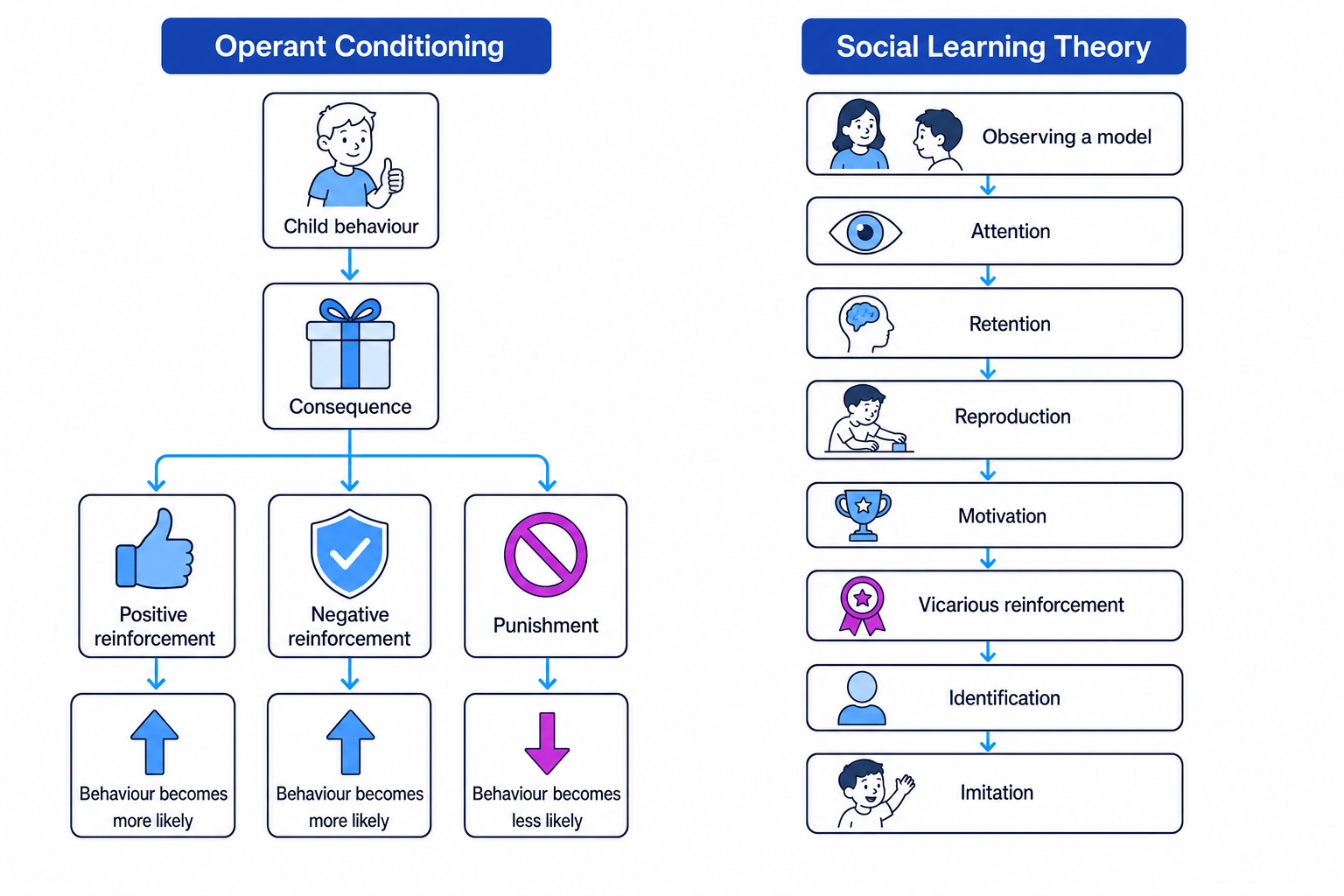
Operant conditioning is learning through the consequences of behaviour. If a behaviour is followed by a desirable consequence, it becomes more likely. If it is followed by an undesirable consequence, it becomes less likely.
This approach is associated with B. F. Skinner, who argued that behaviour can be shaped by reinforcement and punishment. In developmental psychology, this means adults and the wider environment may gradually shape children’s behaviour.
For example, a child who says “please” may receive praise. If praise is rewarding, the child is more likely to say “please” again. Over time, polite language becomes part of the child’s normal behaviour.
Reinforcement: making behaviour more likely
Reinforcement
Reinforcement is any consequence that increases the likelihood of a behaviour being repeated.
There are two main types you need to know.
Positive reinforcement
Positive reinforcement happens when something desirable is added after a behaviour.
Example: a child tidies their toys and receives praise. If the praise increases tidying in the future, it has acted as a reinforcer.
Negative reinforcement
Negative reinforcement happens when something unpleasant is removed after a behaviour, making the behaviour more likely.
Example: a teenager does homework early, so their parent stops nagging them. The removal of nagging may reinforce doing homework early.
Negative reinforcement is not punishment
“Negative” does not mean “bad”. In negative reinforcement, behaviour increases because something unpleasant is taken away. In punishment, behaviour decreases.
Punishment: making behaviour less likely
Punishment
Punishment is a consequence that decreases the likelihood of a behaviour being repeated.
Punishment might involve adding something unpleasant, such as a telling-off, or removing something desirable, such as screen time. In developmental terms, punishment may reduce behaviours like hitting, lying, or breaking rules.
However, punishment does not necessarily teach the child what to do instead. It may also create fear, resentment, or avoidance if used harshly.
Shaping behaviour over time
Shaping
Shaping is when small steps towards a desired behaviour are reinforced until the full behaviour develops.
This is important because many developmental behaviours do not appear perfectly all at once. Adults may reinforce early attempts first, then gradually expect more advanced behaviour.
For example, in language development, a caregiver may respond warmly to early sounds, then clearer words, then full sentences. The child’s behaviour is shaped through repeated social feedback.
Applying reinforcement and punishment
A four-year-old throws toys when frustrated. One day, they ask for help instead. Their parent smiles, gives attention, and helps them solve the problem. Later, when the child throws a toy, the parent removes the toy for five minutes.
-
The child asking for help is followed by attention and support, so this is positive reinforcement if it makes asking for help more likely.
-
Throwing the toy is followed by losing access to the toy, so this is punishment if it makes throwing less likely.
-
Over repeated situations, the child may develop a more socially acceptable way to manage frustration because one behaviour is reinforced and the other is discouraged.
Social learning theory: development through observing others
Operant conditioning focuses on direct consequences. Social learning theory, developed by Albert Bandura, adds a crucial idea: children can learn without being directly rewarded or punished.
Social learning theory
Social learning theory is the view that behaviour develops through observing, remembering, and imitating other people, especially when those people are rewarded or admired.
This matters for development because children are surrounded by models: parents, siblings, peers, teachers, celebrities, and people in media.
Models and imitation
Model
A model is a person whose behaviour is observed and may be copied.
Imitation
Imitation is copying the behaviour of a model.
A child might imitate a parent’s accent, a sibling’s way of playing, a peer’s fashion choices, or an aggressive act seen in media. The child does not need to be directly trained; observation can be enough.
Identification
Identification
Identification is when a child feels similar to, or wants to be like, a model. This makes imitation more likely.
Children are more likely to imitate models who are high-status, nurturing, powerful, similar to them, or rewarded by others. For example, a child may copy an older sibling because they admire them and see them as successful.
Vicarious reinforcement
Vicarious reinforcement
Vicarious reinforcement is learning by observing the consequences of another person’s behaviour.
If a child sees a peer praised for sharing, the child may become more likely to share. If they see another child punished for shouting, they may avoid shouting.
Why social learning theory is different
Social learning theory is not just “copying”. It includes mental processes: the child notices the behaviour, remembers it, judges whether they can reproduce it, and decides whether it is worth doing.
Mediational processes
Bandura argued that four mental processes influence whether observation turns into imitation:
- Attention: the child must notice the behaviour.
- Retention: the child must remember it.
- Reproduction: the child must be capable of performing it.
- Motivation: the child must have a reason to copy it, such as expected reward or approval.
This means children are not passive. They think about what they see and may choose whether to imitate.
Explaining imitation through vicarious reinforcement
A child sees an older sibling get praised for calmly helping with a younger child. Later, the child copies this caring behaviour.
-
The older sibling acts as a model because their behaviour is observed.
-
The praise given to the sibling acts as vicarious reinforcement because the child sees that caring behaviour brings approval.
-
If the child identifies with the sibling and believes they can copy the behaviour, they are more likely to imitate it later.
Evidence for social learning theory
A key piece of evidence comes from Bandura, Ross and Ross (1961) and their Bobo doll research. Children observed an adult model behaving aggressively or non-aggressively towards an inflatable doll. Children who saw the aggressive model were more likely to imitate aggressive actions later.
This supports social learning theory because children learned through observation, not just direct reinforcement.
However, the study was carried out in an artificial setting with an unusual task. Hitting a Bobo doll may not be the same as real-life aggression towards another person. This limits ecological validity.
AO3 phrase to remember
A strong evaluation point is: Bandura’s research gives controlled evidence for observational learning, but the artificial laboratory situation may limit how far we can generalise to everyday development.
Ethics: researching learning in children
When studies involve children, ethical issues are especially important. The BPS Code of Ethics and Conduct (2009) highlights consent, deception, right to withdraw, protection from harm, confidentiality, and debriefing.
In Bandura-style research, children may be exposed to aggressive models, which raises concerns about protection from harm. Researchers would need parental consent, careful monitoring, and debriefing. They would also need to consider whether children might leave the study with increased aggressive behaviour.
Ethics and children
Children are a vulnerable group in research, so researchers must be especially careful that the study does not distress them, teach harmful behaviours, or pressure them to continue.
Applying the theories to development
Both explanations can be applied to many developmental behaviours.
Example applications
Manners: A child says “thank you” because parents praise it, and because they observe adults using polite language.
Aggression: A child may be punished for hitting, but may also imitate aggression if they see powerful models rewarded for it.
Attachment-like behaviours: A baby may learn that crying brings caregiver attention, so crying is reinforced. If the caregiver is warm and responsive, the child may associate them with comfort and safety. This is a learning-theory explanation, not the same as Bowlby’s evolutionary theory.
Gender-role behaviour: A child may be praised for behaviour seen as “appropriate” for their gender and may copy same-sex models they identify with.
Evaluating learning explanations of development
Strength: clear real-world applications
Learning theory has practical value. Parents, teachers, and therapists can use reinforcement to encourage desirable behaviours, such as cooperation, independence, or emotional regulation.
For example, reward charts can reinforce small steps towards a target behaviour. Social learning theory also suggests adults should model the behaviour they want children to copy.
Strength: supported by controlled research
Bandura’s research supports the idea that children learn through observing models. Operant conditioning is also supported by experimental work on reinforcement and punishment, especially Skinner’s behaviourist research.
Controlled studies allow cause-and-effect conclusions because researchers can manipulate what children observe or what consequences follow behaviour.
Weakness: may be too environmentally deterministic
A limitation is that learning theories can seem deterministic.
Determinism
Determinism is the idea that behaviour is controlled by factors outside a person’s free choice, such as reinforcement history or social environment.
Children are not simply shaped by the environment. Their temperament, cognitive development, attachment history, and biological maturation may affect how they respond to rewards, punishments, and models.
Weakness: punishment can have unwanted effects
Punishment may suppress behaviour temporarily, but it does not always create long-term understanding. A child may learn to avoid being caught rather than genuinely change their behaviour.
Harsh punishment can also model aggression. This is important because social learning theory predicts that children may copy aggressive adults, especially if those adults are powerful.
Balanced conclusion
Learning theories are useful because they explain how everyday environments shape development. Operant conditioning explains direct consequences, while social learning theory explains observation and imitation.
The best answers usually recognise that these theories are powerful but incomplete. Development is likely influenced by learning, biology, cognition, family relationships, and wider culture.
In the exam
-
For AO1, clearly separate operant conditioning from social learning theory: direct consequences versus observation of models.
-
For AO2, apply the theory to the scenario using precise terms such as positive reinforcement, punishment, vicarious reinforcement, identification, and imitation.
-
For AO3, evaluate with a balance of evidence, ethics, ecological validity, determinism, and practical applications for parents, teachers, or interventions.
Check yourself
-
Can you explain the difference between positive reinforcement, negative reinforcement, and punishment?
-
Why does social learning theory need attention, retention, reproduction, and motivation?
-
How could Bandura’s Bobo doll research support social learning theory but still be criticised?
