Why do people recovering from drug addiction often relapse when they return to old environments or see the tools they used to use? In Psychology, we call these environmental triggers cues.
This contemporary study by Van den Oever et al. (2008) moves beyond simple behavioral explanations of addiction. It looks deep inside the brain—specifically at the synapses of the prefrontal cortex—to understand the molecular "switch" that triggers a relapse when an individual is exposed to drug-associated cues.
What you'll learn
- How drug-associated cues trigger a relapse at a molecular level.
- The role of synaptic plasticity and AMPA receptors in the medial prefrontal cortex (mPFC).
- How animal models (Wistar rats) are used to isolate biochemical causes of behavior.
- How to evaluate this contemporary biological study using AO1 (description) and AO3 (evaluation) skills.
Key Terms & Biological Foundations
Before we look at the study itself, we need to understand the biological machinery at play.
Synaptic Plasticity
Synaptic plasticity is the ability of synapses (the junctions between neurons) to strengthen or weaken over time in response to increases or decreases in their activity. It is the biological basis of learning and memory.
When a person learns to associate a cue (like a syringe or a specific room) with the rewarding feeling of a drug, their brain is physically changing. This change occurs primarily via glutamatergic transmission—the release of glutamate, the brain's primary excitatory neurotransmitter.
What are AMPA Receptors?
On the receiving (postsynaptic) neuron, glutamate binds to special receptors called AMPA receptors. These receptors act like gates. When glutamate binds to them, they open and allow ions to flood into the neuron, passing the electrical signal along.
AMPA receptors are made of subunits, most notably GluR1 and GluR2.
During learning and addiction, these receptors can be moved:
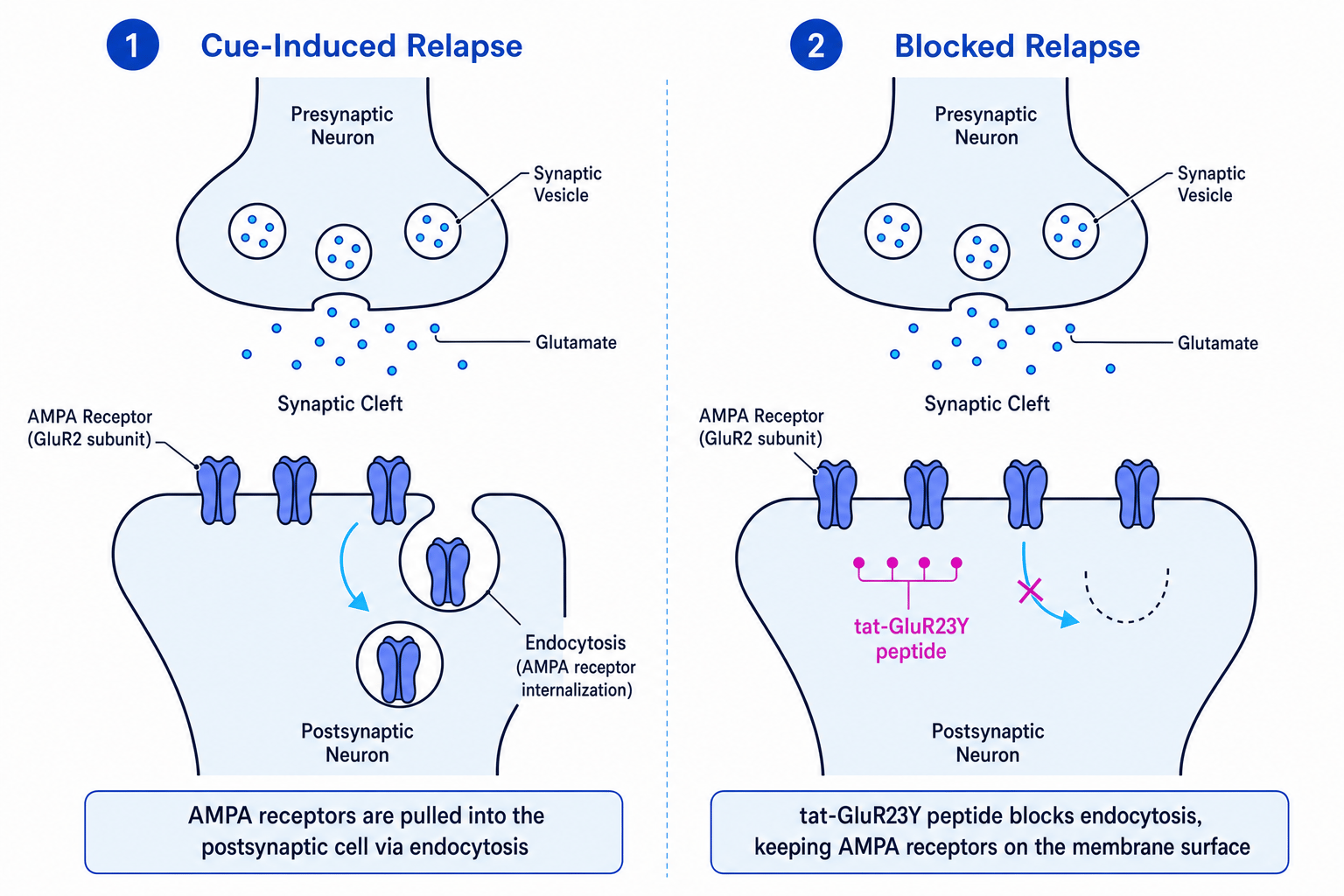
- Endocytosis (Internalisation): The cell pulls the AMPA receptors away from the surface and tucks them inside. This makes the postsynaptic membrane less sensitive to glutamate, weakening the synaptic connection.
- Exocytosis: The cell pushes more AMPA receptors to the surface, making the synapse more sensitive.
The Central Hypothesis
Van den Oever et al. hypothesized that when an animal is exposed to a drug cue after a period of abstinence, a rapid internalisation (endocytosis) of AMPA receptors occurs in the medial prefrontal cortex (mPFC). This sudden weakening of the synapse is what actually drives the relapse behavior.
Methodology and Procedure
Van den Oever et al. (2008) used an experimental lab design with male Wistar rats to track these microscopic changes.
Step 1: Self-Administration Phase
Rats were surgically implanted with an intravenous jugular catheter. They were placed in an operant conditioning chamber where they learned to press an active lever to receive an infusion of heroin.
Every time they pressed the lever and received the drug, a compound cue (a yellow light and a tone) was turned on. This paired the physiological reward of the heroin with the environmental cues (classical conditioning). An inactive lever was also present; pressing it did nothing, acting as a control.
Step 2: Abstinence Phase
Once the rats were thoroughly addicted, the heroin was taken away. The rats were kept drug-free in their home cages for 21 days. This represents a period of clean, drug-free abstinence.
Step 3: The Relapse Test (Cue Re-exposure)
After 21 days, the rats were placed back into the operant chambers.
- Pressing the active lever did not deliver any heroin.
- However, pressing the active lever did turn on the light and tone cues.
- The researchers measured how many times the rats pressed the active lever. Because no drug was delivered, any lever-pressing represents "heroin-seeking behavior"—the animal attempting to get the drug due to the cues.
Step 4: Sacrificing and Brain Analysis
To see what happened to the brain at the exact moment of relapse, some rats were sacrificed immediately after the relapse test. The researchers extracted the medial prefrontal cortex (mPFC) and isolated the postsynaptic density (PSD). They used advanced biochemical techniques, including mass spectrometry and Western blotting, to count the exact number of AMPA receptor subunits (GluR1 and GluR2) present on the synaptic membranes.
Step 5: The Pharmacological Intervention
To prove that AMPA receptor internalisation caused the relapse, the researchers did a final, ingenious test. They microinjected a synthetic peptide called tat-GluR23Y directly into the mPFC of a group of rats before the relapse test. This peptide physically blocks the endocytosis (internalisation) of GluR2-containing AMPA receptors, keeping them locked on the cell membrane.
Key Findings
The study yielded clear, objective quantitative data:
- Behavioral Relapse: Re-exposure to the light/tone cue triggered a massive spike in active lever pressing, demonstrating strong cue-induced relapse behavior.
- Molecular Changes: In the rats exposed to the cues, there was a significant decrease in GluR2-containing AMPA receptors on the postsynaptic membrane in the mPFC. The receptors had indeed been internalised.
- Preventing Relapse: When rats were treated with the tat-GluR23Y peptide (which stopped the AMPA receptors from being internalised), their heroin-seeking behavior was significantly reduced (p<.01p < .01p<.01). They did not struggle to press the lever nearly as much.
The Big Takeaway
The physical removal of AMPA receptors from synapses in the prefrontal cortex is the biological mechanism that triggers relapse when a cue is present. If you block this molecular process, you block the relapse.
Applying the Science
A-Level exams frequently ask you to apply this complex neurobiology to human scenarios (AO2). Let's work through how to structure an application answer.
Applying neurobiology to real-world addiction relapse
Scenario:
Luke completed rehab for heroin addiction six months ago. While walking past a clinic where he used to obtain clean needles, he experienced overwhelming cravings and later suffered a relapse. Explain Luke's experience using the findings of Van den Oever et al. (2008).
- Identify the environmental cue: First, connect the scenario's cue to the concept. The clinic Luke walked past acts as a classical conditioning cue, just like the light and tone paired with heroin in the rat study.
- Describe the immediate biological trigger: Explain that exposure to this cue causes a rapid release of glutamate in Luke's medial prefrontal cortex (mPFC), which is the area of the brain responsible for decision-making and self-control.
- Detail the receptor-level changes: Apply Van den Oever's key biochemical finding. State that the cue exposure triggers the rapid internalisation (endocytosis) of AMPA receptors (specifically those containing GluR2 subunits) from the postsynaptic membranes in Luke's mPFC.
- Link molecular change to behavioral outcome: Explain that this internalisation weakens the synaptic strength in his prefrontal cortex, impairing his executive control. This biological failure of self-regulation manifests behaviorally as the intense "craving" and subsequent relapse.
Evaluating Van den Oever et al. (2008)
To score highly on 8- and 12-mark questions, you must critically evaluate the study's strengths and weaknesses (AO3).
Strengths
- High Scientific Credibility: The study used highly objective, scientific measures. Techniques like mass spectrometry and Western blotting leave no room for researcher bias or subjective interpretation.
- Establishing Causality: By using the tat-GluR23Y peptide to actively block endocytosis and observing that relapse behavior stopped, the researchers moved beyond a mere correlation. They proved a cause-and-effect relationship between receptor internalisation and relapse.
- Extremely Standardised: The use of precise operant conditioning chambers, exact drug dosages, and a fixed 21-day abstinence period means the study has high reliability and can be easily replicated.
Weaknesses
- Generalisability (Anthropomorphism): The study was conducted on Wistar rats. While mammalian brain structures are highly similar, human brains and human addiction are vastly more complex, involving complex social, cognitive, and emotional factors that rats do not experience.
- Low Ecological Validity: Pressing a metal lever in a sterile, sound-attenuated box to receive intravenous heroin through a plastic tube does not accurately reflect the complex, social environments in which humans use drugs and experience relapse.
Confusing receptor types
Students often lose marks by writing vaguely about "receptors" or confusing dopamine with glutamate. Van den Oever et al. specifically investigated AMPA receptors (which respond to glutamate) in the medial prefrontal cortex. Dopamine is crucial for the initiation of addiction in the reward pathway, but AMPA receptors are the key players in cue-induced relapse studied here.
Ethical Considerations
Because this study involved animal research, you must evaluate it using the BPS guidelines for animal research and the 3Rs:
- Reduction: The researchers kept sample sizes to the minimum necessary to achieve statistical power.
- Refinement: Surgical procedures (implants of catheters) were performed under anesthesia, and the rats were housed carefully to minimize distress.
- Replacement: The study could not have been conducted on humans because analyzing the postsynaptic density of the prefrontal cortex requires sacrificing the subject and extracting brain tissue. Therefore, the use of rats was scientifically justified.
In the exam
- Be biochemically precise: Don't just say "the brain changed." Specify the medial prefrontal cortex, AMPA receptors, and GluR2 subunits. Examiners look for these exact terms.
- Explain the peptide step: Students often forget the pharmacological intervention. Make sure you can explain that tat-GluR23Y blocks AMPA receptor internalisation, proving that receptor movement is the physical cause of relapse.
- Balance animal ethics: When evaluating, don't just say "it is unethical because rats died." Frame it scientifically: explain that the critical insights gained into human saving/relapse therapies justify the controlled, regulated use of animals under BPS guidelines.
Check yourself
- What specific biological process happens to AMPA receptors in the mPFC when a drug-addicted rat is re-exposed to a cue?
- How did the researchers prove that this molecular change actually causes the relapse behavior, rather than just occurring alongside it?
- Why does the use of Wistar rats limit the generalisability of these findings to human drug rehabilitation programmes?
