What you'll learn
- What Carlsson et al. (2000) meant by “network interactions” in schizophrenia.
- Why the study challenges a simple dopamine-only explanation.
- How dopamine, glutamate and GABA may interact in symptoms and treatment.
- How to evaluate Carlsson et al. for AO3, including methodology, ethics and applications.
Where this study fits
Carlsson et al. (2000), “Network interactions in schizophrenia — therapeutic implications”, is the contemporary study for schizophrenia in Edexcel A-Level Psychology 9PS0.
It is different from many named studies because it is not a lab experiment with one set of participants. It is a review paper: the authors considered existing biological evidence and used it to build a more complex explanation of schizophrenia and its treatment.
Review paper
A review paper is a secondary-source study that summarises, compares and interprets findings from previous research rather than collecting new data from a fresh sample.
Prerequisite: what schizophrenia involves
Schizophrenia is a serious mental disorder involving disturbances in perception, thinking, emotion and behaviour. Diagnosis is usually based on classification systems such as the DSM or ICD, which list symptom patterns clinicians use to decide whether someone meets criteria.
Positive, negative and cognitive symptoms
Positive symptoms are experiences added to normal functioning, such as hallucinations and delusions. Negative symptoms are reductions in normal functioning, such as avolition, social withdrawal or speech poverty. Cognitive symptoms involve difficulties with thinking processes, such as attention, working memory and planning.
A key issue for biological explanations is that schizophrenia is not just one symptom. A theory that explains hallucinations but cannot explain negative symptoms or cognitive problems is incomplete.
Prerequisite: neurotransmitters and receptors
A neuron is a nerve cell. Neurons communicate across tiny gaps called synapses using chemical messengers called neurotransmitters.
A receptor is a specialised site on a neuron that a neurotransmitter can bind to. When a neurotransmitter binds to a receptor, it changes the activity of the receiving neuron.
Neurotransmitter
A neurotransmitter is a chemical messenger that carries signals between neurons, influencing brain activity, mood, perception and behaviour.
For Carlsson et al., the most important neurotransmitters are:
- Dopamine — linked to reward, motivation and psychosis; high dopamine activity has often been linked to positive symptoms.
- Glutamate — the brain’s main excitatory neurotransmitter, meaning it tends to increase neural activity.
- GABA — the brain’s main inhibitory neurotransmitter, meaning it tends to reduce neural activity.
Carlsson et al. also focus on the NMDA receptor, a type of glutamate receptor involved in learning, memory and complex brain signalling.
NMDA receptor
An NMDA receptor is a receptor for glutamate. If NMDA receptor functioning is too low, glutamate signalling may be disrupted, which can affect dopamine systems and cognitive functioning.
The background: why dopamine alone was not enough
Before Carlsson et al., schizophrenia was often explained using the dopamine hypothesis. This argued that schizophrenia, especially positive symptoms such as hallucinations and delusions, was linked to excessive dopamine activity.
There was some good evidence for this:
- Drugs such as amphetamines, which increase dopamine activity, can produce psychosis-like symptoms.
- Traditional antipsychotic drugs often block dopamine D2 receptors.
- These drugs are usually better at reducing positive symptoms than negative symptoms.
However, the simple dopamine hypothesis had problems. It struggled to explain why antipsychotic effects are delayed, why negative and cognitive symptoms often remain, and why some patients respond poorly to dopamine-blocking drugs.
Dopamine is not the whole explanation
Carlsson et al. argued that schizophrenia is better understood as a disorder of interacting neurotransmitter networks, especially involving dopamine, glutamate and GABA.
Carlsson et al. (2000): aim and method
Aim
Carlsson et al. aimed to review evidence about how different neurotransmitter systems interact in schizophrenia and what this means for treatment.
Their central question was not simply “is dopamine involved?” but rather:
How do dopamine, glutamate and other neurotransmitter systems influence each other in schizophrenia?
Method
Carlsson et al. reviewed existing evidence from several sources, including:
- drug studies involving antipsychotic medication
- evidence from drugs such as amphetamine, ketamine and PCP
- animal research on neurotransmitter systems
- clinical evidence from people with schizophrenia
- research on typical and atypical antipsychotic drugs
This means the study used secondary data rather than directly testing a new participant sample.
Not a laboratory experiment
Do not write that Carlsson et al. “tested participants” or “split patients into conditions” unless you are referring to the earlier studies they reviewed. Carlsson et al. themselves produced a theoretical review of existing evidence.
The network model
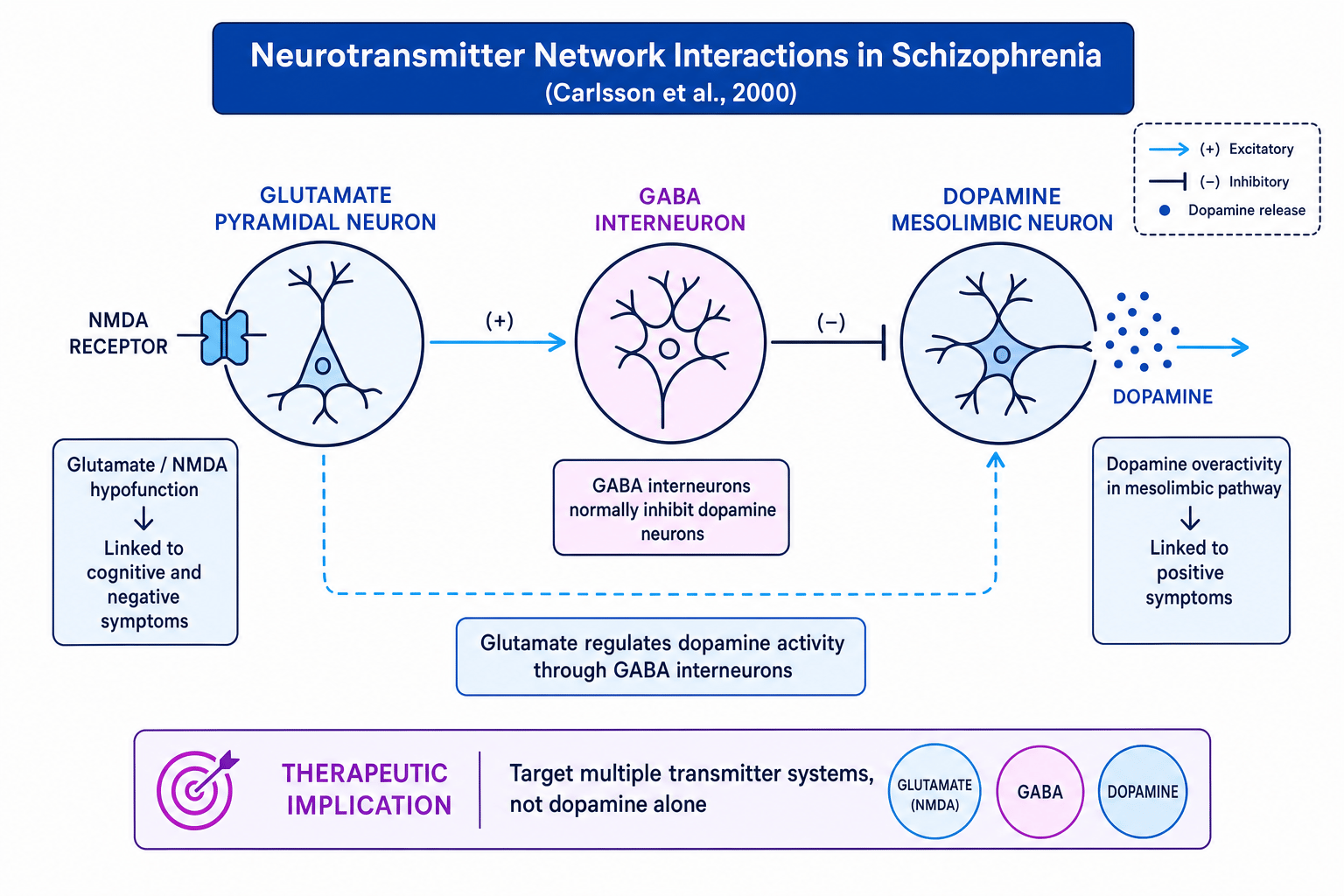
Carlsson et al. suggested that schizophrenia involves abnormal interaction between neurotransmitter systems rather than one isolated chemical imbalance.
The key idea is that glutamate, dopamine and GABA regulate each other. If glutamate signalling through NMDA receptors is too low, this may disturb the normal control of dopamine pathways.
Dopamine pathways
A dopamine pathway is a route in the brain where dopamine neurons communicate between areas.
Two pathways are especially useful for A-Level evaluation:
- The mesolimbic pathway, linked to emotion and reward, may show dopamine overactivity. This is associated with positive symptoms.
- The mesocortical pathway, linked to the prefrontal cortex and thinking, may show dopamine underactivity. This is associated with negative and cognitive symptoms.
This is important because it helps explain why schizophrenia can involve both “too much” and “too little” dopamine activity depending on the brain area.
Glutamate and NMDA hypofunction
Carlsson et al. placed strong emphasis on NMDA receptor hypofunction.
Hypofunction
Hypofunction means reduced or underactive functioning. NMDA receptor hypofunction means glutamate signalling through NMDA receptors is lower than normal.
Evidence for this comes partly from drugs such as PCP and ketamine, which block NMDA receptors. These drugs can produce schizophrenia-like symptoms in healthy people and can worsen symptoms in people with schizophrenia. Importantly, they can affect positive, negative and cognitive symptoms, making glutamate a useful addition to the dopamine explanation.
GABA and inhibition
GABA helps inhibit or “brake” neural activity. Carlsson et al. suggested that if glutamate and GABA systems are disrupted, they may fail to regulate dopamine properly.
So, dopamine abnormalities may be a downstream effect of wider network disruption.
A traffic system, not one broken road
Think of neurotransmitters like roads in a city. A traffic jam in one place may be caused by traffic lights, diversions and side roads elsewhere. Carlsson et al. argued that schizophrenia is more like a disrupted traffic network than one single broken dopamine road.
Therapeutic implications
The phrase therapeutic implications means what the explanation suggests for treatment.
If schizophrenia involves several interacting neurotransmitters, then treatment should not focus only on blocking dopamine. Carlsson et al. argued that future treatments may need to target multiple transmitter systems.
Typical and atypical antipsychotics
Typical antipsychotics mainly reduce dopamine activity, especially by blocking D2 receptors. They are often helpful for positive symptoms but less effective for negative and cognitive symptoms.
Atypical antipsychotics, such as clozapine, affect dopamine but also act on other receptor systems. This fits Carlsson et al.’s network view because it suggests that broader neurotransmitter action may produce better therapeutic effects for some patients.
Applying the network model to treatment
A patient reports hearing voices and believing neighbours are spying on them. After taking a dopamine-blocking antipsychotic, the voices reduce, but they still show low motivation and poor concentration.
-
The voices and paranoid belief are positive symptoms, so Carlsson et al. would link these partly to dopamine overactivity, especially in mesolimbic systems.
-
The low motivation and poor concentration are negative and cognitive symptoms, so a dopamine-only explanation is limited.
-
The partial improvement after a dopamine-blocking drug supports the idea that dopamine is involved, but the remaining symptoms suggest other systems, such as glutamate/NMDA functioning, may also matter.
-
The therapeutic implication is that a broader treatment approach may be needed, such as an atypical antipsychotic and psychological support, rather than relying only on D2 dopamine blockade.
Main conclusions of the study
Carlsson et al. concluded that:
- Schizophrenia is unlikely to be caused by a single dopamine abnormality.
- Glutamate dysfunction, especially NMDA receptor hypofunction, may be central.
- Dopamine abnormalities may differ across brain areas, helping explain different symptom types.
- Treatments should target interacting networks rather than one neurotransmitter in isolation.
The big takeaway
Carlsson et al. moved schizophrenia research from a simple chemical-imbalance model towards a more complex network model with clearer implications for drug development.
AO3 evaluation
Strength: broader explanatory power
A major strength is that the model explains more symptoms than the traditional dopamine hypothesis. Dopamine overactivity can help explain hallucinations and delusions, but glutamate and NMDA dysfunction may also help explain negative and cognitive symptoms.
This gives the study strong theoretical value because schizophrenia is a varied disorder.
Strength: real-world application
The study has clear treatment implications. It supports the development of drugs that affect more than one neurotransmitter system. This is useful because many patients do not fully respond to typical dopamine-blocking antipsychotics.
It also helps explain why atypical antipsychotics may be useful: they often have broader receptor effects.
Strength: converging evidence
Carlsson et al. used evidence from several areas, including drug effects, clinical treatment and animal studies. When different types of evidence point in a similar direction, this can strengthen confidence in the theory.
Weakness: review method and selection bias
Because Carlsson et al. was a review, the authors did not directly control variables, randomly allocate participants or collect new primary data. This means it cannot establish cause and effect in the same way as a well-controlled experiment.
There is also a risk of selection bias, where the evidence chosen may support the authors’ preferred interpretation more than contradictory evidence.
Research methods wording
For Carlsson et al., evaluate the quality of the review and the evidence base. Do not evaluate it as if it used an independent groups design, repeated measures design or matched pairs design.
Weakness: no direct statistical test
This study does not report one main inferential test. So you should not claim that Carlsson et al. used Mann-Whitney U, Wilcoxon signed-ranks, Spearman’s rho or chi-square. Those tests are used for primary data on differences, correlations or associations, with observed values compared to critical values, often using a significance level such as p≤.05p \le .05p≤.05.
For Carlsson et al., the stronger evaluation is about whether the reviewed evidence is valid, consistent and representative.
Weakness: evidence can be indirect
Some evidence comes from drugs such as ketamine or PCP. These can produce schizophrenia-like symptoms, but a drug-induced state is not identical to naturally occurring schizophrenia. This limits how far the findings can be generalised.
Animal research is also useful for understanding mechanisms but cannot fully model human experiences such as delusions.
Weakness: biological reductionism
Carlsson et al. is less reductionist than a simple dopamine explanation because it considers networks. However, it is still mainly biological. It gives less attention to psychological and social factors such as trauma, family dysfunction, cognitive biases or stress.
A balanced essay can argue that Carlsson et al. is valuable, but not a complete explanation of schizophrenia.
Ethics
Carlsson et al. did not directly recruit participants, so issues such as consent, deception, right to withdraw, protection from harm, confidentiality and debrief apply mainly to the original studies they reviewed.
However, the ethical angle still matters. Research involving patients with schizophrenia must follow the BPS Code of Ethics and Conduct (2009), especially because participants may be vulnerable. Drug studies involving ketamine, PCP-like effects or antipsychotics require careful informed consent, protection from harm, the right to withdraw, confidentiality and a full debrief. Any deception would need strong justification and safeguards.
There is also an ethical issue in treatment application: biological explanations can reduce blame, but they may also encourage over-medicalisation if psychological needs are ignored.
In the exam
-
Start AO1 by saying Carlsson et al. (2000) was a review paper, not a new experiment with a participant sample.
-
Explain the key network idea: dopamine, glutamate and GABA interact, with NMDA receptor hypofunction playing an important role.
-
For AO3, balance application with caution: the study influenced drug development, but evidence is indirect and the review method limits causal claims.
Check yourself
- Why does Carlsson et al. challenge the simple dopamine hypothesis of schizophrenia?
- How might NMDA receptor hypofunction help explain negative and cognitive symptoms?
- What is one methodological strength and one methodological weakness of using a review paper as a named study?
