What you'll learn
- What the PHQ-8 is and how it measures current depressive symptoms.
- How Kroenke et al. (2008) tested the PHQ-8 in a large general-population survey.
- The key findings, conclusions, and real-world applications of the study.
- How to evaluate the study for AO3, including methods, ethics, and validity.
Why this study matters
Kroenke et al. (2008) is the contemporary study for depression in Edexcel A-Level Psychology. It focuses on measurement: how can researchers identify people with current depression in a large population without carrying out full clinical interviews with everyone?
This matters because depression is common, but it is not always diagnosed. Public health researchers need tools that are quick, standardised, and suitable for large surveys.
Current depression
Current depression refers to depressive symptoms being experienced recently — in this study, over the previous two weeks — rather than a lifetime history of ever having had depression.
Screening measure
A screening measure is a tool used to identify people who may have a condition. It does not prove someone has a clinical diagnosis, but it can flag likely cases for further assessment.
The PHQ-8: the measure at the centre of the study
The Patient Health Questionnaire-8, usually shortened to PHQ-8, is an eight-item self-report questionnaire measuring symptoms of depression.
It is based on the PHQ-9, but it leaves out the ninth item about suicidal thoughts or self-harm. This made it more suitable for large telephone surveys, where researchers may not be able to provide immediate clinical support if someone reports suicidal ideation.
PHQ-8
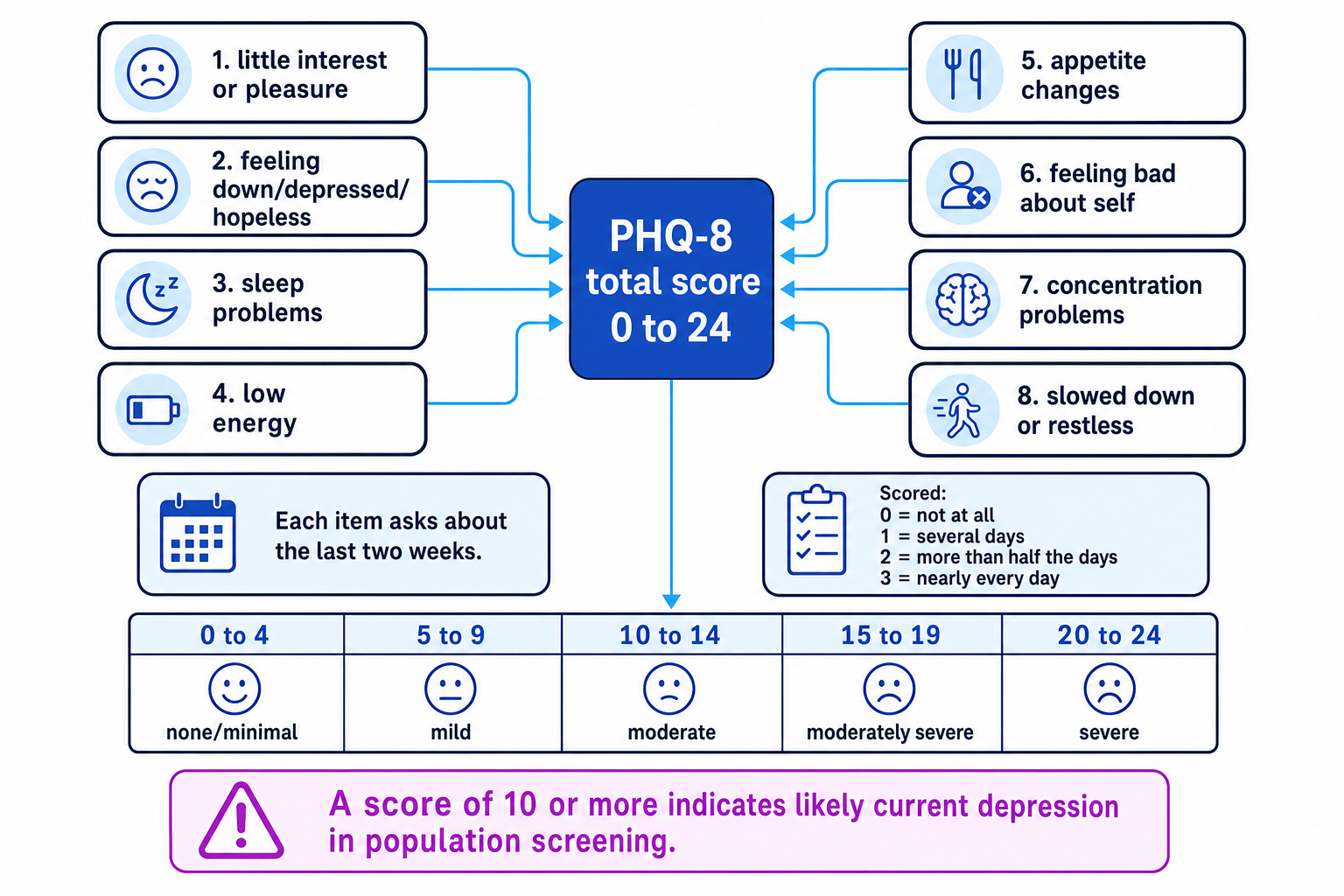
The PHQ-8 is a standardised questionnaire in which people rate how often they have experienced eight depressive symptoms over the last two weeks. Each item is scored from 0 to 3, giving a total score from 0 to 24.
The diagram below summarises how the PHQ-8 is scored and interpreted.
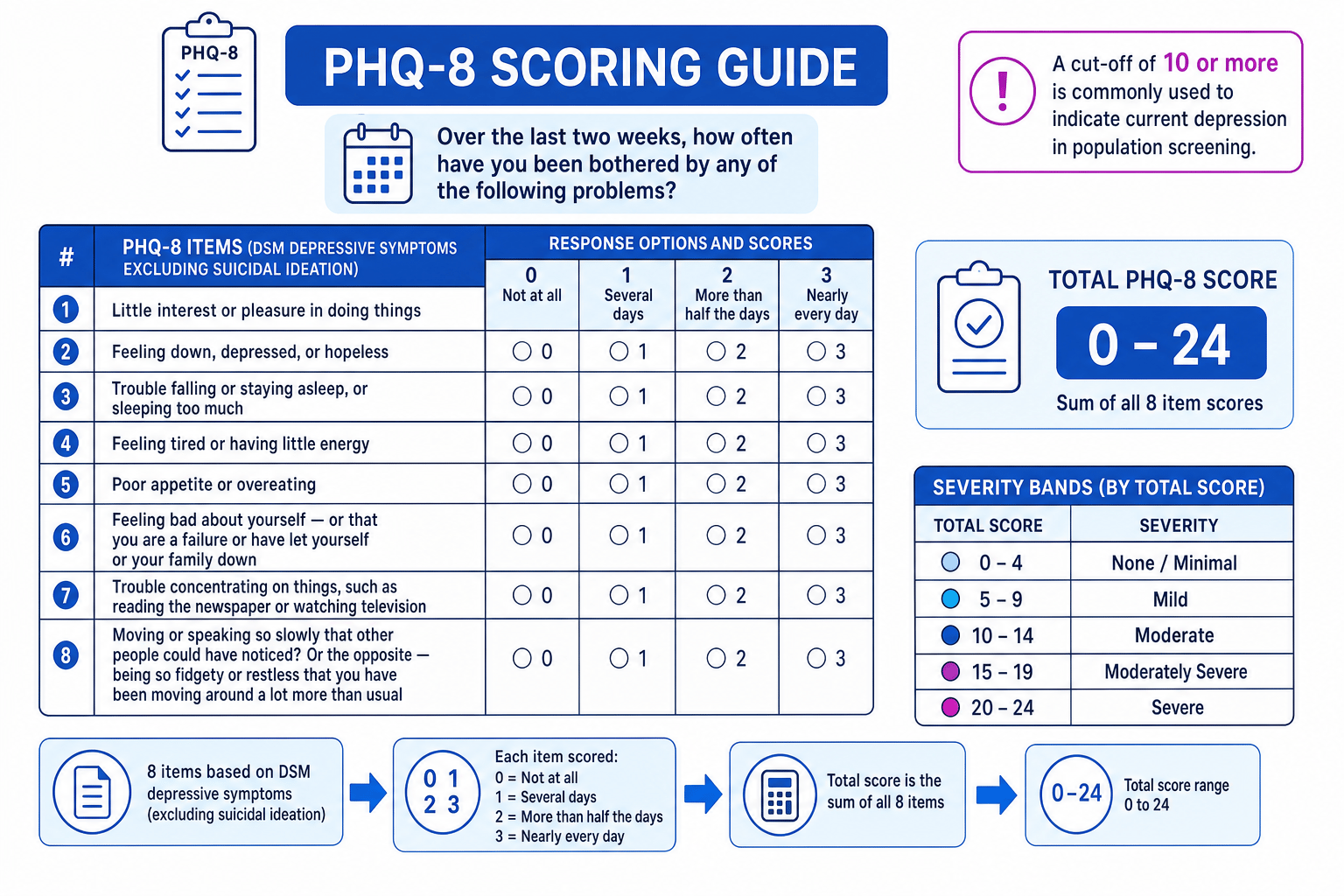
A commonly used cut-off is a PHQ-8 score of 10 or more, which indicates likely current depression in population screening.
Screening, not diagnosis
A high PHQ-8 score suggests probable depression, but it is not the same as a diagnosis from a trained clinician using a full clinical interview.
Scoring a PHQ-8 response
A participant gives these scores on the eight PHQ-8 items: 2, 2, 1, 2, 1, 1, 1, 0.
-
Add the item scores to find the total: 2+2+1+2+1+1+1+0=102+2+1+2+1+1+1+0=102+2+1+2+1+1+1+0=10.
-
Compare the total with the severity bands. A score of 10 falls in the moderate range.
-
Apply the usual screening cut-off. Because the score is 10 or more, this participant would be counted as showing likely current depression in a population survey.
Kroenke et al. (2008): aim and background
Kroenke et al. wanted to assess whether the PHQ-8 could be used as a valid measure of current depression in the general population.
This is slightly different from using a questionnaire in a clinic. In a clinic, people may already be seeking help. In a general-population survey, many people will not have a diagnosis and may not see themselves as patients.
General population
The general population means a broad sample of ordinary adults, not just people already receiving mental health treatment.
The researchers were interested in whether PHQ-8 scores were related to meaningful outcomes such as poor mental health days, physical health problems, social functioning, and life satisfaction. If higher PHQ-8 scores are linked with poorer functioning, that supports the questionnaire’s validity.
Validity
Validity means whether a measure actually measures what it claims to measure. In this case, the issue is whether the PHQ-8 really measures depression in the general population.
AO1: what Kroenke et al. did
Sample
Kroenke et al. analysed data from a very large US survey: the 2006 Behavioral Risk Factor Surveillance Survey.
The final sample included about 198,678 adults from 38 US states, the District of Columbia, Puerto Rico, and the US Virgin Islands. Participants were contacted by telephone.
Procedure
Participants answered the PHQ-8, rating how often they had experienced each depressive symptom over the last two weeks.
They also answered questions about health and daily functioning, including:
- number of days with poor mental health
- number of days with poor physical health
- days where usual activities were limited
- life satisfaction
- social and emotional support
- demographic information, such as age, sex, income, education, and employment
This was a cross-sectional survey, meaning data were collected at one point in time.
Cross-sectional survey
A cross-sectional survey collects data from participants at one point in time, rather than following them over a long period.
Main findings
Kroenke et al. found that the PHQ-8 worked well as a population measure of depression.
Key findings included:
- Around 9% of adults met criteria for current depression.
- Rates of depression were higher in some demographic groups, including women, younger adults, people with lower income, people with lower education, and those unable to work.
- Higher PHQ-8 scores were associated with more unhealthy days and greater impairment.
- Depression severity increased in a meaningful pattern: people with more severe PHQ-8 scores tended to report worse quality of life and functioning.
Main conclusion
Kroenke et al. concluded that the PHQ-8 is a useful, brief, reliable measure of current depression in large general-population surveys.
What the findings show about measurement
The study supports the PHQ-8 because the scores behaved as we would expect if the questionnaire was measuring depression.
People with higher scores reported more problems in everyday life. That matters because depression is not just a mood state; it can affect sleep, concentration, energy, work, relationships, and general functioning.
Construct validity
Construct validity is evidence that a measure relates to other variables in a way that fits the underlying concept. Here, PHQ-8 scores related to poor functioning, which supports the idea that the PHQ-8 measures depression.
AO2: applying the study
If you are given a scenario about a public health researcher wanting to estimate depression rates across a large population, Kroenke et al. is directly relevant.
You could apply the study by saying:
- the PHQ-8 is quick and standardised
- it can be administered by telephone or survey
- it produces quantitative data, so researchers can compare groups
- it avoids the suicidal ideation item, making it more practical in large-scale surveys
- a score of 10 or above can be used to identify likely current depression
Methods link
If you were analysing PHQ-8 data, Spearman’s rho could test a correlation between PHQ-8 score and number of unhealthy days. Mann-Whitney U could compare PHQ-8 scores between two independent groups. Wilcoxon signed-ranks could compare scores before and after an intervention in the same people. Chi-square could test an association between depression category and employment status. The usual significance level is p≤.05p \le .05p≤.05.
AO3: strengths of the study
Large sample
A major strength is the extremely large sample. Nearly 200,000 participants gives the study strong statistical power and makes the findings more reliable than a small questionnaire study.
It also allowed the researchers to compare different demographic groups, such as age, sex, income, and employment status.
Real-world usefulness
The study has strong practical application. Public health services need to estimate how common depression is, where it is most common, and which groups may need extra support.
The PHQ-8 is quick, cheap, and easy to administer. This makes it useful for large surveys where clinical interviews would be too expensive and time-consuming.
Standardised procedure
Every participant answered the same PHQ-8 items using the same response scale. This improves reliability because the measure is consistent across participants.
Reliability
Reliability means consistency. A reliable questionnaire should measure symptoms in a stable, standardised way rather than producing random or unpredictable results.
AO3: weaknesses and limitations
Self-report problems
The PHQ-8 relies on people reporting their own symptoms. This creates possible issues with memory, honesty, and interpretation.
For example, one person’s “several days” may not mean exactly the same thing as another person’s “several days”. Some participants may also under-report symptoms because of stigma.
Screening is not the same as clinical diagnosis
The study did not give every participant a full diagnostic interview. This means some people scoring 10 or above may not have clinical depression, while some people below the cut-off may still be struggling.
Calling PHQ-8 a diagnosis
Do not write that the PHQ-8 “diagnoses depression” on its own. It is better to say it screens for likely current depression or indicates probable depression.
Sampling limitations
The study used a telephone survey. This may exclude some groups, such as people without access to a telephone, people who are homeless, and people in institutions such as hospitals or prisons.
Because the data came from the US, you should also be cautious about generalising directly to the UK population.
Cross-sectional design
The research was cross-sectional, so it cannot show cause and effect. Higher PHQ-8 scores were linked with poorer quality of life, but the study cannot prove that depression caused those difficulties.
It is also possible that physical illness, unemployment, or social isolation contributed to depressive symptoms.
Ethics
The study involved sensitive questions about mental health, so ethical care was important.
Using the BPS Code of Ethics and Conduct (2009), you can evaluate:
- consent: participants should know what the survey involves
- right to withdraw: they should be able to stop taking part
- confidentiality: responses should not identify individuals
- protection from harm: questions about depression may cause distress
- debrief: participants should know where to seek support if needed
- deception: there was no obvious need for deception in this study
The omission of the suicide/self-harm item can be seen as ethically protective in a telephone survey, because researchers may not be able to respond immediately to serious risk.
When PHQ-8 is not enough
The PHQ-8 is not suitable as a full risk assessment. If a person may be suicidal or in immediate danger, a more direct clinical assessment is needed.
How to use this study in an essay
For AO1, describe the aim, sample, procedure, PHQ-8 scoring, and findings.
For AO3, focus on whether the study gives good evidence that the PHQ-8 is a valid population measure. Strong answers balance usefulness with limitations: it is practical and standardised, but it depends on self-report and cannot replace clinical diagnosis.
In the exam
-
Make it clear that Kroenke et al. studied the PHQ-8 as a measure, not depression treatment or the causes of depression.
-
Use precise wording: say “likely current depression” or “screening measure”, rather than claiming the PHQ-8 gives a definite diagnosis.
-
For evaluation, link each point back to measurement quality: validity, reliability, generalisability, self-report bias, ethics, and real-world application.
Check yourself
- Why did the PHQ-8 omit the suicidal ideation item from the PHQ-9?
- What does a PHQ-8 score of 10 or more usually indicate in population screening?
- Give one strength and one weakness of using a large telephone survey to measure depression.