In the early 1970s, psychiatric diagnosis was heavily reliant on the second edition of the Diagnostic and Statistical Manual of Mental Disorders (DSM-II). Psychiatrists believed they could objectively identify mental illness. However, psychologist David Rosenhan questioned this assumption. He wanted to know: how do we distinguish sanity from insanity? Is the diagnosis in the patient, or is it in the environment?
This note covers Rosenhan’s classic study, “On being sane in insane places” (1973), which shook the foundations of psychiatry and completely changed how we think about mental health classification.
What you'll learn
- How Rosenhan tested the validity and reliability of psychiatric diagnosis using pseudo-patients.
- The shocking differences between Study 1 (entering the hospitals) and Study 2 (the reverse test).
- The key findings regarding the "stickiness" of diagnostic labels and institutional depersonalisation.
- How to evaluate this classic study in your exams using AO1 (description) and AO3 (evaluation) skills.
The Background: Reliability vs. Validity
Before diving into the study, you must understand two fundamental concepts in clinical classification.
Reliability of Diagnosis
The consistency of a diagnosis. If different clinicians assess the same patient and arrive at the same diagnosis, the system is reliable (inter-rater reliability). If the same clinician diagnoses the same patient with the same condition at two different points in time, it is test-retest reliable.
Validity of Diagnosis
The accuracy of a diagnosis. A diagnostic system is valid if it measures what it claims to measure—meaning it correctly identifies a genuine mental disorder that actually exists in the patient, distinguishing it from other conditions or from healthy functioning.
Rosenhan set out to show that psychiatric diagnosis in 1973 had very poor validity. He argued that psychiatrists could not reliably distinguish those who were sane from those who were insane.
Study 1: Sane in Insane Places
In his primary study, Rosenhan used a research method known as a participant observation set in a field environment (real psychiatric hospitals).
The Procedure
- The Pseudo-patients: Eight sane people acted as "pseudo-patients" (five men and three women, including Rosenhan himself). The group included three psychologists, a pediatrician, a psychiatrist, a painter, a housewife, and a graduate student.
- The Setting: Twelve psychiatric hospitals across five different states in the USA. The hospitals varied: some were old and underfunded, others were modern and private, and some had high staff-to-patient ratios.
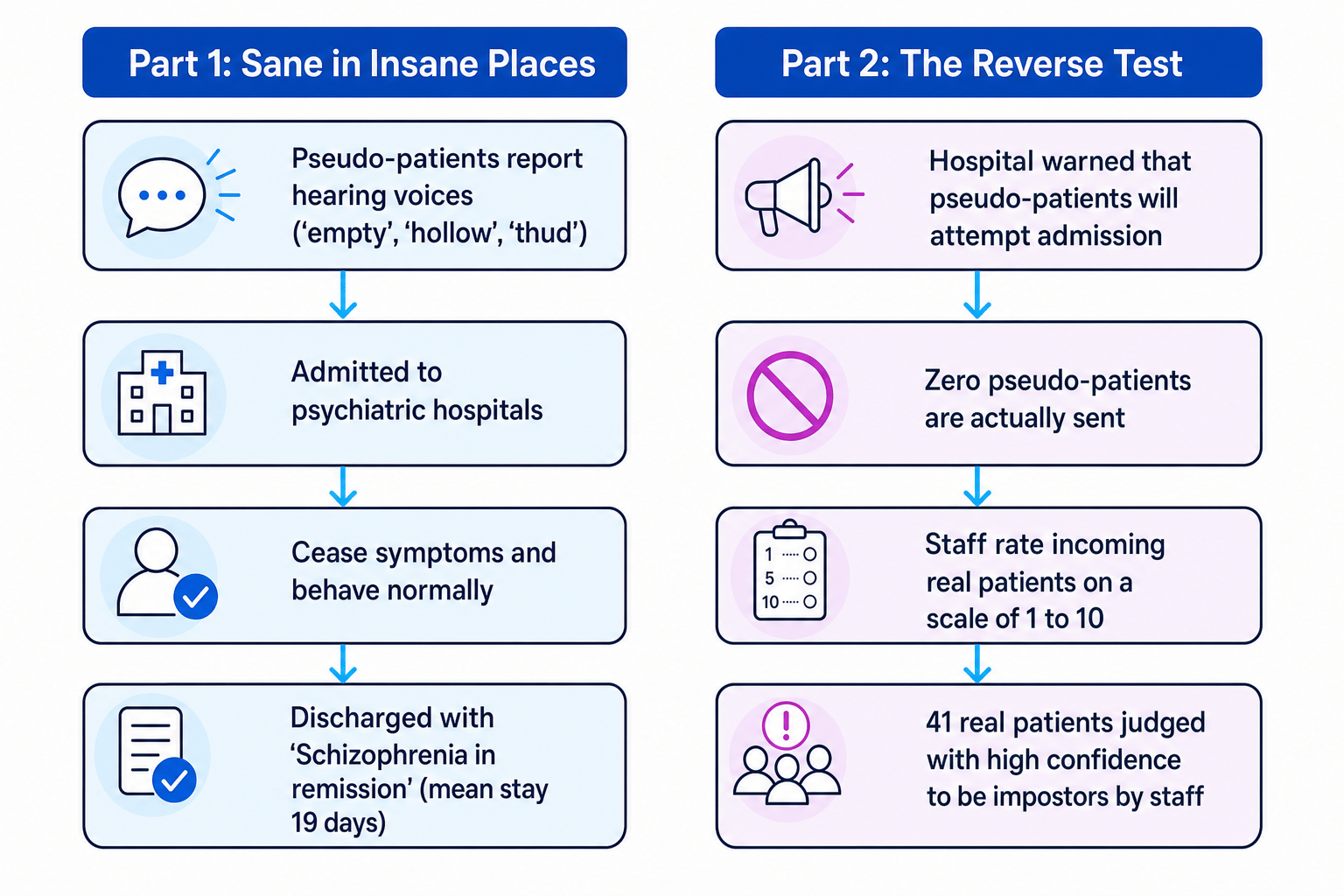
- The Symptom: The pseudo-patients called the hospital for an appointment. At the clinical interview, they complained of hearing voices. When asked what the voices said, they replied they were unclear but seemed to say "empty", "hollow", and "thud".
Why these symptoms?
Rosenhan chose the words "empty", "hollow", and "thud" because they suggest an existential crisis (a feeling that one's life is meaningless) but do not match any known symptoms of schizophrenia or psychosis in the psychiatric literature.
- The Behavior After Admission: Immediately upon being admitted, the pseudo-patients stopped simulating any symptoms. They behaved completely normally, interacted politely with staff and patients, and indicated that they no longer heard voices.
- Data Collection: They kept written notes of their observations. Initially, they did this secretly, but when they realised the staff did not pay attention, they took notes openly in the ward corridors.
The Findings of Study 1
Despite showing zero symptoms after admission, none of the pseudo-patients were detected by staff.
- Admissions: All twelve admissions were accepted. Eleven were diagnosed with schizophrenia, and one was diagnosed with manic-depressive psychosis (at the private hospital).
- Length of Stay: The pseudo-patients remained in the hospitals for 7 to 52 days (with a mean stay of 19 days).
- Discharge: When they were finally released, they were not declared "cured." Instead, they were discharged with the diagnosis of "Schizophrenia in remission". This proved that once a label was applied, it was permanent.
- Real Patients' Suspicions: Interestingly, while the staff failed to detect them, the real patients did! In the first three hospitalisations, 35 out of 118 real patients voiced suspicions, saying things like: "You're not crazy. You're a journalist or a professor. You're checking up on the hospital."
The Power of Diagnostic Labels
Rosenhan observed that once a psychiatric label was applied to an individual, all of their normal behaviors were reinterpreted to fit that label. This is known as the "stickiness of psychodiagnostic labels."
- Note-taking: When pseudo-patients took notes, the nursing staff wrote in the daily logs: "Patient engages in writing behavior", treating it as a symptom of their mental illness.
- Pacing: When a pseudo-patient paced up and down the corridor out of sheer boredom, staff recorded it as a sign of "extreme anxiety".
- Waiting for lunch: Patients waiting outside the cafeteria early were described by a psychiatrist as displaying "oral-acquisitive" behaviors of the disorder, ignoring the simple fact that they were just hungry and had nothing else to do.
Study 2: The Reverse Test (The Secondary Study)
After Rosenhan published his initial findings, many prestigious psychiatric institutions were furious. One teaching and research hospital claimed that while such errors might occur at poor hospitals, they would never make such mistakes.
Rosenhan accepted their challenge and set up a second study over a three-month period.
The Procedure
- Rosenhan informed the staff at this prestigious hospital that over the next three months, one or more pseudo-patients would attempt to gain admission to their psychiatric unit.
- Staff members were instructed to observe every presenting patient and rate them on a 10-point scale according to how likely they were to be a pseudo-patient (with 1 meaning high confidence they were an impostor, and 10 meaning they were a genuine patient).
- The Catch: Rosenhan actually sent zero pseudo-patients during those three months!
The Findings of Study 2
The staff at the hospital assessed 193 genuine patients who arrived for treatment during this period. Because they were actively looking for impostors, they made massive errors in the opposite direction (Type II errors):
- 41 patients were judged with high confidence to be pseudo-patients by at least one staff member.
- 23 patients were suspected of being pseudo-patients by at least one psychiatrist.
- 19 patients were suspected of being pseudo-patients by both a psychiatrist and another staff member.
By demonstrating that staff would reject genuine patients when expecting an impostor, Rosenhan showed that the diagnostic system was highly subjective and easily swayed by expectation.
The Core Takeaway
Psychiatrists cannot reliably distinguish the sane from the insane. In Study 1, they committed a Type I error (diagnosing a healthy person as sick—a false positive). In Study 2, they committed a Type II error (diagnosing sick people as healthy impostors—a false negative).
Worked Example: Calculating Diagnostic Error Rates
Psychology exams often require you to work with research data. Let's look at how to calculate percentages and fractions from the quantitative data in Rosenhan's Study 2.
Calculating the rate of false suspicions in Study 2
In Rosenhan's secondary study, a total of 193 patients were evaluated by the hospital staff.
- 19 patients were suspected of being pseudo-patients (impostors) by both a psychiatrist and at least one other staff member.
- 23 patients were suspected by at least one psychiatrist.
Question: Calculate the percentage of the total sample of patients who were suspected of being pseudo-patients by both a psychiatrist and another staff member. Show your workings and round your answer to two decimal places.
Solution:
-
Identify the target frequency: The number of patients suspected by both groups is 19.
-
Identify the total sample size (NNN): The total number of patients evaluated is 193.
-
Set up the percentage calculation:
Percentage=(19193)×100 \text{Percentage} = \left( \frac{19}{193} \right) \times 100 Percentage=(19319)×100 -
Perform the division:
19193≈0.09844559... \frac{19}{193} \approx 0.09844559... 19319≈0.09844559... -
Multiply by 100:
0.09844559×100=9.844559...% 0.09844559 \times 100 = 9.844559...\% 0.09844559×100=9.844559...% -
Round to two decimal places: Look at the third decimal digit (4). Since it is less than 5, round down to get 9.84%9.84\%9.84%.
Study 3: The Experience of Psychiatric Ward Life (Qualitative Data)
Rosenhan's study wasn't just about diagnosis; it was also an indictment of how psychiatric patients were treated. The pseudo-patients gathered qualitative data about the realities of life inside a 1970s institution.
Depersonalisation and Powerlessness
The study highlighted how psychiatric institutions stripped patients of their human rights:
- Lack of privacy: Toilet cubicles had no doors, staff would inspect patients' personal belongings without permission, and clinical staff discussed patients in front of them as if they were invisible.
- Lack of interaction: Clinical staff remained largely segregated in their glass-walled offices (which the pseudo-patients called "the cage").
- Physical abuse: Pseudo-patients witnessed staff verbally abusing and physically striking patients, though this behavior stopped the moment a high-status clinician walked into the room.
The Mini-Experiment on Staff Interaction
To quantify this lack of interaction, pseudo-patients in four hospitals conducted a mini-experiment. They approached a member of staff and asked a polite, reasonable question: "Pardon me, Dr. [Name], could you tell me when I will be presented at the staff meeting?"
They compared this to a control condition where a female researcher approached staff members on the Stanford University campus to ask for directions.
- Psychiatric Hospital Results: Only 4% of psychiatrists stopped to talk to the pseudo-patient. 88% completely ignored them or walked away.
- University Results: 100% of the university staff stopped, made eye contact, and answered the question.
Evaluation (AO3)
To score top marks in your Edexcel essays, you must balance your description with strong, structured evaluative points.
Strengths
- High Ecological Validity: The study was conducted in real, functioning psychiatric hospitals with genuine staff who had no idea they were part of a study. The behavior observed was natural and unmanipulated.
- Range of Settings: By using 12 different hospitals across 5 US states—ranging from prestigious private clinics to poorly funded state institutions—Rosenhan ensured his findings were not just a reflection of one bad hospital. This increases the generalisability of the results across the US psychiatric system of that era.
- Spurred Reform: The study had a massive real-world impact. It acted as a major catalyst for the deinstitutionalisation movement (moving patients out of long-stay institutions and into community care) and directly influenced the development of the DSM-III, which introduced much more rigid, objective criteria for diagnoses to improve reliability.
Weaknesses
- Ethical Issues: The study violated several ethical guidelines:
- Deception: Hospital staff were completely deceived, which meant they could not give informed consent.
- Protection from Harm: Real patients may have suffered because psychiatric beds and staff time were taken up by healthy pseudo-patients.
- Right to Withdraw: The pseudo-patients could not leave instantly; they had to stay until they were discharged by the doctors, which caused some of them significant stress.
- Lack of Temporal Validity: The study was conducted in 1973 using the DSM-II. Diagnostic tools have undergone massive revisions since then. Today’s DSM-5-TR uses highly specific, objective criteria, meaning modern diagnoses are far more reliable and valid than they were in Rosenhan's time.
- Manipulating the System: Critics (like psychiatrist Seymour Kety) argued that Rosenhan’s study was unrealistic. If someone walks into a doctor's office, drinks a bottle of blood, and vomits, the doctor will assume they have a bleeding ulcer. It is not "invalid" for a doctor to trust a patient's self-reported symptoms; clinical diagnosis relies on the assumption of honesty.
Confusing Study 1 and Study 2
In essays, students often write that "in Study 2, Rosenhan sent pseudo-patients who were then turned away." This is incorrect! In Study 2, Rosenhan sent zero pseudo-patients. The staff turned away/suspected real patients because they expected impostors. Make sure you keep these two parts clearly separated in your mind.
In the exam
- Clearly distinguish between AO1 and AO3: If a question asks you to "Describe Rosenhan's (1973) study" (AO1), do not waste time evaluating it. Focus entirely on the aims, procedure, findings, and conclusions. Save your evaluation for "Discuss..." or "Evaluate..." questions.
- Memorise key numbers: Examiners love precise quantitative details. Ensure you know the number of pseudo-patients (8), hospitals (12), the mean stay (19 days), and the number of patients suspected in Study 2 (41).
- Use the correct terminology: Do not just say the diagnosis was "wrong". Explain that the diagnosis lacked validity, and use the term "Type I error" for Study 1 and "Type II error" for Study 2.
- Link to the BPS Code of Ethics: When discussing ethics (AO3), explicitly mention the British Psychological Society (BPS) guidelines: consent, deception, protection from harm, and debriefing. Explain why the breach occurred and whether it was justified by the study's benefits.
Check yourself
- Why did Rosenhan choose the words "empty, hollow, thud" as the presenting symptom for his pseudo-patients?
- What is meant by the phrase "the stickiness of psychodiagnostic labels"? Give one example from the study.
- What are the differences between Type I and Type II errors in the context of psychiatric diagnosis?
- Evaluate Rosenhan's study in terms of its ethical considerations. Do you think the research was justified?
