What you'll learn
- Why the POTS study by March et al. (2004) matters for treating obsessive compulsive disorder in young people.
- How the study compared cognitive behavioural therapy, sertraline, combined treatment and placebo.
- The key findings, including why combination treatment was especially effective.
- How to evaluate the study for AO3: methodology, ethics, validity and real-world usefulness.
First: what is OCD?
Obsessive compulsive disorder, usually shortened to OCD, is a mental health condition involving unwanted intrusive thoughts and repetitive behaviours or mental acts.
Obsessions and compulsions
An obsession is a persistent, unwanted thought, image or urge that causes anxiety. A compulsion is a repetitive behaviour or mental act carried out to reduce that anxiety, such as checking, washing, counting or repeating phrases.
For example, a young person might have an obsession that their hands are contaminated, followed by a compulsion to wash repeatedly. The compulsion may reduce anxiety briefly, but this relief can reinforce the behaviour, making OCD harder to break.
Why study treatments for children and adolescents?
OCD often begins in childhood or adolescence. If symptoms are treated early, the person may experience less disruption to school, friendships, family life and later development.
The POTS study is important because it did not just ask whether treatment works. It compared different treatment options in a controlled way.
The big question
March et al. (2004) wanted to find out whether cognitive behavioural therapy, sertraline medication, or their combination was most effective for children and adolescents with OCD.
The treatments compared
Cognitive behavioural therapy
Cognitive behavioural therapy, or CBT, is a psychological therapy based on the idea that thoughts, feelings and behaviours are linked. For OCD, CBT often includes exposure and response prevention.
Exposure and response prevention
Exposure and response prevention, or ERP, involves gradually exposing the person to feared situations while preventing the usual compulsive response. Over time, the anxiety should reduce without the compulsion being performed.
So, if a child fears contamination, ERP might involve touching a “contaminated” object and then delaying or avoiding handwashing. The aim is to learn that anxiety naturally falls without the compulsion.
Applying ERP to a contamination fear
- Identify the obsession and compulsion: the young person fears germs after touching a door handle and usually washes their hands repeatedly.
- Create a manageable exposure: the therapist might ask them to touch the door handle for a short time.
- Prevent the usual response: the young person delays handwashing, with support, so they can experience anxiety falling naturally.
- Build up gradually: later exposures might involve touching more feared objects or waiting longer before washing.
Sertraline
Sertraline is a drug treatment from a class of antidepressants called selective serotonin reuptake inhibitors, or SSRIs.
SSRI
A selective serotonin reuptake inhibitor is a drug that increases the availability of serotonin in the brain by reducing its reabsorption into the presynaptic neuron. Serotonin is a neurotransmitter linked to mood and anxiety regulation.
SSRIs are used for depression, anxiety disorders and OCD. In OCD, they may reduce the intensity of obsessive thoughts and compulsive urges.
Combined treatment
Combined treatment means using CBT and sertraline together. The logic is that medication may reduce symptoms enough for the young person to engage more successfully with CBT, while CBT teaches long-term coping skills.
Simple memory hook
Think “skills plus support”: CBT teaches behavioural and cognitive skills, while sertraline may biologically reduce symptom intensity.
Aim of March et al. (2004)
The POTS team, including March et al. (2004), aimed to compare the effectiveness of:
- CBT alone
- sertraline alone
- CBT and sertraline combined
- pill placebo
The study was titled “Cognitive behaviour therapy, sertraline, and their combination for children and adolescents with OCD.”
Method: how the study was designed
March et al. used a randomised controlled trial, often shortened to RCT.
Randomised controlled trial
A randomised controlled trial is an experiment where participants are randomly allocated to different treatment conditions, allowing researchers to compare outcomes while reducing participant-selection bias.
The sample included 112 children and adolescents aged 7 to 17 with a primary diagnosis of OCD. They were randomly allocated to one of four treatment groups for 12 weeks. Each group had 28 participants.
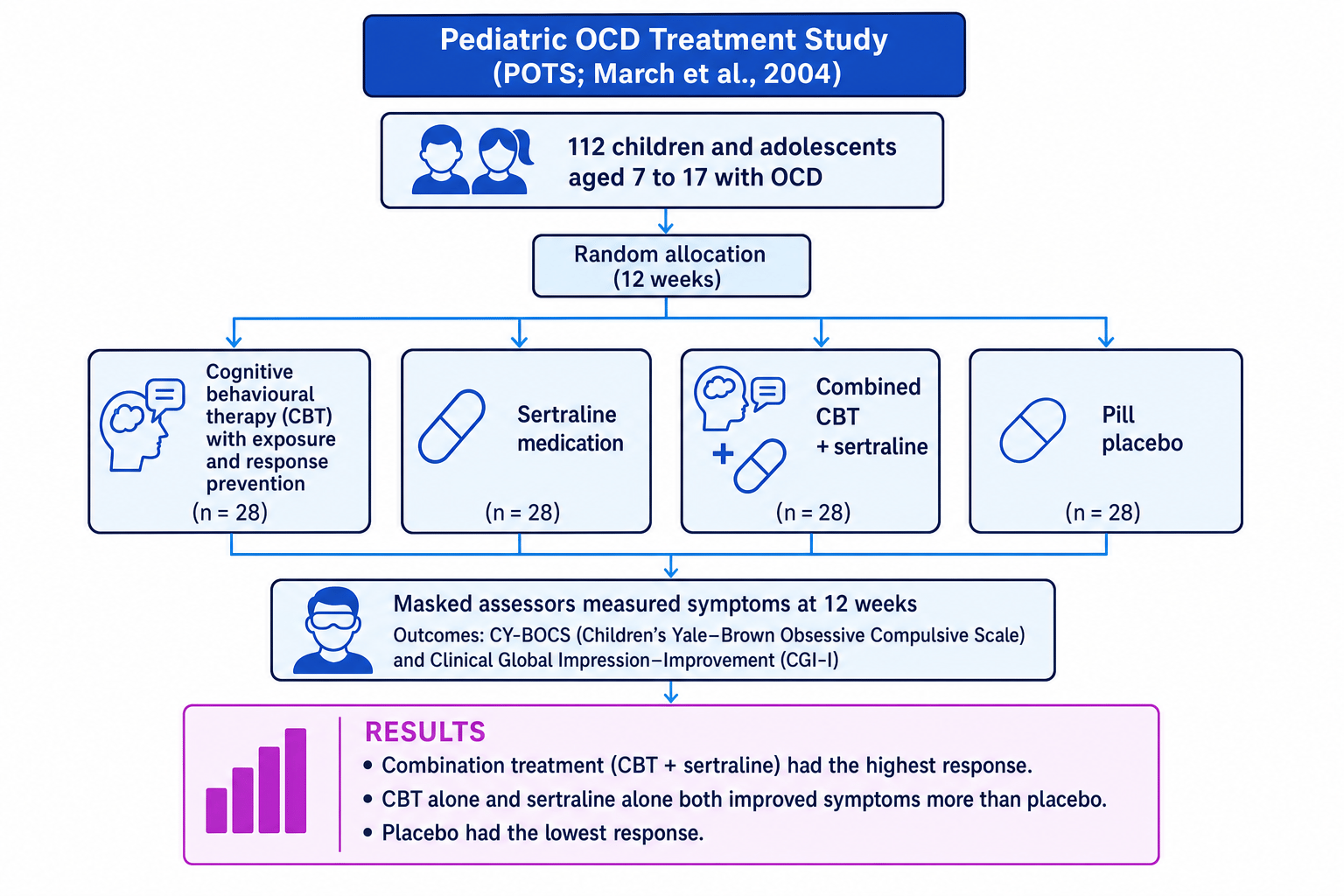
The four conditions
- CBT alone: therapy focused on OCD symptoms, including ERP.
- Sertraline alone: medication treatment.
- Combined CBT and sertraline: both treatments together.
- Pill placebo: an inactive pill used as a comparison condition.
Placebo
A placebo is an inactive treatment that looks like a real treatment. It helps researchers test whether improvement is due to the active treatment rather than expectations or attention.
Measuring improvement
The researchers used standard clinical measures, including the Children’s Yale-Brown Obsessive Compulsive Scale, usually called CY-BOCS.
CY-BOCS
The CY-BOCS is a clinical scale used to measure the severity of OCD symptoms in children and adolescents, including the time taken by obsessions and compulsions, distress, resistance and interference.
The study also used clinical improvement ratings, and assessments were carried out by evaluators who were masked to treatment condition.
Masked assessment
A masked assessor does not know which treatment condition a participant was in. This reduces observer bias when judging improvement.
Results: what did they find?
All three active treatments improved OCD symptoms more than placebo. The strongest outcome was for combined CBT and sertraline.
Clinical remission rates were approximately:
- Combined treatment: 53.6%
- CBT alone: 39.3%
- Sertraline alone: 21.4%
- Placebo: 3.6%
Main finding
The best treatment outcome was found for CBT plus sertraline, but CBT alone and sertraline alone were also more effective than placebo.
This suggests that both psychological and biological treatments can help childhood OCD, but using them together may produce the greatest short-term improvement.
Saying the study proves medication is always best
The study did not show that sertraline alone was the best treatment. The strongest evidence was for the combined treatment, and CBT alone also performed well.
Conclusion
March et al. concluded that children and adolescents with OCD should be offered CBT, sertraline, or especially their combination where appropriate. The findings support a biopsychological approach, because OCD can be treated through both psychological learning processes and biological intervention.
AO3 evaluation: strengths
Strong experimental control
A major strength is that this was a randomised controlled trial. Random allocation reduces the chance that one group was more severe, more motivated or more likely to improve before treatment even began.
The placebo condition also helped researchers judge whether improvement was due to active treatment rather than expectation.
Use of standardised measures
The CY-BOCS is a well-established measure of OCD severity. This improves reliability, meaning the assessment can be applied consistently across participants.
Reliability
Reliability means consistency. In this study, standardised symptom measures help make the results less dependent on one researcher’s personal judgement.
Real-world application
The findings have clear practical value. They support treatment guidelines recommending CBT with ERP and SSRIs for young people with OCD, especially when symptoms are moderate to severe.
This is useful for clinicians, families and schools because it gives evidence-based guidance on treatment planning.
AO3 evaluation: weaknesses and issues
Limited generalisability
The participants were children and adolescents who met the study criteria and were treated in specialist clinical settings. This means the findings may not generalise perfectly to adults, very young children, people with complex comorbid conditions, or those treated in less specialist services.
Generalisability
Generalisability is the extent to which findings from a study apply beyond the original sample and setting.
CBT cannot be fully blinded
Medication and placebo can be double-blinded more easily, because participants may not know whether they are receiving the real drug. However, CBT cannot be hidden in the same way: participants know whether they are attending therapy.
This could create expectancy effects. For example, a family receiving CBT may expect improvement, which might influence motivation or symptom reporting.
Short treatment period
The trial lasted 12 weeks. This is useful for measuring short-term treatment response, but OCD is often long-lasting. Longer follow-up is needed to know whether improvements are maintained, whether relapse occurs, and whether young people continue using CBT strategies.
Possible side effects and adherence
Sertraline can have side effects, and not all young people want to take medication. Some may also struggle to complete ERP tasks because exposure can be distressing at first.
ERP can feel worse before it feels better
ERP deliberately brings the person into contact with feared triggers. This can be ethically acceptable only when carefully planned, consented to, monitored and delivered by trained professionals.
Ethics
Because participants were children and adolescents, ethical safeguards were especially important.
Using the BPS Code of Ethics and Conduct (2009) as a framework, key issues include:
- Consent: parents or guardians would need to give informed consent, and young people should give assent where possible.
- Right to withdraw: families should be able to leave the study without penalty.
- Protection from harm: side effects, distress during ERP and symptom deterioration must be monitored.
- Confidentiality: clinical information should be stored securely and anonymised where possible.
- Debrief: participants and families should be informed about the treatment and study findings when appropriate.
- Deception: the placebo condition involves some withholding of full information, so it must be justified by scientific value and managed carefully.
Research methods link: analysing this kind of study
For A-Level exam answers, you may be asked to connect the study to research methods.
If you were analysing simplified POTS-style data:
- Use measures of central tendency such as the mean or median for symptom scores.
- Use measures of dispersion such as the range or standard deviation to show spread.
- Use a bar chart for remission rates across treatment groups.
- Use a histogram to inspect whether symptom scores are normally distributed or skewed.
- Use a frequency table for categories such as “remitted” and “not remitted”.
For inferential testing:
- Mann-Whitney U: difference between two independent groups, such as CBT versus placebo, especially if scores are ordinal or skewed.
- Wilcoxon signed-ranks: difference between two related scores, such as before-treatment versus after-treatment scores for the same participants.
- Spearman’s rho: correlation, such as whether higher starting severity is related to poorer improvement.
- Chi-square: association between categories, such as treatment group and remission category.
Choosing a statistical test for POTS-style data
- Decide what the research question is asking: comparing CBT and placebo symptom scores is a test of difference, not a correlation.
- Decide whether the groups are related: CBT participants and placebo participants are different people, so the groups are independent.
- Decide whether the data suit a non-parametric test: symptom scores may be ordinal or skewed, so a non-parametric test is appropriate.
- Select the test: for a difference between two independent groups, use Mann-Whitney U.
The usual significance level is p≤.05p \leq .05p≤.05. A stricter level, p≤.01p \leq .01p≤.01, reduces the risk of a Type I error, which is a false positive. A more lenient level, p≤.10p \leq .10p≤.10, may be used in exploratory research but increases the chance of claiming an effect when there is not one.
For critical-value tables, remember the decision rule:
- For Mann-Whitney U and Wilcoxon, the observed value usually needs to be equal to or less than the critical value.
- For Spearman’s rho and chi-square, the observed value usually needs to be equal to or greater than the critical value.
A one-tailed test is used for a directional hypothesis, such as “combined treatment will reduce symptoms more than sertraline alone”. A two-tailed test is used for a non-directional hypothesis, such as “there will be a difference between treatments”.
How to use this study in essays
For AO1, describe the aim, sample, four conditions, 12-week RCT design, measures and findings.
For AO2, apply the findings to treatment decisions. For example, if a child has severe OCD, the study suggests combined CBT and sertraline may be considered, alongside ethical monitoring and family involvement.
For AO3, evaluate the strong control and clinical usefulness, but balance this with issues of generalisability, expectancy effects, placebo ethics and the relatively short follow-up.
In the exam
- Name the study clearly: POTS team / March et al. (2004).
- Include the four conditions: CBT, sertraline, combined treatment and placebo.
- Use one precise result, such as the higher remission rate for combined treatment.
- Evaluate both methodology and ethics, especially randomisation, masked assessment, placebo use and working with children.
- Link the conclusion back to OCD treatment: combined biological and psychological treatment was especially effective.
Check yourself
- What were the four treatment conditions in March et al. (2004)?
- Why was the placebo group important in this study?
- Give one strength and one weakness of using a randomised controlled trial to study OCD treatment.
