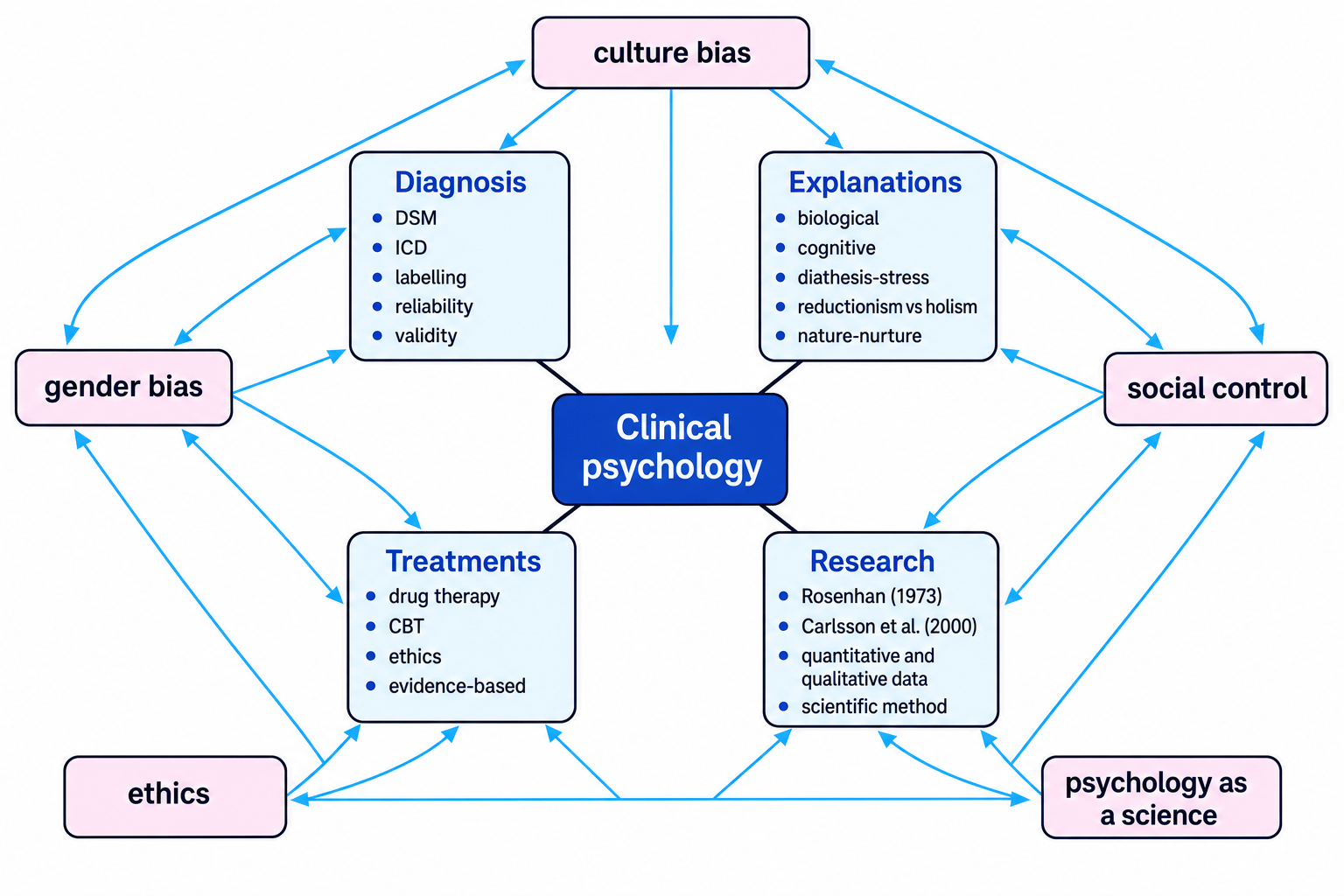
What you'll learn
- How to use the main issues and debates to evaluate clinical psychology.
- Why diagnosis, explanations, treatments and research methods raise ethical and practical questions.
- How debates such as reductionism, nature–nurture, culture/gender bias and social control apply to mental health.
- How to turn these ideas into AO1, AO2 and AO3 essay points.
Starting point: what is an “issue or debate”?
Issue or debate
An issue or debate is a broad evaluation theme that psychologists use to judge theories, studies, diagnoses or treatments. In clinical psychology, the key question is often: does this approach help people with mental health difficulties accurately, fairly and ethically?
Clinical psychology is the branch of psychology concerned with explaining, diagnosing and treating mental disorders. For Edexcel, you should be ready to apply issues and debates to diagnosis such as ICD and DSM, explanations of disorders, treatments such as drug therapy and psychological therapy, and research such as Rosenhan (1973) and Carlsson et al. (2000).
The spec uses “e.g.” examples, so these are not the only possible applications. Think of each issue as a lens you can apply flexibly.
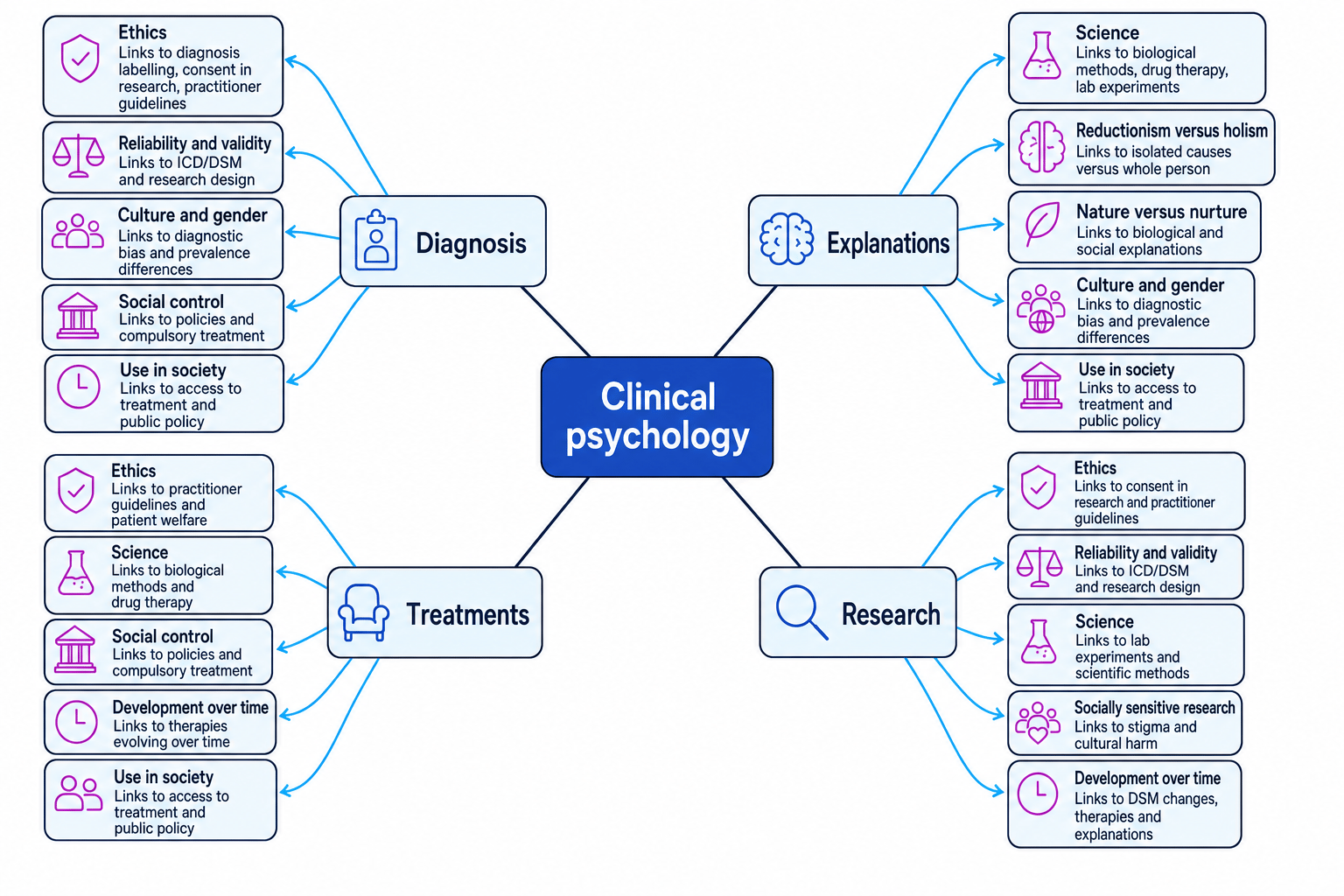
Your essay structure
Use issues and debates as AO3 evaluation: AO1 describes the clinical idea, AO2 applies it to a scenario or named study, and AO3 judges strengths, weaknesses, ethics, methodology or real-world value.
Ethics: helping without harming
Ethics
Ethics are principles that guide psychologists to protect participants, patients and the public from unnecessary harm.
In research, the BPS Code of Ethics and Conduct (2009) includes informed consent, avoiding unnecessary deception, the right to withdraw, protection from harm, confidentiality and debriefing. These are especially important in clinical psychology because participants may be distressed, vulnerable or receiving treatment.
In practice, practitioner psychologists are regulated by the HCPC — the Health and Care Professions Council. HCPC standards include working within competence, gaining consent where possible, maintaining confidentiality, keeping accurate records, and prioritising service-user welfare.
Diagnosis also raises ethical issues. A diagnostic label can help a person access treatment and support, but it can also lead to stigma, discrimination or a self-fulfilling prophecy, where someone starts to see themselves mainly through the label.
Rosenhan (1973) is a classic example. Pseudopatients were admitted to psychiatric hospitals after reporting hearing voices, then behaved normally. Staff often interpreted normal behaviour as symptoms, supporting concerns about labelling and diagnostic validity. However, the study itself involved deception and lacked informed consent from hospital staff.
Applying ethical guidance to a therapy study
A psychologist wants to study a new therapy for people recently diagnosed with schizophrenia.
- Decide whether consent is meaningful: participants need clear information about the therapy, possible distress, confidentiality and their right to withdraw without losing normal care.
- Balance benefit against harm: if the therapy may reduce symptoms, the study has potential value, but researchers must monitor distress and provide support if symptoms worsen.
- Protect confidentiality carefully: mental health data are sensitive, so records should be anonymised and stored securely.
- Plan the debrief: participants should be told the study’s aims, what their data will be used for, and where to access further help.
Diagnosis is not automatically unethical
Do not write “labelling is bad” as a one-sided point. A balanced answer says diagnosis can create stigma, but it can also provide explanation, treatment access and legal protection.
Practical issues: validity, reliability and data
Reliability and validity
Reliability means consistency, such as two clinicians reaching the same diagnosis. Validity means accuracy, such as whether the diagnosis truly identifies the disorder it claims to identify.
Clinical diagnosis often uses classification systems. The DSM is the Diagnostic and Statistical Manual of Mental Disorders, published by the American Psychiatric Association. The ICD is the International Classification of Diseases, published by the World Health Organization. Both aim to improve reliability by giving clinicians standard symptom criteria.
However, reliability does not guarantee validity. Two clinicians may agree on a diagnosis, but the category may still be too broad, culturally biased, or overlapping with another disorder. Problems include comorbidity — when disorders occur together — and symptom overlap, where different diagnoses share similar features.
Research design also matters. Quantitative data are numerical, such as symptom scores. Qualitative data are non-numerical, such as interview accounts. Quantitative data can be easier to compare and analyse statistically, but qualitative data may capture the person’s lived experience more holistically.
For descriptive statistics, you should be able to refer to:
- Measures of central tendency: mean, median and mode.
- Measures of dispersion: range and standard deviation.
- Frequency tables, bar charts for categories, and histograms for continuous data.
- Normal distributions, which are symmetrical, and skewed distributions, where the mean may be pulled toward the tail.
- Thematic analysis for qualitative data, where researchers identify recurring themes in interview or diary material.
For inferential testing in clinical research, remember the Edexcel tests:
- Mann–Whitney U: a test of difference for independent groups, such as drug therapy group versus placebo group.
- Wilcoxon signed-ranks: a test of difference for related data, such as symptom scores before and after CBT.
- Spearman’s rho: a correlation test, such as the relationship between stress scores and symptom severity.
- Chi-square: a test of association between categories, such as diagnosis type and gender category.
The usual significance level is p≤.05p \le .05p≤.05. A more lenient level is p≤.10p \le .10p≤.10, while a stricter level is p≤.01p \le .01p≤.01. Researchers compare an observed value with a critical value from a critical-value table. For Mann–Whitney U and Wilcoxon, lower observed values are usually significant. For Spearman’s rho and chi-square, higher observed values are usually significant.
Choosing and interpreting a clinical test
A researcher measures the same patients’ anxiety scores before and after therapy.
- Identify the design: the same patients are measured twice, so the data are related.
- Select the correct test: because it is a difference test with related data, use Wilcoxon signed-ranks.
- Decide the tail: if the hypothesis predicts therapy will reduce anxiety, use a one-tailed test; if it only predicts a change, use a two-tailed test.
- Interpret the table: if the observed value is 8 and the critical value is 14, then Tobs≤TcritT_{\text{obs}} \le T_{\text{crit}}Tobs≤Tcrit, so the result is significant at the chosen level.
- Link to error risk: using p≤.01p \le .01p≤.01 reduces the risk of a Type I error — a false positive — but increases the risk of a Type II error — a false negative.
Reductionism versus holism
Reductionism
Reductionism explains complex behaviour by reducing it to one level, such as genes, neurotransmitters or isolated symptoms. Holism considers the whole person, including biology, cognition, family, culture and life history.
Clinical psychology can be reductionist when it isolates causes of mental disorders. For example, a biological explanation of schizophrenia may focus on dopamine or genetics. Carlsson et al. (2000) is useful here because it shows biological explanations becoming more complex, linking schizophrenia to interacting neurotransmitter systems rather than dopamine alone.
Reductionism has strengths. It can lead to measurable hypotheses, brain-based research and drug therapies. This supports psychology as a science. But it can also ignore subjective experience, trauma, family relationships or social context.
Diagnosis can also be reductionist. A person may become a list of symptoms rather than a whole individual. A more holistic approach would combine diagnosis with personal formulation, considering triggers, strengths, culture and support systems.
Nature–nurture and competing explanations
Nature–nurture debate
The nature–nurture debate asks whether behaviour is mainly influenced by biological inheritance and bodily processes, or by environmental experiences such as learning, family and culture.
Clinical psychology rarely fits neatly into one side. Biological explanations may emphasise genes, brain structure or neurotransmitters. Social and psychological explanations may emphasise family dysfunction, cognitive biases, trauma or stress.
A useful middle position is the diathesis-stress model. A diathesis is a vulnerability, such as genetic risk. Stress is an environmental trigger, such as life events. A disorder may develop when vulnerability and stress combine.
Best evaluation move
Avoid saying “nature or nurture”. Stronger clinical evaluation says mental disorders are often interactionist, meaning biological vulnerability and environmental experience influence each other.
Psychology as a science
Science in psychology
A scientific approach uses objective measurement, controlled methods, testable hypotheses, replication and evidence-based conclusions.
Clinical psychology has become increasingly scientific. Biological methods, drug trials, brain imaging and laboratory experiments can provide controlled evidence. Treatments such as drug therapy and CBT are often evaluated through outcome measures and statistical testing.
This is a strength because it can improve reliability, allow replication and support evidence-based treatment. However, the scientific approach can struggle with subjective experiences such as hearing voices, sadness or identity. If researchers only measure symptom scores, they may miss whether the person feels understood, empowered or socially supported.
Science is not just biology
You can argue that biological research often looks scientific, but psychological therapies can also be scientific if they use controlled trials, clear outcome measures and replicable procedures.
Culture, gender and socially sensitive research
Cultural and gender bias
Cultural bias occurs when diagnosis or research unfairly reflects the values of one culture. Gender bias occurs when explanations, diagnosis or treatment are influenced by assumptions about gender.
ICD and DSM aim to standardise diagnosis, but diagnostic categories may still reflect Western assumptions about “normal” behaviour. For example, hearing voices may be interpreted differently across cultures. Cooper et al. (1972) found differences between US and UK schizophrenia diagnoses, suggesting diagnostic practice can vary between contexts.
Gender also matters. Some disorders are diagnosed more often in one gender, but this could reflect genuine prevalence differences, help-seeking behaviour, clinician expectations or biased criteria. You should be cautious: a gender difference in frequency does not automatically prove a biological difference.
Clinical research is often socially sensitive, meaning it may affect how groups are viewed. Research into culture, gender or genetics can reduce blame and improve treatment, but it can also increase stigma if reported carelessly.
Do not confuse difference with bias
A cultural or gender difference is not automatically unfair. Bias means the method, criteria or interpretation disadvantages a group or misrepresents them.
Development over time, social control and use in society
Psychological understanding changes. The DSM has been revised repeatedly; for example, homosexuality was removed as a disorder in 1973, showing how diagnosis can reflect changing social values as well as scientific evidence. Explanations have also shifted from moral or supernatural views to biological, cognitive and biopsychosocial models.
Treatments have changed too. Mental health care has moved from long-term institutionalisation toward drug therapies, psychological therapies and community care, although access and quality vary.
Social control
Social control refers to ways society regulates behaviour through rules, institutions, labels or treatment practices.
Clinical psychology can be used for social good: diagnosis can unlock treatment, therapy can reduce distress, and research can shape public policy. But it can also be used to define some behaviour as “abnormal”, justify compulsory treatment, or pressure people to conform to social norms.
A balanced answer should recognise both sides. Mental health systems can protect people and the public, but they also hold power over vulnerable individuals.
In the exam
- Start by naming the issue clearly, such as ethics, reductionism, culture bias or social control.
- Apply it directly to clinical content: ICD/DSM, diagnosis, Rosenhan (1973), Carlsson et al. (2000), explanations, treatments or research methods.
- Make a balanced AO3 judgement: explain both the benefit and the limitation, then link back to mental health care.
- Use research-method terms accurately: reliability, validity, quantitative, qualitative, significance level, observed value and critical value.
- For longer answers, finish with a mini-conclusion about whether the issue seriously weakens clinical psychology or can be managed through good practice.
Check yourself
- How can diagnosis be both helpful and potentially harmful?
- Which inferential test would you use for a before-and-after therapy study, and why?
- Why is an interactionist explanation often stronger than a purely biological or purely social explanation?