What you'll learn
- What Masellis, Rector and Richter (2003) investigated about OCD and quality of life.
- How obsessions, compulsions and depression comorbidity were measured.
- The key findings: depression and obsessions mattered more for quality of life than compulsions.
- How to evaluate the study for AO3: methods, ethics, generalisability and application.
1. The starting point: what is OCD?
Obsessive Compulsive Disorder, or OCD, is a mental health disorder involving obsessions and/or compulsions. It can affect everyday functioning, relationships, work, study and emotional wellbeing.
Obsessions and compulsions
Obsessions are persistent, unwanted thoughts, images or urges that cause anxiety. Compulsions are repetitive behaviours or mental acts carried out to reduce anxiety or prevent a feared outcome.
For example, a person may have an obsessive fear of contamination and then wash their hands repeatedly as a compulsion. However, Masellis et al. (2003) are important because they did not treat OCD as one simple “severity” score. They looked at whether obsessions, compulsions and depression affected quality of life differently.
2. Quality of life: the outcome variable
Quality of life
Quality of life means a person’s overall satisfaction and functioning in areas such as social relationships, work or education, leisure, daily activities and emotional wellbeing.
This matters because a treatment might reduce visible compulsions, but the person may still have poor wellbeing if intrusive thoughts or depression remain severe.
3. Comorbidity: why depression matters
Comorbidity
Comorbidity means having two or more disorders or conditions at the same time. In this study, the key comorbidity was depression alongside OCD.
Depression can make quality of life much worse because it affects mood, motivation, sleep, concentration and hopefulness. Masellis et al. wanted to know whether poor quality of life in OCD was mainly linked to OCD symptoms themselves, or whether depression explained a large part of the impairment.
The core idea
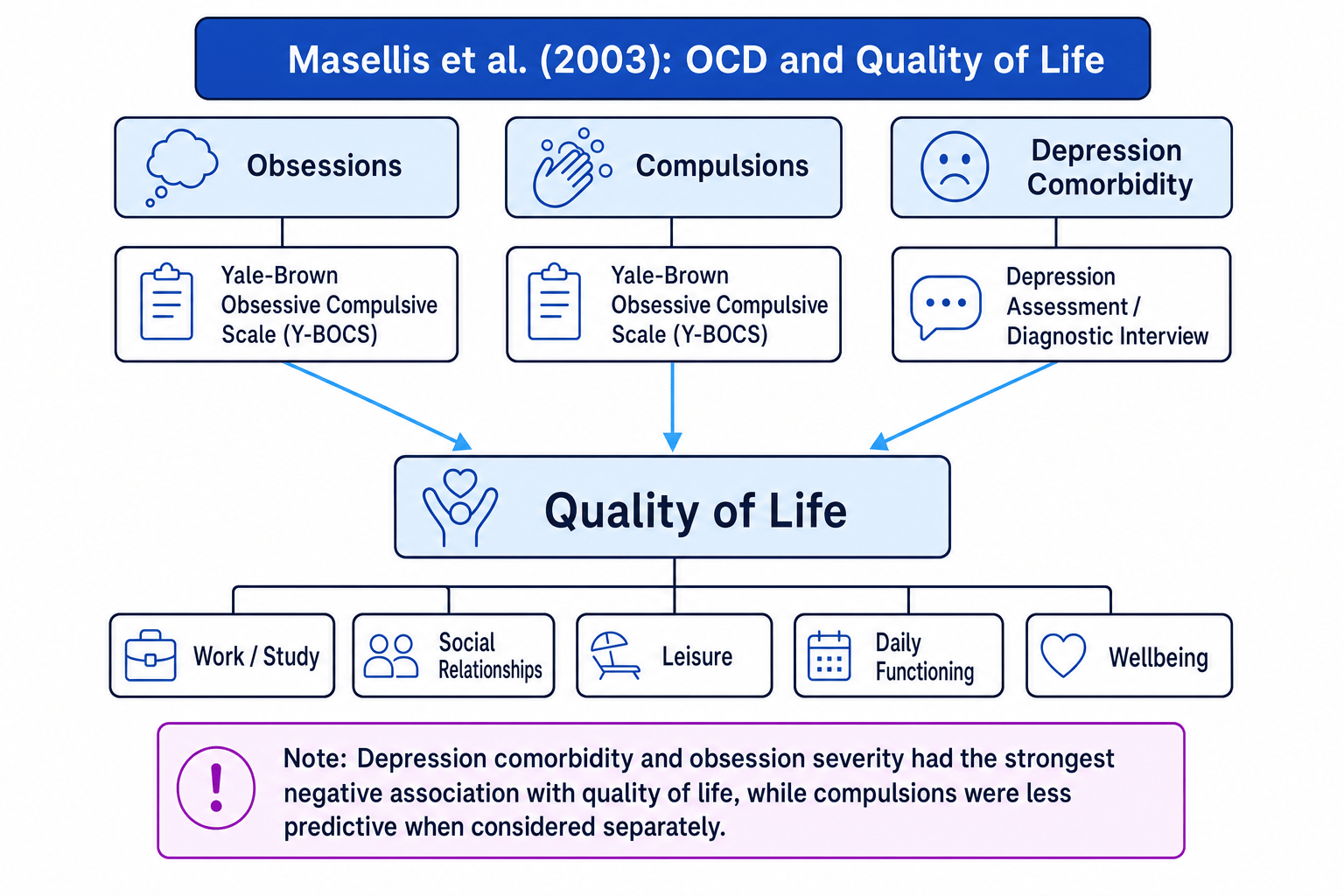
Masellis et al. (2003) found that quality of life in OCD was especially poor when depression was also present, and that obsession severity was more strongly linked to poor quality of life than compulsion severity.
4. AO1: Aim of Masellis et al. (2003)
Masellis, Rector and Richter (2003) conducted the study “Quality of life in OCD: Differential impact of obsessions, compulsions, and depression comorbidity.”
The main aim was to investigate how OCD affects quality of life, and to examine whether obsessions, compulsions and comorbid depression have different levels of impact.
In simpler terms, they asked:
- Do people with OCD experience reduced quality of life?
- Is quality of life worse when depression is also present?
- Are obsessions or compulsions more strongly related to quality of life?
5. AO1: Design and participants
The study was a clinical, cross-sectional, correlational study.
Cross-sectional and correlational
A cross-sectional study measures participants at one point in time. A correlational study looks for relationships between variables, such as symptom severity and quality of life, without manipulating an independent variable.
Participants were adults with a diagnosis of OCD, recruited from a clinical setting. They were assessed using standardised measures of OCD symptoms, depression and quality of life.
This means the study was not an experiment. Masellis et al. did not create OCD or depression, and they did not allocate people to conditions. They measured naturally occurring differences between people.
6. AO1: Measures used in the study
A key measure was the Yale-Brown Obsessive Compulsive Scale, often shortened to Y-BOCS.
Y-BOCS
The Y-BOCS is a clinician-rated scale used to assess the severity of OCD symptoms. It gives separate scores for obsessions and compulsions, which allowed Masellis et al. to compare their different effects.
They also used measures or clinical assessments of depression and quality of life. The important point for your exam answer is that the study used standardised clinical measures, rather than informal impressions.
Applying the finding to a client profile
A psychologist assesses two clients with OCD.
-
Client A has very time-consuming checking rituals, but reports little low mood and has manageable intrusive thoughts. Client B has fewer visible rituals, but has severe intrusive thoughts and comorbid depression.
-
Masellis et al.’s findings suggest you should not assume Client A has the poorer quality of life just because the compulsions are more visible.
-
Client B may experience greater impairment because depression and obsession severity were more strongly linked to poor quality of life than compulsion severity.
7. AO1: Main findings
The study found that people with OCD experienced impaired quality of life. However, the impact was not equal across all symptoms.
The most important findings were:
- OCD was linked with reduced quality of life.
- Quality of life was especially poor when depression was also present.
- Obsession severity was more strongly associated with poor quality of life than compulsion severity.
- Compulsions were still clinically important, but they were less predictive of quality of life when considered separately.
Assuming compulsions matter most
Because compulsions are easier to see, students sometimes write as if they are always the most damaging part of OCD. Masellis et al. showed that intrusive obsessions and comorbid depression may be more strongly linked to reduced quality of life.
8. AO2: Applying the study to OCD treatment
A useful application is that clinicians should assess more than just visible rituals. If a person’s compulsions reduce after treatment, they may still need help with intrusive thoughts, depressive symptoms and life satisfaction.
For example, Cognitive Behavioural Therapy could target obsessional beliefs and anxiety, while depression may require additional psychological support, behavioural activation or medication, depending on the individual case.
Real-world application
Use this study to argue that effective OCD care should include assessment of quality of life and depression, not just counting compulsive behaviours.
9. AO3: Strengths of the study
Standardised clinical measures
A major strength is the use of standardised measures such as the Y-BOCS. This improves reliability, because symptoms are assessed in a structured way.
It also improves construct validity, because obsessions and compulsions were measured separately. That directly matched the aim of the study.
Clinical usefulness
The study has practical value because it used people with diagnosed OCD. This makes it more relevant to real clinical settings than research using only student volunteers or hypothetical scenarios.
More detailed than a simple OCD score
Masellis et al. did not just ask whether “OCD severity” affects quality of life. They separated obsessions, compulsions and depression, giving a more nuanced understanding of the disorder.
10. AO3: Weaknesses of the study
Correlation does not prove cause and effect
Because the study was correlational and cross-sectional, it cannot prove that depression or obsessions cause poor quality of life.
Poor quality of life might worsen depression. Depression might make people rate their quality of life more negatively. Or a third variable, such as social support, could affect both depression and quality of life.
Explaining the causality problem
Suppose the study finds that higher depression scores are linked with lower quality of life.
-
One interpretation is that depression reduces motivation, enjoyment and social functioning, which lowers quality of life.
-
Another interpretation is that living with severe OCD and poor quality of life increases depression over time.
-
Because Masellis et al. measured variables at one point in time, the study can show an association but cannot decide the direction of cause and effect.
Generalisability may be limited
The participants came from a clinical sample, so the findings may apply best to people seeking treatment for OCD. They may not represent people with milder OCD, undiagnosed OCD or those who avoid services.
Self-report and mood effects
Quality of life measures often rely on people’s own ratings. This is useful because quality of life is subjective, but it can also be affected by current mood. A person with depression may rate every area of life more negatively, which could strengthen the link between depression and poor quality of life.
11. Ethics
This study involved people with mental health difficulties, so ethical care was essential.
The British Psychological Society Code of Ethics and Conduct (2009) is relevant here. Researchers should ensure informed consent, the right to withdraw, confidentiality, protection from harm and debriefing. Because depression can involve serious distress, researchers also need procedures for supporting participants if assessment raises concerns.
12. Methods link: statistics and exam awareness
Masellis et al. used quantitative clinical data to examine relationships between variables. In your wider Edexcel research methods work, remember that different questions need different statistical tests.
For example, if you were correlating OCD symptom scores with quality of life scores, Spearman’s rho would often be suitable for a correlation using rating-scale data, especially if distributions were skewed. If comparing quality of life between an OCD-only group and an OCD-plus-depression group, Mann-Whitney U could be used for two independent groups. Wilcoxon signed-ranks is for related scores, such as before-and-after therapy. Chi-square is for associations between categories, such as depression present or absent and high or low quality of life.
In significance testing, psychologists often use p≤.05p \le .05p≤.05 as the default level. A stricter level such as p≤.01p \le .01p≤.01 reduces the risk of a Type I error, while a more lenient level such as p≤.10p \le .10p≤.10 increases sensitivity but also increases false-positive risk.
13. Essay structure: how to write this study
For AO1, describe the aim, clinical sample, measures and findings.
For AO2, apply the findings to a person with OCD: do not focus only on visible compulsions; consider intrusive obsessions, depression and everyday functioning.
For AO3, evaluate the study’s strengths and weaknesses: standardised measures and clinical relevance are strengths; correlational design, sample limits and self-report issues are weaknesses.
In the exam
-
Start with the study’s purpose: Masellis et al. (2003) investigated how obsessions, compulsions and comorbid depression affect quality of life in OCD.
-
For findings, be precise: depression comorbidity and obsession severity were especially linked to poorer quality of life; compulsions were less strongly predictive.
-
For AO3, avoid generic evaluation only. Link each point back to this study, such as Y-BOCS improving reliability or the correlational design preventing causal conclusions.
Check yourself
- Why did Masellis et al. separate obsessions and compulsions rather than using only one OCD severity score?
- How does comorbid depression affect interpretation of quality of life in OCD?
- What is one strength and one weakness of using a clinical correlational design in this study?
