What you'll learn
- Why Guardia et al. (2012) studied body schema in anorexia nervosa.
- How the aperture task tested imagined body actions for the self and for another person.
- The key finding: people with anorexia overestimated their own body’s action limits, but not another person’s.
- How to evaluate the study for AO3, including methodology, ethics, and application.
Why this study matters
Guardia et al. (2012), “Imagining One’s Own and Someone Else’s Body Actions: Dissociation in Anorexia Nervosa”, is the contemporary study for anorexia in Edexcel 9PS0 Clinical Psychology.
The study looks beyond the simple idea that people with anorexia “think they look fat”. Instead, it asks whether anorexia nervosa involves a deeper disturbance in how the body is represented for action.
Anorexia nervosa
Anorexia nervosa is an eating disorder involving severe restriction of food intake, significantly low body weight, intense fear of gaining weight, and disturbance in how the person experiences their body shape or size.
Key background concepts
Body image and body schema
You need to distinguish two related but different ideas.
Body image is the conscious, psychological experience of your body: how you think, feel, and make judgements about your appearance.
Body schema is more automatic. It is the brain’s internal representation of your body’s size, position, and movement, used to guide actions such as walking through a doorway or reaching for an object.
Body schema
Body schema is an internal, action-based representation of the body that helps you plan and control movement without having to consciously measure yourself each time.
In anorexia, a person may be underweight but still experience their body as “too large”. Guardia et al. were interested in whether this distortion affects the person’s motor planning: their ability to imagine what their body can physically do.
Motor imagery
Motor imagery
Motor imagery means mentally simulating an action without actually performing it, such as imagining yourself walking through a narrow gap.
Motor imagery is useful in psychology because it can reveal how the brain represents the body for action. If someone imagines needing a much wider gap than they physically need, this may suggest a distorted body schema.
Dissociation
Dissociation
In this study, dissociation means a split between two kinds of judgement: anorexia patients showed abnormal judgements for their own body, but not for someone else’s body.
This is important because it suggests the problem is not simply poor visual perception. It is specifically linked to the person’s representation of their own body.
Aim of Guardia et al. (2012)
Guardia et al. aimed to investigate whether people with anorexia nervosa have a distorted body schema when imagining body actions.
More specifically, they wanted to test whether any distortion was:
- specific to the person’s own body
- also present when judging another person’s body
- linked to action planning rather than just conscious body dissatisfaction
Procedure: the aperture task
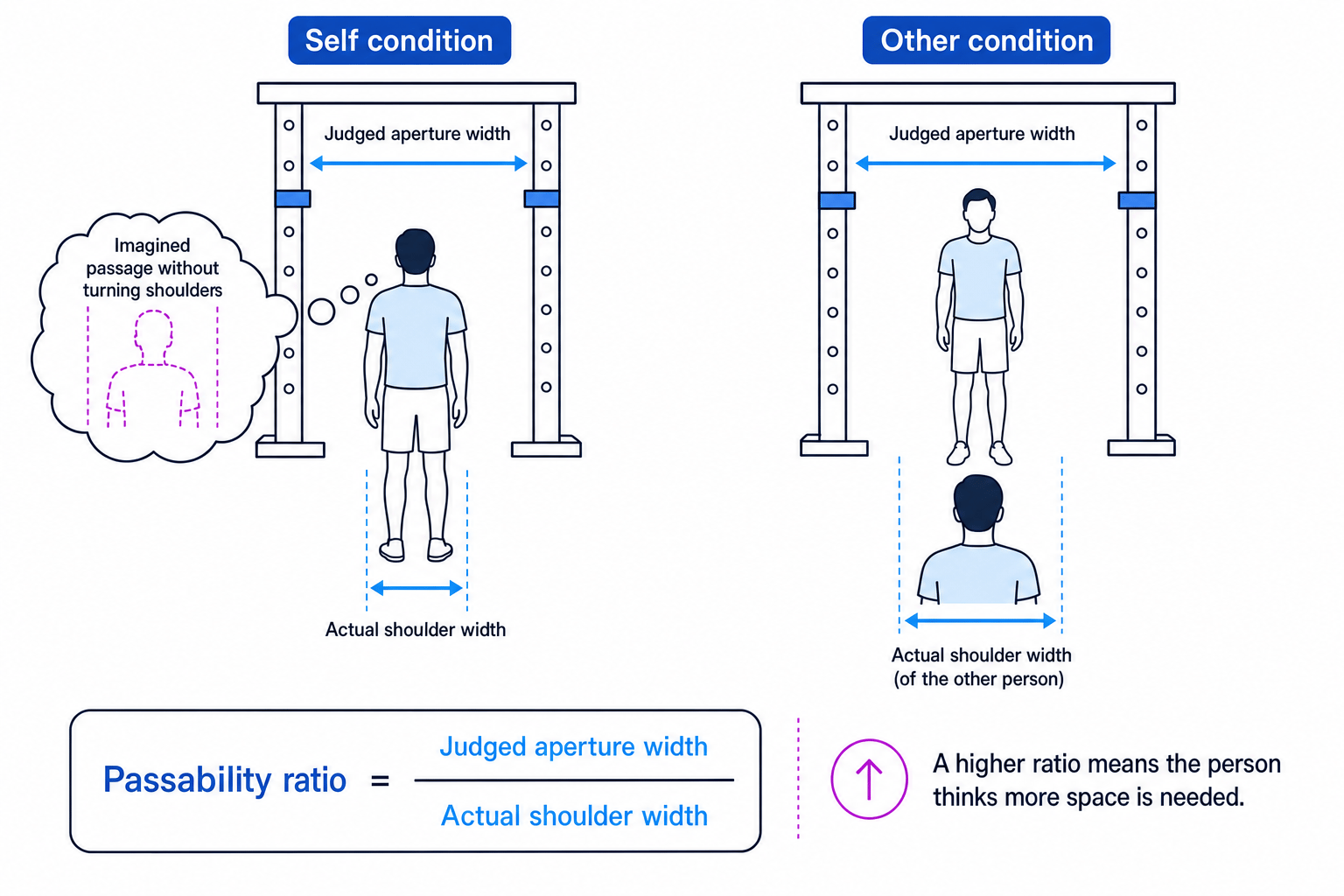
The study used a controlled laboratory task involving an adjustable doorway-like opening, called an aperture.
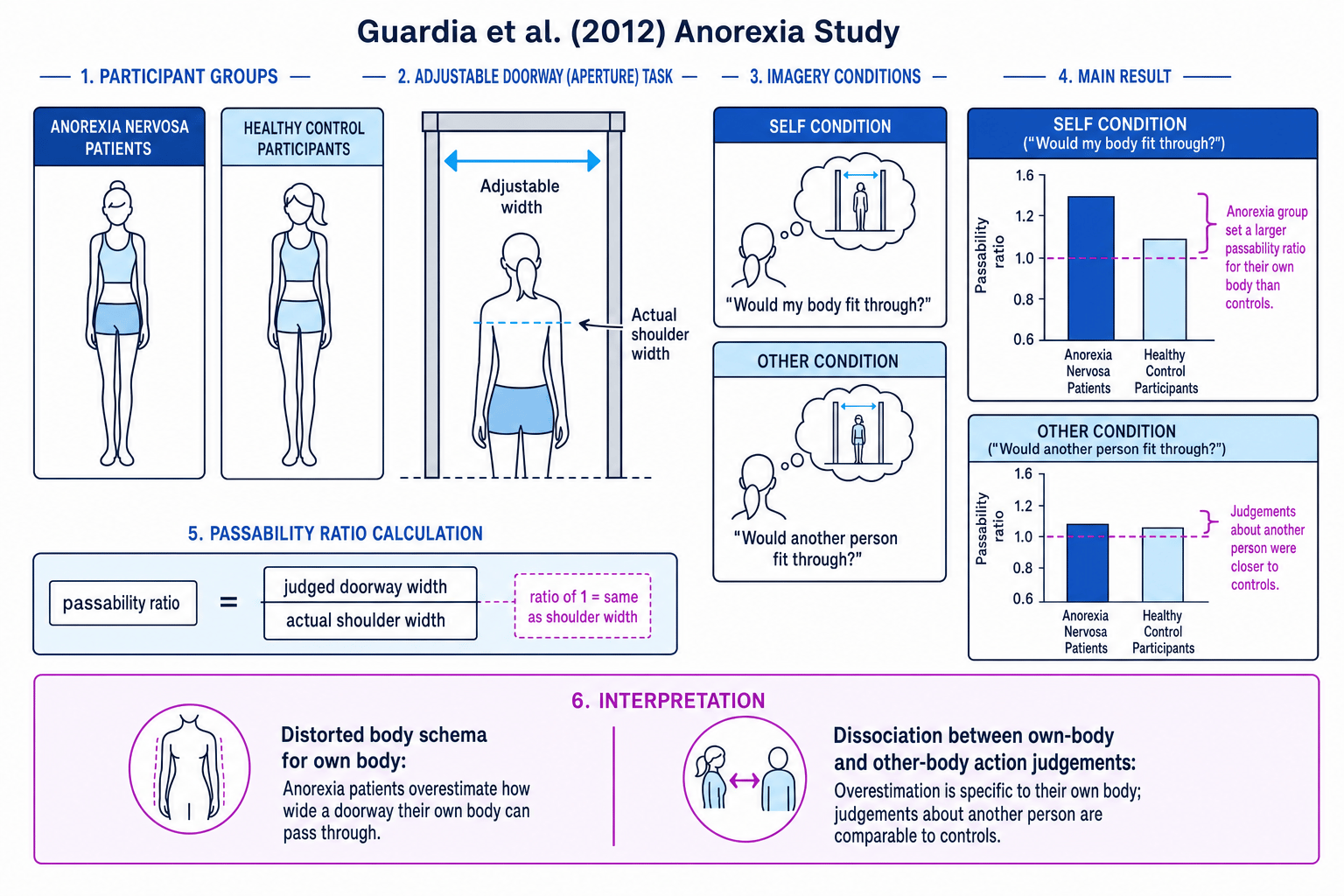
Participants included a clinical group of people diagnosed with anorexia nervosa and a healthy control group. The researchers measured participants’ actual body dimensions, especially shoulder width, so that judgements could be compared fairly across people of different sizes.
Participants completed two main conditions:
- Self condition: they imagined whether they themselves could pass through the aperture without turning their shoulders.
- Other condition: they judged whether another person could pass through the aperture.
The key dependent variable was the passability ratio: the judged aperture width needed for passage compared with actual shoulder width.
passability ratio=judged aperture widthactual shoulder width\text{passability ratio} = \frac{\text{judged aperture width}}{\text{actual shoulder width}}passability ratio=actual shoulder widthjudged aperture widthA higher passability ratio means the person thinks a wider opening is needed relative to body size.
Interpreting the passability ratio
-
Suppose a participant’s actual shoulder width score is 40, and they judge that they need an aperture width score of 56 to pass through.
-
Substitute into the formula:
passability ratio=5640=1.40\text{passability ratio} = \frac{56}{40} = 1.40passability ratio=4056=1.40 -
Compare this with another participant whose ratio is 1.10. The participant with 1.40 is judging that they need much more extra space, so they are showing greater overestimation of body action limits.
-
If this high ratio appears in the self condition but not the other condition, the interpretation is that the distortion is specific to their own body schema, not general difficulty judging apertures.
Findings
The main finding was that participants with anorexia nervosa judged that they needed a larger aperture to pass through than healthy controls did.
This means they overestimated how much space their own body required, even though anorexia typically involves low body weight.
However, when judging whether another person could pass through the aperture, anorexia patients were much more accurate and similar to the control group.
Main finding
Guardia et al. found a self-specific distortion: anorexia patients overestimated the space needed for their own body to pass through an aperture, but did not show the same abnormality when judging another person’s body.
Conclusion
Guardia et al. concluded that anorexia nervosa involves disturbance in the body schema used for action.
This supports the idea that body disturbance in anorexia is not only about appearance, attitudes, or conscious dissatisfaction. It may also involve a more automatic representation of the body that has not updated properly.
One interpretation is that the person’s body schema may remain “larger” than their actual body after weight loss, so they continue to act or imagine acting as if their body occupies more space than it does.
Body image is not the whole story
Do not reduce this study to “people with anorexia think they look overweight”. Guardia et al. specifically investigated body schema for action, not just conscious body image.
AO2: applying the study
If you are given a scenario, look for behaviour where someone with anorexia acts as if their body is larger than it is.
For example, a person may avoid narrow gaps, feel uncomfortable in crowded spaces, or insist they are “too big” to fit somewhere even when they are objectively underweight.
You could apply Guardia et al. by saying this may reflect a distorted body schema. Their internal action-based representation of their body may not match their actual physical size.
Scenario application
Use the phrase “overestimation of action limits” when applying Guardia et al. It shows you understand that the study is about imagined movement, not just visual body dissatisfaction.
Research methods links
Design
This was a quasi-experiment because the researchers did not randomly allocate people to have anorexia nervosa or not. Diagnosis was a naturally occurring participant variable.
Quasi-experiment
A quasi-experiment compares groups based on a naturally occurring difference, such as clinical diagnosis, rather than random allocation.
There was also a repeated-measures element because participants made judgements in both the self and other conditions.
The dependent variable was quantitative: the passability ratio or judged aperture width.
Controls
Useful controls included:
- measuring actual body size, so judgements could be scaled to each participant
- using a healthy control group for comparison
- using both self and other judgement conditions
- using a standardised aperture task
These controls strengthen internal validity because the researchers could argue that the effect was specifically linked to anorexia and to own-body representation.
Statistics you can mention
For Edexcel research methods, you do not need to calculate the original study’s statistics, but you can make intelligent links.
A comparison between anorexia patients and controls would be a test of difference using independent groups. If the data were ordinal or not normally distributed, a Mann-Whitney U test could be appropriate.
A comparison between a participant’s self and other judgements would involve related data, so a Wilcoxon signed-ranks test could be appropriate.
If researchers correlated passability ratio with a symptom score, Spearman’s rho could be used. If data were converted into categories, such as “overestimator” and “not overestimator”, a chi-square test could test association.
The usual significance level is p≤.05p \le .05p≤.05. A stricter level such as p≤.01p \le .01p≤.01 reduces the risk of a Type I error, while a more lenient level such as p≤.10p \le .10p≤.10 increases the chance of finding a significant result but also increases false-positive risk.
AO3 evaluation
Strength: objective and body-scaled measurement
A major strength is that Guardia et al. used a behavioural, quantitative task rather than relying only on self-report questionnaires.
Self-report measures can be affected by social desirability, poor insight, or demand characteristics. The aperture task gives a more indirect measure of body representation.
Because the researchers scaled judgements to actual shoulder width, they could compare participants fairly even if they had different body sizes.
Strength: self versus other condition
The other-person condition is a strong feature of the design.
If anorexia patients had been inaccurate in both conditions, the findings might simply show poor visual judgement or misunderstanding of the task. Instead, the key abnormality appeared for the participant’s own body.
This supports the conclusion that anorexia involves a specific disturbance in own-body schema.
Weakness: causality is limited
Because this was a quasi-experiment, it cannot prove that distorted body schema causes anorexia.
It is possible that anorexia causes changes in body representation. It is also possible that another factor, such as anxiety, low confidence, depression, medication, or long-term body dissatisfaction, influences the results.
So the study shows an association between anorexia and altered body-action judgement, but causation is harder to establish.
Weakness: sample and generalisability
Clinical studies often use small samples because recruiting diagnosed patients is difficult.
This can limit generalisability, especially if the sample is mainly female, adult, or receiving specialist treatment. The findings may not apply equally to males with anorexia, adolescents, recovered patients, or people with different eating disorder presentations.
Weakness: imagining is not the same as acting
The task used motor imagery rather than making participants physically walk through apertures.
This is useful because it is safe and controlled, but it may reduce ecological validity. A person’s imagined judgement might differ from what they would actually do in a real doorway.
However, because the study was specifically interested in imagined body actions, the method still has good relevance to the research aim.
Ethical considerations
Guardia et al. studied a potentially vulnerable clinical group, so ethical safeguards were especially important.
Under the BPS Code of Ethics and Conduct (2009), researchers would need informed consent, protection from psychological harm, confidentiality, the right to withdraw, and debriefing.
The task could be sensitive because it draws attention to body size and body judgement. Researchers therefore needed to avoid shaming language, monitor distress, and ensure participants had appropriate clinical support if needed.
Deception was not central to the procedure, which is ethically positive. However, even low-risk studies with eating disorder patients need careful handling because body-focused tasks can be emotionally triggering.
Real-world application
Guardia et al.’s findings may help improve treatment for anorexia.
If the disorder involves body schema as well as body image, therapy may need to target action-based body representation. For example, interventions could include virtual reality, body exposure tasks, movement-based therapy, or exercises that help patients update their sense of body size in relation to the environment.
This matters because a patient may intellectually know they are underweight but still feel and act as if their body is too large.
In the exam
-
For AO1, describe the aim, aperture task, self/other conditions, and passability ratio clearly.
-
For AO2, apply the study to action-based examples, such as someone with anorexia believing they need more space to move through a gap.
-
For AO3, balance strengths such as objective measurement and the control condition against weaknesses such as quasi-experimental design, limited generalisability, and ethical sensitivity.
Check yourself
- What is the difference between body image and body schema?
- Why was the other-person condition important in Guardia et al.’s study?
- Why can’t this study prove that distorted body schema causes anorexia?