What you'll learn
- What Mundt et al. (2012) investigated about adolescent alcohol use and friendship groups.
- The difference between peer selection and peer influence.
- How a stochastic actor-based model helped analyse changing friendships over time.
- How to evaluate the study for AO3, including methods, ethics and real-world application.
Why this study matters in Health Psychology
Mundt et al. (2012) is a contemporary study in Health Psychology because it focuses on alcohol use, which is a health-risk behaviour. Rather than treating drinking as only an individual choice, the study looks at the social environment around adolescents: their friendship networks.
This is useful for A-Level Psychology because it links neatly to explanations of health behaviour, addiction and health promotion. If teenage drinking is partly shaped by peers, then interventions may need to target friendship groups, not just individual attitudes.
Adolescent alcohol use
Adolescent alcohol use refers to drinking behaviour during the teenage years. In psychological research, it is often measured using self-report questions about how often a young person drinks alcohol.
The key issue: do friends cause drinking, or do drinkers choose each other?
A simple observation is that teenagers who drink alcohol often have friends who also drink. The difficult question is: why?
There are two main possibilities.
Peer selection
Peer selection
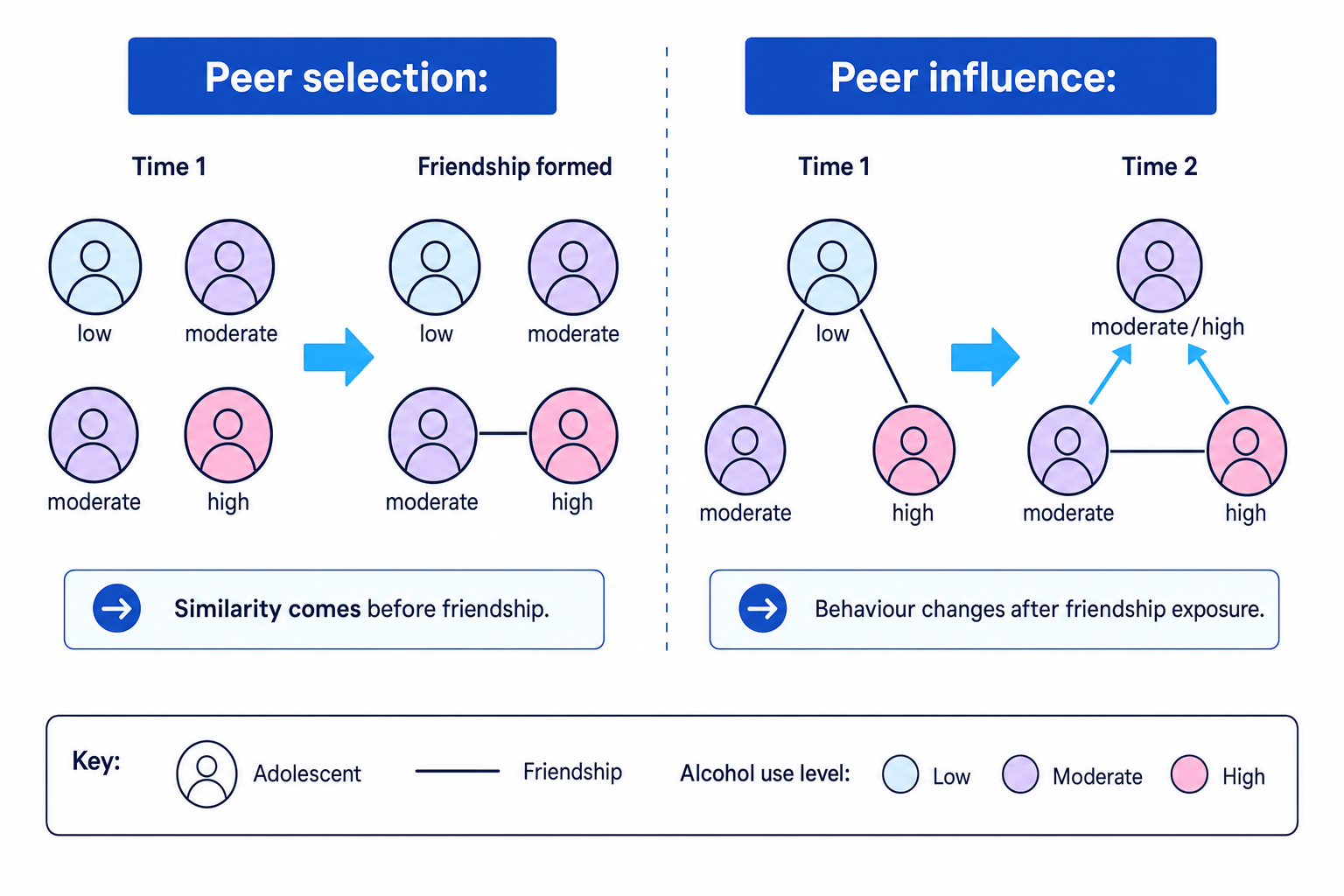
Peer selection means adolescents choose friends who are already similar to themselves, for example in their alcohol use, attitudes, interests or lifestyle.
If peer selection is happening, a teenager who drinks may become friends with other drinkers because they have shared habits or social settings.
Peer influence
Peer influence
Peer influence means adolescents change their behaviour to become more like their friends. In this study, it refers to alcohol use changing in the direction of friends’ alcohol use.
If peer influence is happening, a teenager may start drinking more because their friends drink more, normalise drinking, invite them to drink, or reward drinking socially.
Selection and influence are not the same
Friendship similarity does not automatically prove peer pressure. Mundt et al. tried to separate whether adolescents selected similar friends, were influenced by friends, or both.
Distinguishing selection from influence
-
If two adolescents are both moderate drinkers before becoming friends, and then form a friendship, this supports peer selection because similarity came before the friendship.
-
If one adolescent is a low drinker, becomes friends with heavier drinkers, and later increases their alcohol use, this supports peer influence because the behaviour changed after friendship exposure.
-
If both processes happen in the same network, the best conclusion is not “friends cause all drinking” or “friends do not matter”, but that friendship choices and friendship effects can work together.
Aim of Mundt et al. (2012)
The study aimed to investigate whether similarity in adolescent alcohol use was due to:
- adolescents choosing friends with similar drinking behaviour;
- adolescents being influenced by their friends’ drinking behaviour;
- or a combination of both.
The title of the paper is “Peer selection and influence effects on adolescent alcohol use: a stochastic actor-based model.”
Method: what type of study was it?
Mundt et al. used a longitudinal social network study.
Longitudinal study
A longitudinal study collects data from the same participants at more than one time point, allowing researchers to look at change over time.
This was important because the researchers needed to know whether friendship ties and drinking behaviour changed across time. A one-off snapshot could show that friends are similar, but it could not clearly show whether similarity came from selection or influence.
Social network
A social network is a map of relationships between people. In this study, adolescents were the “nodes” in the network, and friendship nominations were the “ties” between them.
Participants reported their friendship links and their own alcohol use. This created a network showing who was connected to whom, and how drinking behaviour was distributed across the friendship group.
Friendship nominations
Participants identified friends, creating directed ties. A directed tie means one person names another as a friend. If both name each other, the tie is reciprocal.
This matters because reciprocal friendships may be stronger and more influential than one-sided nominations.
Self-report
Self-report means participants provide information about themselves, usually through questionnaires or interviews. Here, adolescents reported their own alcohol use and friendships.
The stochastic actor-based model
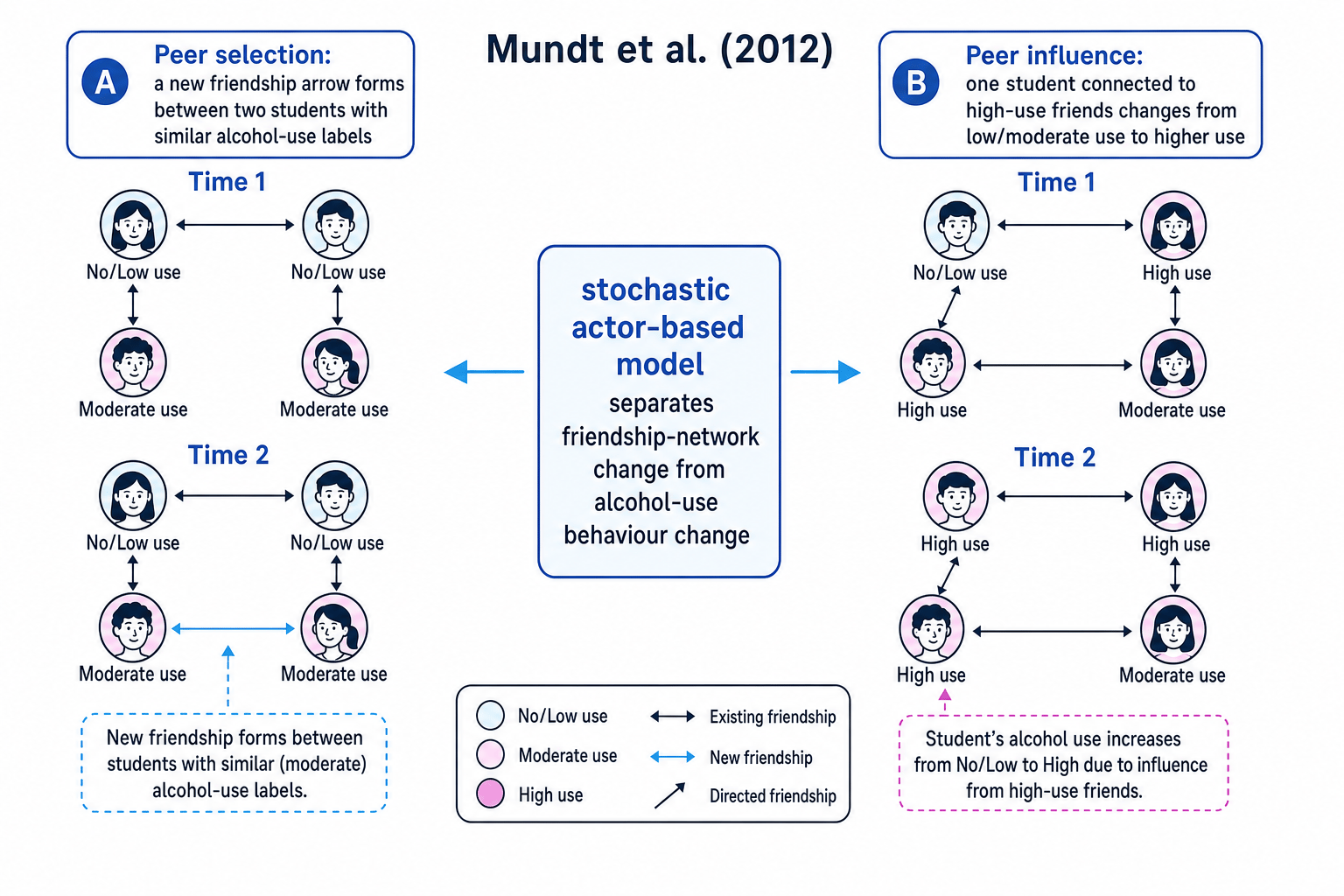
The distinctive feature of this study is its use of a stochastic actor-based model, often shortened to SABM.
Stochastic actor-based model
A stochastic actor-based model is a statistical model used to analyse how social networks and individual behaviours change over time. “Stochastic” means it works with probabilities, and “actor” means each individual in the network is treated as someone who can change friendships or behaviour.
In simpler terms, the model estimates two things at once:
- how likely adolescents are to create, keep or drop friendships;
- how likely adolescents are to change their alcohol use.
This is stronger than simply correlating friends’ drinking levels, because a correlation cannot separate selection from influence.
Simple way to remember SABM
Think: SABM separates the network from the behaviour. It asks whether teenagers change their friends, change their drinking, or both.
Findings and conclusions
Mundt et al. found evidence that adolescent alcohol use was linked to friendship networks. The key conclusion was that both peer selection and peer influence helped explain why friends had similar alcohol-use patterns.
In other words:
- adolescents tended to form or maintain friendships with peers who had similar alcohol-use behaviour;
- adolescents’ alcohol use also tended to shift in the direction of their friends’ alcohol use.
This supports the idea that health-risk behaviours develop within social contexts. Alcohol use is not just about individual decision-making; it is also shaped by friendship patterns and group norms.
Main finding
Mundt et al. concluded that similarity in adolescent drinking was produced by both choosing similar friends and being influenced by friends.
Interpreting the statistics
You do not need to calculate a stochastic actor-based model for Edexcel A-Level Psychology, but you should understand what the statistical approach achieved.
The model produced estimates showing whether certain effects were likely to be meaningful. In psychological research, results are often judged using significance levels such as p≤.05p \le .05p≤.05, meaning there is a 5% or lower probability that the result would occur by chance if there were no real effect.
This is different from the standard Edexcel inferential tests you learn elsewhere, such as:
- Mann-Whitney U for differences between two independent groups;
- Wilcoxon signed-ranks for differences between two related conditions;
- Spearman’s rho for correlations;
- chi-square for associations between categories.
Mundt et al. used a more advanced network model because their data involved changing relationships, not just two groups or two variables.
Calling it a simple correlation
Do not describe the study as just showing a correlation between friends’ alcohol use. The important methodological point is that the model analysed changes over time in both friendships and drinking behaviour.
AO1: how to describe the study
For AO1, keep your description clear and structured:
- Mundt et al. (2012) studied adolescent alcohol use and friendship networks.
- The aim was to test whether similarity in drinking came from peer selection, peer influence, or both.
- The researchers used longitudinal self-report data on friendships and alcohol use.
- They analysed the data using a stochastic actor-based model.
- They found evidence for both selecting friends with similar alcohol use and being influenced by friends’ alcohol use.
AO2: applying the study
You can apply Mundt et al. to scenarios about teenage drinking, school-based health campaigns or peer-group interventions.
For example, if a school notices that alcohol use clusters within certain friendship groups, Mundt et al. would suggest two possible explanations. Students may be choosing friends who already drink similarly, but they may also be changing their own drinking because of exposure to friends’ behaviour.
Applying the study to a school intervention
-
Suppose a school finds that several friendship groups have high levels of weekend drinking. Mundt et al. would suggest the school should not assume the behaviour is only due to individual “bad choices”.
-
Because peer influence may operate, the school could target group norms, for example by using peer leaders to challenge the idea that “everyone drinks”.
-
Because peer selection may also operate, the school should recognise that drinkers may cluster together, so interventions aimed at isolated individuals may be less effective than whole-network approaches.
AO3: strengths of the study
Stronger than a one-off survey
A major strength is the longitudinal design. By collecting data over time, Mundt et al. could examine whether friendships changed before drinking changed, or whether drinking similarity existed before friendships formed.
This gives stronger evidence than a cross-sectional study, which only measures people at one point in time.
Advanced analysis of real social networks
The stochastic actor-based model was well suited to the research question. It allowed the researchers to model friendship changes and behavioural changes together.
This improves internal validity because the study directly addressed the selection-versus-influence problem.
Real-world relevance
The study has clear applications to health promotion. If adolescent drinking spreads partly through peer influence, then prevention programmes may be more effective if they work through social networks.
For example, schools could train influential students as peer educators, challenge perceived drinking norms, or design interventions for whole friendship groups.
AO3: weaknesses and limitations
Self-report may reduce validity
Alcohol use was measured using self-report. Adolescents may under-report drinking because alcohol use is sensitive, socially judged, or illegal depending on age and context. Others may exaggerate to appear mature or socially confident.
This could reduce the accuracy of the alcohol-use data.
Friendship nominations are imperfect
Friendship networks are difficult to measure perfectly. A participant may forget to nominate someone, may name a friend who does not name them back, or may interpret “friend” differently from another participant.
This means the network map may not fully reflect real peer relationships.
Causality is still cautious
Although the longitudinal model is stronger than a simple correlation, it is still not a laboratory experiment. The researchers could not randomly assign adolescents to friendship groups or drinking conditions.
Other factors, such as family attitudes, personality, local culture, availability of alcohol, stress or socioeconomic background, may also affect alcohol use.
Do not overclaim causation
It is fair to say the study gives evidence consistent with peer influence, but avoid writing that it proves friends are the only cause of adolescent drinking.
Ethical issues
This study involves sensitive information because adolescents reported alcohol use and friendship links.
Under the BPS Code of Ethics and Conduct (2009), the key issues include:
- consent: young people, and often parents or guardians, should understand what participation involves;
- confidentiality: alcohol-use data and friendship nominations must be anonymised carefully;
- protection from harm: questions should not shame participants or expose them to punishment;
- right to withdraw: participants should know they can stop taking part;
- debrief: participants should be given appropriate information afterwards, especially where health-risk behaviour is discussed.
There was no obvious need for deception, which is ethically positive.
Link to wider Health Psychology
Mundt et al. supports the idea that health behaviours are socially embedded. This fits with approaches that focus on social norms, peer modelling and health promotion in real-life settings.
It also shows why health psychologists need methods that can handle complex real-world behaviour. Teenage drinking is not just a simple stimulus-response behaviour or a purely biological process; it occurs within families, schools, friendships and wider culture.
In the exam
-
Start with the aim: Mundt et al. investigated whether adolescent alcohol-use similarity was due to peer selection, peer influence, or both.
-
Use the key terms accurately: selection means choosing similar friends; influence means changing behaviour to become more like friends.
-
For evaluation, balance a strong methodological point, such as the longitudinal network model, with a limitation, such as self-report data or difficulty proving full causality.
Check yourself
- What is the difference between peer selection and peer influence?
- Why was a longitudinal social network method useful in this study?
- Give one strength and one weakness of using self-report to study adolescent alcohol use.