What you'll learn
- How an accidental surgical mistake led to the discovery of the brain's primary reward centres.
- The surgical and behavioral procedures used to investigate intracranial self-stimulation in rats.
- How to evaluate the study's scientific rigor alongside the ethical implications of animal research.
The Background: Accidental Discovery and the Reward Centre
Before 1954, psychologists knew that behavior could be shaped by external rewards like food, water, or escape from pain (operant conditioning). However, they did not know where or how these rewards were processed inside the brain.
James Olds and Peter Milner set out to investigate whether stimulating the reticular activating system (a network of neurons in the brainstem that controls arousal and sleep) would make rats learn a maze faster. During the surgery for one particular rat, the electrode slipped and was accidentally implanted in the septal area instead.
To their surprise, whenever this rat received a brief pulse of electricity, it did not run away; instead, it kept returning to the exact spot on the table where it had been stimulated. Olds and Milner realised they had stumbled upon something extraordinary: a brain region that, when stimulated, appeared to produce intense pleasure or satisfaction.
Intracranial Self-Stimulation (ICSS)
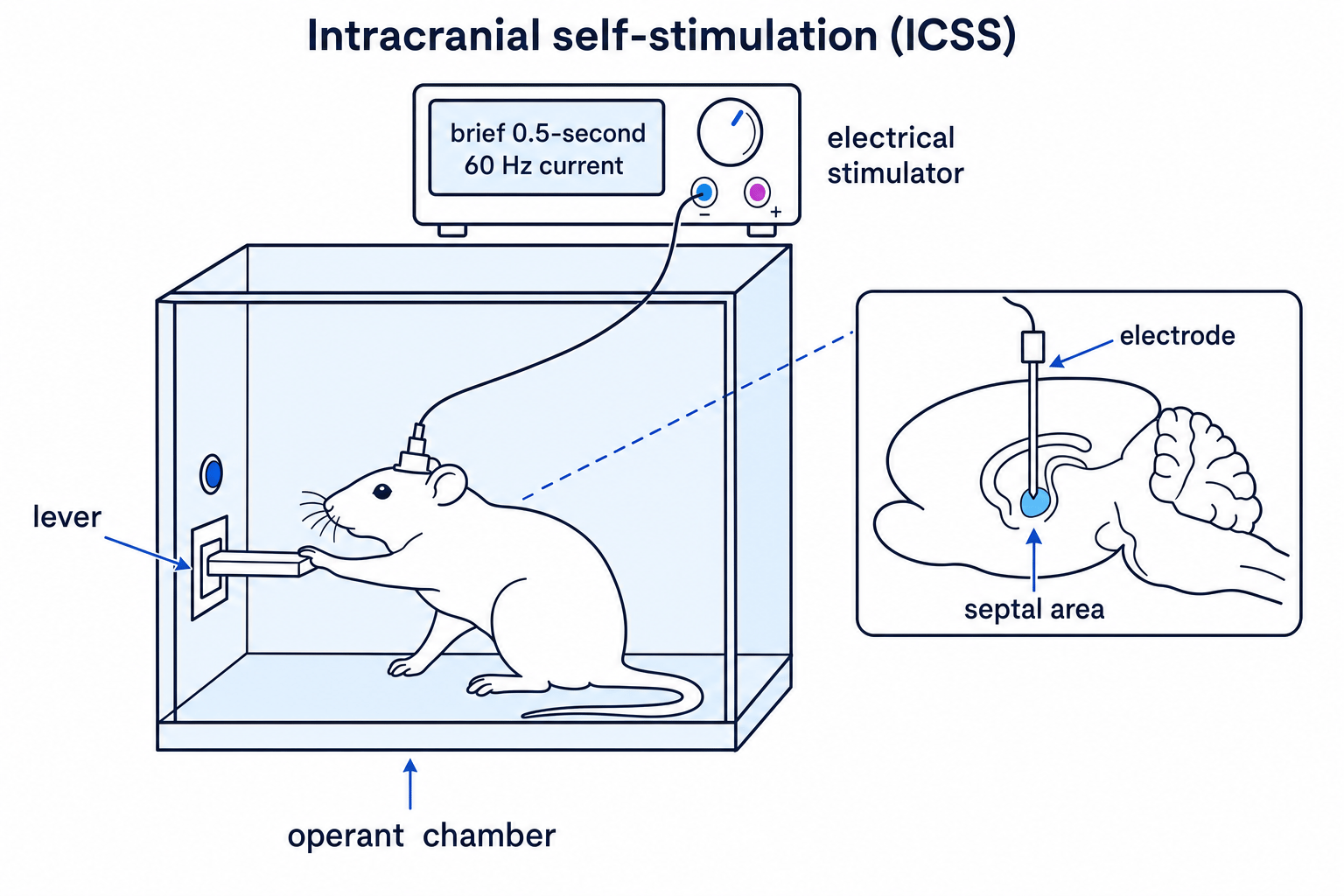
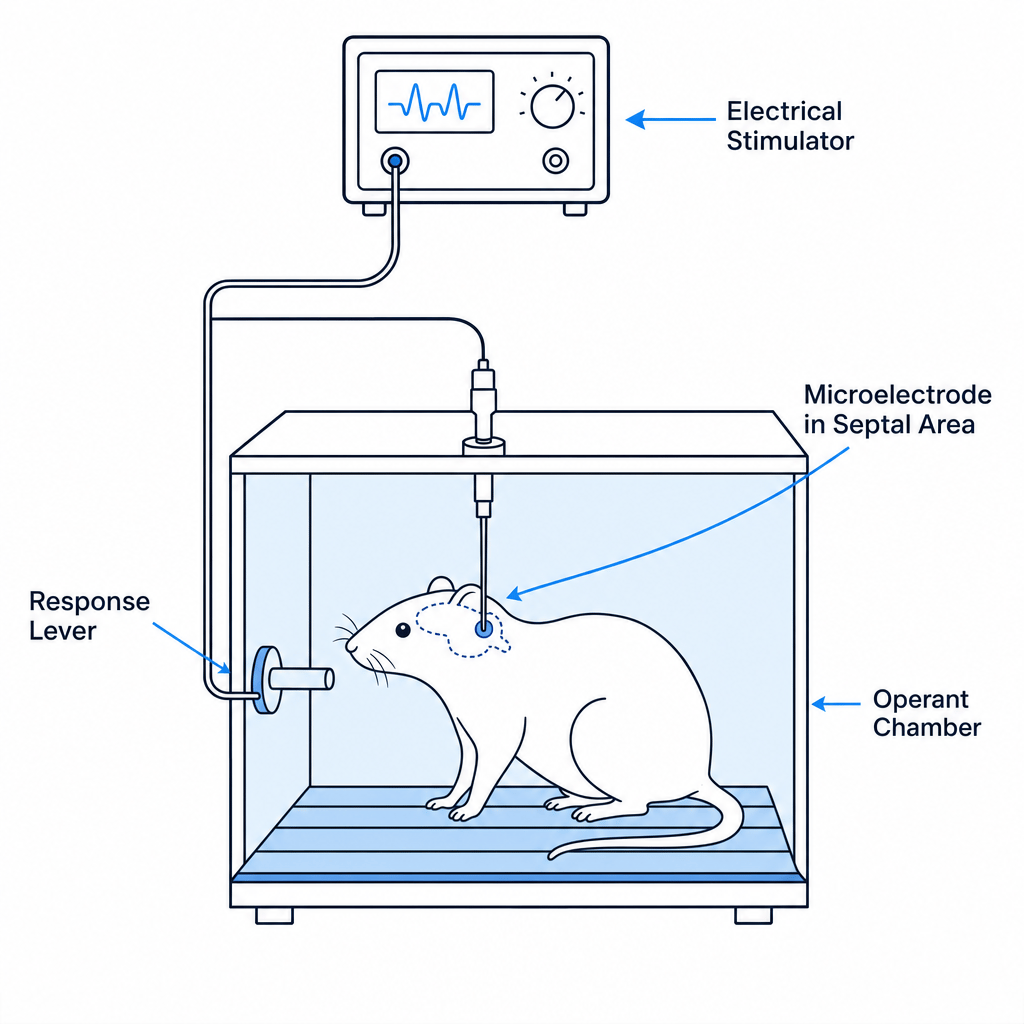
Intracranial Self-Stimulation (ICSS) is a behavioral procedure in which an animal learns to perform a response (such as pressing a lever) in order to deliver brief electrical pulses to specific regions of its own brain.
Septal Area
The septal area (or septum) is a structure located deep within the limbic system of the brain. It is highly interconnected with other structures involved in emotion, motivation, and the reinforcement of survival behaviors.
Aim of the Study
Olds and Milner (1954) aimed to systematically investigate the effects of electrical brain stimulation (EBS) on animal behavior. Specifically, they wanted to:
- Identify whether electrical stimulation to specific subcortical structures could act as a positive reinforcer (strengthening behavioral responses).
- Map out which specific regions of the brain produced the strongest reinforcing effects when stimulated, and which produced neutral or negative (aversive) reactions.
Methodology and Procedure
The Sample
The researchers used 15 male hooded rats, weighing between 250g250\text{g}250g and 300g300\text{g}300g at the time of surgery.
Surgical Procedure
- Each rat was anesthetised and placed in a stereotaxic instrument (a device used to hold the head still and guide instruments to precise coordinates).
- A pair of fine, insulated electrode wires (insulated except at the very tips) was surgically lowered into a specific target area of the brain.
- The electrode assembly was anchored to the skull using dental cement and screws.
- The researchers intentionally targeted different areas across the 15 rats to map out different brain regions, including the septal area, caudate nucleus, hypothalamus, amygdala, and hippocampus.
Testing Procedure (The "Skinner Box" Setup)
After a post-surgery recovery period of 3 days, the rats were tested in a modified Skinner box (an operant conditioning chamber) measuring 3×3×33 \times 3 \times 33×3×3 feet.
- The Circuit: The electrode on the rat's head was connected by a flexible overhead wire to an electrical stimulator.
- The Operant Response: Whenever the rat pressed a lever inside the chamber, it closed a switch, which automatically delivered a brief (0.50.50.5-second), low-voltage 60 Hz60\text{ Hz}60 Hz AC current to its brain.
- Acquisition Phase: The rats were placed in the chamber and allowed to press the lever freely. If the stimulation was rewarding, the rate of lever pressing would increase.
- Extinction Phase: To prove that the behavior was driven purely by the electrical current, the researchers disconnected the stimulator. If the bar pressing stopped when the current was turned off, this confirmed that the stimulation was the reinforcer.
Post-Mortem Brain Histology
Once behavioral testing was complete, the rats were euthanised, and their brains were sliced, stained, and examined under a microscope. This histological analysis allowed Olds and Milner to identify the exact anatomical location of the electrode tip in each rat and correlate it with the behavioral data.
Key Results and Data Interpretation
The findings varied dramatically depending on where the electrode had been placed:
- The Septal Area (High Reinforcement): Rats with electrodes implanted in the septal area showed exceptionally high rates of self-stimulation. They would press the lever continuously, ignoring food, water, and sleep.
- Other Areas (Moderate to No Reinforcement): Electrodes in the mammillary bodies or parts of the hippocampus produced moderate reinforcement, while placements in the lateral thalamus or medial lemniscus resulted in neutral or even aversive (punishing) effects, where rats actively avoided pressing the lever.
- Extinction Curves: During extinction trials (when the current was switched off), the high rate of lever pressing rapidly decreased back to near-zero baseline levels.
The Primary Takeaway
The brain contains localized "reward centres" (predominantly within the limbic system, such as the septal area). Electrical stimulation of these structures acts as a more powerful positive reinforcer than natural biological drives like hunger or thirst.
Let's look at how researchers determine whether a stimulus is reinforcing by calculating the rates of responding during the acquisition and extinction phases.
Calculating and comparing response rates
A researcher replicates Olds and Milner's procedure on a rat with a septal electrode. During a 454545-minute testing session with the stimulator switched on (Acquisition), the rat presses the lever 1,8001,8001,800 times. During a subsequent 454545-minute session with the stimulator switched off (Extinction), the rat presses the lever only 151515 times.
Calculate the rate of lever pressing per minute for both phases, and determine the percentage decrease in responding during extinction.
-
Calculate the response rate for the Acquisition phase (RacqR_{acq}Racq): Divide the total number of bar presses by the total duration of the session in minutes.
Racq=1800 presses45 minutes=40 presses per minute R_{acq} = \frac{1800\text{ presses}}{45\text{ minutes}} = 40\text{ presses per minute} Racq=45 minutes1800 presses=40 presses per minute -
Calculate the response rate for the Extinction phase (RextR_{ext}Rext): Divide the total number of bar presses when the current was off by the duration of the session.
Rext=15 presses45 minutes=0.33 presses per minute R_{ext} = \frac{15\text{ presses}}{45\text{ minutes}} = 0.33\text{ presses per minute} Rext=45 minutes15 presses=0.33 presses per minute -
Calculate the percentage decrease in responding from acquisition to extinction: Use the percentage change formula:
Percentage Decrease=Racq−RextRacq×100 \text{Percentage Decrease} = \frac{R_{acq} - R_{ext}}{R_{acq}} \times 100 Percentage Decrease=RacqRacq−Rext×100 Percentage Decrease=40−0.3340×100≈99.18% \text{Percentage Decrease} = \frac{40 - 0.33}{40} \times 100 \approx 99.18\% Percentage Decrease=4040−0.33×100≈99.18% -
Interpret the findings: The massive (99.18%99.18\%99.18%) drop in response rate when the current was turned off confirms that the electrical stimulation was the direct functional reinforcer maintaining the bar-pressing behavior, rather than any intrinsic pleasure derived from pressing the lever itself.
Conclusions
Olds and Milner concluded that:
- The brain does indeed contain a specialized, localized reward system (often referred to now as the mesolimbic dopamine pathway).
- Electrical stimulation of these pleasure centres bypasses natural physiological states (like satiation), creating an artificial reward signal that the brain values above all else.
- Operant conditioning can be driven directly by manipulating brain chemistry and electrical activity, rather than relying on external environmental stimuli.
AO3: Evaluation of Olds and Milner (1954)
To score highly on your 8-mark or 12-mark essay questions, you must systematically evaluate the strengths and weaknesses of the study, including its methodology, ethics, and theoretical contributions.
Methodological Strengths
- High Internal Validity: The study was conducted in a highly controlled laboratory environment. The use of a modified Skinner box allowed precise recording of operant responses (bar presses), leaving no room for subjective interpretation by the researchers.
- Objective Verification (Histology): Rather than guessing where the electrodes were, the researchers used post-mortem brain slicing. This physical evidence allowed them to draw precise, direct causal links between specific brain structures and behavioral rates.
- Control Conditions: By incorporating an extinction phase (turning off the current), they proved that the rats were not simply pressing the lever due to hyperactivity or curiosity, but specifically to receive the electrical reward.
Methodological Weaknesses
- Extrapolating Animal Research (Anthropomorphism): The study used rats. While the subcortical limbic structures of rats and humans share evolutionary similarities, human behavior is far more complex, governed by a highly developed prefrontal cortex, cognitive expectations, and social values. We cannot confidently assume humans would react in an identical biological fashion.
- Small Sample Size: Although 151515 rats were used, they had electrodes placed in many different brain locations. This meant that for any single specific brain region (like the septal area), only a very small number of rats were tested, reducing the reliability of the regional mapping.
Ethical Considerations
Because this is an animal study, you must evaluate it using modern guidelines (such as the British Psychological Society's guidelines for animal research and the Three Rs):
- Refinement (Pain and Distress): The rats underwent invasive brain surgery, which carries risks of infection and pain. Additionally, during testing, some rats self-stimulated to the point of physical exhaustion, ignoring basic biological needs like food and water. This violates the principle of minimising distress.
- Reduction: Although they used only 151515 rats, the exploratory nature of the study meant many electrodes were misplaced, which could be argued to be a waste of animal lives.
- Scientific Benefit: On the other hand, the study provided monumental breakthroughs in our understanding of addiction, motivation, and neurotransmitter pathways, which has directly helped develop treatments for human clinical depression and substance abuse.
Conflating Olds & Milner with standard operant conditioning
Students often write that Olds and Milner were testing Skinner's theory of operant conditioning. This is inaccurate. They did use Skinner's operant boxes as a tool, but their primary aim was biological: they wanted to map the physiological "pleasure pathways" in the brain. Keep your focus firmly on the biological mechanisms of brain stimulation.
In the exam
- Clearly distinguish between AO1 and AO3: When asked to "Describe and evaluate Olds and Milner (1954)", ensure you allocate roughly half your time to describing the surgical and behavioral procedures (AO1) and the other half to critical analysis, particularly animal ethics and generalisability (AO3).
- Memorise key terms: Use biological terms such as septal area, intracranial self-stimulation (ICSS), and histology to show examiners you have a deep, technical understanding of the study.
- Link to Issues and Debates: You can easily link this classic study to the debate of "Ethics of animal research" or "Reductionism vs Holism" (as it attempts to reduce complex motivational states to simple electrical pulses in the limbic system).
Check yourself
- Why did the researchers include an "extinction phase" in their procedure, and what did the results of this phase prove?
- Explain how post-mortem histological analysis contributed to the validity of Olds and Milner's conclusions.
- Evaluate the Olds and Milner (1954) study using the ethical concept of the "Three Rs" (Replacement, Reduction, and Refinement).