When a crime is committed, police officers rely heavily on eyewitness testimony (EWT) to identify suspects. However, real-world crimes are often sudden, shocking, and highly stressful. How does this intense stress affect our ability to remember faces accurately?
While laboratory experiments allow researchers to control variables easily, they often lack the emotional impact of a real-life crisis. In this contemporary study, Valentine and Mesout (2009) found a creative way to study the effects of high anxiety on eyewitness identification within a highly realistic, naturally stressful setting: the London Dungeon.
What you'll learn
- The theoretical conflict between laboratory research and real-world anxiety on eyewitness memory.
- The methodology, procedure, and findings of Valentine and Mesout's (2009) field experiment.
- How to evaluate the study's strengths and weaknesses for your AO3 exam questions.
Prerequisites: Anxiety and Eyewitness Memory
Before looking at the study itself, we must understand why it was conducted. Psychologists have long debated the exact relationship between stress and memory recall.
The Yerkes-Dodson Law
The relationship between arousal (stress) and performance is often explained by the Yerkes-Dodson Law (sometimes called the Inverted-U Hypothesis).
Yerkes-Dodson Law
The principle that performance increases with physiological or mental arousal, but only up to an optimal point. When levels of arousal become excessively high, cognitive performance (such as memory recall) drops drastically.
In low-stress laboratory environments, participants are often relaxed, which might keep them below the optimal level of arousal. In real-life crimes, however, witnesses experience extreme panic, pushing them far past the optimal point and severely impairing their cognitive processing.
Why a Field Experiment?
Laboratory experiments on anxiety can be unethical (you cannot deliberately terrify a participant in a lab) and lack mundane realism (the tasks do not mirror real life). Valentine and Mesout (2009) chose a field experiment because it allowed them to study genuine, high-level physiological fear in a controlled, naturalistic setting where participants willingly paid to be scared.
The Study: Valentine and Mesout (2009)
Aim
To test the hypothesis that high levels of physiological arousal (stress/anxiety) impair the accuracy of eyewitness identification and recall of a person encountered in a realistic, scary environment.
Sample
- 56 participants (29 females and 27 males) who were visitors to the London Dungeon.
- They were recruited via opportunity sampling after they had already purchased tickets, and were offered free admission and a small payment for participating.
Methodology and Procedure
The study took place in the "Labyrinth" section of the London Dungeon.
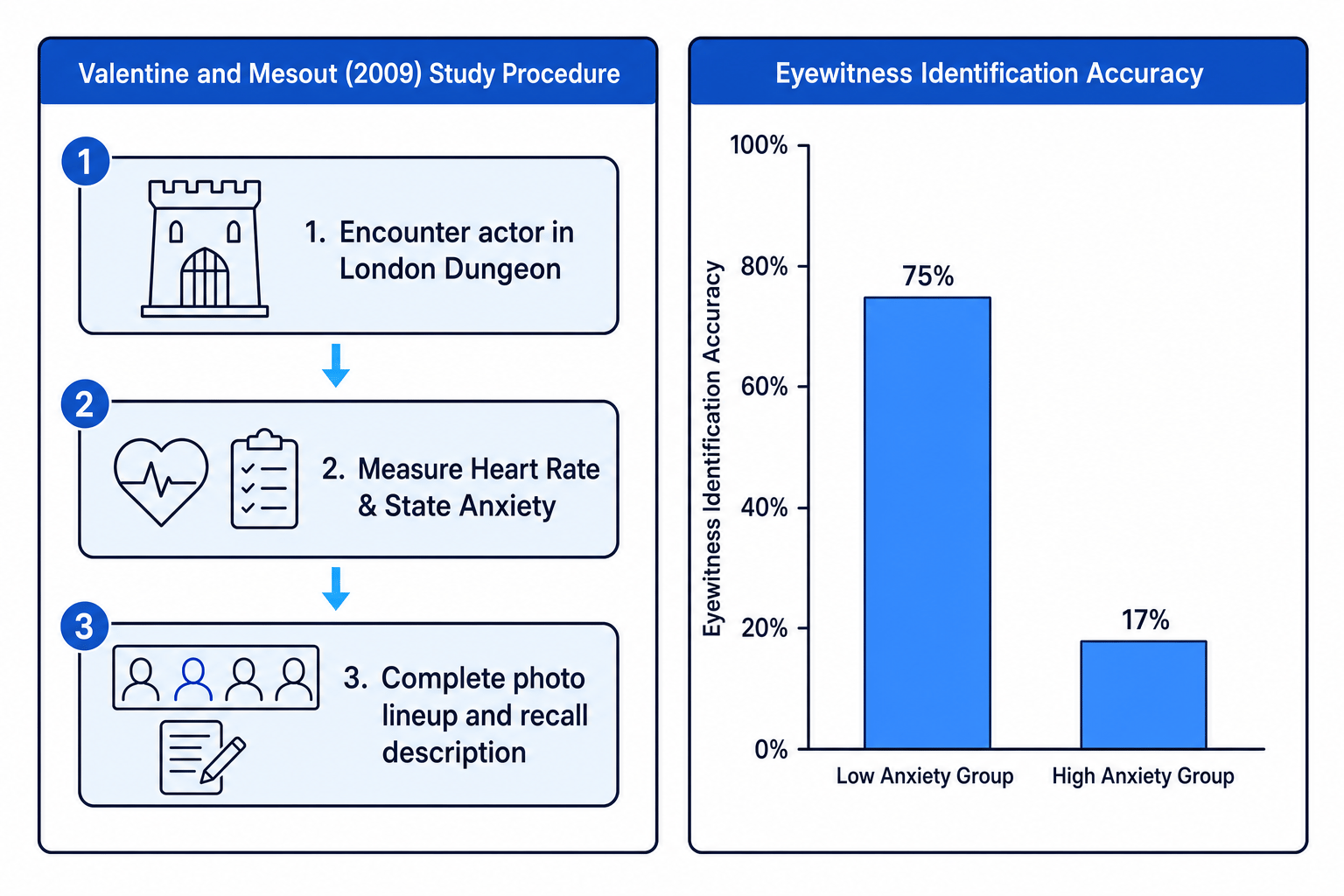
1. The Encounter
While walking through the Labyrinth, participants were confronted by a scary actor (the "Scary Person"), who blocked their path and spoke to them. This encounter lasted approximately 45 seconds, during which the actor's face was clearly visible.
2. Measuring Anxiety
To objectively assess whether the dungeon caused fear, researchers measured two types of anxiety:
- Physiological State Anxiety (Heart Rate): Participants wore a wireless heart rate monitor throughout their visit to track their physical arousal.
- Psychological State and Trait Anxiety: After the tour, participants completed the State-Trait Anxiety Inventory (STAI) questionnaire.
State vs. Trait Anxiety
- State Anxiety: A temporary, situational emotional state characterized by apprehension, tension, and physiological arousal in response to a specific threat (e.g., being scared by an actor).
- Trait Anxiety: A stable, long-term personality characteristic reflecting a person's general tendency to perceive situations as threatening and react with anxiety.
3. The Eyewitness Tasks
After completing the tour and anxiety questionnaires, participants completed two cognitive tasks:
- Free Recall: They were asked to write down a detailed physical description of the "Scary Person" (the actor they met in the Labyrinth).
- Photo Lineup: They were shown a 9-person, target-present photo lineup. The actor was in the lineup, and participants had to identify him or state that they did not recognize him. They were warned that the actor may or may not be present in the lineup.
Confusing the Lineup Setup
Students often assume that the actor was absent from the lineup to test for false identifications. In this study, the lineup was target-present (the actor was actually in the lineup). The key measure was whether high-anxiety participants could successfully pick him out.
Findings and Results
The researchers split the participants into two groups ("High Anxiety" and "Low Anxiety") based on whether their STAI state anxiety score was above or below the median.
Key Quantitative Findings
- Anxiety and Identification Accuracy:
- Only 17% of the participants in the High Anxiety group correctly identified the actor from the photo lineup.
- In contrast, 75% of the participants in the Low Anxiety group correctly identified the actor.
- Recall Accuracy:
- High-anxiety participants recalled significantly fewer correct physical descriptors of the actor than low-anxiety participants.
- Gender and Anxiety:
- Female participants reported higher state anxiety scores than male participants. However, there was no significant difference between males and females in their ability to correctly identify the actor in the photo lineup.
The Headline Takeaway
High levels of physiological and psychological stress significantly impair both eyewitness identification accuracy and the ability to recall descriptive details of a target individual.
Statistical Analysis in Valentine and Mesout
Because the data collected for identification accuracy was categorical (participants were either in the High or Low anxiety group, and they either made a Correct or Incorrect identification), the researchers had to use a Chi-Square (χ2\chi^2χ2) test of association to see if there was a statistically significant relationship between the two variables.
Let's look at how researchers determine if these findings are statistically significant using this inferential test.
Interpreting a Chi-Square Test of Association
Suppose you are analyzing the contingency table for Valentine and Mesout's study. You want to calculate the degrees of freedom (dfdfdf) for their analysis and determine whether their observed value represents a statistically significant result.
The data can be arranged in a 2×22 \times 22×2 contingency table:
| Correct Identification | Incorrect/No Identification | |
|---|---|---|
| Low Anxiety | Group A | Group B |
| High Anxiety | Group C | Group D |
Steps to determine significance:
-
Calculate the Degrees of Freedom (dfdfdf): Use the formula:
df=(r−1)(c−1) df = (r - 1)(c - 1) df=(r−1)(c−1)where rrr is the number of rows and ccc is the number of columns.
df=(2−1)×(2−1)=1×1=1 df = (2 - 1) \times (2 - 1) = 1 \times 1 = 1 df=(2−1)×(2−1)=1×1=1 -
Locate the Critical Value: Using a standard critical values table for a Chi-Square test with df=1df = 1df=1 and a standard significance level of p≤.05p \le .05p≤.05 (one-tailed, as we predicted high anxiety would reduce accuracy):
Critical Value=2.71 \text{Critical Value} = 2.71 Critical Value=2.71 -
Compare Observed and Critical Values: The observed (calculated) χ2\chi^2χ2 value from Valentine and Mesout's actual data was χ2=14.86\chi^2 = 14.86χ2=14.86. Since the observed value is much larger than the critical value (14.86>2.7114.86 > 2.7114.86>2.71), we reject the null hypothesis. The difference in identification rates between the high and low anxiety groups is highly statistically significant (p<.001p < .001p<.001).
How to remember the numbers
To help remember the main finding, think of the numbers 17 and 75 as mirror opposites.
- High-anxiety identification: 17% (very low)
- Low-anxiety identification: 75% (very high)
Evaluation (AO3)
Evaluating contemporary studies is a crucial skill for your 8-mark and 12-mark exam essays. Use the GRAVE framework (Generalizability, Reliability, Application, Validity, Ethics) to structure your evaluation.
Strengths
- High Ecological Validity: Unlike laboratory studies where participants watch a video of a crime, this study took place in a real-world, highly immersive environment. The fear experienced by the participants was genuine and physiological, making the findings highly generalizable to real-life eyewitness situations.
- Objective Measurement of Stress: Rather than relying solely on self-report questionnaires, the researchers used wireless heart rate monitors. This provided objective, physiological proof that the participants in the high-anxiety group were experiencing actual physical stress.
- Useful Real-World Application: The findings have major implications for the justice system. They warn police forces and courts to be highly cautious when relying on eyewitness identification if the witness experienced extreme terror during the crime.
Weaknesses
- Sample Generalizability: The sample consisted of people who chose to visit the London Dungeon. These individuals may have different personality traits (e.g., being more sensation-seeking or adventurous) compared to the general public, which might affect how they respond to stress or remember details.
- Ethical Issues (Protection from Harm): Although the participants chose to visit the dungeon, they did not initially consent to being part of a psychology experiment where their fear levels would be measured. However, the researchers mitigated this by obtaining fully informed consent after the experience, debriefing them, and giving them the right to withdraw their data.
- Lack of Control Over Extraneous Variables: Because this was a field study, researchers could not control exactly how long each participant looked at the actor, the ambient light levels in the Labyrinth at any given second, or the exact movements of other visitors in the crowd.
In the exam
- Clearly distinguish between AO1 and AO3: In an 8-mark question asking you to "Describe and evaluate Valentine and Mesout (2009)", aim for a 4/4 split. Spend the first half clearly describing the aim, sample, procedure, and results (AO1), and the second half evaluating the methodology and ethics (AO3).
- Use the statistics to back up your points: When describing the results, do not just say "the low anxiety group did better." Quote the actual percentages (75% vs 17%) to show the examiner you have precise, detailed knowledge.
- Connect evaluation to the real world: Don't just list "ecological validity" as a strength. Explain why it matters—for instance, because it proves that laboratory findings on EWT (which often show better memory) might over-represent how reliable witnesses actually are in court.
Check yourself
- Why did Valentine and Mesout use both heart rate monitors and the STAI questionnaire instead of just one?
- What was the specific percentage difference in photo lineup identification between the high and low-anxiety groups?
- Explain one ethical issue associated with conducting this study in the London Dungeon and how the researchers addressed it.
