What you'll learn
- What Cassibba et al. (2013), Attachment the Italian way, investigated.
- How the study used a meta-analysis rather than collecting one new sample.
- The main findings about Italian attachment patterns in typical and atypical samples.
- How to evaluate the study for AO3, including methods, ethics and culture.
Big picture: why this study matters
Cassibba et al. (2013) is the contemporary study for attachment in Topic 7: Child Psychology. It builds on earlier cross-cultural research, especially Van IJzendoorn and Kroonenberg (1988), which found that secure attachment was the most common classification across cultures, but that attachment distributions varied between and within countries.
Attachment
Attachment is a close, two-way emotional bond between an infant and a caregiver, in which the infant uses the caregiver as a source of comfort, safety and security.
Cassibba et al. asked whether there is a distinct “Italian way” of attachment. In other words: do Italian children and adults show attachment patterns that differ from international benchmarks?
Key background: attachment classifications
The main child attachment categories come from Ainsworth’s Strange Situation, a structured observation in which an infant experiences brief separations from and reunions with a caregiver.
The key infant classifications are:
- Secure attachment: the child uses the caregiver as a secure base, shows some distress when separated, and is comforted on reunion.
- Insecure-avoidant attachment: the child shows little visible distress and avoids or ignores the caregiver on reunion.
- Insecure-resistant/ambivalent attachment: the child shows high distress and both seeks and resists comfort.
- Disorganised attachment: the child shows confused, contradictory or disoriented behaviour, often linked with frightening or inconsistent caregiving.
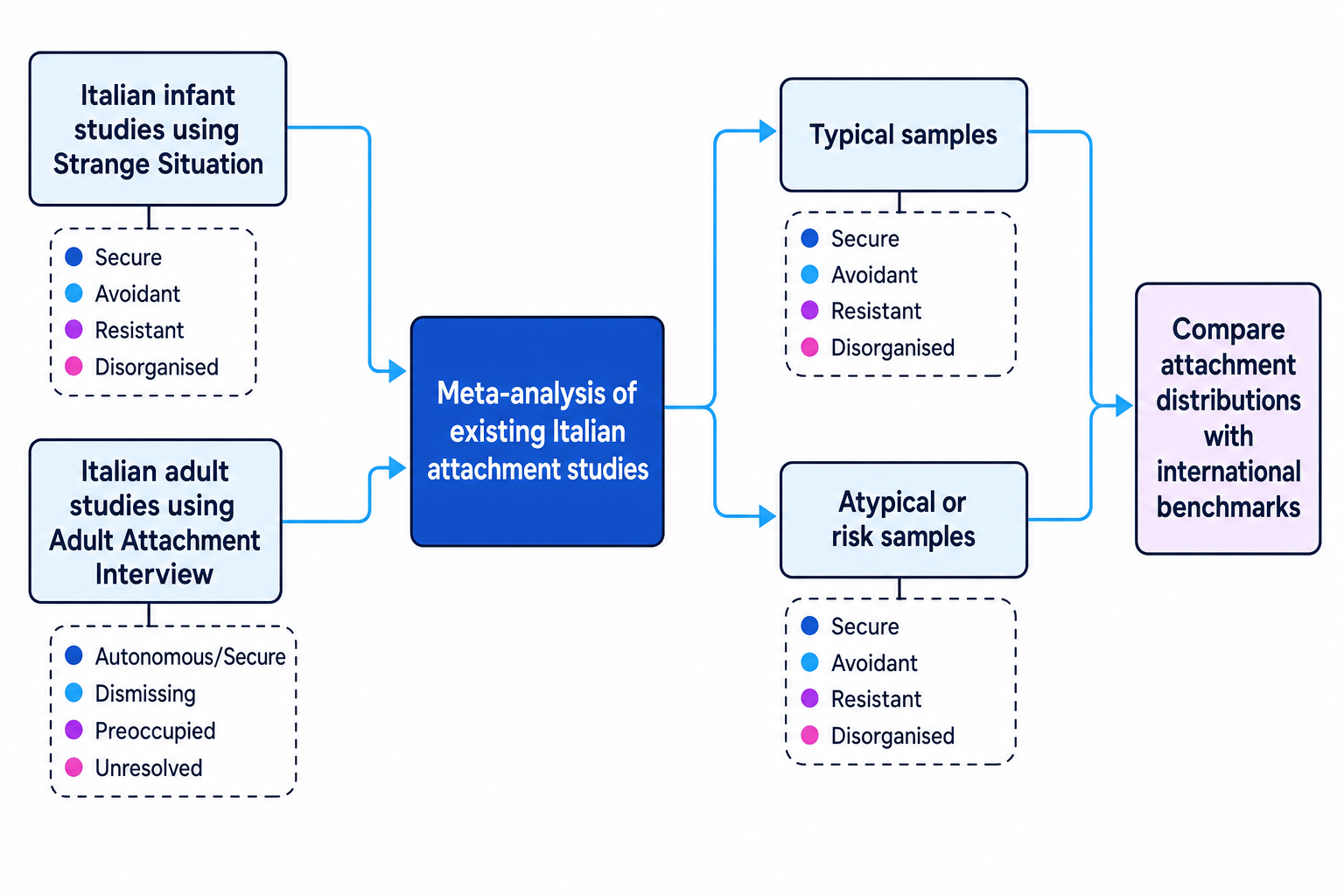
Cassibba et al. also considered adult attachment where studies used the Adult Attachment Interview, a semi-structured interview that classifies adults’ “state of mind” about attachment, such as autonomous/secure, dismissing, preoccupied or unresolved.
What Cassibba et al. did
Meta-analysis
A meta-analysis is a research method that combines numerical findings from several existing studies to identify an overall pattern. It uses secondary data, meaning the researchers analyse data already collected by others.
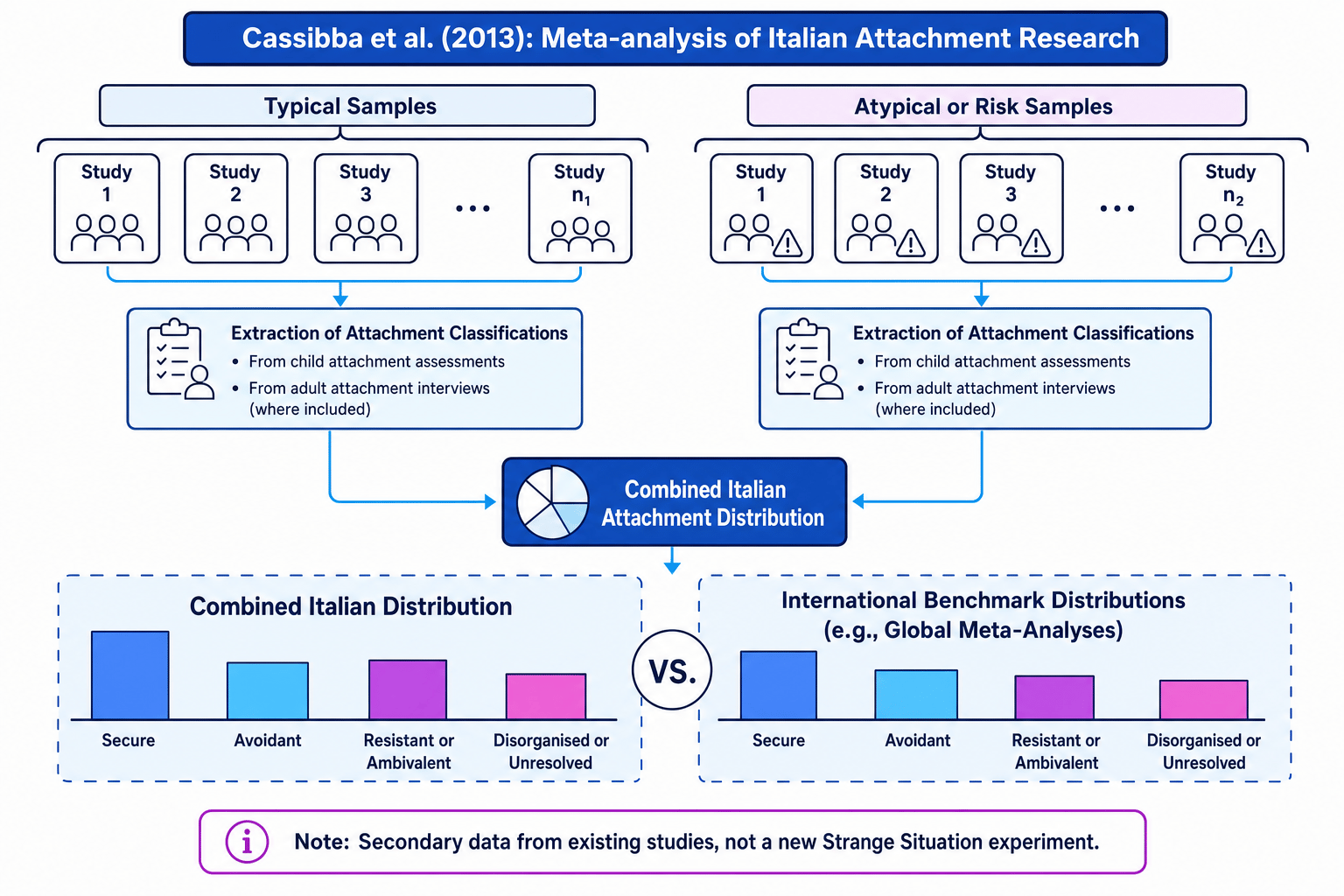
Cassibba et al. did not run a brand-new Strange Situation study with Italian infants. Instead, they gathered existing Italian attachment studies and combined their findings.
They looked at Italian samples including:
- Typical samples: participants not selected because of a known clinical or social risk.
- Atypical or risk samples: participants selected because of factors such as clinical difficulties, developmental risk, family adversity or other vulnerabilities.
They then compared Italian attachment distributions with international attachment benchmarks from previous research.
Do not describe it as one experiment
A common error is to write as if Cassibba et al. personally tested one group of Italian infants in the Strange Situation. The study is best described as a meta-analysis of existing Italian attachment research.
AO1: aim, method, findings and conclusion
Aim
The study aimed to investigate whether Italian attachment patterns in children and adults were similar to, or different from, international attachment distributions.
It was especially interested in whether typical and atypical Italian samples showed different patterns.
Method
Cassibba et al. used a quantitative review/meta-analysis. They extracted attachment classifications from existing Italian studies and compared the combined Italian distribution with attachment distributions reported in international research.
The data were mainly nominal data, meaning participants were placed into named categories, such as secure, avoidant, resistant or disorganised.
Findings
The headline finding was that secure attachment was still an important and common category, supporting the idea that attachment is a widespread human pattern.
However, typical Italian child samples showed a distribution that was not identical to international benchmarks. Cassibba et al. reported a tendency towards lower proportions of secure attachment and higher proportions of insecure-avoidant attachment than some global comparison data.
Atypical or risk samples showed more insecurity and disorganisation, which fits attachment theory because risk factors can disrupt consistent, sensitive caregiving.
For adult samples, the study also considered whether Italian adults showed different attachment-state distributions, especially in typical compared with clinical or risk groups.
Conclusion
Cassibba et al. concluded that attachment patterns are shaped by both universal processes and cultural context. The study supports the idea that attachment categories can be used cross-culturally, but it also warns us not to assume that one international distribution is the only “normal” pattern.
The six-month takeaway
Cassibba et al. (2013) shows that attachment is broadly universal, but the distribution of attachment types can vary across cultural and social contexts.
Interpreting attachment distributions
When you describe findings, focus on patterns, not just labels. A lower percentage of secure attachment does not mean Italian children “lack attachment”. It means the proportions across categories differ.
Interpreting attachment distributions
Suppose a simplified summary gives 52% secure attachment in an Italian sample and 65% secure attachment in an international benchmark.
-
Compare like with like: both figures are percentages for the same category, secure attachment, so a direct comparison is valid.
-
Work out the size of the difference: 65%−52%=1365\% - 52\% = 1365%−52%=13 percentage points, so the Italian sample has a lower secure classification rate in this simplified comparison.
-
Check the wider pattern: if avoidant attachment is higher in the Italian sample, the conclusion is not “Italian children are unattached”, but “the distribution shows relatively less secure and more avoidant attachment than the benchmark.”
AO2: applying the study
You could apply Cassibba et al. to a scenario about cultural differences in childcare.
For example, if a psychologist finds that a country has more avoidant classifications than Ainsworth’s original US sample, Cassibba et al. helps you explain why this should not automatically be treated as abnormal. Cultural expectations about independence, childcare, family roles and separation may affect how attachment behaviours appear in a laboratory situation.
It is also useful for real-world practice. Professionals working with families should avoid assuming that one culture’s attachment distribution is the universal standard. At the same time, risk factors linked with disorganisation or insecurity should still be taken seriously, especially where children may need support.
Avoid cultural stereotyping
Do not write as if “Italian children are avoidant” or “Italian parents are less sensitive”. Cassibba et al. looked at group-level distributions, not fixed traits of every Italian family.
AO3: strengths
Stronger evidence than a single small study
A meta-analysis can combine several samples, giving a broader evidence base than one small observation study. This improves confidence that the findings reflect a wider pattern in Italian attachment research.
Uses standardised attachment measures
Many included studies used recognised attachment measures, such as the Strange Situation or Adult Attachment Interview. This makes it easier to compare findings across studies and countries.
Useful cultural contribution
The study updates earlier work such as Van IJzendoorn and Kroonenberg (1988). It supports the view that secure attachment is common across cultures, but it also challenges ethnocentric assumptions by showing that distributions may differ in Italy.
AO3: weaknesses
Secondary data depends on original study quality
Because Cassibba et al. used existing studies, the researchers had limited control over how the original data were collected. If the original studies differed in sample age, region, family background or coding reliability, the combined result may be harder to interpret.
Italy is not one single culture
The title “the Italian way” is memorable, but Italy contains regional, social-class and urban-rural differences. A national label can hide important within-country variation.
Classification systems may be culturally biased
The Strange Situation was developed in a Western context. A brief separation from the caregiver may not have the same meaning in every culture or family routine. This is a possible etic issue: applying one culture’s measurement system to another culture.
Cannot prove cause and effect
Cassibba et al. can show that attachment distributions differ, but it cannot prove exactly why. Differences could relate to childcare arrangements, parental working patterns, socioeconomic factors, sample differences or measurement issues.
Methods and statistics link
Because Cassibba et al. dealt with categories of attachment, the data are best shown using frequency tables or bar charts, not histograms. Histograms are for continuous data grouped into intervals.
For A-Level research methods, the most relevant inferential test would be chi-square, because it tests for an association between two categorical variables, such as country and attachment category.
Choosing the right test
Use chi-square for associations between categories. Use Mann-Whitney U for differences between two independent groups, Wilcoxon signed-ranks for repeated or matched differences, and Spearman’s rho for correlations. Attachment categories are nominal, so chi-square is the best fit here.
At the usual significance level, psychologists often use p≤.05p \le .05p≤.05. A stricter level such as p≤.01p \le .01p≤.01 reduces the risk of a Type I error: falsely claiming a significant effect. A more lenient level such as p≤.10p \le .10p≤.10 reduces the risk of a Type II error: missing a real effect.
For chi-square, the observed value must usually be greater than the critical value from the table to be significant. One-tailed and two-tailed decisions are more relevant to directional and non-directional hypotheses in tests such as Mann-Whitney U, Wilcoxon and Spearman’s rho.
Ethics
Cassibba et al.’s own study mainly used anonymised secondary data, so there was no direct deception or direct risk to participants from the meta-analysis itself.
However, the original attachment studies still needed to follow ethical principles from the BPS Code of Ethics and Conduct (2009):
- Consent: parents or adult participants should agree to take part.
- Right to withdraw: parents should be able to stop infant participation, especially during separation episodes.
- Protection from harm: infant distress in the Strange Situation must be brief and monitored.
- Confidentiality: personal and family data should be protected.
- Debrief: participants should be told the purpose of the research afterwards where appropriate.
In the exam
-
For AO1, state clearly that Cassibba et al. (2013) was a meta-analysis of Italian attachment studies, not one new experiment.
-
For AO3, balance one methodological strength, such as larger combined evidence, with one limitation, such as variation in original study quality.
-
For AO2, apply the study carefully: cultural variation affects attachment distributions, but it does not justify stereotyping individual families.
Check yourself
- What is the difference between a meta-analysis and a single Strange Situation study?
- What was the main pattern Cassibba et al. found in typical Italian child samples?
- Why is it risky to describe one attachment distribution as the only “normal” pattern?