What you'll learn
- Why depression can involve negative interpretation biases.
- How Williams et al. (2013) tested an online treatment combining internet-CBT and cognitive bias modification.
- The study’s aim, design, participants, procedure, findings and conclusion.
- How to evaluate the study for AO3, including methodology, ethics and real-world application.
First: what problem were Williams et al. trying to solve?
In A-Level Psychology, you need to be able to describe studies using AO1 (what the study did and found), apply them using AO2 (linking ideas to scenarios or the topic), and evaluate them using AO3 (strengths, weaknesses, ethics and usefulness).
Williams, Blackwell, Mackenzie, Holmes and Andrews (2013) focused on depression and whether an internet-based treatment could be improved by combining two approaches: reason and imagination.
Depression
Depression is a mood disorder involving persistent low mood and/or loss of pleasure, often alongside changes in sleep, appetite, concentration, motivation and thoughts about the self, world and future.
A key cognitive feature of depression is that people may interpret ambiguous events negatively. For example, if a friend does not reply to a message, someone with depression might think, “They are ignoring me because they dislike me,” rather than “They might be busy.”
Cognitive bias
A cognitive bias is a systematic tendency to process information in a particular way. In depression, this often means attending to, remembering or interpreting information negatively.
The treatment ideas: “reason” and “imagination”
Cognitive behavioural therapy: using reason
Cognitive behavioural therapy
Cognitive behavioural therapy (CBT) is a psychological therapy that aims to change unhelpful thoughts and behaviours. In depression, CBT often involves identifying negative automatic thoughts, testing the evidence for them, and replacing them with more balanced interpretations.
CBT is the “reason” part of the study title. It encourages the person to step back from a thought and ask: What evidence supports this? What evidence goes against it? Is there a more realistic explanation?
Cognitive bias modification: using imagination
Cognitive bias modification for interpretation
Cognitive bias modification for interpretation (CBM-I) is a computer-based training procedure designed to shift how people interpret ambiguous information, usually by repeatedly practising more positive or balanced interpretations.
In Williams et al., the CBM-I was based on positive mental imagery. Participants imagined themselves in ambiguous situations that resolved positively. The idea is that repeated practice may make positive interpretations more automatic.
The treatment logic
CBT uses deliberate reasoning to challenge negative thoughts, while CBM-I uses repeated imaginative practice to make healthier interpretations feel more automatic.
Applying the treatment logic
-
Imagine a depressed client thinks, “My colleague didn’t smile at me, so they must hate me.” This is a negative interpretation of an ambiguous event.
-
CBT would ask the client to test the thought: perhaps the colleague was tired, distracted, or did not see them.
-
CBM-I would repeatedly train the client to imagine ambiguous social situations ending in a positive or neutral way, so that “they might just be busy” becomes easier to generate automatically.
Williams et al. (2013): aim and design
Williams et al. (2013), in “Combining imagination and reason in the treatment of depression”, aimed to test whether adding internet-based CBM-I to an existing internet-CBT programme would improve outcomes for adults with depression.
Randomised controlled trial
A randomised controlled trial (RCT) is an experiment where participants are randomly allocated to different conditions, so researchers can compare treatments while reducing the effect of participant variables.
The study compared an online CBT treatment with an online condition that also included positive imagery-based CBM-I. Random allocation matters because it helps make the groups similar at the start, so any later difference is more likely to be due to the treatment.
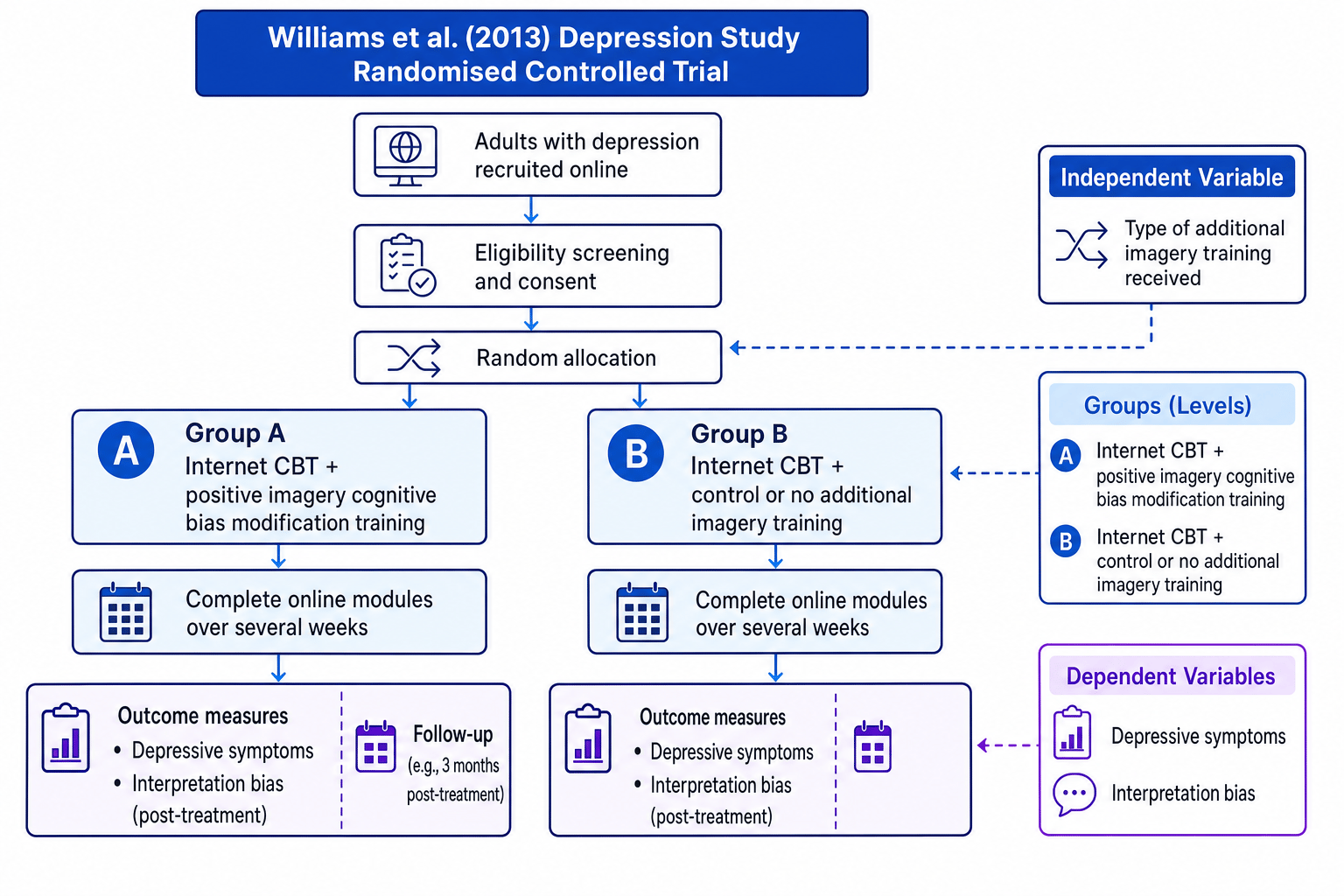
Variables
Independent and dependent variables
The independent variable (IV) is the factor compared between conditions. The dependent variable (DV) is the outcome measured by the researchers.
In this study, the IV was the type of online treatment condition. The DVs included depression symptoms and cognitive interpretation bias, measured before and after treatment, with follow-up assessment.
Identifying the variables
-
Look at what differed between groups: one group received internet-CBT with positive imagery CBM-I, while the comparison group received internet-CBT without that positive-bias training.
-
Identify what was measured: depression symptom scores and interpretation-bias measures were used to assess treatment outcomes.
-
Because participants were randomly allocated, Williams et al. could make a stronger causal claim that differences in outcomes were linked to the treatment condition rather than pre-existing participant differences.
AO1: what happened in the study?
Participants
The study used a relatively small clinical sample, commonly reported as around 70 adults with depression who were recruited for online treatment. Participants were screened before taking part, which is important because depression is a clinical condition and researchers needed to consider risk and suitability.
Procedure
Participants were randomly allocated to treatment conditions. The key elements were:
- Internet-CBT: an online CBT depression programme delivered over several weeks, including structured lessons and activities designed to challenge negative thoughts and change unhelpful behaviour patterns.
- CBM-I with positive imagery: online training in which participants imagined ambiguous scenarios resolving positively, encouraging a shift away from negative interpretations.
- Repeated assessment: participants completed standardised measures of depressive symptoms and interpretation bias before and after treatment, with follow-up to see whether changes lasted.
Measures
The study mainly produced quantitative data, meaning numerical data such as questionnaire scores. Depression studies often use standardised self-report scales, where higher scores usually indicate more severe symptoms. Interpretation bias can be assessed by asking how positively or negatively participants interpret ambiguous material.
Findings and conclusion
Overall, participants improved across treatment, showing that internet-based CBT could reduce depressive symptoms. The group receiving positive imagery CBM-I alongside internet-CBT showed evidence of more positive interpretation bias and promising improvement in depression outcomes.
The conclusion was that combining “imagination” through CBM-I with “reason” through CBT may be a useful way to treat depression, especially because the intervention can be delivered online.
Overclaiming the result
Do not write that Williams et al. “proved” online CBM-I cures depression. A better answer is that the study provides evidence that adding positive imagery-based CBM-I to internet-CBT may improve cognitive bias and depressive symptoms.
Research-methods link
This study is useful for research-methods AO3 because it was an RCT with repeated outcome measures.
Researchers may summarise depression scores using a mean as a measure of central tendency and standard deviation as a measure of dispersion if the data are roughly normally distributed. If scores are very skewed, meaning clustered unevenly with a long tail at one end, medians and ranges may be more appropriate. Graphs such as bar charts or line graphs can show changes in symptom scores over time.
Stats link for Edexcel
- The usual significance convention is p≤.05p \le .05p≤.05; p≤.01p \le .01p≤.01 is stricter, while p≤.10p \le .10p≤.10 is more lenient.
- A one-tailed test is used for a directional hypothesis; a two-tailed test is used when the hypothesis does not predict the direction of the difference.
- For Edexcel tests: Mann-Whitney U is for independent-groups differences, Wilcoxon signed-ranks is for repeated-measures differences, Spearman’s rho is for correlations, and chi-square is for associations between categories.
- In critical-value tables, Mann-Whitney U and Wilcoxon are usually significant when the observed value is equal to or less than the critical value; Spearman’s rho and chi-square are usually significant when the observed value is equal to or greater than the critical value.
AO3: strengths
Stronger causal inference
Because Williams et al. used random allocation, the study has stronger internal validity than a simple before-and-after study. If one group improves more than another, it is more reasonable to link that improvement to the treatment condition.
Standardised and replicable
The online treatment materials and symptom measures were standardised. This improves reliability because each participant receives a similar procedure, and future researchers can repeat the study more easily.
Real-world application
The study has clear practical value. Online interventions can reach people who face barriers to face-to-face therapy, such as cost, location, waiting lists, mobility difficulties or stigma. This makes the study relevant to modern mental health services.
AO3: weaknesses
Sample and generalisability
The sample was relatively small and self-selected. People willing to take part in internet treatment may be more motivated, more comfortable with technology, or less severely depressed than other clinical populations. This limits how far the findings can be generalised.
Attrition risk
Online interventions often have attrition, meaning participants drop out before the end. If people who do not improve are more likely to leave, the results may make the treatment look more effective than it really is.
Self-report and demand characteristics
Depression questionnaires rely on self-report. Participants may misjudge their symptoms, answer in a socially desirable way, or respond to what they think the researchers expect. This can reduce validity.
Mixed evidence for CBM-I
CBM-I is promising, but its effects in clinical depression are not always as strong or consistent as traditional CBT. Later research on cognitive bias modification has sometimes found smaller effects, so Williams et al. should be treated as supportive evidence rather than a final answer.
Ethics
Williams et al. studied people with depression, so ethical safeguards were especially important under the BPS Code of Ethics and Conduct (2009).
Researchers needed informed consent, confidentiality for online data, the right to withdraw, and debriefing. Protection from harm was particularly important because some participants may have experienced severe low mood or suicidal thoughts. Screening, monitoring and referral procedures would be needed to ensure online treatment did not leave vulnerable participants unsupported.
Online therapy is not suitable for every case
Internet-based treatment may be helpful for mild to moderate depression, but people at high risk of harm may need more immediate, face-to-face or crisis support.
How to use Williams et al. in an essay
For AO1, describe it as a randomised controlled trial testing internet-CBT with positive imagery-based CBM-I for depression.
For AO2, apply it to a person with depression who negatively interprets ambiguous events. Explain that CBM-I trains more positive interpretations, while CBT challenges negative thoughts through reasoning.
For AO3, focus on RCT control, standardisation and real-world usefulness, balanced against sample limitations, attrition, self-report data and ethical issues in online clinical treatment.
In the exam
-
Start with the treatment logic: depression involves negative interpretations, so Williams et al. tried to modify these using CBT and CBM-I.
-
For AO1, include the design, random allocation, online treatment conditions, outcome measures and broad findings.
-
For AO3, balance strengths such as control and application with weaknesses such as attrition, self-report and limited generalisability.
Check yourself
- What is the difference between CBT and CBM-I in this study?
- Why does random allocation improve the study’s internal validity?
- Give one strength and one weakness of using internet-based treatment for depression.
