When studying clinical psychology, it is easy to assume that eating disorders like Anorexia Nervosa (AN) are purely driven by social media, cultural pressures, or cognitive distortions. However, biological psychologists have long suspected a strong genetic vulnerability.
In this note, we will explore your contemporary clinical study: Scott-Van Zeeland et al. (2013). This study provides crucial evidence that anorexia has biological and metabolic roots, specifically looking at a gene called EPHX2.
What you'll learn
- The molecular genetics and background of the EPHX2 gene in relation to cholesterol and anorexia.
- The two-stage scientific methodology (discovery and replication) used by Scott-Van Zeeland et al. (2013).
- How the researchers linked genetic variations to physical and psychological symptoms (phenotypes).
- Critical AO3 evaluation points, including generalisability, validity, ethics, and real-world clinical applications.
1. Background & Key Terminology
To understand this study, you first need to understand how modern geneticists hunt for genes. Rather than guessing which gene causes a disorder, researchers use massive screens to look at DNA variations across thousands of people.
Genome-Wide Association Study (GWAS)
A Genome-Wide Association Study (GWAS) is an observational study that scans the entire genome of many individuals to find genetic variations associated with a particular disease or trait.
Single Nucleotide Polymorphism (SNP)
A Single Nucleotide Polymorphism (SNP) (pronounced "snip") is a variation in a single DNA building block (nucleotide) at a specific position in the genome. It is the most common type of genetic variation among people.
For years, twin studies showed that anorexia is highly heritable (with estimations between 50% and 80%). However, finding the specific genes responsible was incredibly difficult.
Scott-Van Zeeland and her team focused on a specific candidate gene: EPHX2 (epoxide hydrolase 2). This gene codes for an enzyme called soluble epoxide hydrolase (sEH), which plays a major role in cholesterol metabolism and cardiovascular health.
Why cholesterol?
People with active anorexia often show abnormally high levels of cholesterol in their blood, despite being severely malnourished and consuming almost no fat. This clinical paradox suggested to the researchers that anorexia might be tied to a genetic disruption in how the body processes lipids (fats).
2. Aim of the Study
The main aims of Scott-Van Zeeland et al. (2013) were:
- To identify whether specific genetic variants (SNPs) are significantly associated with Anorexia Nervosa.
- To investigate the role of the EPHX2 gene in the development and maintenance of anorexia.
- To determine if genetic variations in EPHX2 correlate with specific clinical features (phenotypes), such as cholesterol levels, body mass index (BMI), and psychological traits like anxiety or depression.
3. Methodology (AO1)
The study was highly complex and structured into multiple stages to ensure the findings were reliable and not just a statistical fluke.
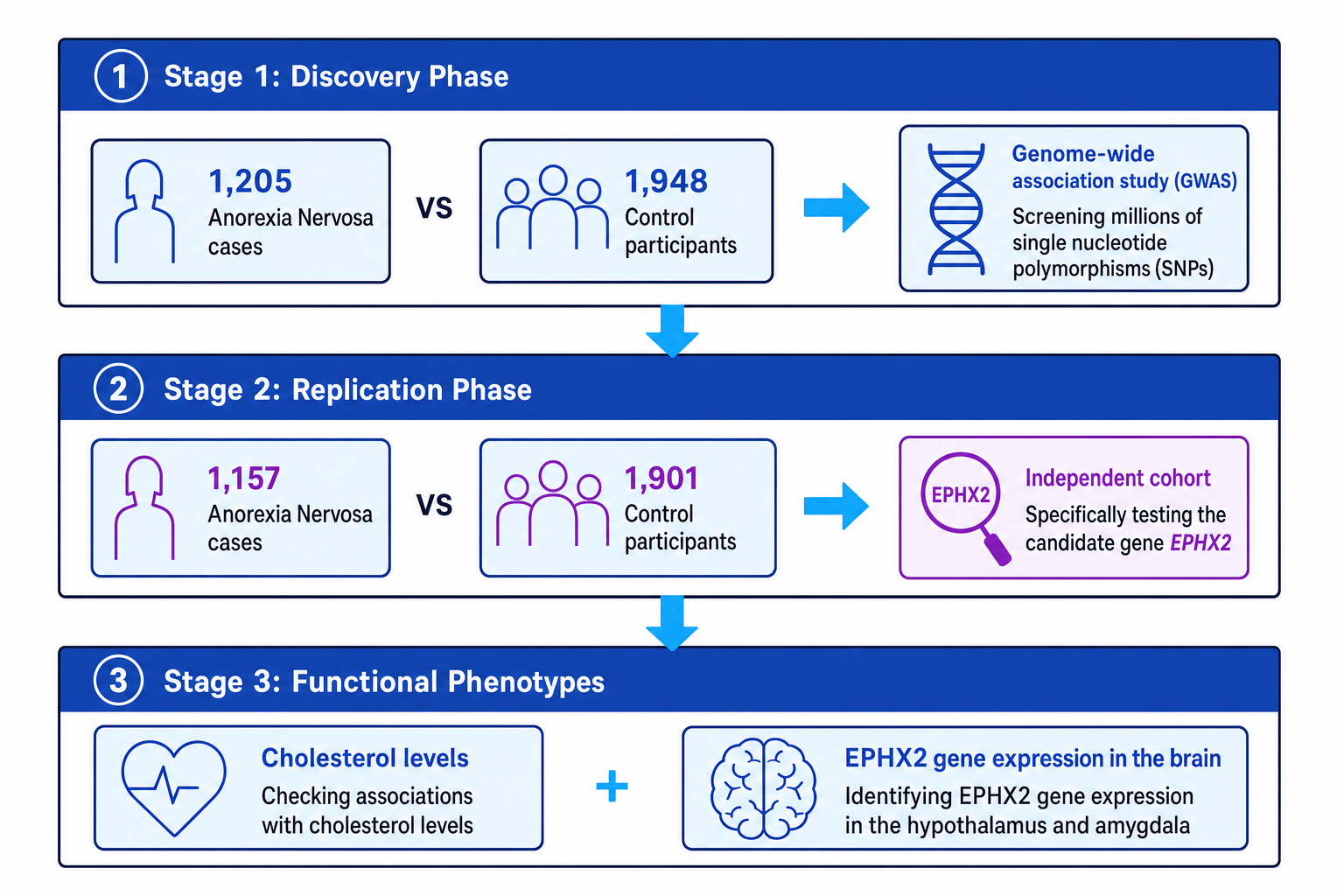
Stage 1: The Discovery Phase (GWAS)
The researchers began with a large-scale genome-wide screen:
- Sample: 1,2051,2051,205 female cases diagnosed with Anorexia Nervosa (using DSM-IV criteria) and 1,9481,9481,948 ancestry-matched female controls.
- Procedure: DNA was extracted from blood or saliva samples. They analyzed over 1.21.21.2 million SNPs across the genome to see if any specific variants appeared significantly more often in the anorexia group than in the healthy control group.
Stage 2: The Replication Phase
Because scanning millions of genes can lead to false positives (Type I errors), findings must be replicated in a completely separate sample.
- Sample: An independent cohort of 1,1571,1571,157 anorexia cases and 1,9011,9011,901 controls.
- Procedure: The researchers zoomed in on the most promising candidate gene from Stage 1—EPHX2—and tested its variants in this new, second sample to see if the statistical association held true.
Stage 3: Functional Phenotypes and Brain Expression
To understand how the gene affected the body, the researchers investigated:
- Clinical Phenotypes: They looked at whether specific variants of the EPHX2 gene in AN patients were linked to physical and psychological markers, including blood cholesterol levels, BMI, anxiety, depression, and obsessive-compulsive traits.
- Brain Expression: They analyzed where the EPHX2 gene is expressed in the brain using post-mortem brain tissues.
The Metabo-Psychiatric Link
Scott-Van Zeeland et al. did not just look at genes in isolation. By linking EPHX2 variants directly to patient cholesterol levels and brain tissue expression, they attempted to bridge the gap between molecular biology and psychological symptoms.
4. Worked Example: Statistical Correction in Genetics
In genetic studies testing thousands of SNPs, researchers run a massive risk of making a Type I error (finding a significant association purely by chance). To prevent this, they must adjust their significance level (ppp-value threshold) using a statistical correction.
Calculating a Bonferroni-corrected significance level
Suppose a geneticist tests the association of 200200200 different SNPs within a candidate gene to see if any are linked to anorexia. To maintain an overall family-wise significance level of α=.05\alpha = .05α=.05, the researcher applies a Bonferroni correction.
Calculate the adjusted ppp-value threshold (padjustedp_{\text{adjusted}}padjusted) required to declare any single SNP test statistically significant.
-
Identify the original significance level (α\alphaα) and the number of independent statistical tests (mmm): In this scenario, the baseline significance level is α=.05\alpha = .05α=.05, and the number of tests (SNPs) being evaluated is m=200m = 200m=200.
-
State the Bonferroni correction formula: The adjusted significance level is calculated by dividing the original significance level by the number of tests:
padjusted=αm p_{\text{adjusted}} = \frac{\alpha}{m} padjusted=mα -
Substitute the values into the formula and calculate:
padjusted=.05200=.00025 p_{\text{adjusted}} = \frac{.05}{200} = .00025 padjusted=200.05=.00025 -
Formulate the final statistical decision rule: To be considered genuinely significant and control for Type I errors, any individual SNP test must yield an observed ppp-value of p≤.00025p \le .00025p≤.00025.
5. Findings (AO1)
The study yielded several key results that pointed directly to the importance of the EPHX2 gene:
- Significant Genetic Association: Several SNPs within the EPHX2 gene showed a highly significant association with Anorexia Nervosa. This association was successfully confirmed in the independent replication cohort.
- Cholesterol Relationship: Specific risk-associated alleles (variants) of the EPHX2 gene were associated with higher total cholesterol levels in anorexia patients.
- Correlation with Clinical Symptoms: The genetic variations in EPHX2 were associated with clinical phenotypes, including lower body mass index (BMI) and higher scores on self-report scales measuring anxiety, depression, and eating disorder severity.
- Brain Expression: Functional analysis revealed that the EPHX2 gene is widely expressed in several key regions of the human brain, particularly in the hypothalamus (which regulates hunger and feeding behavior) and the amygdala (which processes fear and emotional responses).
Correlation is not causation
Be careful in how you write about these findings in your exams. Having the risk variant of EPHX2 does not directly cause anorexia on its own; rather, it increases genetic susceptibility by altering how the body processes fats and how key brain regions regulate eating and mood.
6. Conclusions (AO1)
Scott-Van Zeeland et al. (2013) concluded that:
- The EPHX2 gene is a susceptibility gene for Anorexia Nervosa.
- Anorexia is not purely a psychological/psychiatric condition. Instead, it has a significant metabolic component, particularly concerning cholesterol metabolism.
- This biological vulnerability likely interacts with environmental stressors to trigger the onset of the disorder.
7. Critical Evaluation (AO3)
When evaluating a contemporary study for an Edexcel A-Level essay, you must analyze its methodological strengths, limitations, ethical considerations, and real-world applications.
Strengths
- Methodological Rigour (Replication): The use of a two-stage design (a discovery phase followed by an independent replication phase) is a major strength. It greatly reduces the likelihood of false positives and increases the scientific reliability of the genetic associations found.
- Large Sample Size: With over 2,3002,3002,300 cases and 3,8003,8003,800 controls across both phases, the study has very high statistical power. This is essential in genetic studies where individual gene effects are typically very small.
- Triangulation of Data: The researchers did not just look at DNA. They combined genetic sequencing with physical clinical data (blood cholesterol), psychological self-reports, and post-mortem brain tissue studies, providing a comprehensive, multi-level explanation.
Weaknesses
- Sample Bias (Generalisability): The study focused almost exclusively on female participants of European ancestry. Because genetic frequencies and environmental interactions vary across different ethnic groups, the findings may not generalise to non-Western or male populations with anorexia.
- Self-Report Measures: The data for psychological phenotypes (like anxiety and eating attitudes) relied on self-report questionnaires. These are susceptible to social desirability bias, where patients might underreport or exaggerate symptoms, reducing validity.
- The "Missing Heritability" Problem: Although EPHX2 was significantly linked to anorexia, it only explains a tiny fraction of the overall genetic risk. Anorexia is highly polygenic, meaning it is influenced by hundreds or thousands of genes, each having a minuscule effect.
Overstating the gene's power
Do not write that Scott-Van Zeeland et al. "discovered the gene that causes anorexia". EPHX2 is only one of many genes involved. Anorexia is a complex, polygenic disorder, not a single-gene disorder like Huntington's disease.
Ethical Considerations
- Informed Consent: Obtaining fully informed consent can be complex with patients suffering from severe psychiatric conditions like anorexia. Researchers had to ensure participants were cognitively capable of consenting.
- Handling Sensitive Genetic Data: Genetic testing carries a risk of distress if participants learn they carry high-risk alleles. The researchers had to maintain strict confidentiality and ensure that genetic data was anonymised and securely stored, keeping in line with the British Psychological Society (BPS) code of ethics.
Real-World Applications
- Medical Screenings: Identifying risk genes like EPHX2 could lead to early genetic screening for vulnerable individuals (e.g., children with a family history of eating disorders), allowing for early preventative intervention.
- New Pharmacological Treatments: Knowing that soluble epoxide hydrolase (sEH) and cholesterol pathways are disrupted opens the door to developing new medications. Drugs targeting these specific metabolic pathways could help regulate appetite and physical symptoms in patients who do not respond well to traditional psychological therapies (like CBT-E).
In the exam
- Know the details: If you are asked to describe the study (AO1), make sure you can name the gene (EPHX2), state that it relates to cholesterol, and explicitly mention the two-stage process (discovery sample vs. replication sample).
- Link AO1 directly to AO3: When evaluating, don't just say "it had a large sample." Explain why that matters: "A sample of over 2,0002,0002,000 cases provides the high statistical power necessary to detect tiny genetic variations in complex, polygenic disorders."
- Use the metabolic angle for essays: If you get an essay question on biological explanations of anorexia, use Scott-Van Zeeland et al. (2013) as your biological crown jewel. It proves that anorexia is not just a psychological fear of weight gain, but a metabo-psychiatric condition.
Check yourself
- Why did the researchers specifically focus on cholesterol metabolism when investigating genetic variants in anorexia patients?
- What is the scientific purpose of using a second, independent replication cohort in genetic research?
- State two limitations of Scott-Van Zeeland et al.'s (2013) sample in terms of generalisability.
