What you'll learn
- What van IJzendoorn and Kroonenberg (1988) investigated using the Strange Situation.
- How a meta-analysis works and why it was useful for cross-cultural attachment research.
- The key findings: secure attachment was most common, but insecure patterns varied.
- How to evaluate the study for AO3, including culture bias, methodology and ethics.
Why this study matters
In Child Psychology, attachment is not just about individual parent–infant relationships. Psychologists also ask whether attachment patterns are universal — found across human societies — or shaped by cultural child-rearing practices.
Van IJzendoorn and Kroonenberg (1988) carried out the classic study “Cross-cultural patterns of attachment: A Meta-Analysis of the Strange Situation”. They wanted to know whether attachment types identified by Ainsworth in the USA appeared in similar ways across different countries.
Attachment
Attachment is a strong emotional bond between an infant and caregiver that tends to endure over time and involves seeking comfort, security and closeness.
Prerequisite: the Strange Situation
The study depends on Ainsworth et al.’s Strange Situation, so you need to be clear on this first.
The Strange Situation
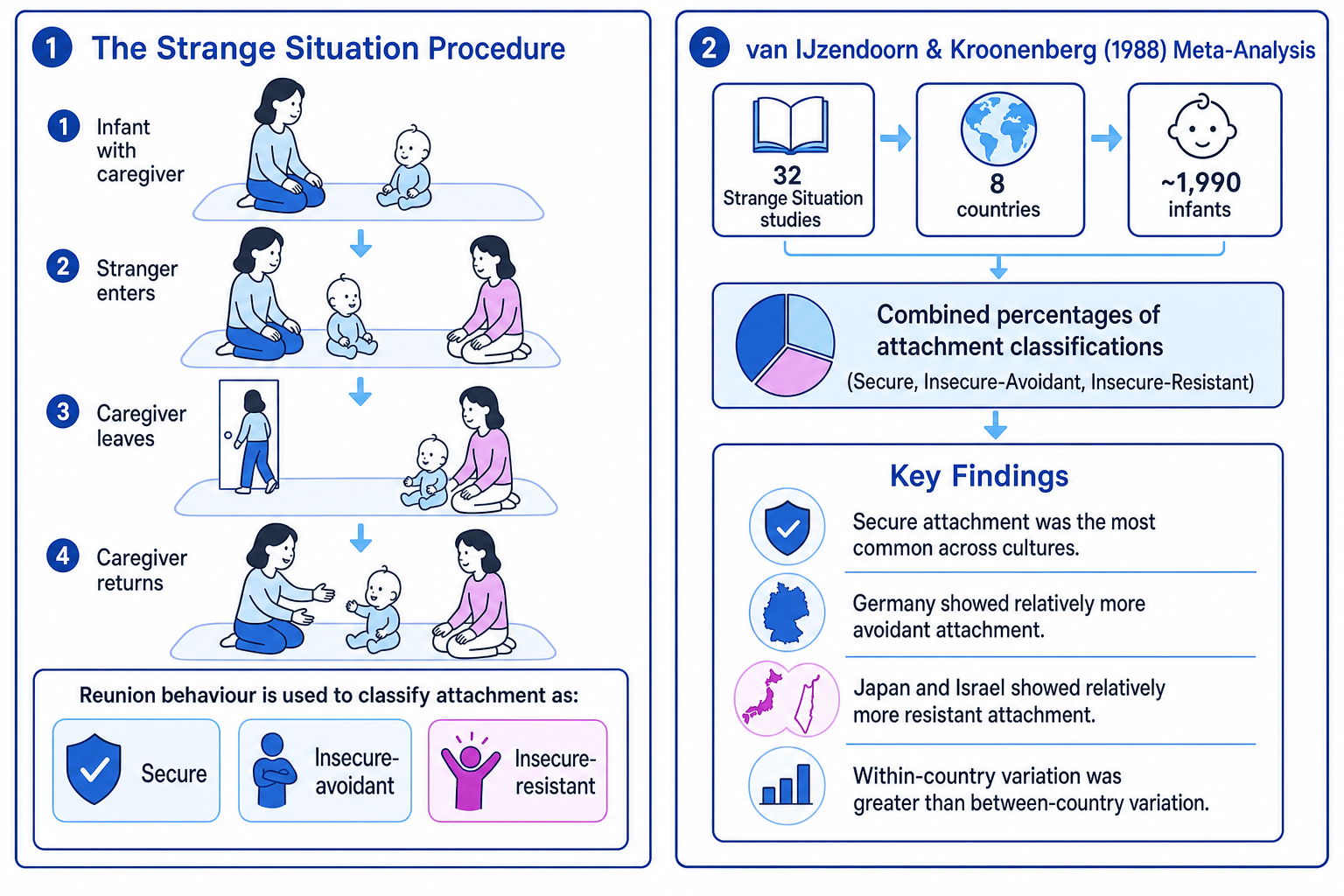
The Strange Situation is a standardised observation used to assess infant attachment. Infants experience brief separations and reunions with their caregiver, and their behaviour is classified mainly from exploration, stranger anxiety, separation anxiety and reunion behaviour.
The main attachment classifications used in van IJzendoorn and Kroonenberg’s meta-analysis were:
- Secure attachment: the infant uses the caregiver as a secure base, may be distressed by separation, and is comforted by reunion.
- Insecure-avoidant attachment: the infant shows little visible distress on separation and avoids or ignores the caregiver on reunion.
- Insecure-resistant attachment: also called insecure-ambivalent; the infant is very distressed, seeks contact, but may resist comfort and remain unsettled.
Do not add disorganised attachment
Van IJzendoorn and Kroonenberg (1988) focused on Ainsworth’s main A, B and C classifications: insecure-avoidant, secure and insecure-resistant. Disorganised attachment was developed later and is not a core finding of this study.
What is a meta-analysis?
Meta-analysis
A meta-analysis is a research method that combines the results of several studies to look for an overall pattern across a larger body of evidence.
This is different from doing one new observation. Van IJzendoorn and Kroonenberg used secondary data, meaning data already collected by other researchers. Their “participants” were not directly tested by them; instead, they analysed published Strange Situation studies.
This matters because a single cross-cultural study might be too small or unrepresentative. A meta-analysis can give a broader picture by combining many samples.
Combining percentages across studies
Imagine two Strange Situation studies report secure attachment.
-
Convert each percentage into a number of infants: if Study A has 20 infants and 50% are secure, then 20×0.50=1020 \times 0.50 = 1020×0.50=10 secure infants. If Study B has 80 infants and 70% are secure, then 80×0.70=5680 \times 0.70 = 5680×0.70=56 secure infants.
-
Add the secure infants and total sample sizes: secure infants are 10+56=6610 + 56 = 6610+56=66, and the total sample is 20+80=10020 + 80 = 10020+80=100.
-
Calculate the combined percentage: 66100×100=66%\frac{66}{100} \times 100 = 66\%10066×100=66%.
-
Compare this with a simple average of 50% and 70%, which would be 60%. The weighted calculation is better because the larger study contributes more evidence.
AO1: Aim, sample and procedure
Aim
The aim was to investigate whether attachment classifications found using the Strange Situation showed similar or different patterns across cultures.
In simple terms, they asked:
- Is secure attachment the most common type everywhere?
- Do some cultures show more insecure-avoidant or insecure-resistant attachment?
- Are differences between countries bigger than differences within the same country?
Sample
Van IJzendoorn and Kroonenberg analysed 32 Strange Situation studies from 8 countries, involving about 1,990 infants.
The countries included places such as the USA, Great Britain, the Netherlands, Germany, Japan, Israel, China and Sweden. However, the number of studies from each country was not equal; there were many more from the USA than from some other countries.
Procedure
The researchers collected studies that had used the Strange Situation and compared the percentages of infants classified as:
- Type A: insecure-avoidant
- Type B: secure
- Type C: insecure-resistant
They then compared patterns between countries and within countries.
Key findings
The main finding
Secure attachment was the most common classification across all the cultures studied, but the pattern of insecure attachment varied between countries.
Secure attachment was most common
The strongest headline result was that secure attachment was the most common type in every country studied.
This supports the idea that attachment may have a universal basis. It fits with Bowlby’s view that attachment helps infants survive by keeping them close to caregivers.
Insecure-avoidant attachment varied
Insecure-avoidant attachment was relatively high in Germany compared with many other countries.
One interpretation is that German child-rearing values may place more emphasis on independence and self-reliance. In the Strange Situation, an infant who does not seek much comfort at reunion may be classified as avoidant, but in that cultural context the behaviour might partly reflect learned independence.
Insecure-resistant attachment varied
Insecure-resistant attachment was relatively high in Japan and Israel.
For Japanese infants, one explanation is that separation from the mother may have been especially unusual and stressful, making the Strange Situation more likely to produce intense distress. For Israeli samples, particularly those involving kibbutz child-rearing contexts, infants may have had different experiences of caregivers and unfamiliar adults.
Variation within countries was important
A very important finding was that intra-cultural variation was greater than inter-cultural variation.
Intra-cultural and inter-cultural variation
Intra-cultural variation means differences between samples within the same culture or country. Inter-cultural variation means differences between cultures or countries.
This means it is too simplistic to say “German infants are like this” or “Japanese infants are like that”. Differences within a country — for example, between regions, social classes or child-rearing settings — may be larger than differences between national averages.
AO2: Applying the study
If a scenario says that infants in one country show more avoidant behaviour in the Strange Situation, you can apply van IJzendoorn and Kroonenberg by saying that the behaviour may reflect cultural norms around independence, not necessarily poor caregiving.
If a scenario says infants become very distressed during separation, you can link this to the Japanese findings: if separation from the caregiver is uncommon in that culture, the Strange Situation may be more stressful and may over-classify infants as resistant.
Best application phrase
A strong AO2 phrase is: “The Strange Situation may not have the same meaning in every culture.” This helps you move beyond simply listing findings.
AO3: Strengths of the study
Large overall evidence base
A strength is that the study combined 32 studies and nearly 2,000 infants. This gives a broader evidence base than one small observation.
Because the same basic Strange Situation procedure was used, the researchers could compare attachment classifications across studies more easily. This improves reliability, meaning consistency of measurement.
Useful real-world message
The study encourages psychologists, teachers, social workers and childcare professionals to be culturally sensitive. A behaviour that appears “insecure” in one cultural framework may have a different meaning in another.
This is useful in real-world settings such as adoption, fostering, nursery care and clinical assessment, where professionals should avoid judging families using one narrow cultural standard.
AO3: Weaknesses of the study
Culture bias and imposed etic
A major criticism is that the Strange Situation was developed in the USA. Applying it to all cultures may be an imposed etic.
An imposed etic is when a theory or method developed in one culture is treated as if it applies universally. The problem is that behaviours may not mean the same thing everywhere. For example, avoidant behaviour might reflect independence rather than emotional insecurity.
Country is not the same as culture
The study often compares countries, but a country can contain many cultures and subcultures. Social class, region, childcare arrangements and family structure may all affect attachment behaviour.
This is especially important because van IJzendoorn and Kroonenberg found that variation within countries was greater than variation between countries.
Uneven and limited samples
The studies were not evenly distributed across countries. Some countries had several studies, while others had very few. The USA was over-represented.
This limits generalisability because the findings may reflect the available research rather than a truly balanced global sample. Many non-Western cultures were not represented at all.
Secondary data problems
Because this was a meta-analysis, the researchers relied on other people’s studies. They could not fully control how each original study was carried out.
There may also be publication bias, where studies that get published are not perfectly representative of all research conducted. Studies with unusual or interesting findings may be more likely to appear in journals.
Later research adds nuance
Later research supports the idea that cultural context matters. For example, Takahashi (1990) found that Japanese infants showed high distress in the Strange Situation, possibly because separation from the mother was uncommon. This suggests the procedure itself may create different levels of stress in different cultures.
So, the classic study is valuable, but you should not treat its percentages as fixed truths about whole nations.
Ethics
Van IJzendoorn and Kroonenberg’s own study had relatively low ethical risk because it used published secondary data. The infants were not directly tested again, and the data were already anonymised.
However, the original Strange Situation studies involved infants experiencing mild stress. Under the BPS Code of Ethics and Conduct (2009), researchers would need parental consent, protection from harm, confidentiality, the right to withdraw and debriefing. Since infants cannot give informed consent themselves, researchers have a particular responsibility to stop the procedure if distress becomes excessive.
Essay-ready conclusion
Van IJzendoorn and Kroonenberg (1988) found that secure attachment was the most common type across the cultures studied, suggesting some universality in attachment. However, variations in insecure-avoidant and insecure-resistant attachment show that culture and child-rearing practices affect how attachment is expressed. The study is strong because it uses a large meta-analysis, but it is limited by culture bias, uneven samples and the danger of treating countries as if they are single cultures.
In the exam
-
Start AO1 with the full study name and method: van IJzendoorn and Kroonenberg (1988), meta-analysis of Strange Situation studies across 8 countries.
-
Include the key findings precisely: secure attachment was most common; Germany showed relatively more avoidant attachment; Japan and Israel showed relatively more resistant attachment; intra-cultural variation was greater than inter-cultural variation.
-
For AO3, do not just say “it was cross-cultural so it is generalisable”. Balance this with culture bias, imposed etic, uneven samples and the problem that country does not equal culture.
Check yourself
- Why is van IJzendoorn and Kroonenberg’s study described as a meta-analysis?
- What does it mean to say intra-cultural variation was greater than inter-cultural variation?
- How could the Strange Situation be culturally biased?
