How does playing violent video games affect how we view ourselves and others? While traditional psychological research has focused on how media violence increases aggressive behavior, Bastian et al. (2011) investigated a deeper cognitive shift: cyber-dehumanization. This study is your contemporary study for the Learning Theories and Development topic. It explores whether entering virtual worlds where we repeatedly perpetrate violence strips away our perceived humanity.
What you'll learn
- The definitions of cyber-dehumanization, uniquely human (UH) traits, and human nature (HN) traits.
- The methodology, procedures, and findings of both Experiment 1 and Experiment 2.
- How to evaluate the study's validity, reliability, ethics, and practical applications for your exam essays.
Core Concepts: Understanding Dehumanization
To understand this study, we must first look at how psychologists define "humanity." Dehumanization is not just treating someone badly; it is a psychological process where we perceive others—or even ourselves—as lacking the core qualities that make us human.
Bastian et al. divided human characteristics into two distinct types:
Uniquely Human (UH) Traits
Uniquely Human (UH) traits are attributes that distinguish humans from animals. They include cognitive capacity, civility, refinement, rationality, moral agency, and maturity. When these are denied, people are viewed as animal-like (animalistic dehumanization).
Human Nature (HN) Traits
Human Nature (HN) traits are attributes that distinguish humans from objects, robots, or machines. They include emotional warmth, cognitive flexibility, agency, and vital interests. When these are denied, people are viewed as cold, sterile, and machine-like (mechanistic dehumanization).
In the context of violent video games, players regularly commit extreme acts of violence against game characters or other online players. Bastian et al. wanted to see if this leads to two types of dehumanization:
- Target-dehumanization: Perceiving the opponent/co-player as lacking human qualities.
- Self-dehumanization: Perceiving oneself as lacking human qualities after committing virtual violence.
Experiment 1: Laboratory Investigation
The first experiment aimed to test whether playing a violent video game against another person in a controlled laboratory environment would lead to both self-dehumanization and target-dehumanization.
Methodology and Sample
- Participants: 106 undergraduate students (58 female, 48 male) from an Australian university.
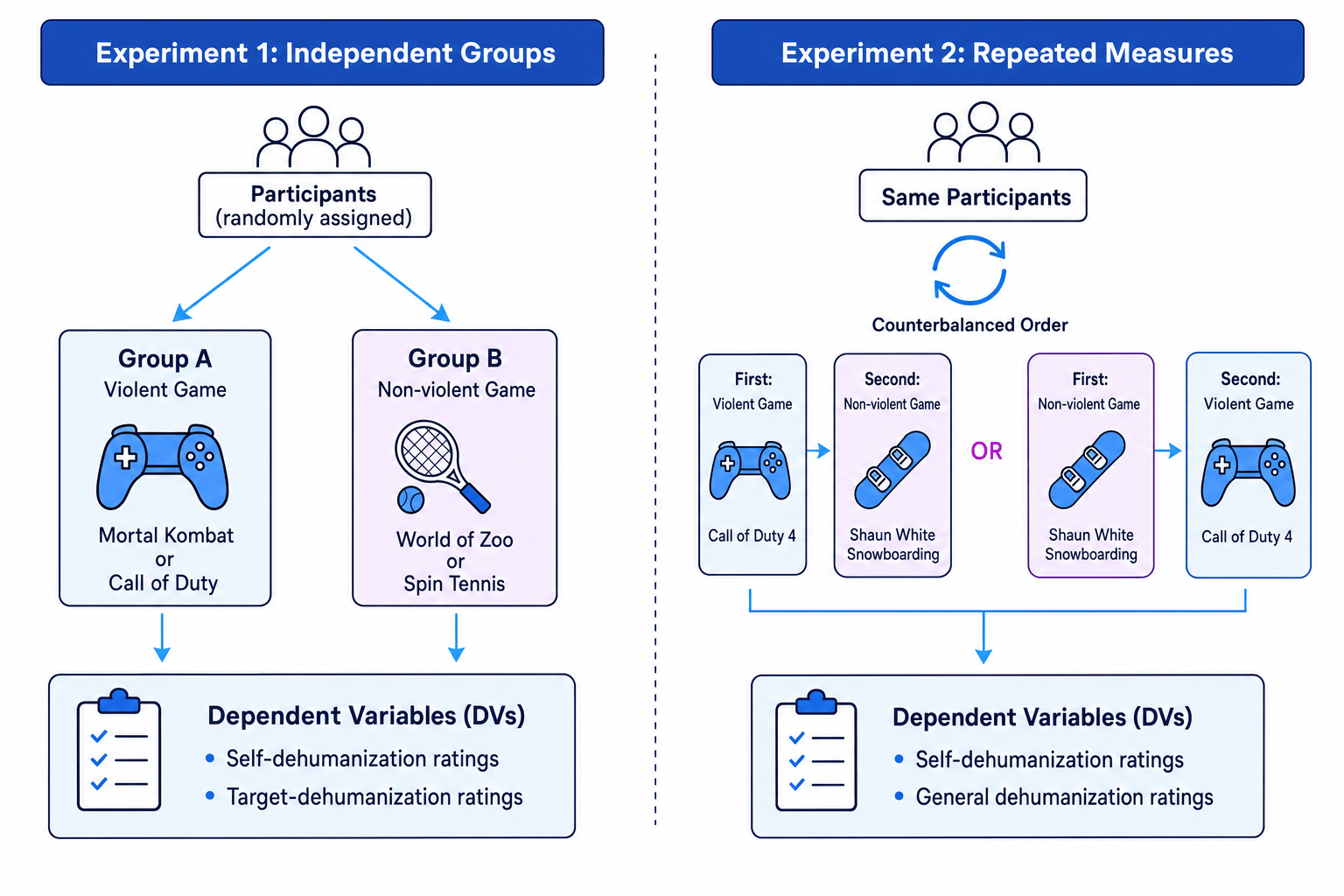
- Research Design: Independent groups design. Participants were randomly assigned to play either a violent or a non-violent video game in pairs (co-players).
- Independent Variable (IV): The type of game played for 15 minutes:
- Violent Condition: Mortal Kombat or Call of Duty.
- Non-Violent Condition: Spin Tennis or World of Zoo.
- Dependent Variables (DVs):
- Ratings of self-humanity (to measure self-dehumanization).
- Ratings of co-player's humanity (to measure target-dehumanization).
- These were measured using a 7-point Likert scale rating both UH traits (e.g., refined, rational) and HN traits (e.g., warm, emotional).
- The researchers also measured control variables like the participants' mood (using the PANAS scale) and game enjoyment/difficulty to ensure these did not confound the results.
Findings
- Participants who played the violent video games rated themselves significantly lower in both UH and HN traits compared to those who played the non-violent games.
- Participants also rated their co-players significantly lower in both UH and HN traits in the violent condition than in the non-violent condition.
- These differences remained significant even when controlling for variables like age, gender, mood, and game enjoyment.
Headline Takeaway: Experiment 1
Playing a violent video game for just 15 minutes against an opponent significantly diminished players' perceptions of both their own humanity (self-dehumanization) and their opponent's humanity (target-dehumanization).
Experiment 2: Addressing Participant Variables
A major limitation of Experiment 1's independent groups design is that individual differences (participant variables) could have influenced the results, despite random allocation. Experiment 2 was designed to rule this out by using a repeated measures design where every participant played both types of games.
Methodology and Sample
- Participants: 38 undergraduate students (21 male, 17 female).
- Research Design: Repeated measures design. To control for order effects (where playing the first game affects performance or mood in the second), the researchers used counterbalancing (half of the participants played the violent game first, and the other half played the non-violent game first).
- Independent Variable (IV): Game type played:
- Violent Game: Call of Duty 4.
- Non-Violent Game: Shaun White Snowboarding.
- Dependent Variables (DVs):
- Ratings of self-humanity (UH and HN traits).
- Ratings of humanity of players in general (rather than a specific co-player, because they played solo/online).
Findings
- The findings replicated Experiment 1: participants reported significantly lower self-humanity (self-dehumanization) after playing the violent game than after playing the non-violent game.
- They also rated the general population of video game players as lower in human qualities after playing the violent game.
- Because the same participants were tested in both conditions, this experiment confirmed that the dehumanizing effect was caused by the game content itself, not by pre-existing personality differences.
Research Methods Application: Statistical Significance
In Edexcel Psychology, you must understand how researchers use inferential statistics to draw conclusions. Ratings on Likert scales (such as the 1-to-7 scale used by Bastian et al.) are treated as ordinal data (data that can be ordered, but where the intervals between the points are not necessarily equal).
Let's look at how a researcher chooses the correct inferential test to analyze differences in a study like this.
Selecting the correct statistical test
Imagine you are asked to select the appropriate non-parametric statistical test to analyze the self-dehumanization scores from both Experiment 1 and Experiment 2.
-
Identify the experimental design for each experiment.
- Experiment 1 uses an independent groups design (different participants in violent vs. non-violent conditions).
- Experiment 2 uses a repeated measures design (same participants in both conditions).
-
Identify the level of measurement.
- In both cases, the data consists of Likert rating scale scores, which is classified as ordinal data.
-
Select the correct statistical test based on design and data type.
- For Experiment 1 (test of difference, independent groups, ordinal data): The correct non-parametric test is the Mann-Whitney U test.
- For Experiment 2 (test of difference, repeated measures, ordinal data): The correct non-parametric test is the Wilcoxon Signed-Ranks test.
Statistical Significance Conventions
In psychological research, the standard significance level used is p≤.05p \le .05p≤.05. This means there is a 5%5\%5% or lower probability that the observed difference occurred by chance. Bastian et al. (2011) found highly significant results (often p<.01p < .01p<.01), meaning we can be very confident that video game violence was the cause of the dehumanization.
Evaluating Bastian et al. (2011) (AO3)
To score highly on 8-mark or 12-mark essay questions, you must provide balanced, analytical evaluation. Use the GRAVE framework (Generalizability, Reliability, Application, Validity, Ethics) to structure your points.
Strengths
- High Internal Validity (Controls): Both experiments were conducted in controlled laboratory settings. In Experiment 1, the researchers controlled for variables like baseline mood, game difficulty, and game enjoyment. This ensures that the drop in humanity ratings was specifically due to the violent content of the games, establishing a clear cause-and-effect relationship.
- Controlling for Participant Variables (Reliability & Validity): Experiment 2 used a repeated measures design. By testing the same participants in both conditions, Bastian et al. ruled out the possibility that participants in the violent condition were naturally less empathetic or more cold-hearted than those in the non-violent condition.
- Counterbalancing: In Experiment 2, counterbalancing was used to control for order effects (such as fatigue or boredom). This prevents the order of play from confounding the results.
Weaknesses
- Low Mundane Realism & Ecological Validity: Playing video games in an artificial university laboratory for exactly 15 minutes does not reflect how people play games in real life (often for hours, in the comfort of their own homes, while talking to friends). Therefore, the findings may not fully generalize to natural gaming environments.
- Response Bias (Social Desirability): The study relied entirely on self-report questionnaires (Likert scales). Participants might have guessed the aim of the study or felt uncomfortable admitting to feeling "less human," leading to biased responses.
- Sample Bias (Generalizability): Both samples consisted of university students from a single Australian university. Students are not representative of the wider population of video game players, who span a huge range of ages, backgrounds, and cultures.
Confusing Dehumanization with Aggression
Do not write that Bastian et al. directly measured aggressive behavior (like hitting or blasting noise). They measured dehumanization (beliefs about humanity). While theories suggest dehumanization leads to aggression, this study only measured the cognitive shift, not physical or verbal aggression itself.
Ethical Considerations
Applying the BPS Code of Ethics and Conduct (2009):
- Protection from Harm: There is a risk that playing highly violent games like Mortal Kombat or Call of Duty could cause mild psychological distress, anxiety, or temporarily hostile feelings. However, the exposure was brief (15 minutes), and the games used were commercially available and widely played, meaning the harm did not exceed everyday risks.
- Deception and Consent: Participants were not fully informed about the specific hypothesis (that violent games make them feel less human) to avoid demand characteristics. However, they provided informed consent to participate in a study about "video games" and were fully debriefed afterwards.
Real-World Applications
Why do these findings matter?
- Media Regulation & Age Ratings: The study supports the strict enforcement of age ratings (e.g., PEGI or ESRB ratings) on violent games, as young, developing minds may be even more vulnerable to self- and target-dehumanization.
- Explaining Real-World Violence: Dehumanization is a precursor to severe anti-social behavior and bullying. Understanding that virtual violence triggers dehumanization helps schools and psychologists design targeted empathy-building interventions for heavy gamers.
In the exam
- Differentiate the two experiments: If an exam question asks you to describe the procedure of Bastian et al. (2011), make sure you explicitly mention that there were two experiments. Detail the independent groups design of Experiment 1 and the repeated measures design of Experiment 2.
- Use the precise terminology: Do not just say "they felt bad." Use terms like Uniquely Human (UH) and Human Nature (HN) traits, self-dehumanization, and target-dehumanization.
- Link to Learning Theories: Remember that this study is situated within the "Learning Theories" topic. In an essay, connect these cognitive changes to Social Learning Theory (SLT): dehumanization removes the cognitive barriers (such as empathy) that normally stop us from imitating violent role models.
Check yourself
- Can you explain the difference between a Uniquely Human (UH) trait and a Human Nature (HN) trait?
- What was the purpose of changing from an independent groups design in Experiment 1 to a repeated measures design in Experiment 2?
- What are two methodological weaknesses of using university student samples and laboratory settings in this study?
