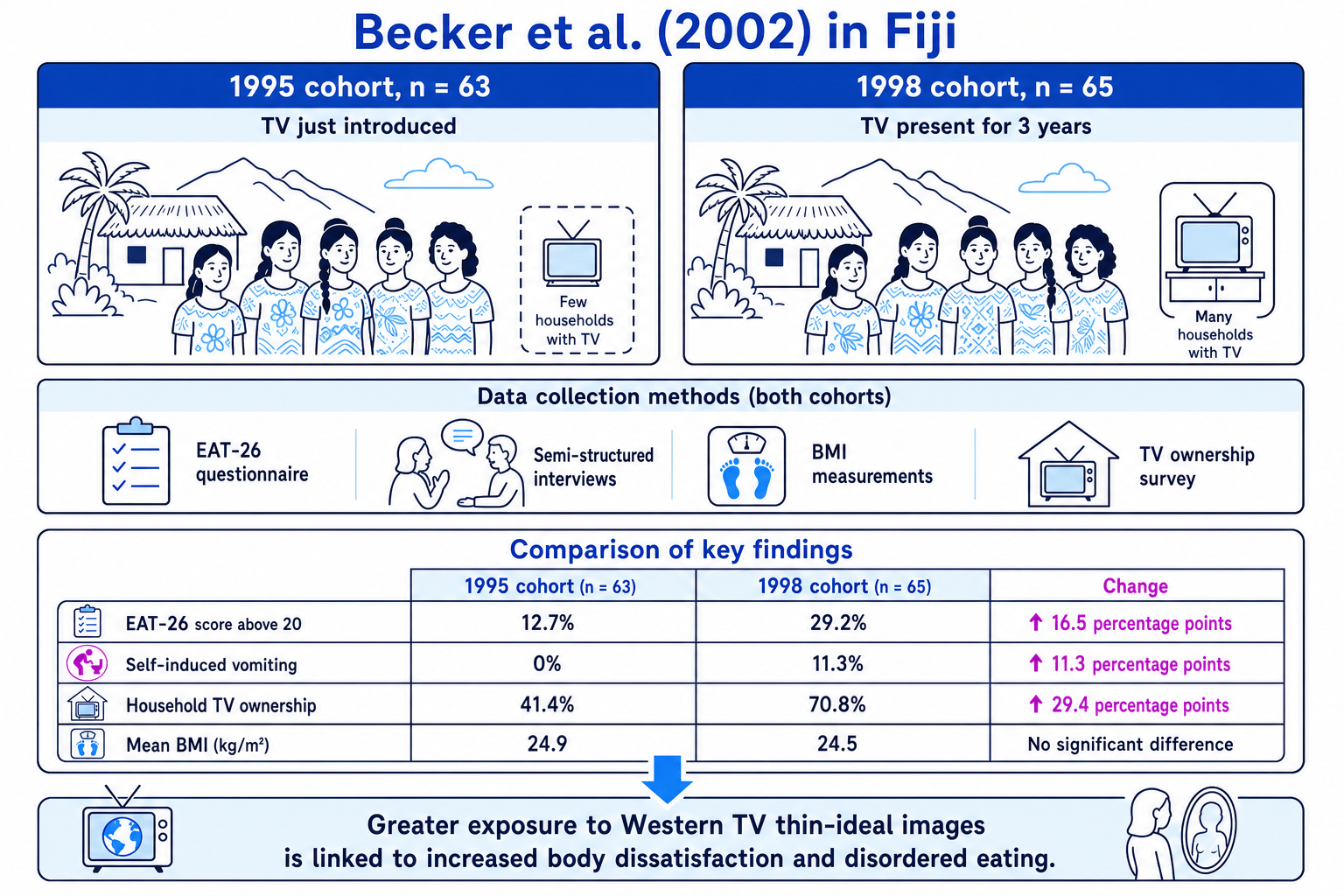
This contemporary study is a key component of your Learning Theories and Development topic (Section 4.3.2). It provides critical real-world evidence for Social Learning Theory (SLT) by investigating how the introduction of television altered cultural body ideals and eating behaviours in a community previously unexposed to Western media.
What you'll learn
- The cultural context of Fiji before the introduction of television.
- How Becker et al. designed and conducted this natural experiment.
- Key quantitative and qualitative findings regarding EAT-26 scores and self-induced vomiting.
- How to evaluate the study using methodological, practical, and ethical criteria (AO3).
Prerequisites: Cultural Context and Social Learning
To understand the impact of Becker et al.’s research, you must first understand the cultural landscape of Fiji in the mid-1990s.
Traditionally, ethnic Fijian culture celebrated a robust and well-rounded body shape. A larger body was traditionally associated with:
- Health, strength, and physical fertility.
- Generosity and care from the community (reflecting that a person was well-fed and cherished by their family).
- A collective responsibility for feeding and nutrition.
Before 1995, there was virtually no clinical awareness of eating disorders, and dieting or body dissatisfaction were culturally alien concepts.
Disordered Eating
Disordered eating refers to a range of irregular eating behaviours that may or may not warrant a clinical diagnosis of an eating disorder (like anorexia or bulimia nervosa). Examples include self-induced vomiting, extreme dieting, and severe anxiety around body weight or shape.
In 1995, broadcast television was introduced to the Nadroga province of Fiji. This created a unique opportunity for researchers to study the immediate, real-time effects of Western media exposure on a population that had never experienced it before.
The Power of Social Learning Theory (SLT)
Social Learning Theory predicts that individuals learn new behaviours by observing and imitating models (e.g., thin actors in Western TV shows) who receive vicarious reinforcement (e.g., popularity, wealth, or romantic success). Becker et al. set out to test this prediction in a real-world setting.
Aim of the Study
Becker et al. (2002) aimed to investigate the impact of prolonged exposure to television on eating attitudes and behaviours among ethnic Fijian adolescent girls.
Specifically, they wanted to determine whether the introduction of media showcasing Western thin-ideal body shapes would lead to:
- An increase in body dissatisfaction.
- A rise in disordered eating behaviours (such as purging/self-induced vomiting).
Methodology & Procedure
This study is classified as a natural experiment (or a quasi-experiment) with a cross-sectional design comparing two separate, independent cohorts of adolescent girls.
Natural Experiment
A natural experiment is an empirical study where the independent variable (IV) is naturally occurring and is not manipulated by the researchers. In this study, the IV was the introduction of television to the community.
The Sample
The participants were ethnic Fijian girls aged 15 to 19 from schools in the Nadroga district.
- 1995 Cohort: n=63n = 63n=63 girls studied just as television was being introduced.
- 1998 Cohort: n=65n = 65n=65 girls studied three years after television had been introduced.
The Procedure
The researchers used a mixed-methods approach to gather both quantitative (numerical) and qualitative (descriptive) data.
                  +-----------------------------------+
                  |      Ethnic Fijian Girls (15-19)  |
                  +-----------------------------------+
                                    |
            +-----------------------+-----------------------+
            |                                               |
  [ 1995 Cohort (n = 63) ]                        [ 1998 Cohort (n = 65) ]
  • TV just introduced                            • TV present for 3 years
            |                                               |
            +-----------------------+-----------------------+
                                    |
                 +-------------------------------------+
                 |           Data Collection           |
                 |  • EAT-26 Questionnaire (>20 risk)  |
                 |  • Semi-Structured Interviews       |
                 |  • BMI (Weight/Height) Measures     |
                 +-------------------------------------+
- EAT-26 Questionnaire: All participants completed the standard Eating Attitudes Test (EAT-26), a clinical survey measuring symptoms of eating disorders. A score above 20 indicates a high risk of disordered eating.
- Semi-structured Interviews: Participants who indicated disordered eating behaviours (or a subset of girls) were interviewed about their attitudes toward body image, beauty ideals, and television.
- Physical Measurements: The height and weight of each participant were measured to calculate their Body Mass Index (BMI), ensuring any change in eating habits was not simply due to physical weight changes.
- TV Ownership Survey: Participants were asked about whether they had a television in their household and how often they watched it.
Key Findings
The results of Becker et al. (2002) revealed a dramatic shift in both eating behaviours and cultural attitudes over the three-year period.
Quantitative Findings
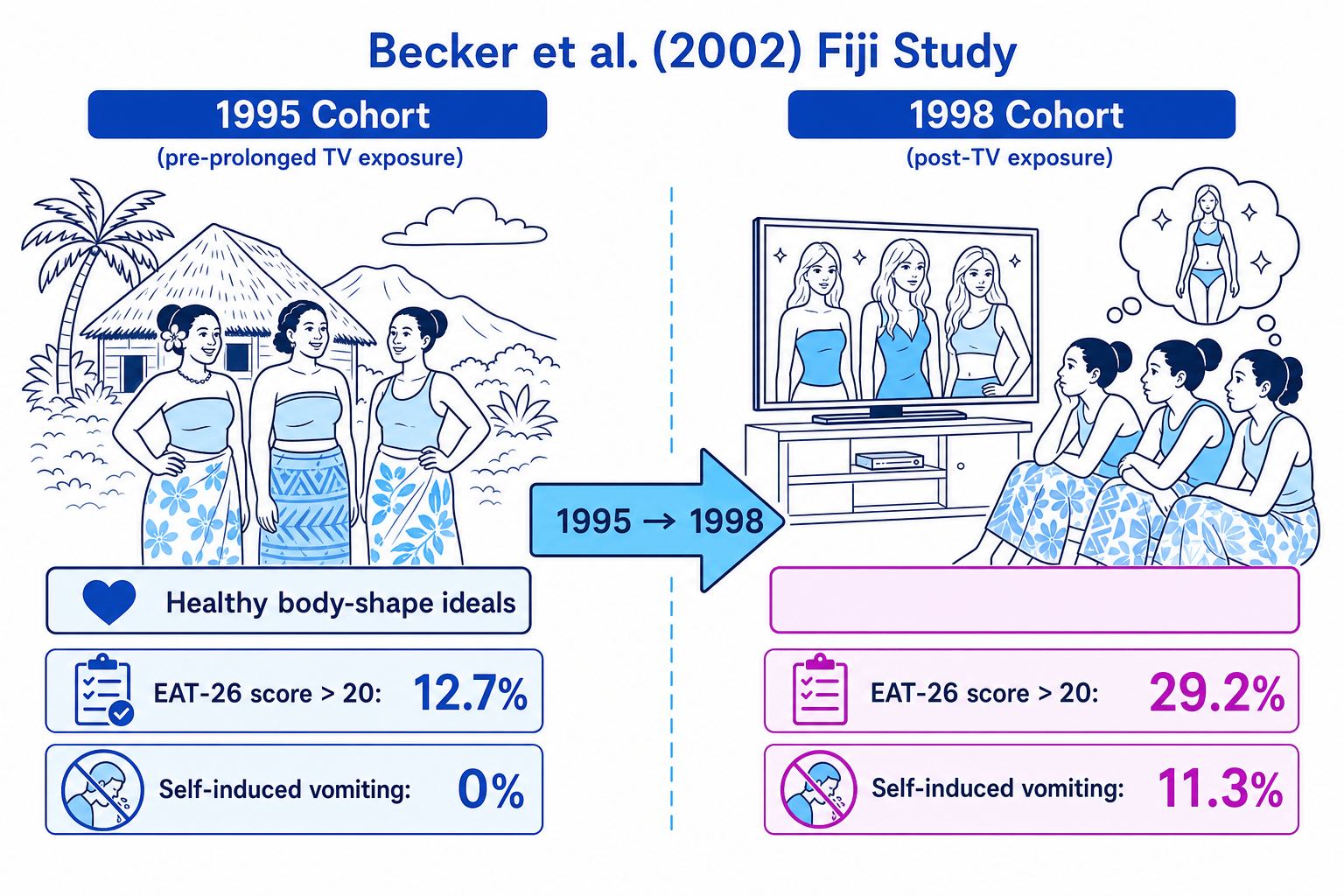
- EAT-26 Scores: The percentage of girls scoring above 20 on the EAT-26 (indicating serious risk of disordered eating) rose from 12.7% in 1995 to 29.2% in 1998. This difference was statistically significant.
- Purging (Self-Induced Vomiting): In 1995, 0% of the girls reported purging to control their weight. By 1998, this figure had risen sharply to 11.3%.
- Television Ownership: Household TV ownership increased from 41.4% in 1995 to 70.8% in 1998.
- Body Mass Index (BMI): There was no significant difference in average BMI between the 1995 cohort (mean = 24.9) and the 1998 cohort (mean = 24.5). This indicates that changes in eating attitudes were psychological rather than reflecting changes in actual physical weight distribution.
Qualitative Findings
The semi-structured interviews in 1998 revealed a direct link between media consumption and body image ideals:
- Many girls expressed a desire to reshape their bodies to look more like the Western television characters they watched on shows like Melrose Place and Beverly Hills 90210.
- Participants remarked that slimness was associated with modernization, career success, and being "desirable."
- The girls reported experiencing conflict between traditional Fijian values (which encouraged eating well) and the new cultural pressure to be thin.
Calculating percentage increase and identifying statistical significance
In psychological research, we often convert raw statistics into percentage changes to highlight trends. We also use inferential statistics to determine whether a trend is meaningful.
Problem:
- Calculate the relative percentage increase in ethnic Fijian girls scoring above 20 on the EAT-26 questionnaire between 1995 and 1998.
- Given that the researchers conducted a Chi-square test on this change and obtained a significance value of p=.03p = .03p=.03, explain what this tells us about the null hypothesis at the standard p≤.05p \le .05p≤.05 level.
Solution:
-
Identify the baseline and final values:
- 1995 (baseline) value: 12.7%12.7\%12.7%
- 1998 (final) value: 29.2%29.2\%29.2%
-
Calculate the absolute increase:
29.2−12.7=16.5 29.2 - 12.7 = 16.5 29.2−12.7=16.5 -
Calculate the relative percentage increase: Use the percentage change formula:
Percentage Increase=Absolute ChangeOriginal Value×100 \text{Percentage Increase} = \frac{\text{Absolute Change}}{\text{Original Value}} \times 100 Percentage Increase=Original ValueAbsolute Change×100 Percentage Increase=16.512.7×100≈129.92% \text{Percentage Increase} = \frac{16.5}{12.7} \times 100 \approx 129.92\% Percentage Increase=12.716.5×100≈129.92%The proportion of girls scoring above 20 on the EAT-26 increased by approximately 130%130\%130%.
-
Assess the statistical significance of the Chi-square test:
- Compare the observed probability (p=.03p = .03p=.03) with the significance threshold (α=.05\alpha = .05α=.05).
- Because .03≤.05.03 \le .05.03≤.05, the probability that this dramatic increase occurred by random sampling variation is less than 3%.
- Therefore, we reject the null hypothesis and accept the alternative hypothesis. The increase in disordered eating attitudes between 1995 and 1998 is statistically significant.
Conclusions
Becker et al. concluded that prolonged exposure to media featuring thin-ideal roles models can rapidly undermine traditional body ideals and lead to disordered eating behaviours, even in a culture with historically strong protections against body dissatisfaction.
This study provides compelling evidence for Social Learning Theory, suggesting that the girls observed thin characters receiving praise, attention, and high social status (vicarious reinforcement) and imitated these behaviours (purging, dieting) to achieve the same rewards.
Confusing Cohorts with Longitudinal Designs
Many students mistakenly write that the same group of girls was followed over three years. This is incorrect. It was a cross-sectional study using two different independent cohorts (one in 1995, one in 1998). Make sure to state that they were different groups of girls to show precise methodological understanding.
Evaluation (AO3)
When evaluating a study in A-Level Psychology, structure your points using the G-R-A-V-E framework.
Strengths
- High Ecological Validity (V): Because this was a natural experiment, the independent variable (introduction of TV) occurred naturally. The girls remained in their everyday environments, meaning their media exposure and behavioural reactions were entirely authentic.
- Mixed-Methods Design (V/R): By combining quantitative questionnaires (EAT-26) with qualitative interviews, Becker et al. achieved both objective, standardized measurements and deep, rich insights into the girls' subjective thoughts and motivations.
- Practical Application (A): The findings have major real-world applications. They highlight the danger of exporting Western media to vulnerable cultures, prompting calls for more diverse body sizes in global broadcasting and the development of targeted eating-disorder prevention programs.
Weaknesses
- Issues with Generalisability (G): The sample consisted exclusively of adolescent ethnic Fijian girls. The findings may not generalize to:
- Male adolescents, who may react differently to media exposure.
- Individuals in older or younger age brackets.
- Western cultures that have already developed complex psychological coping mechanisms over decades of media exposure.
- Lack of Direct Control (V): Because this was a natural experiment, the researchers could not control for extraneous variables. For instance, we cannot be certain that the increase in eating disorders wasn't influenced by other elements of Westernization, such as changes in dietary options, fashion trends, or economic developments occurring between 1995 and 1998.
- Ethical Considerations (E): Although the researchers did not introduce television themselves (avoiding direct harm), they uncovered high rates of self-induced vomiting and eating distress among vulnerable teenagers. Under modern BPS guidelines, researchers have a duty to protect participants from harm and ensure that those showing severe clinical symptoms are offered appropriate psychiatric support.
Integrating Issues and Debates
Use the "Nature vs. Nurture" debate to elevate your AO3 evaluation. Becker's study strongly supports the Nurture side of the debate, demonstrating that eating disorders are heavily influenced by environmental conditioning, cultural context, and social learning, rather than being purely hardwired biological (nature) conditions.
In the exam
If you are asked about Becker et al. (2002) in an exam, use these three strategy tips:
- Always lead with the culture: Clearly explain the baseline traditional cultural ideal in Fiji (robust body shape = positive) to highlight why the sudden appearance of dieting and purging was such a radical, unexpected shift.
- Be precise with the statistics: Memorise at least two key numbers (e.g., EAT-26 scores rising from 12.7%12.7\%12.7% to 29.2%29.2\%29.2%, or purging rising from 0%0\%0% to 11.3%11.3\%11.3%). Precise quantitative data will guarantee top-band AO1 marks.
- Explicitly link to Social Learning Theory: Don't just describe what the girls did; explain why they did it using SLT terms. Mention vicarious reinforcement (observing TV characters gain status/success) and imitation of attractive role models.
Check yourself
- Why did the researchers measure the participants' BMI, and what did these measurements reveal about the change in eating attitudes?
- What is the difference between the 1995 cohort and the 1998 cohort, and why does this mean the study is not a longitudinal design?
- How did the qualitative interview data support the idea that Social Learning Theory explains the rise in body dissatisfaction?