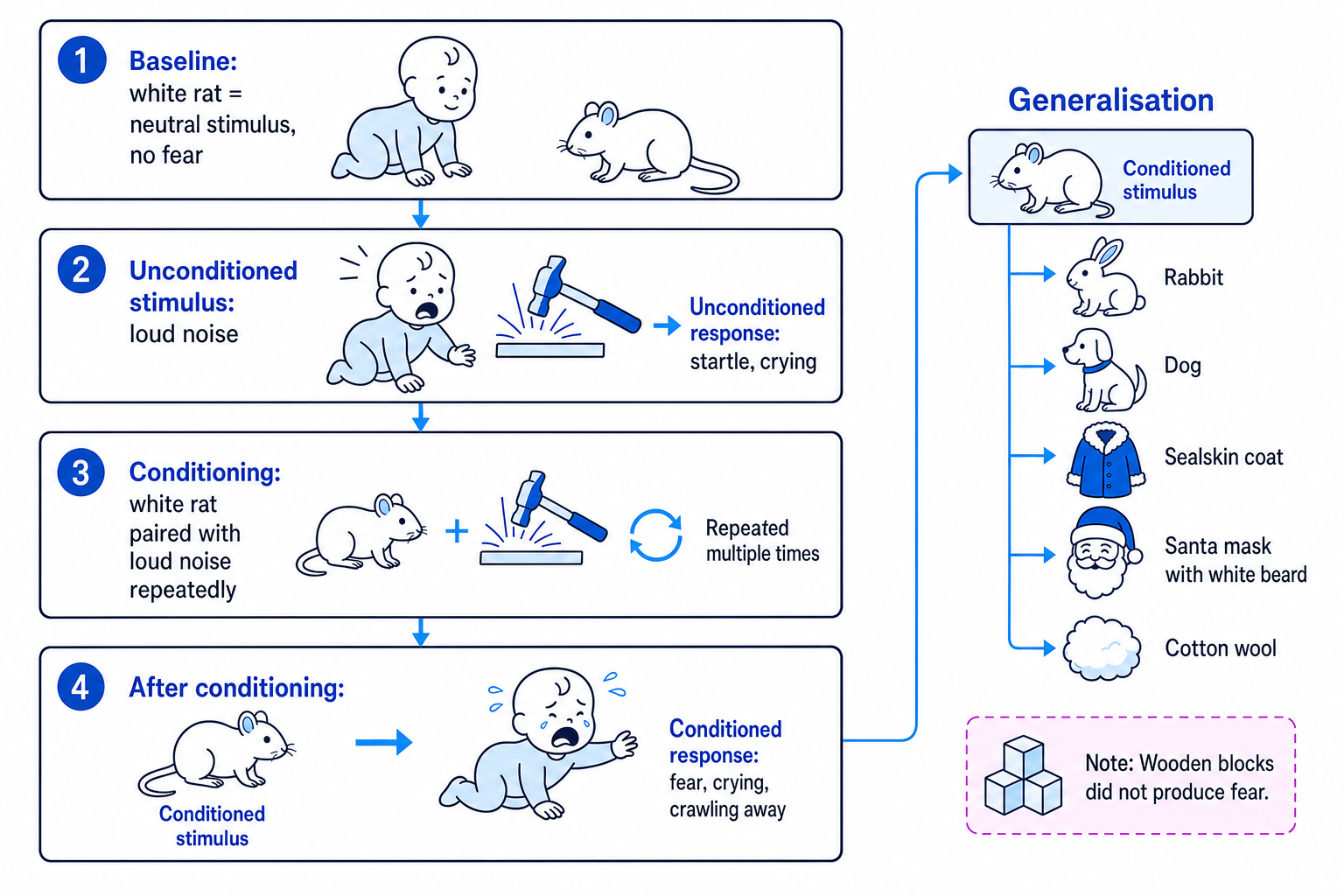
In the early 20th century, the dominant perspective in psychology was shifting from looking at the inner, unobservable mind (psychodynamic approach) to investigating measurable, observable behaviour (behaviourist approach). Watson and Rayner (1920) wanted to demonstrate that human emotions, specifically fear, are not innate or driven by unconscious conflicts, but are learned through simple environmental associations.
This study is your core classic study for the Learning Theories topic in your Edexcel A-Level Psychology specification.
What you'll learn
- The aim, methodology, and results of Watson and Rayner's (1920) study on Little Albert.
- How classical conditioning explains the acquisition and generalisation of phobias.
- How to critically evaluate the study's strengths, weaknesses, and substantial ethical implications.
Prerequisite: The Classical Conditioning Model
Before looking at the study itself, we must define the core mechanism Watson and Rayner used: classical conditioning.
Classical Conditioning
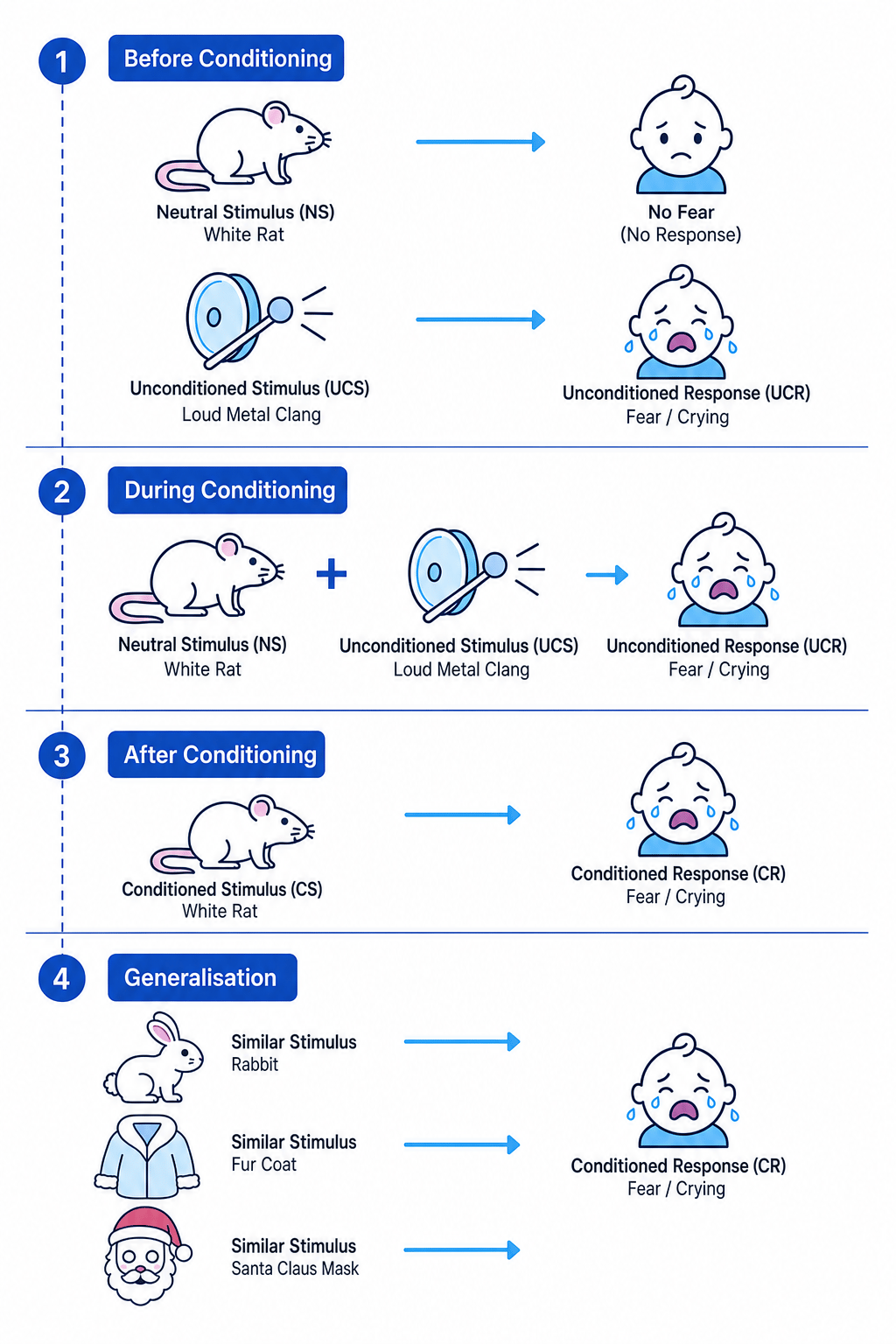
Classical conditioning is a form of learning by association. It occurs when a neutral stimulus is repeatedly paired with an unconditioned stimulus that naturally produces a response, until the neutral stimulus eventually produces the same response on its own.
To understand the experiment, you need to be comfortable with these terms:
- Unconditioned Stimulus (UCS): Something in the environment that naturally and automatically triggers a response without any prior learning.
- Unconditioned Response (UCR): The unlearned, natural reaction that occurs automatically in response to the UCS.
- Neutral Stimulus (NS): A stimulus that initially does not elicit any specific fear or emotional response.
- Conditioned Stimulus (CS): A previously neutral stimulus that, after becoming associated with the UCS, eventually comes to trigger a conditioned response.
- Conditioned Response (CR): The learned reaction to a previously neutral (but now conditioned) stimulus.
Watson and Rayner (1920): The Study
Aim
To investigate whether an infant could be classically conditioned to fear an initially neutral stimulus (a white rat), and to see whether this learned fear would generalise to other similar stimuli.
Participant
The study used a single infant participant, known as "Little Albert", who was 11 months old when the conditioning began. He was chosen because he was judged to be emotionally stable, healthy, and "phlegmatic" (not easily frightened or crying). His mother was a wet nurse at the hospital where the study took place, and Albert lived in the hospital environment.
The Procedure
The study was a controlled observation conducted in a laboratory room at Johns Hopkins University. It was split into several distinct phases:
1. Baseline Testing (Establishing the stimuli)
- Testing the Neutral Stimulus (NS): Albert was presented with a white rat, a rabbit, a dog, a monkey, masks with and without hair, and cotton wool. He showed no fear or crying; he reached out to play with them.
- Testing the Unconditioned Stimulus (UCS): To establish a fear response, the researchers struck a suspended steel bar with a hammer just behind Albert’s head. This loud, sudden sound (UCS) made him jump, whimper, and cry (UCR).
2. The Conditioning Phase
When Albert was 11 months and 3 days old, the conditioning trials began.
- Albert was presented with the white rat (NS).
- As soon as he reached out to touch the rat, the hammer struck the steel bar (UCS) behind his head.
- This paired presentation was repeated multiple times over several weeks.
3. Testing the Conditioned Response
After several pairings, the rat was presented on its own without the loud sound. The researchers recorded Albert's reaction to see if he had developed a fear response to the rat (CS).
4. Generalisation Testing
The researchers wanted to see if Albert's fear would transfer to other similar stimuli.
Generalisation
Generalisation is when a conditioned response is triggered not only by the original conditioned stimulus, but also by other stimuli that share similar physical characteristics with it.
Albert was presented with other furry objects, including a rabbit, a dog, a sealskin coat, cotton wool, and a Santa Claus mask with a white, fluffy beard.
5. Change of Environment
To ensure the fear was not bound to the specific laboratory room, Albert was tested in a different, larger lecture room with brighter lighting.
Results
- Baseline: Albert showed no fear of the white rat or other furry objects initially.
- During Conditioning: After only a few pairings, Albert became hesitant around the rat.
- After Conditioning: When presented with the white rat alone, Albert whimpered, burst into tears, and crawled away rapidly. The white rat had successfully become a Conditioned Stimulus (CS) causing a Conditioned Response (CR) of fear.
- Generalisation: Albert showed strong fear responses to the rabbit, the dog, and the sealskin coat. He showed a mild, negative reaction to the cotton wool and the Santa Claus mask. He showed no fear towards non-furry objects like wooden blocks.
- Time and Environment: The fear response persisted in the new lecture room, although it was slightly less intense. When tested 31 days after the conditioning had stopped, Albert still showed a fear response to the rat and other furry objects.
Conclusion
Watson and Rayner concluded that emotional responses (such as fear) can be successfully conditioned in humans using the classical conditioning model. Furthermore, this learned fear is not restricted to the original conditioned stimulus but can generalise to other objects that share similar characteristics.
Phobias as learned behaviours
The primary takeaway from Watson and Rayner's study is that phobias are not necessarily the result of deep psychological trauma or repressed conflicts (as Freud argued). Instead, they are simple, learned behaviours acquired through environmental association.
Applying Classical Conditioning to Phobias
In your Edexcel exams, you will often be asked to apply the classical conditioning model to novel scenarios (AO2). Let's work through an example of how to systematically map out classical conditioning variables in a practical application.
Deconstructing phobia acquisition using classical conditioning
Scenario: Clara was involved in a minor car accident when a sudden, loud tire blowout caused her to crash into a barrier. She escaped unhurt but was deeply terrified by the noise and impact. Since then, Clara experiences intense anxiety and panic whenever she sees or has to get into a car.
Deconstruct this scenario using the classical conditioning model to explain how Clara developed her phobia of cars.
Step-by-step solution:
- Identify the Unconditioned Stimulus (UCS) and Unconditioned Response (UCR): Locate the natural, biological threat and the corresponding reflexive reaction. In this scenario, the sudden, loud tire blowout and crash are terrifying and naturally trigger fear/anxiety. Thus, the blowout/crash is the UCS, and the resulting fear/panic is the UCR.
- Identify the Neutral Stimulus (NS) that becomes the Conditioned Stimulus (CS): Look for the environmental object or situation that was present during the event but did not previously cause fear. Here, cars were previously neutral to Clara. Therefore, the car is the NS.
- Describe the pairing process: Explain how the NS was paired with the UCS. During the accident, the car (NS) was experienced at the exact same time as the terrifying tire blowout and crash (UCS).
- Identify the Conditioned Stimulus (CS) and Conditioned Response (CR): Define the final state of learning. Now, the car alone acts as the CS, which triggers a learned emotional response of anxiety and panic, which is the CR.
Confusing classical and operant conditioning
Students frequently lose marks by mixing up conditioning terms. Always remember:
- Classical conditioning is about association of stimuli and reflexive, involuntary responses (e.g., crying, fear, salivation).
- Operant conditioning is about consequences (reinforcement and punishment) and voluntary behaviours. In Watson and Rayner's study, Albert's fear is learned purely through association (classical), not through rewards or punishments (operant).
AO3: Evaluation of Watson and Rayner (1920)
To achieve high marks in your 8-mark or 12-mark essay questions, you must provide balanced evaluation points that address methodological issues, ethical issues, and real-world applications.
Methodological Strengths
- High Control of Extraneous Variables: The study was a highly controlled laboratory observation. Watson and Rayner controlled the environment to ensure Albert was not startled by other noises, and they conducted baseline tests to prove he did not already fear rats. This increases the internal validity of the finding that the fear was indeed caused by conditioning.
- Standardised Procedures: The researchers carefully documented the exact timing of the pairings and how the stimuli were presented. They also used film cameras to record Albert’s reactions, which allowed other researchers to review the footage and confirm the reliability of the observations.
Methodological Weaknesses
- Sample Constraints (N=1N = 1N=1): Because this was a single case study on one infant, the findings are extremely difficult to generalise to the wider population. Albert may have had an atypical temperament or neurological makeup that made him more susceptible to conditioning than other children.
- Low Ecological Validity: Presenting a child with a live rat while banging a steel bar directly behind their head is highly artificial. It does not reflect how children encounter animals or noises in real life.
Ethical Considerations
Watson and Rayner’s study is famous for its extensive ethical violations, which directly conflict with the modern British Psychological Society (BPS) Code of Ethics and Conduct.
- Protection from Psychological Harm: The researchers deliberately induced distress, fear, and crying in an infant. More importantly, they allowed Albert to leave the study with a freshly conditioned phobia, without any attempt to reverse the conditioning (extinction/deconditioning).
- Informed Consent: Although Albert’s mother gave consent for him to participate, it is highly questionable whether she was fully informed of the psychological harm her child would experience. Furthermore, because she worked at the hospital, she may have felt pressured to agree (lack of a genuine right to withdraw without social consequences).
- Confidentiality: Although "Little Albert" was a pseudonym, his real identity (often believed to be Douglas Merritte or Albert Barger) has been heavily investigated. The use of films showing his face clearly violated modern standards of participant anonymity.
The myth of 'reversing' the phobia
A common misconception is that Watson and Rayner wanted to decondition Albert but forgot. In reality, they did plan to try and remove the fear, but Albert was abruptly withdrawn from the hospital by his mother before they could attempt any deconditioning.
Real-World Applications
Despite the ethical issues, the study's findings had a profound impact on clinical psychology:
- Therapeutic Techniques: Proving that phobias are learned meant they could also be unlearned. This study paved the way for behaviorist therapies such as systematic desensitisation (where a patient is gradually re-exposed to a feared stimulus alongside relaxation techniques to break the association) and flooding.
In the exam
- Clearly distinguish between UCS/UCR/NS/CS/CR: Write them out explicitly if you get a question asking you to outline Watson and Rayner's study or apply classical conditioning. Examiners award marks for exact terminology.
- Be specific about the stimuli: Don't just say "the noise" or "the animal". Refer to the "loud sound of the hammer hitting the steel bar" and the "white rat".
- Contrast with Freud: Watson and Rayner wanted to disprove the psychodynamic explanation of phobias (which argued phobias represent repressed unconscious conflicts, like Little Hans' horse phobia). Mentioning this background shows excellent AO1 and AO3 conceptual understanding. </2>
Check yourself
- Can you list the five stimuli that Little Albert's fear generalised to?
- Why does the sample size of this study (N=1N=1N=1) limit its external validity?
- Which specific ethical guidelines from the modern BPS code did Watson and Rayner breach?