What you'll learn
- How clinical psychologists research mental health using designs such as longitudinal, cross-sectional, cross-cultural and meta-analytic methods.
- How case studies and interviews are used in clinical psychology, including Lavarenne et al. (2013) and Vallentine et al. (2010).
- How to analyse quantitative data using descriptive and inferential statistics, and qualitative data using thematic analysis and grounded theory.
- How to plan your clinical practical investigation: a summative content analysis of attitudes toward mental health.
Why research methods matter in clinical psychology
Clinical psychology investigates mental health, diagnosis, treatment and support. Because this work often involves people experiencing distress, research must be methodologically strong and ethically careful.
Clinical psychology
Clinical psychology is the branch of psychology concerned with understanding, assessing and treating mental health difficulties, usually using evidence from research and practice.
For Edexcel 9PS0, you need to think in essay terms:
- AO1: accurately describe the method, guideline, statistic or study.
- AO2: apply it to clinical scenarios, key questions and your practical investigation.
- AO3: evaluate strengths, weaknesses, ethics, validity, reliability and usefulness.
HCPC guidelines for clinical practitioners
The Health and Care Professions Council, or HCPC, is the UK regulator for practitioner psychologists. Clinical psychologists must meet HCPC standards to practise legally and safely.
HCPC guidelines
HCPC guidelines are professional standards for registered practitioners, including competence, confidentiality, consent, record keeping, honesty, safe practice and acting in the service user’s best interests.
In clinical work, this means practitioners should:
- work only within their competence
- gain valid consent where possible
- protect confidentiality, unless there is serious risk of harm
- keep accurate records
- communicate clearly with service users
- manage risk and safeguard vulnerable people
- be honest about evidence, diagnoses and treatment options
HCPC versus BPS
The HCPC regulates professional clinical practice. The BPS Code of Ethics and Conduct (2009) is especially useful when evaluating research ethics: consent, deception, right to withdraw, protection from harm, confidentiality and debrief.
Researching mental health
Mental health research can use several broad designs. The best design depends on the research question, the sample and the ethical constraints.
Longitudinal methods
Longitudinal study
A longitudinal study follows the same participants over time to see how behaviour, symptoms or attitudes change.
For example, researchers might track people diagnosed with depression over five years to see whether symptoms improve after therapy. This is useful for studying development, relapse and long-term treatment outcomes.
Strengths include rich data about change over time and stronger evidence about patterns before and after an intervention. Weaknesses include attrition, where participants drop out, and the high cost of repeated data collection.
Cross-sectional methods
Cross-sectional study
A cross-sectional study compares different people or groups at one point in time.
For example, a researcher might compare attitudes toward schizophrenia among teenagers, adults and older adults in the same month. This is quicker than a longitudinal study, but differences may be due to cohort effects, meaning differences between generations rather than true age-related change.
Cross-cultural methods
Cross-cultural research
Cross-cultural research compares behaviour, diagnosis or attitudes across different societies or cultural groups.
This is important in clinical psychology because definitions of mental health may vary between cultures. A symptom seen as unusual in one culture may be interpreted differently in another.
AO3 issues include translation problems, cultural bias in diagnostic systems such as DSM and ICD, and whether researchers impose an outside, or etic, framework rather than understanding the culture from within, known as an emic approach.
Meta-analysis
Meta-analysis
A meta-analysis statistically combines the findings of several studies to estimate an overall effect.
For example, a meta-analysis might combine many studies testing whether cognitive behavioural therapy reduces depressive symptoms. It can give a stronger overall conclusion than one small study, but it depends on the quality of the included research.
Assuming bigger always means better
A meta-analysis with many poor-quality studies can still produce a misleading conclusion. Always evaluate publication bias, sampling differences and whether the studies measured the same thing.
Primary and secondary data
Primary and secondary data
Primary data is collected directly by the researcher for the current study. Secondary data already exists, such as medical records, published reports or previous datasets.
Primary data is tailored to the research aim, but it can be expensive and ethically sensitive. Secondary data may allow large-scale analysis, but the researcher has less control over how the data was originally collected.
Choosing a research method
A researcher wants to know whether workplace attitudes toward depression have become less stigmatising over the last 20 years.
- The phrase “over the last 20 years” suggests change over time, so a longitudinal design would be ideal if the same workplaces had been measured repeatedly.
- If those repeated data do not exist, the researcher could use secondary data, such as archived workplace policies or newspaper articles from different years.
- Because the researcher is comparing attitudes in sources from different time periods, a content analysis could count positive, neutral and stigmatising language.
- AO3: the method is practical and avoids distressing participants, but historical sources may not represent private attitudes accurately.
Case studies in clinical psychology
Case study
A case study is an in-depth investigation of one person, group, institution or unusual clinical situation, often using several sources of data.
Case studies are valuable when a clinical case is rare, complex or difficult to study experimentally. Data might come from interviews, observations, therapy notes, psychological assessments and medical records.
Lavarenne et al. (2013)
Lavarenne et al. (2013), Containing psychotic patients with fragile boundaries: a single group case study, is an example of a clinical case study. It focused on a therapeutic group for psychotic patients described as having fragile psychological boundaries.
AO1: the study used detailed qualitative material from a single group setting.
AO2: it shows how case studies can explore complex therapeutic processes that are hard to reduce to numbers.
AO3: it provides depth and ecological validity, but generalisation is limited because the findings are based on a specific group and clinical context.
Ethically, researchers must protect confidentiality especially carefully because detailed case material can make people identifiable even if names are changed.
Interviews in clinical psychology
Interview
An interview is a research method where participants are asked questions verbally, either face to face, online or by telephone.
Interviews may be:
- structured: same questions in the same order
- semi-structured: core questions plus follow-up prompts
- unstructured: flexible, conversational exploration
Clinical interviews can gather rich information about symptoms, experiences and treatment views. However, participants may give socially desirable answers or find sensitive topics distressing.
Vallentine et al. (2010)
Vallentine et al. (2010), Psycho-educational group for detained offender patients: understanding mental illness, is an example relevant to interviews in clinical psychology. Detained offender patients are a vulnerable group, so interviews can help researchers understand their views and learning, but the setting creates ethical challenges.
AO3 issues include whether consent is fully voluntary in a secure setting, whether participants feel pressured by staff, and whether discussing mental illness causes distress. Researchers should ensure right to withdraw, confidentiality, protection from harm and debriefing.
Evaluating interviews
For AO3, balance rich detail and rapport against low standardisation, interviewer bias and social desirability.
Quantitative data: descriptive statistics
Quantitative data
Quantitative data is numerical data, such as symptom scores, frequency counts or questionnaire ratings.
Measures of central tendency
A measure of central tendency summarises the typical score.
- The mean is the arithmetic average.
- The median is the middle value when scores are ordered.
- The mode is the most frequent value.
The mean uses all scores, but it is affected by extreme values. The median is better for skewed data. The mode is useful for category data, such as the most common diagnosis in a sample.
Measures of dispersion
Dispersion
Dispersion describes how spread out the scores are.
The range is the highest score minus the lowest score. The standard deviation shows the average spread of scores around the mean. A larger standard deviation means scores are more varied.
Interpreting skewed clinical data
A small therapy group has depression scores of 3, 4, 5, 6 and 22 after treatment.
- The score 22 is much higher than the rest, so the distribution is likely to be positively skewed.
- The mean would be pulled upward by 22, making the group look more depressed than most participants actually are.
- The median is 5, so it better represents the typical participant in this skewed set.
- AO3: reporting the median as well as the range would give a clearer picture of both typical outcome and variability.
Tables and graphs
A frequency table shows how often each category or score occurs. A bar chart is used for discrete categories, such as positive, neutral and negative portrayals of mental health. A histogram is used for continuous data grouped into intervals, such as symptom-score bands.
Quantitative data: inferential statistics
Inferential statistics
Inferential statistics test whether a result is likely to be due to chance, allowing researchers to make cautious conclusions about a wider population.
Clinical psychology often uses non-parametric tests because data may be ordinal, skewed, based on ranks or collected from small samples.
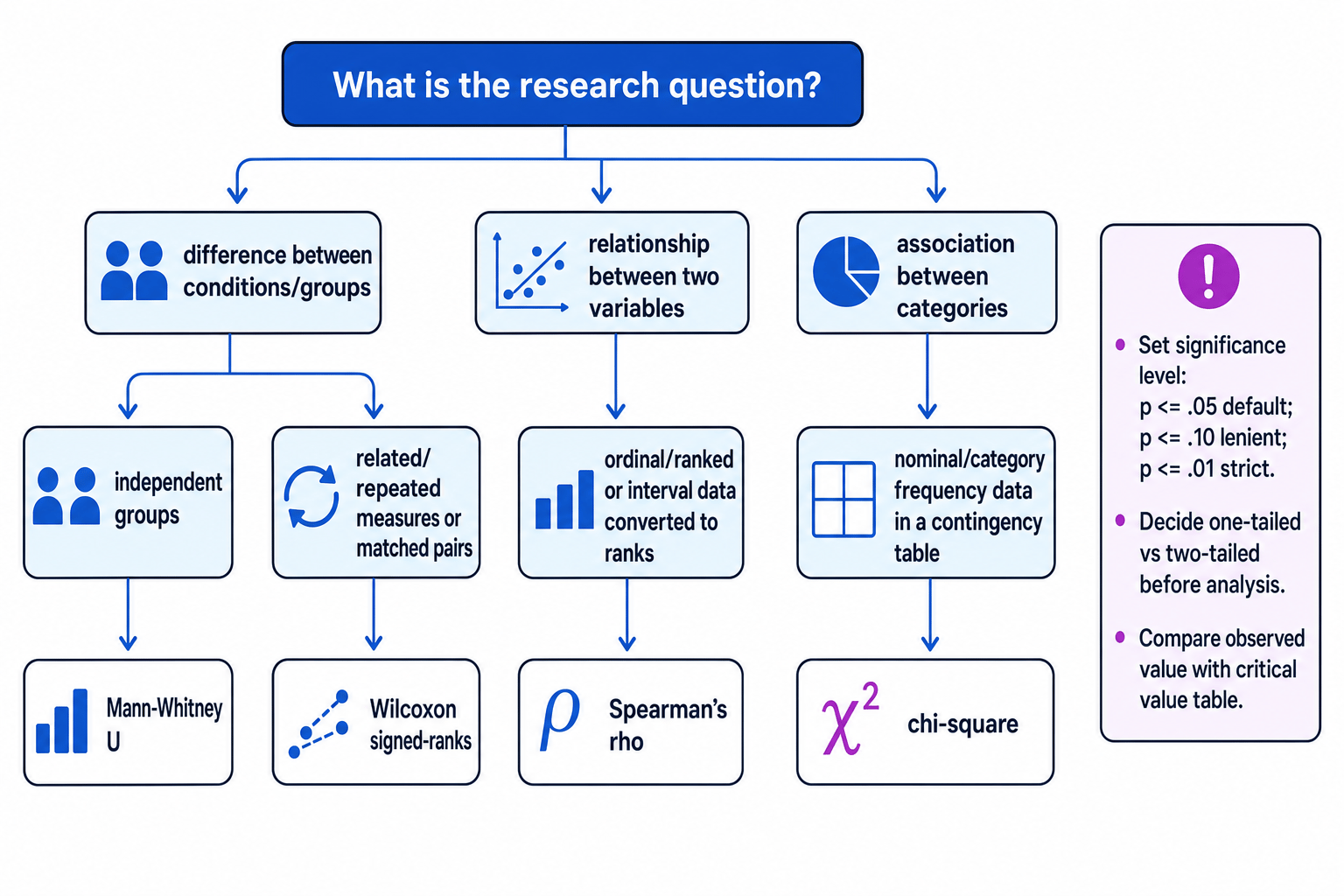
This decision tree helps you choose between the inferential tests named in the specification.
The four named tests
| Test | Use it when… | Clinical example |
|---|---|---|
| Mann-Whitney U | testing a difference between two independent groups | comparing anxiety scores for patients receiving CBT versus medication |
| Wilcoxon signed-ranks | testing a difference between two related conditions | comparing the same patients before and after therapy |
| Spearman’s rho | testing a correlation between two ranked/ordinal variables | seeing whether depression severity is associated with days absent from work |
| Chi-square | testing an association between categories using frequencies | testing whether source type is associated with positive or stigmatising language |
Significance levels and hypotheses
A null hypothesis predicts no real effect or relationship. An alternative hypothesis predicts a real effect or relationship.
The default significance level in psychology is usually p≤.05p \le .05p≤.05. This means there is a 5% or lower probability of getting the observed result if the null hypothesis is true. Sometimes p≤.10p \le .10p≤.10 is used as a more lenient level, while p≤.01p \le .01p≤.01 is stricter.
Type I and Type II errors
A Type I error is a false positive: rejecting the null hypothesis when it is actually true. A Type II error is a false negative: failing to reject the null hypothesis when there really is an effect.
If you use a stricter level such as p≤.01p \le .01p≤.01, you reduce the risk of a Type I error but increase the risk of a Type II error.
One-tailed and two-tailed tests
A one-tailed test is used when the hypothesis predicts the direction of the result, such as “CBT will reduce symptom scores.” A two-tailed test is used when the hypothesis predicts a difference or relationship but not the direction.
Decide the tail before analysis
Researchers should decide whether a test is one-tailed or two-tailed before looking at the results. Choosing afterwards increases the risk of bias and false positives.
Observed and critical values
The observed value is the statistic calculated from your data. The critical value comes from a table and depends on factors such as sample size, significance level and whether the test is one-tailed or two-tailed.
For chi-square and Spearman’s rho, larger observed values usually show stronger evidence against the null hypothesis. For Mann-Whitney U and Wilcoxon signed-ranks, smaller observed values are often more extreme. Always follow the table instructions.
Choosing and interpreting an inferential test
A researcher measures anxiety scores for the same 12 patients before and after a six-week therapy programme. The data are ordinal questionnaire scores and the hypothesis is that anxiety will decrease.
- The researcher is testing a difference, not a correlation or association.
- The same patients are measured twice, so the design uses related data.
- The correct test is Wilcoxon signed-ranks, because it compares two related sets of scores.
- The hypothesis predicts a decrease, so a one-tailed test is appropriate if this was decided before analysis.
- The researcher compares the observed Wilcoxon value with the critical value for 12 participants at p≤.05p \le .05p≤.05 using the correct table.
Qualitative data: thematic analysis and grounded theory
Qualitative data
Qualitative data is non-numerical data, such as interview transcripts, written accounts, open-ended questionnaire responses or media language.
Thematic analysis
Thematic analysis
Thematic analysis is a method for identifying repeated patterns of meaning, called themes, in qualitative data.
For example, in interviews about schizophrenia, themes might include “fear of stigma”, “medication side effects” and “support from family”. Thematic analysis is flexible and rich, but researcher subjectivity can reduce reliability unless coding is checked carefully.
Grounded theory
Grounded theory
Grounded theory is a qualitative approach where theory is built from the data rather than imposed before data collection.
Researchers code data, compare examples, refine categories and gradually develop an explanation. This is useful in under-researched clinical areas, but it is time-consuming and still influenced by researcher interpretation.
Mixing up the two qualitative methods
Thematic analysis identifies themes in data. Grounded theory goes further by using those themes and categories to build a new theoretical explanation.
Key question: mental health in society
A suitable clinical key question is: What are the issues surrounding mental health in the workplace?
This matters because many people experience stress, anxiety or depression at work. Social stigma can reduce help-seeking, while supportive policies may improve wellbeing and productivity.
You can apply clinical psychology by discussing:
- diagnosis and classification, including whether workplace distress is medicalised
- treatments such as CBT or drug therapy
- cultural differences in defining mental health
- research into attitudes, stigma and access to support
- ethical issues around confidentiality when employees disclose mental health difficulties
AO3 should stay focused on society, not just theory. For example, workplace screening may identify people who need support, but it could also increase labelling or discrimination if confidentiality is weak.
Practical investigation: summative content analysis
For this topic, your practical research exercise should gather data relevant to clinical psychology by using content analysis to explore attitudes toward mental health.
Summative content analysis
Summative content analysis counts the frequency of selected words, phrases or categories, then interprets what those patterns suggest about meaning or attitudes.
You must analyse at least two sources, such as newspapers, magazines or radio interviews, and compare attitudes toward mental health.
This workflow shows the main stages of a practical content analysis.
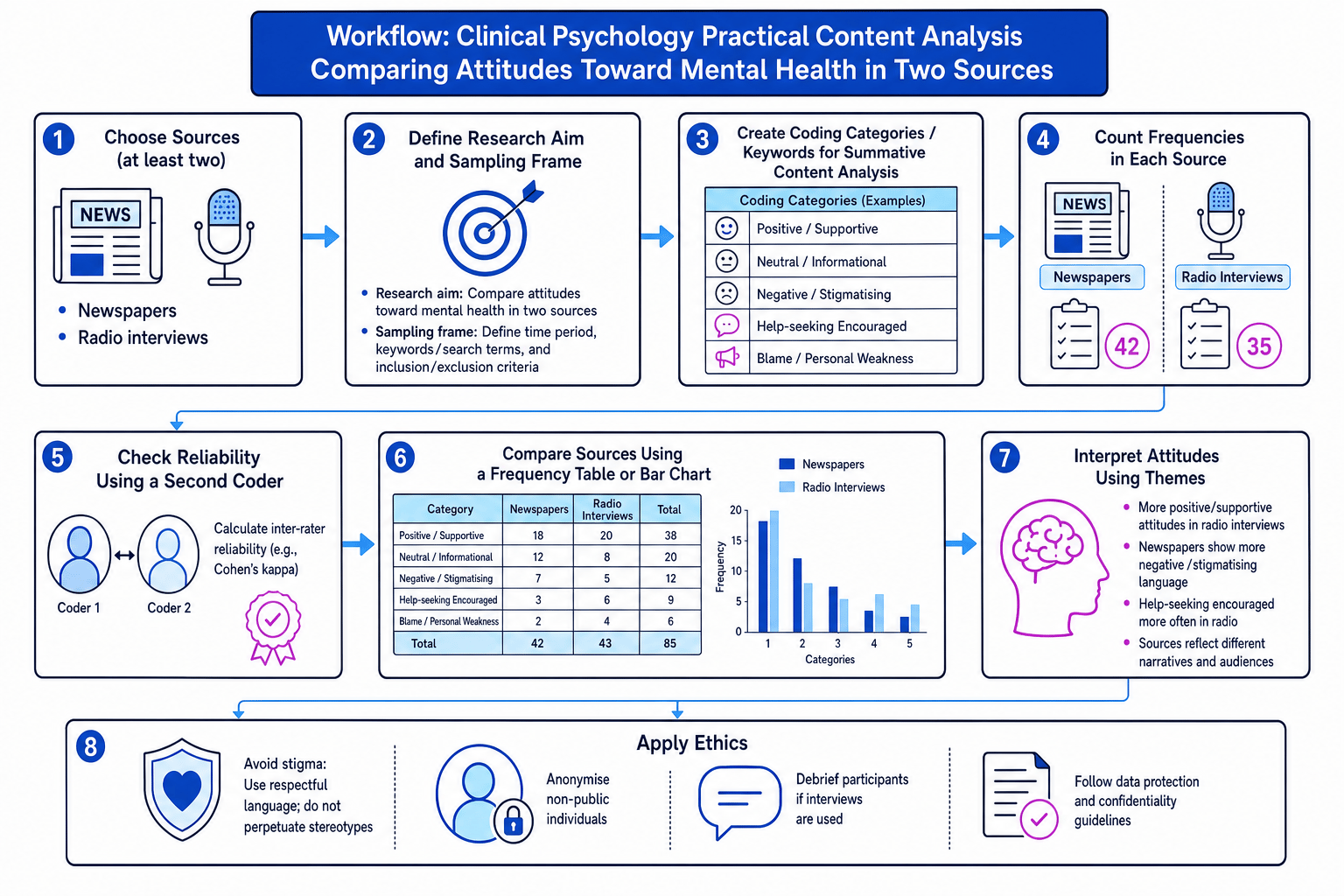
A simple practical could compare how two newspapers report depression. You might create categories such as:
- positive/supportive language
- neutral/informational language
- negative/stigmatising language
- references to treatment or help-seeking
- blame or personal weakness
You could present the results in a frequency table and bar chart. If you wanted to test whether source type is associated with language category, chi-square may be appropriate because the data are categorical frequencies.
Ethically, avoid reproducing harmful stereotypes. If you analyse public media, consent is usually less of an issue, but you should still treat mental health sensitively. If you use interviews or non-public material, apply BPS principles: consent, right to withdraw, confidentiality, protection from harm and debrief.
In the exam
- Name the method or statistic precisely, then link it directly to the clinical context in the question.
- For inferential tests, decide whether the question is about a difference, correlation or association before naming the test.
- In AO3, evaluate both method and ethics: validity, reliability, generalisability, consent, harm, confidentiality and usefulness.
Check yourself
- When would you choose Mann-Whitney U rather than Wilcoxon signed-ranks?
- Why might cross-cultural research be important when studying mental health diagnosis?
- How could you improve reliability in a content analysis of newspaper attitudes toward depression?
