Schizophrenia is a severe, chronic mental health disorder characterized by disruptions in thought, perception, and behavior. While it is classified as a psychiatric condition, modern clinical psychology views schizophrenia through a neurodevelopmental lens. This means that genetic vulnerabilities and biochemical imbalances do not just appear suddenly; they disrupt the normal developmental trajectory of the brain from gestation through to late adolescence.
What you'll learn
- How genetic variations act as a predisposing factor for schizophrenia across development.
- The biochemical mechanism of the dopamine hypothesis and how it explains positive and negative symptoms.
- How genetic and biochemical vulnerabilities interact with developmental milestones, such as adolescent synaptic pruning.
The Genetic Explanation of Schizophrenia
To understand how schizophrenia develops, we must first look at our DNA. The genetic explanation argues that individuals inherit a vulnerability to develop the disorder from their biological parents. This vulnerability is not caused by a single "schizophrenia gene" but is instead polygenic.
Polygenic
A characteristic or disorder that is influenced by the combined action of multiple different genes, rather than a single gene.
Research by Ripke et al. (2014) analyzed the genetic makeup of over 36,000 patients with schizophrenia and compared them to over 113,000 controls. They identified 108 separate genetic loci (specific locations on chromosomes) associated with an increased risk of developing schizophrenia. Many of these genes code for chemical messengers in the brain, including dopamine and glutamate.
Measuring Genetic Risk: Concordance Rates
Psychologists use twin, family, and adoption studies to estimate how heritable a condition is. By comparing genetic similarity to the likelihood of both individuals sharing the diagnosis, we calculate a concordance rate.
Concordance Rate
The probability or percentage of pairs (such as twins or family members) where both individuals exhibit a particular trait or disorder, given that one individual has it.
- Monozygotic (MZ) twins share 100% of their genetic material.
- Dizygotic (DZ) twins share approximately 50% of their genetic material (the same as non-twin siblings).
If a disorder is purely genetic, we would expect a 100% concordance rate in MZ twins. If it is purely environmental, the concordance rates for MZ and DZ twins should be roughly equal.
The Gottesman (1991) Meta-Analysis
Gottesman (1991) reviewed large-scale family and twin studies of schizophrenia. He established a clear genetic gradient:
- General population risk: 1%
- Dizygotic (DZ) twins risk: 17%
- Monozygotic (MZ) twins risk: 48%
This demonstrates a powerful genetic component because MZ twins (who share all their DNA) have nearly three times the risk of DZ twins (who share half their DNA). However, because the MZ rate is not 100%, environmental factors must also play a role.
Calculating Concordance Rate Ratios
To evaluate the relative strength of genetic influence compared to environmental baseline risk, psychologists calculate the risk ratio (RRR) of a genetically vulnerable group against the general population. Let PcondP_{\text{cond}}Pcond be the concordance rate of the genetically related group and PgenP_{\text{gen}}Pgen be the baseline risk of the general population (1%1\%1%).
Let's calculate the risk ratio (RRR) for Monozygotic (MZ) twins versus Dizygotic (DZ) twins to see how much genetic sharing increases risk relative to the baseline.
-
Locate the concordance rates from Gottesman's (1991) meta-analysis:
PMZ=48%,PDZ=17%,Pgen=1% P_{\text{MZ}} = 48\%, \quad P_{\text{DZ}} = 17\%, \quad P_{\text{gen}} = 1\% PMZ=48%,PDZ=17%,Pgen=1% -
Calculate the risk ratio for Monozygotic twins (RMZR_{\text{MZ}}RMZ) compared to the general population baseline:
RMZ=PMZPgen=48%1%=48 R_{\text{MZ}} = \frac{P_{\text{MZ}}}{P_{\text{gen}}} = \frac{48\%}{1\%} = 48 RMZ=PgenPMZ=1%48%=48This indicates that an individual with an identical twin diagnosed with schizophrenia is 48 times more likely to develop the disorder than a member of the general public.
-
Calculate the risk ratio for Dizygotic twins (RDZR_{\text{DZ}}RDZ) compared to the baseline:
RDZ=PDZPgen=17%1%=17 R_{\text{DZ}} = \frac{P_{\text{DZ}}}{P_{\text{gen}}} = \frac{17\%}{1\%} = 17 RDZ=PgenPDZ=1%17%=17This indicates that sharing 50% of genetic material yields a risk 17 times higher than the baseline.
-
Compare the two ratios to draw a genetic conclusion:
RMZRDZ=4817≈2.82 \frac{R_{\text{MZ}}}{R_{\text{DZ}}} = \frac{48}{17} \approx 2.82 RDZRMZ=1748≈2.82Because doubling the genetic sharing (from 50% in DZ to 100% in MZ) increases the relative risk by a factor of nearly 2.82.82.8, we can conclude that genetic similarity is a highly potent risk factor, though the lack of a 100% rate in MZ twins confirms the necessity of environmental triggers.
The Biochemical Explanation: The Dopamine Hypothesis
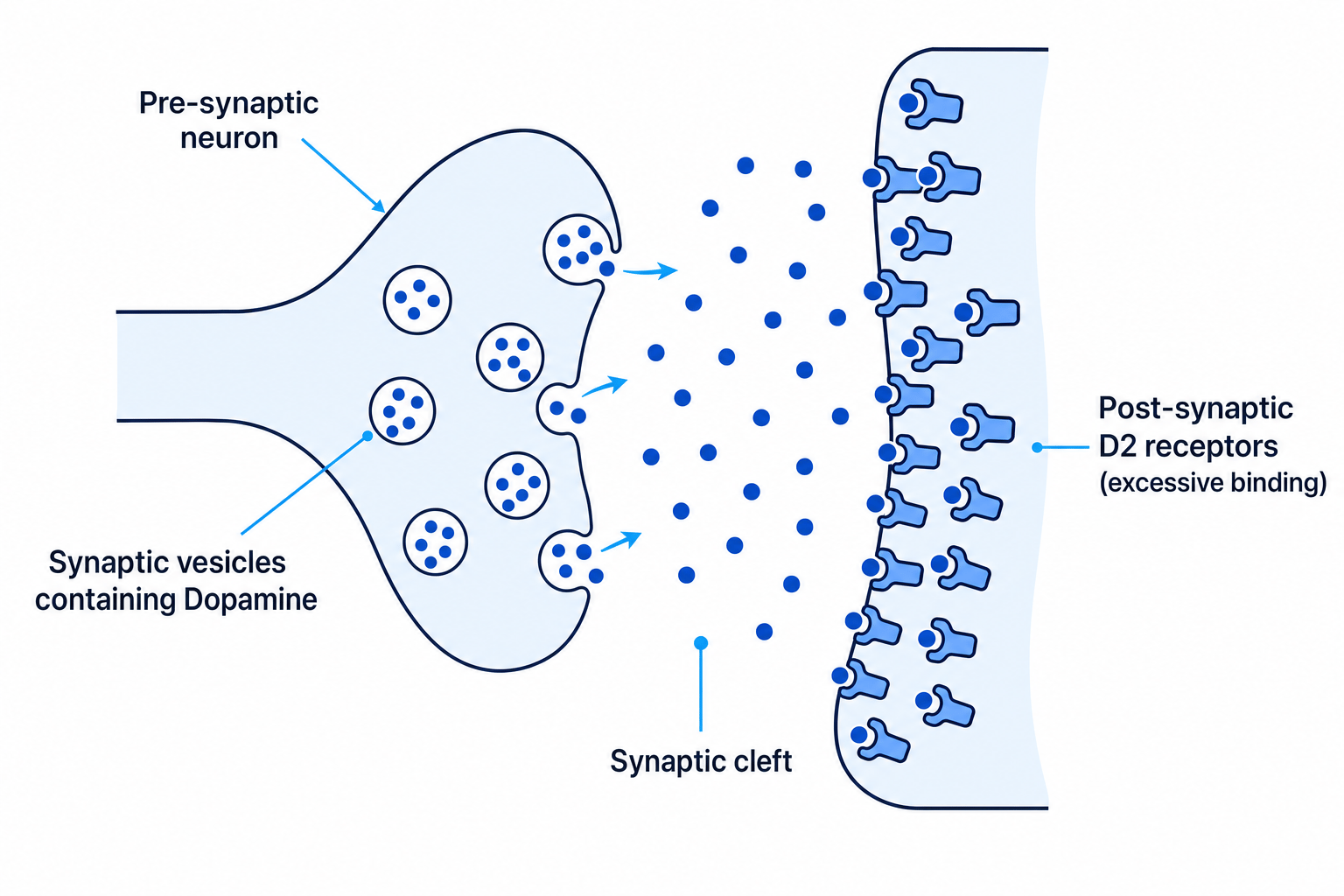
How do these genes manifest as psychological symptoms? The main biochemical explanation is the Dopamine Hypothesis. Dopamine is a key neurotransmitter involved in regulating attention, motivation, and reward pathways.
The dopamine hypothesis has evolved into two key developmental phases:
Phase 1: Hyperdopaminergia (Excess Dopamine)
Early formulations of the hypothesis focused on an excess of dopamine activity in the subcortex (specifically the subcortical structures of the limbic system).
- The Mechanism: An overabundance of dopamine release, or an over-sensitivity of post-synaptic D2 receptors, causes neurons to fire too often.
- The Developmental Impact: This pathway (the mesolimbic pathway) is associated with attention and memory. Overstimulation here leads to the positive symptoms of schizophrenia, such as auditory hallucinations and delusions, because the brain is unable to filter out irrelevant sensory stimuli.
Phase 2: Hypodopaminergia (Deficient Dopamine)
More recent updates to the hypothesis recognize that dopamine is not high everywhere. Instead, there is a deficit of dopamine activity in the prefrontal cortex.
- The Mechanism: Low levels of dopamine activity in the mesocortical pathway.
- The Developmental Impact: The prefrontal cortex is responsible for executive decision-making, planning, and emotional regulation. Underactivity here corresponds directly to the negative symptoms of schizophrenia, such as flat affect (lack of emotion), alogia (poverty of speech), and avolition (lack of motivation).
Confusing Positive and Negative Symptoms
Students often think "positive" means good and "negative" means bad. In psychology, positive symptoms represent an excess or distortion of normal functioning (adding a behavior, like hearing voices), whereas negative symptoms represent a loss or deficit of normal functioning (taking away a behavior, like failing to speak or show emotion).
How Genes and Biochemistry Affect Development
Schizophrenia rarely presents in childhood; its typical onset is in late adolescence or early adulthood (ages 15 to 25). Why does a genetic or biochemical vulnerability take so long to manifest?
This is explained by the neurodevelopmental model of schizophrenia.
1. Prenatal Development and Genetic Mutation
Some of the genetic risk loci identified by Ripke et al. (2014) are responsible for early brain construction. Minor disruptions in utero—such as abnormal neuronal migration (where brain cells do not move to their correct locations)—create a "silent" vulnerability. The child's brain functions adequately during childhood, but the structural foundations are fragile.
2. Adolescent Synaptic Pruning
During adolescence, the human brain undergoes a massive developmental reorganization. A key part of this is synaptic pruning.
Synaptic Pruning
A natural developmental process where the brain eliminates weak or unused synaptic connections to increase the efficiency of active neural networks.
In a typically developing adolescent brain, pruning streamlines cognitive processing. However, in individuals with a genetic vulnerability to schizophrenia, this pruning process can be excessive or dysregulated. The brain prunes away too many active connections, particularly in the prefrontal cortex. This sudden reduction in grey matter, combined with changing adolescent hormone levels, triggers the biochemical imbalance (dopamine dysregulation) and results in the first psychotic episode.
The Faulty Bridge Analogy
Think of genetic vulnerability as a bridge built with sub-standard structural supports (abnormal prenatal migration). During normal traffic (childhood), the bridge stands fine. However, during rush hour (the turbulent developmental transition of adolescence, with heavy hormonal changes and intense synaptic pruning), the structural flaws are exposed, and the bridge collapses (the onset of schizophrenia).
3. The Diathesis-Stress Model
To fully explain how these factors affect development, psychologists use the diathesis-stress model.
- Diathesis (Vulnerability): Genetic predisposition (e.g., inherited risk genes) and/or prenatal brain damage.
- Stress (Trigger): Environmental stressors encountered during development, such as childhood trauma, high urbanicity, family dysfunction (high Expressed Emotion), or cannabis use during adolescence.
A person with a high genetic diathesis will require a very small developmental stressor to trigger the onset of schizophrenia. Conversely, someone with low genetic vulnerability may experience severe developmental stress and never develop the disorder.
Evaluating the Biological Explanations
To write high-scoring AO3 evaluation paragraphs in your Edexcel essays, you must balance the strengths of these biological explanations against their limitations.
Strengths (Supporting Evidence & Applications)
- Strong Empirical Support: Twin and adoption studies consistently show high heritability. For example, Heston (1966) conducted an adoption study and found that children born to biological mothers with schizophrenia, but raised by healthy adoptive families, still had a significantly higher rate of schizophrenia (10.4%) compared to control adoptees (0%). This isolates the genetic factor from the rearing environment.
- Real-World Application: Understanding the biochemical role of dopamine led directly to the development of antipsychotic medications. First-generation antipsychotics (like Chlorpromazine) act as dopamine antagonists, blocking D2 receptors and reducing positive symptoms. This has allowed millions of patients to live in the community rather than being permanently institutionalized.
Weaknesses (Alternative Views & Criticisms)
- Biological Reductionism: Reducing a complex, deeply personal experience like schizophrenia down to simple genetic codes or neurotransmitter levels ignores the role of psychological and social factors. For instance, dysfunctional family communication patterns (like the double-bind theory or high Expressed Emotion) are also heavily correlated with relapse rates.
- Biological Determinism: Assuming that having certain risk genes means a person is "destined" to develop schizophrenia can be harmful and disempowering. Because the concordance rate for MZ twins is only 48%, more than half of the explanation must come from non-genetic, environmental factors.
- The "Cause-and-Effect" Problem: While we can observe abnormal dopamine levels in patients with schizophrenia, we cannot definitively prove that this biochemical imbalance caused the disorder. It is possible that living with the chronic stress of schizophrenia alters brain chemistry, meaning the dopamine imbalance is a consequence (effect) rather than a cause.
In the exam
- Never write "genes cause schizophrenia": Always use terms like vulnerability, predisposition, or diathesis. This shows the examiner that you appreciate the complexity of the disorder and avoid deterministic traps.
- Link biology back to development: Edexcel essays on section 5.1.6 specifically assess how these biological issues affect development. Make sure you explicitly write about why symptoms peak in late adolescence (synaptic pruning, hormonal shifts) rather than treating the essay as a standard biology dump.
- Use researchers and dates accurately: Mentioning Gottesman (1991) for twin studies, Heston (1966) for adoption studies, and Ripke et al. (2014) for the polygenic explanation will elevate your AO1 and AO3 credit significantly.
Check yourself
- Why is it accurate to say schizophrenia is "polygenic" rather than caused by a single gene?
- What is the difference between hyperdopaminergia and hypodopaminergia in terms of brain location and symptom types?
- How does the process of adolescent synaptic pruning explain the timing of the onset of schizophrenia?
