What you'll learn
- How brain injury may increase risk of impulsive or anti-social behaviour.
- How the amygdala is linked to aggression and threat responses.
- What XYY syndrome is, and why it is not a simple “criminal chromosome” explanation.
- How to evaluate biological explanations, including gender differences, research methods and ethics.
The starting point: biology as a risk factor
A biological explanation looks for causes of behaviour in the body: brain structures, brain damage, chromosomes, genes, hormones or nervous-system activity. In this topic, you focus on three biological explanations: brain injury, amygdala functioning, and XYY syndrome.
Biological explanation
A biological explanation of crime argues that some criminal or anti-social behaviour can be partly explained by physical factors, such as brain damage, abnormal brain activity or chromosome differences.
Crime means behaviour that breaks the law. Anti-social behaviour is broader: behaviour that harms, threatens or disrupts others, even if it is not always a criminal offence.
The key word is risk. Biology may make certain behaviours more likely, but it does not make crime inevitable.
Risk, not destiny
For essays, avoid saying “biology causes crime” as if it is automatic. A stronger answer says biology may increase vulnerability to impulsivity, aggression or poor emotional control, especially when combined with environmental factors.
How to build a biological explanation
A good AO1/AO2 chain usually has four links:
- Biological factor — for example, damage to the prefrontal cortex.
- Psychological effect — for example, weaker impulse control or emotional regulation.
- Behavioural outcome — for example, aggressive reactions, risk-taking or poor decision-making.
- Criminal/anti-social context — for example, assault after provocation, theft without thinking through consequences, or repeated rule-breaking.
Building a biological explanation chain
- Identify the biological factor: a person has damage to the prefrontal cortex, the front part of the brain involved in planning and inhibition.
- Infer the psychological effect: reduced inhibition may make it harder to pause, consider consequences and control anger.
- Apply it to behaviour: in a heated argument, the person may react impulsively rather than walking away.
- Keep the conclusion balanced: this increases the risk of aggression, but whether it becomes a crime also depends on learning, social context, opportunity and policing.
Brain injury and crime
A brain injury is physical damage to brain tissue. It may result from a blow to the head, illness, stroke, tumour, infection or lack of oxygen. In crime explanations, the most important area is often the prefrontal cortex.
Prefrontal cortex
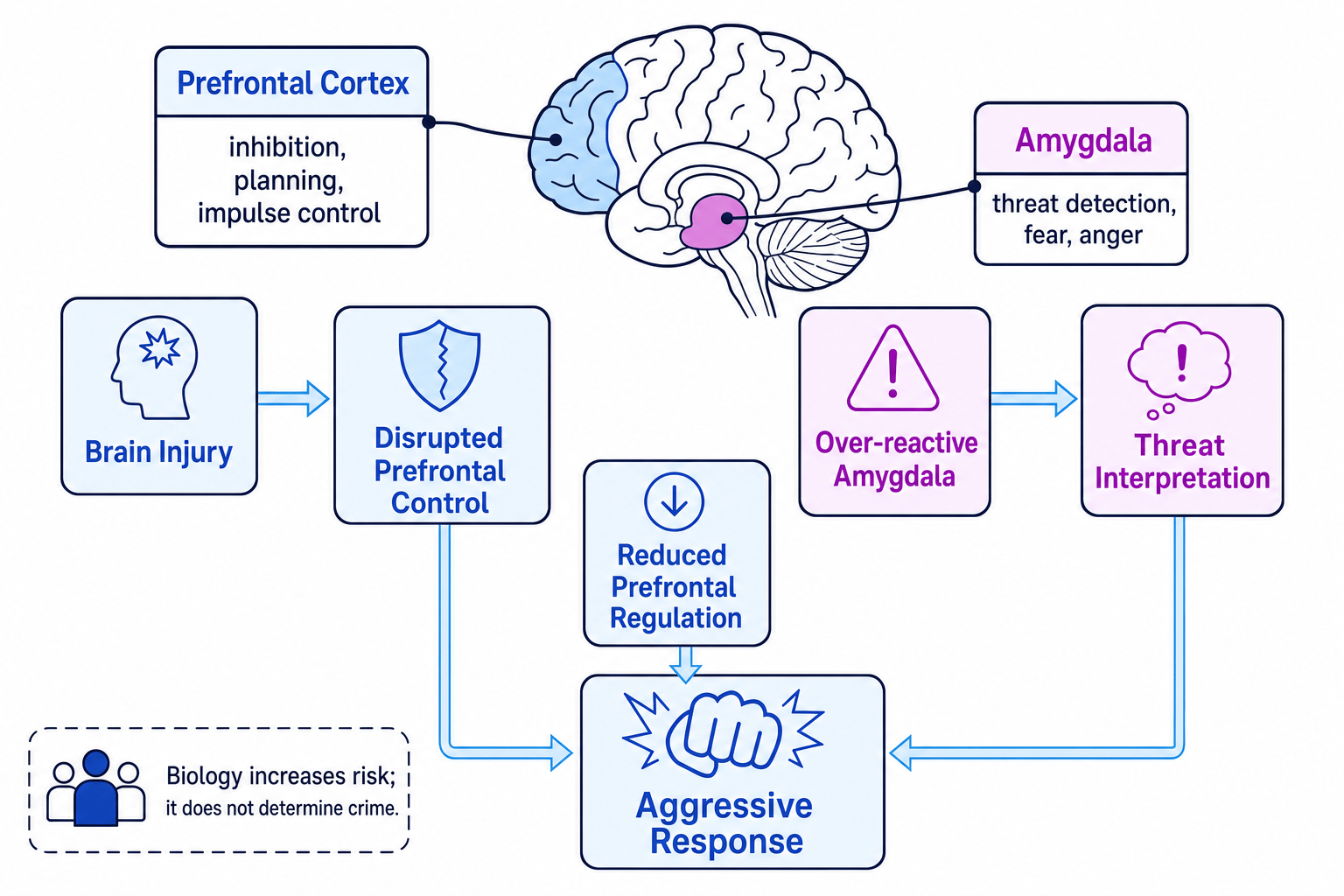
The prefrontal cortex is the front area of the brain involved in planning, decision-making, impulse control, emotional regulation and considering consequences.
If this area is damaged, a person may become more disinhibited, meaning they are less able to suppress inappropriate impulses. They may also show poor judgement, irritability, risk-taking or difficulty learning from punishment.
The basic neural pathway is that brain injury can weaken prefrontal control, while emotional brain systems such as the amygdala may still produce strong threat or anger responses.
A classic case often used to illustrate this is Phineas Gage, reported by Harlow in 1868. After severe frontal-lobe damage, Gage’s personality was described as more impulsive and socially inappropriate. This is useful AO1 evidence, but it is only a case study, so it cannot prove that brain injury generally causes crime.
More recent evidence comes from brain-scan and offender studies. For example, Raine et al. (1997) used PET scans with murderers pleading not guilty by reason of insanity and found reduced activity in areas including the prefrontal cortex compared with controls. This supports a link between brain functioning and violent behaviour, though it does not show that abnormal brain activity was the original cause.
Evaluating brain injury explanations
A strength is that the explanation is scientific and objective. Brain scans and neurological assessment can provide measurable evidence rather than relying only on self-report.
However, there is a major cause-and-effect problem. Brain differences may contribute to offending, but they could also be linked to other factors, such as substance use, childhood trauma, poverty, or injuries gained through risky lifestyles.
Gender differences also matter. Males are more likely than females to be convicted of violent crime, and they may also be more exposed to head injury through fighting, risk-taking or some sports. However, brain injury cannot explain all male offending, and many people with brain injuries never offend.
Assuming injury means criminality
Do not write that brain injury “makes someone a criminal”. A better phrase is: brain injury may reduce inhibition or emotional control, which can increase the risk of anti-social behaviour in some situations.
Amygdala and aggression
The amygdala is a small structure deep in the brain, part of the limbic system, which is involved in emotion and survival responses.
Amygdala
The amygdala is a brain structure involved in threat detection, fear, anger and emotional learning.
Aggression means behaviour intended to harm another person physically or psychologically. The amygdala can be linked to aggression in two slightly different ways.
First, an over-reactive amygdala may make a person interpret ambiguous cues as threatening. For example, a neutral look may be misread as disrespect, leading to anger and reactive aggression.
Second, an under-functioning or atypical amygdala may reduce fear learning and empathy. This is often discussed in relation to psychopathic traits, where a person may show low emotional response to others’ distress.
Research support includes Coccaro et al. (2007), who found heightened amygdala responses to angry faces in people with intermittent explosive disorder. Raine et al. (1997) also found abnormal patterns of brain activity in violent offenders, including areas involved in emotion and control.
Explaining reactive aggression
- Start with the trigger: someone is bumped in a crowded corridor and interprets it as deliberate.
- Link to the amygdala: an over-reactive amygdala may produce a strong threat response, including fear or anger.
- Add prefrontal regulation: if prefrontal control is weak, the person may not inhibit the aggressive impulse.
- Apply to crime: the result could be assault, but only if the situation, learned responses and opportunity allow the aggression to become criminal behaviour.
Evaluating amygdala explanations
A strength is that the amygdala explanation gives a clear mechanism for aggression: threat detection, emotional arousal and poor regulation.
A weakness is that much evidence is correlational. If aggressive people show different amygdala activity, this does not prove the amygdala difference caused the aggression. Violent experiences, trauma or repeated conflict could also alter emotional responses.
Essay wording
Instead of calling the amygdala an “aggression centre”, describe it as part of a wider emotion-regulation system involving the amygdala, prefrontal cortex and social learning.
XYY syndrome and personality
Humans usually have 46 chromosomes, including two sex chromosomes. Most biological females have XX sex chromosomes and most biological males have XY sex chromosomes.
XYY syndrome
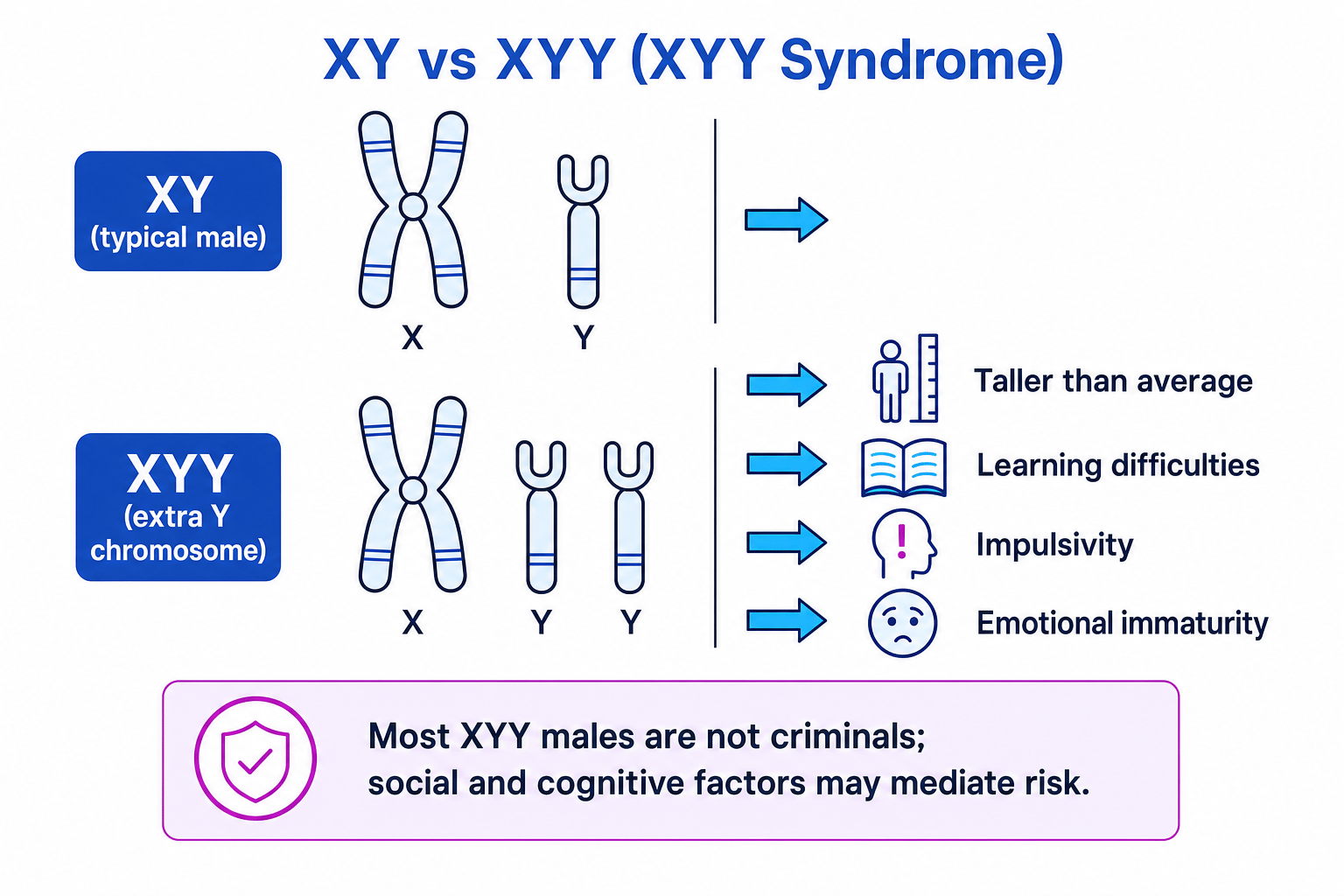
XYY syndrome is a sex chromosome variation where a biological male has an extra Y chromosome, giving the pattern XYY rather than XY.
XYY syndrome occurs because of a cell-division error called nondisjunction. Early research wrongly encouraged the idea of a “supermale” who was naturally violent. This is now seen as an oversimplified and stigmatising interpretation.
A more careful explanation links XYY to possible personality and developmental features. Some XYY males may be taller than average and may have learning difficulties, lower verbal ability, impulsivity or emotional immaturity. These features could indirectly increase risk of anti-social behaviour, especially if they lead to school failure, frustration, poor peer relationships or contact with the justice system.
Evidence is mixed. Jacobs et al. (1965) found a higher-than-expected number of XYY males in a secure hospital population, but this sample was biased because it already contained institutionalised men. Witkin et al. (1976) found XYY males were more likely to have criminal convictions, but not especially for violent crime. Theilgaard (1984) suggested XYY may be linked more to immaturity and impulsivity than to extreme aggression.
Interpreting an XYY finding
- Identify the biological factor: an offender has an XYY chromosome pattern.
- Avoid the deterministic claim: XYY does not automatically produce criminal behaviour.
- Link through personality: impulsivity, learning difficulties or emotional immaturity may make rule-breaking more likely in some environments.
- Evaluate the explanation: because XYY is rare and most XYY males are not criminals, it cannot explain most male crime or female offending.
Gender differences
XYY syndrome is relevant to gender because it only applies to biological males. It may help explain a tiny proportion of male offending, but it cannot explain why males generally offend more than females. Social factors, policing patterns, peer groups, gender norms and opportunity must also be considered.
Wider evaluation: strengths, limits and ethics
Biological explanations are useful because they can lead to practical support. For example, young offenders with brain injury might benefit from neuropsychological assessment, impulse-control training, emotional regulation work or educational support.
However, these explanations can be reductionist, meaning they reduce complex behaviour to one level of explanation. Crime is also affected by family, learning, poverty, peer influence, substance use and culture.
They can also be deterministic, because they may imply offenders lack free will. This has legal and moral implications: if biology affects responsibility, courts may consider mitigation, but society still needs protection from harm.
Methods link
When evaluating biological evidence, link it to research methods: independent offender-control comparisons may use Mann-Whitney U, repeated or matched comparisons may use Wilcoxon signed-ranks, correlations between brain activity and aggression scores may use Spearman’s rho, and associations such as XYY status with conviction category may use chi-square. The usual significance level is p≤.05p \le .05p≤.05; p≤.01p \le .01p≤.01 is stricter and p≤.10p \le .10p≤.10 is more lenient. For Mann-Whitney and Wilcoxon, the observed value usually needs to be equal to or less than the critical value; for Spearman’s rho and chi-square, it usually needs to be equal to or greater than the critical value.
Ethics are especially important because biological research on crime can label people as dangerous. Under the BPS Code of Ethics and Conduct (2009), researchers should ensure informed consent, avoid unnecessary deception, protect participants from harm, maintain confidentiality, allow the right to withdraw and provide a debrief. Genetic and brain-scan data are highly sensitive, so confidentiality and avoiding stigma are crucial.
In the exam
- Use a clear chain: biological factor → psychological effect → anti-social behaviour → cautious conclusion.
- For gender differences, explain what the biological factor can and cannot account for, especially the limits of XYY syndrome.
- Evaluate with evidence, then add a methodological issue, ethical issue or real-world application.
Check yourself
- How could prefrontal cortex damage increase the risk of impulsive offending?
- Why is the amygdala not simply a “crime centre”?
- Why is XYY syndrome a weak explanation for overall gender differences in crime?
