What you'll learn
- How schizophrenia is described, including thought insertion, hallucinations, delusions and disordered thinking.
- How neurotransmitters, genetics and cognitive explanations can explain schizophrenia.
- How unipolar depression is described and explained biologically and psychologically.
- How to evaluate explanations using evidence, treatments, limitations and ethics.
First: symptoms, features and explanations
A symptom is a sign of a disorder experienced by the person or observed by others, such as hearing voices or persistent low mood. A feature is a broader characteristic of the disorder, such as impaired functioning, distress, duration or patterns of behaviour.
An explanation is different: it tries to say why the disorder develops or continues. In Clinical Psychology, you usually compare biological explanations with non-biological explanations, such as cognitive or social approaches.
Psychosis
Psychosis is a loss of contact with reality, where a person may experience hallucinations, delusions or severely disorganised thinking. Schizophrenia is classed as a psychotic disorder.
Description vs explanation
For AO1, do not mix up “what the disorder looks like” with “why it happens”. Symptoms describe the disorder; explanations account for its possible causes.
These notes use unipolar depression as the “one other disorder”. If your class studies anorexia nervosa or OCD instead, keep the schizophrenia section and replace the depression section with your chosen disorder.
Schizophrenia: symptoms and features
Schizophrenia is a severe mental disorder involving disturbances in perception, thinking, emotion and behaviour. Symptoms are often grouped into positive symptoms and negative symptoms.
Positive and negative symptoms
Positive symptoms are experiences added to normal functioning, such as hallucinations or delusions. Negative symptoms are reductions in normal functioning, such as lack of motivation, reduced speech or flat emotional expression.
Key positive symptoms
Hallucinations are perceptions without an external stimulus. They can involve any sense, but auditory hallucinations, such as hearing voices, are especially common.
Delusions are strongly held false beliefs that are not shared by the person’s culture and are resistant to evidence. For example, a person may believe they are being watched by secret agents.
Thought insertion is the belief that thoughts have been placed into one’s mind by an external force. This is a type of delusional experience and can be very distressing.
Disordered thinking means thoughts are poorly organised. It is often seen through speech that becomes hard to follow, jumps between unrelated ideas, or appears illogical.
Other features
Schizophrenia can also involve avolition, meaning reduced motivation; speech poverty, meaning very limited speech; and affective flattening, meaning reduced emotional expression. Diagnosis is made by clinicians using systems such as DSM or ICD, not by one symptom alone.
Not split personality
Schizophrenia does not mean “split personality”. That is a common media myth. Schizophrenia is mainly about disturbances in reality testing, thought, perception and functioning.
Classifying schizophrenia symptoms
A person says, “The television presenter is sending me secret messages. I can hear a voice commenting on my actions. Sometimes my sentences jump around and I cannot keep my thoughts in order. I know some thoughts have been put into my mind.”
- The belief about secret messages is a delusion, because it is a fixed false belief held despite lack of evidence.
- Hearing a voice commenting on actions is a hallucination, because it is a perception without an external stimulus.
- Sentences jumping around suggests disordered thinking, because the organisation of thought is impaired.
- The belief that thoughts have been put into the mind is thought insertion, a specific psychotic symptom.
Schizophrenia explanation 1: neurotransmitters
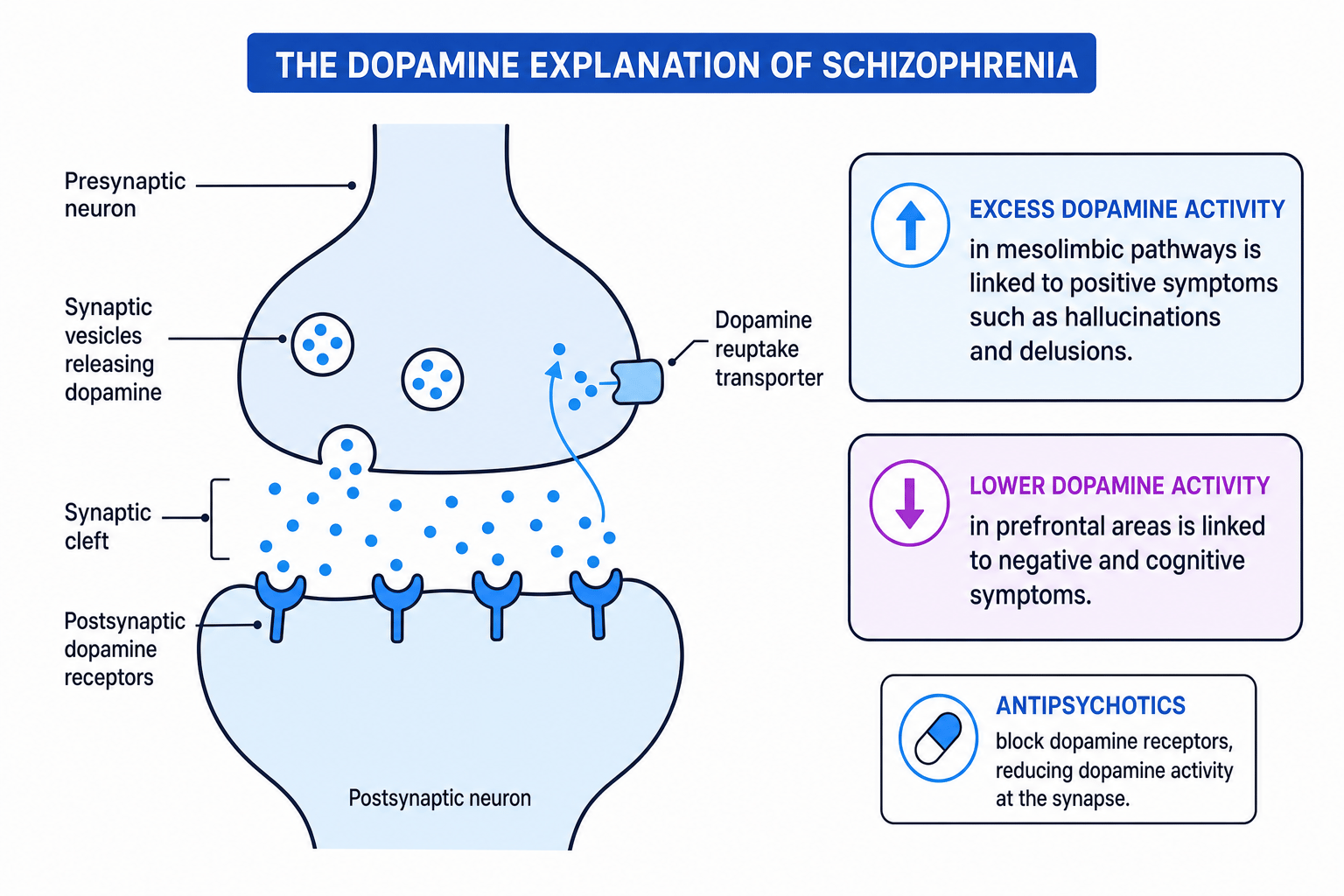
A neurotransmitter is a chemical messenger that passes signals between neurons across a tiny gap called a synapse. In schizophrenia, the most important neurotransmitter explanation is the dopamine hypothesis.
Dopamine hypothesis
The dopamine hypothesis suggests that abnormal dopamine activity is involved in schizophrenia. Too much dopamine activity in some brain pathways is linked to positive symptoms, while too little dopamine activity in prefrontal areas may be linked to negative and cognitive symptoms.
The older version of the theory focused mainly on excess dopamine causing hallucinations and delusions. The revised version is more balanced: different symptoms may relate to different dopamine pathways.
AO3: evaluating the neurotransmitter explanation
A strength is supporting drug evidence. Antipsychotic drugs often block dopamine receptors and can reduce positive symptoms. Also, drugs such as amphetamines, which increase dopamine activity, can produce schizophrenia-like symptoms in some people.
However, the explanation is reductionist because schizophrenia is not only about dopamine. Glutamate, serotonin, genes, stress and cognition may also be involved. Another weakness is that antipsychotics do not work equally well for everyone, and they can produce side effects, which affects real-world treatment adherence.
Dopamine is not the whole story
A strong essay says dopamine is important, especially for positive symptoms, but avoids claiming it fully explains every case of schizophrenia.
Schizophrenia explanation 2: genetics
A second biological explanation is the genetic explanation. This argues that inherited biological vulnerability increases the risk of schizophrenia.
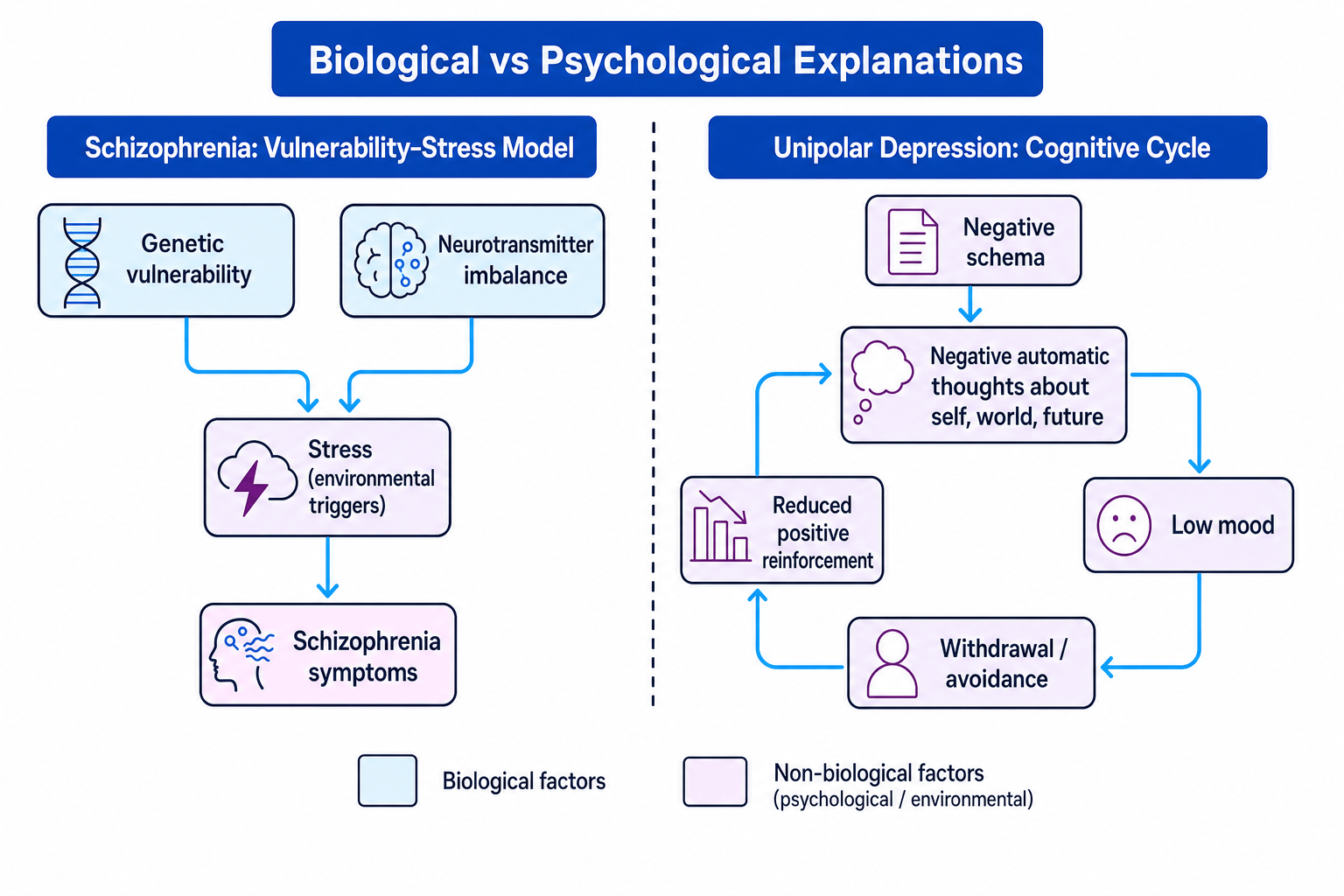
Schizophrenia is not caused by one single “schizophrenia gene”. It is better described as polygenic, meaning many genes each contribute a small amount of risk. Genetic vulnerability may combine with environmental stress in a diathesis-stress model.
Diathesis-stress model
The diathesis-stress model says a disorder develops when an underlying vulnerability, such as genetic risk, is triggered by stressors such as trauma, family conflict, drug use or major life events.
AO3: evaluating the genetic explanation
Twin research supports a genetic role. For example, Gottesman (1991) reported higher concordance for schizophrenia in identical twins than non-identical twins. This suggests genes matter.
But concordance is not 100 percent, even for identical twins. This is important because identical twins share all their genes, so environmental factors must also play a role. Twin studies can also be methodologically difficult because identical twins may share more similar environments than non-identical twins.
One-gene explanation
Do not write that schizophrenia is “inherited directly” or caused by one gene. Better wording: genes create vulnerability, and environmental factors influence whether symptoms develop.
Schizophrenia explanation 3: cognitive explanation
A non-biological explanation is the cognitive explanation, associated with Frith (1992). A cognitive explanation focuses on mental processes such as perception, attention, memory and interpretation.
Frith suggested that some symptoms occur because people misinterpret their own internal mental events. For example, a person may fail to recognise inner speech as self-generated, so it is experienced as an external voice. This can explain hallucinations. Problems with monitoring one’s own thoughts may also help explain thought insertion.
AO3: evaluating the cognitive explanation
A strength is that it explains specific symptoms in detail, especially thought insertion and auditory hallucinations. It also has real-world application because cognitive behavioural therapy for psychosis, often called CBTp, helps people challenge interpretations and manage distress.
A weakness is that the explanation may describe what is happening during symptoms rather than explain the original cause. It also does not fully account for biological findings, such as genetic risk or neurotransmitter differences. The best approach may be interactionist: biological vulnerability plus cognitive and environmental triggers.
Unipolar depression: symptoms and features
Unipolar depression involves depressive episodes without manic episodes. This separates it from bipolar disorder, where mood can swing between depression and mania.
Mania
Mania is an abnormally elevated or irritable mood with increased energy, reduced need for sleep and impulsive behaviour. Unipolar depression does not include manic episodes.
Core symptoms include persistent low mood and anhedonia, meaning loss of interest or pleasure. Other features can include sleep disturbance, appetite changes, fatigue, poor concentration, feelings of worthlessness or guilt, psychomotor slowing or agitation, and thoughts of death or suicide.
Clinically, symptoms must be persistent and impair everyday functioning. A person may withdraw from friends, stop completing school or work tasks, or struggle with basic self-care.
Depression explanation 1: the monoamine hypothesis
A biological explanation of unipolar depression is the monoamine hypothesis, linked to Schildkraut (1965). Monoamines are neurotransmitters including serotonin, noradrenaline and dopamine.
This theory suggests depression is associated with low activity of monoamine neurotransmitters, especially serotonin and noradrenaline. This links to drug treatments such as SSRIs, which increase serotonin availability at synapses by reducing reuptake.
AO3: evaluating the monoamine hypothesis
A strength is real-world application: antidepressants can reduce symptoms for many people. This supports the idea that neurotransmitters are involved.
However, the explanation is incomplete. Antidepressants alter neurotransmitter levels quickly, but mood improvement often takes weeks. This suggests depression cannot simply be “low serotonin”. Some people also do not respond to medication, and side effects may limit use.
Depression explanation 2: Beck’s cognitive theory
A non-biological explanation is Beck’s cognitive theory of depression, proposed by Beck (1967). Beck argued that depression is maintained by negative thinking patterns.
The first part is negative schemas. A schema is a mental framework used to interpret information. Negative schemas make a person more likely to interpret events pessimistically.
The second part is the negative cognitive triad: negative views about the self, the world and the future. For example, “I am worthless”, “people will reject me”, and “things will never improve”.
The third part is negative automatic thoughts, which are quick, involuntary pessimistic thoughts that appear in everyday situations.
Applying Beck’s cognitive triad
A student fails one test and thinks, “I am useless. Everyone thinks I am a failure. My future is ruined.” They stop seeing friends and avoid revision.
- “I am useless” is a negative view of the self, showing one part of the cognitive triad.
- “Everyone thinks I am a failure” is a negative view of the world, because the student interprets other people as rejecting.
- “My future is ruined” is a negative view of the future, completing the triad.
- Avoiding friends and revision may maintain depression because it reduces positive experiences and increases evidence that life feels difficult.
AO3: evaluating Beck’s theory
A strength is strong real-world application. Cognitive behavioural therapy is based on identifying and challenging negative thoughts, and it is widely used for depression.
A weakness is the cause-and-effect problem. Negative thinking may cause depression, but depression may also cause negative thinking. The theory may also underplay biological factors, such as genetic vulnerability and neurotransmitters.
Ethics when researching clinical disorders
Research with people experiencing schizophrenia or depression must follow the BPS Code of Ethics and Conduct (2009). Researchers need informed consent, protection from harm, confidentiality, the right to withdraw, careful debriefing and avoidance of unnecessary deception. This is especially important when participants may be distressed, vulnerable, medicated or experiencing impaired reality testing.
In the exam
- Keep AO1 organised: symptoms first, then biological explanations, then non-biological explanations.
- For AO2, apply precise terms to scenarios: hallucination, delusion, thought insertion, disordered thinking, anhedonia or cognitive triad.
- For AO3, evaluate using evidence, reductionism, cause-and-effect issues, treatment applications and ethical concerns.
Check yourself
- How is thought insertion different from a general delusion?
- Why is the dopamine explanation useful but incomplete?
- How would Beck’s cognitive triad explain withdrawal in unipolar depression?
