Cognitive psychology investigates the hidden processes of the human mind: how we perceive, process, store, and retrieve information. Because we cannot "see" a memory, cognitive psychologists must design clever ways to study these internal processes scientifically.
In this section, we will explore how cognitive psychology navigates core debates and ethical dilemmas, and how our understanding of mental architecture has evolved.
What you'll learn
- How cognitive psychologists balance scientific rigour with the practical challenges of measuring unobservable mental processes.
- The debate between reductionist models of memory and holistic, biological, or reconstructive views.
- The ethical and socially sensitive considerations surrounding cognitive impairment, brain damage, and social control.
1. Ethics in Cognitive Psychology
Ethical guidelines (defined by the British Psychological Society, or BPS) protect participants from harm, respect their autonomy, and preserve their privacy. In cognitive research, these rules face unique tests, particularly when studying brain-damaged patients.
Case Studies and Vulnerability: Henry Molaison (HM)
The case of Henry Molaison (widely known as patient HM), who underwent a bilateral medial temporal lobectomy to treat severe epilepsy, highlights major ethical challenges:
- Informed Consent: Because HM lost the ability to form new long-term memories (anterograde amnesia), he could not remember giving consent to be tested. Minutes after signing a consent form, the agreement would slip from his mind. Psychologists had to rely on presumptive consent from his family and guardians.
- Confidentiality: To protect his privacy and allow him to live a normal life outside of research, his true identity was kept strictly confidential. He was referred to only as "HM" in psychological literature for over 50 years, until his death in 2008 when his real name was finally revealed.
- Protection from Harm: HM was subjected to decades of rigorous, repetitive cognitive testing. While he did not experience physical pain, the constant frustration of failing basic memory tasks could have caused psychological distress, though his amnesia meant he rarely remembered the distress for long.
Presumptive Consent
Asking a group of people from the same target population as the participant (or their legal guardians) if they would agree to take part in a study. If they say yes, it is presumed that the actual participant would also consent if they had the capacity to do so.
2. Practical Issues in Research Design
Because cognitive processes are internal and invisible, psychologists face major practical hurdles in measuring them objectively.
How to Measure Memory
We cannot directly observe a memory trace in the brain; instead, we must operationalise memory through behavioural outputs. Common methods include:
- Free Recall: Asking participants to write down as many words as they can remember from a studied list (e.g., Baddeley, 1966).
- Serial Recall: Asking participants to recall items in the exact order they were presented (crucial for measuring the phonological loop).
- Digit Span: Testing the maximum number of sequentially presented digits a participant can accurately repeat back (e.g., Sebastian & Hernández-Gil, 2012).
Validity of Experimental Designs
To study memory in isolation, cognitive psychologists often use highly controlled laboratory experiments. However, this creates a trade-off:
- High Internal Validity: Laboratory settings allow researchers to control extraneous variables. For example, Baddeley (1966) controlled the rate at which word lists were read out (one word every 3 seconds) and used an interference task to prevent rehearsal. This ensured he was measuring the specific effects of acoustic or semantic similarity.
- Low Ecological Validity: Real-world memory is rarely about memorising lists of disconnected monosyllabic words. In everyday life, we remember events, faces, routes, and complex narratives. Therefore, lab findings may not generalise to how our memory operates in daily life.
The Trade-off of Control
The more control a cognitive psychologist exerts to isolate a single memory store, the more artificial the task becomes, lowering its ecological validity.
3. Reductionism vs Holism
This debate asks whether human behaviour is best understood by breaking it down into simple, individual parts (reductionism) or by looking at the mind and body as a whole, interconnected system (holism).
Structural and Experimental Reductionism
Cognitive models are fundamentally reductionist. They attempt to explain complex human experience by dividing memory into neat, compartmentalised boxes:
- The Multi-Store Model (MSM): Artificially separates memory into three distinct, linear stores: Sensory Register, Short-Term Memory (STM), and Long-Term Memory (LTM). Critics argue this ignores how these stores actively interact in real time.
- The Working Memory Model (WMM): While more dynamic than the MSM, it still breaks STM down into separate slave systems (the Phonological Loop and the Visuospatial Sketchpad).
Biological Reductionism
Cognitive neuroscience can also be reductionist. It often attempts to map specific, isolated cognitive functions to precise brain regions (e.g., attributing spatial memory entirely to the hippocampus). This under-emphasises the extensive, dynamic neural networks and interconnections between different brain areas that work together to retrieve a single memory.
Holism in Reconstructive Memory
In contrast, Bartlett’s (1932) theory of Reconstructive Memory takes a more holistic approach. Instead of treating memory as a passive, isolated recording system, Bartlett argued that memory is an active process of reconstruction. It is influenced by our culture, personal experiences, emotions, and pre-existing cognitive frameworks (schemas). This views memory as integrated with our wider social identity and personality.
The Clockwork Mind
Reductionism views the mind like a mechanical watch: if you take it apart and study each gear (or memory store) individually, you can understand how the whole watch works. Holism argues that the watch only makes sense when all the gears are assembled and running together in their wider environment.
4. Comparing Explanations of Behaviour
A key skill in cognitive psychology is comparing different theoretical models that attempt to explain the same phenomenon.
Comparing MSM and WMM
When evaluating memory models, we compare how they conceptualise the processing of information:
| Feature | Multi-Store Model (Atkinson & Shiffrin, 1968) | Working Memory Model (Baddeley & Hitch, 1974) |
|---|---|---|
| View of STM | Unitary (a single, passive container for information). | Multi-component (an active workstation with multiple systems). |
| Capacity | Limited (7±27 \pm 27±2 items). | Limited, but split across different modalities (auditory and visual). |
| Role of Rehearsal | Maintenance rehearsal is the primary mechanism to transfer info to LTM. | Rehearsal is complex (e.g., the articulatory loop), and the Central Executive directs attention. |
| Evidence base | Highly dependent on digit-span tasks and simple recall experiments. | Dual-task studies (doing visual and verbal tasks simultaneously) support its structure. |
5. Psychology as a Science
Cognitive psychology is one of the most scientific branches of psychology, aligning closely with the features of a natural science.
Scientific Features
- Objectivity: Researchers collect quantitative data (e.g., the number of words recalled, response times in milliseconds) that is free from personal bias.
- Standardisation and Replicability: Lab experiments use strict, repeatable protocols. Sebastian and Hernández-Gil (2012) used a highly standardised digit-span test, reading digits at a steady rate of one per second to Spanish schoolchildren, allowing other researchers to replicate the exact conditions.
- Hypothesis Testing: Researchers make precise predictions (e.g., "Acoustically similar words will be recalled less accurately from STM than acoustically dissimilar words") and use inferential statistics to test them.
The Problem of Inference
Despite these scientific strengths, cognitive psychology has a major limitation: the mind is a "black box." Because we cannot directly see information processing, cognitive psychologists must make inferences (logical deductions) based on external behaviour. This is less direct than other sciences, where physical structures can be observed and measured in real-time.
6. Culture and Gender in Cognitive Research
Historically, cognitive psychology assumed that memory structures were universal biological hardwiring. However, modern research shows that culture heavily shapes how we process and store information.
Cultural Schemas
Our cultural background provides us with distinct mental shortcuts (schemas). In Bartlett's (1932) classic study, British participants read a Native American folk tale ("The War of the Ghosts"). When asked to recall the story, they reconstructed it to fit their own cultural expectations:
- They changed unfamiliar words like "canoe" to "boat".
- They replaced "paddling" with "rowing".
- They omitted spiritual or supernatural concepts that did not fit their Western, rationalist schemas.
Cross-Cultural Differences in Memory Capacity
At full A-Level, you must understand how language influences cognitive performance. Sebastian and Hernández-Gil (2012) demonstrated that digit span is not purely biological; it is culturally and linguistically mediated.
Spanish children had a lower digit span than Anglo-Saxon children because numbers in Spanish contain more syllables (e.g., "cuatro" vs "four"). It takes longer to say the Spanish words, which fills up the sub-vocal rehearsal loop faster, showing how cultural language structures alter basic cognitive processing limits.
Confusing Language with Intelligence
Do not assume that Spanish children have a "weaker" working memory because of their lower digit span. The difference is a linguistic factor (the length of words in their language), not a deficit in their cognitive ability or intelligence.
7. The Nature-Nurture Debate
Cognitive psychology sits squarely at the interaction of the nature and nurture debates.
Nature
Our memory capacity and processing speeds are limited by physical biological structures.
- Case studies of brain damage (like HM) show that memory processing is heavily dependent on specific brain structures like the hippocampus (nature).
- Digit span increases steadily with age (from 5 to 17 years old) as the prefrontal cortex and myelination of brain pathways mature biologically (Sebastian & Hernández-Gil, 2012).
Nurture
While we are born with the hardware (nature), our environment, experiences, and culture program the software (nurture).
- Bartlett's reconstructive memory theory emphasizes that the content and accuracy of our memories are heavily shaped by nurture (our personal history, cultural education, and social interactions).
8. Development of Psychological Understanding Over Time
Science progresses by building upon, modifying, or discarding old models when new evidence emerges.
The Evolution of Memory Models
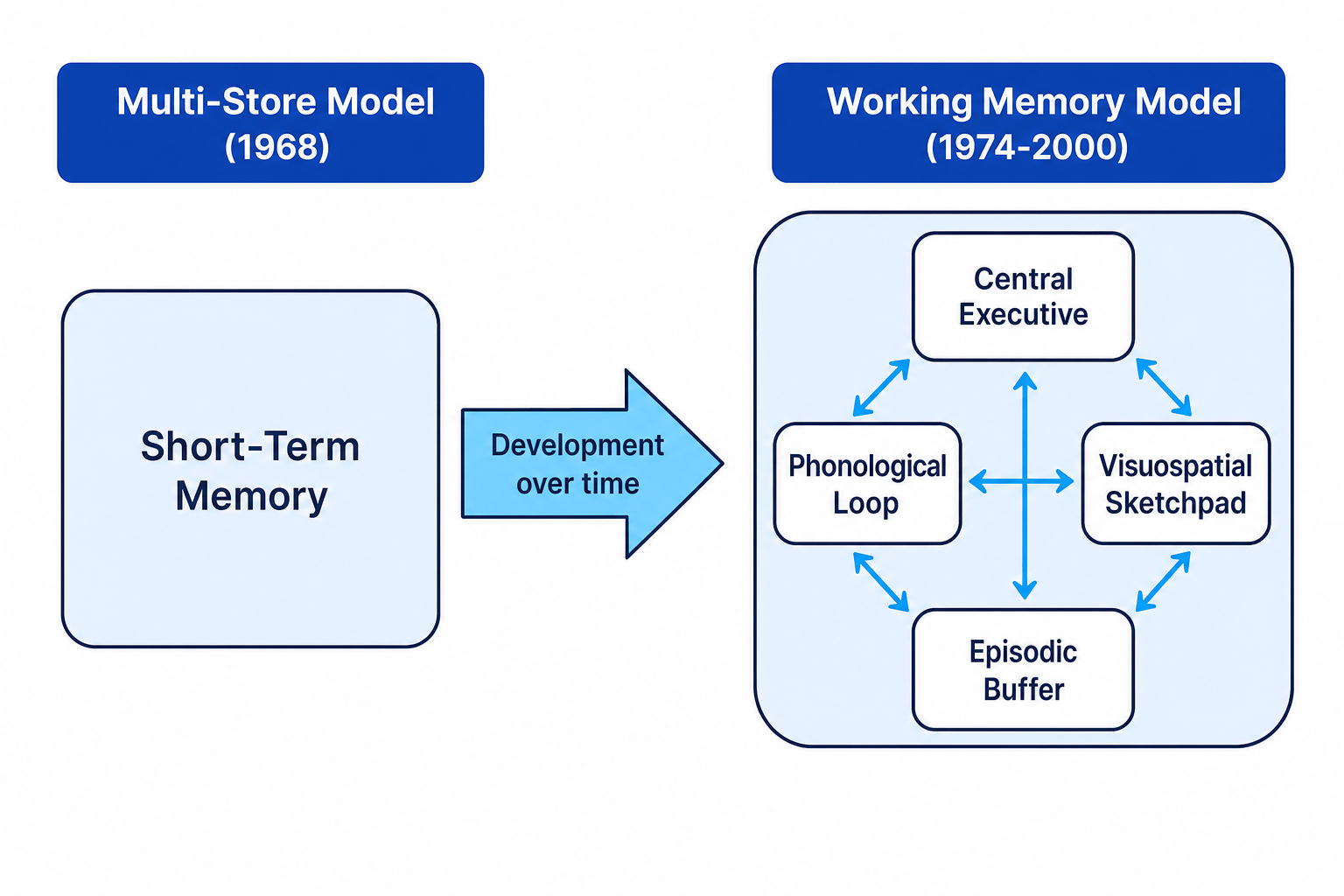
- The Starting Point: Atkinson and Shiffrin (1968) proposed the MSM. It was a pioneering attempt to map the mind, but its view of STM as a single, passive box was quickly seen as too simplistic.
- The Progression: Baddeley and Hitch (1974) recognized this limitation and proposed the WMM, which replaced the single STM with an active, multi-component system.
- Continuous Refinement: When the original WMM could not explain how visual and verbal information integrated with LTM, Baddeley (2000) updated his own model to include a fourth component: the Episodic Buffer.
This demonstrates how cognitive models are not static; they adapt as new empirical evidence is gathered.
9. Social Control, Social Sensitivity, and Practical Applications
Cognitive research has a profound impact on real-world systems, sometimes leading to ethical concerns about social control.
Social Control: Eye-Witness Testimony (EWT)
Reconstructive memory research shows that memory is highly malleable and easily distorted by post-event information or leading questions.
- The Application: This has been used to reform the legal system. For example, the development of the Cognitive Interview ensures police do not use leading questions that could plant false memories in witnesses' minds.
- The Social Control Angle: By determining what makes a witness "reliable" or "unreliable," cognitive psychologists hold immense power over who is believed in a court of law, directly influencing judicial outcomes and individual freedom.
Socially Sensitive Research and Dementia
Studying cognitive decline, particularly in conditions like Alzheimer's disease or dementia, is highly socially sensitive.
- For the individual: Research can highlight their cognitive deficits, causing anxiety, distress, or a loss of autonomy.
- For families: It brings to light the distressing realities of progressive cognitive decline.
- The Benefit: Despite these sensitivities, this research has led to incredible practical applications. For example, some cities operate "memory buses" (specially modified buses decorated with 1950s/60s memorabilia) to help trigger long-term memories and provide comfort to dementia patients through familiar environmental cues.
Worked Example
Let's walk through a cognitive research methods scenario to see how we apply statistical and design decisions to memory research.
Selecting and Justifying a Statistical Test for a Memory Experiment
A cognitive psychologist wanted to investigate whether a person's working memory capacity is affected by background noise.
Fifteen participants were asked to complete a digit span test in two separate conditions:
- Condition A: In a silent room.
- Condition B: In a room with a loud lawnmower running outside.
The psychologist recorded the maximum digit span (the number of digits recalled in the correct order) for each participant in both conditions. The data is ordinal.
Determine the most appropriate inferential statistical test for this study and justify your choice.
- Identify the hypothesis goal: The psychologist is looking to see if there is a difference in digit span between the two conditions (silent vs noisy). Therefore, this is a test of difference, not a correlation.
- Identify the experimental design: The same fifteen participants completed both Condition A and Condition B. This means the study uses a repeated measures design (related data).
- Identify the level of measurement: The data collected is the maximum digit span (e.g., 5, 6, 7). Digit span is treated as ordinal data because the intervals between ranks are not standard, fixed physical units.
- Select the correct inferential test: Based on the requirements (test of difference, repeated measures design, and ordinal data), the correct statistical test to use is the Wilcoxon Signed-Ranks test.
In the exam
- Structure your Issues and Debates essays using the terms AO1, AO2, and AO3:
- AO1: Clearly describe the debate (e.g., explain what reductionism means, or define the ethical guidelines).
- AO2: Apply the debate directly to cognitive psychology (e.g., "The Multi-Store Model is reductionist because...").
- AO3: Evaluate the implications of this debate (e.g., "While this reductionist approach allows for high internal validity in lab experiments, it limits our understanding of holistic real-world memory...").
- Use specific studies as currency: Never discuss a debate in the abstract. Always anchor your arguments with named studies and years (e.g., Bartlett, 1932; Baddeley, 1966; Sebastian & Hernández-Gil, 2012).
- Emphasize the "So What?": Don't just state that a study is socially sensitive or reductionist. Explain why that matters to society, clinical practice, or the credibility of psychology as a scientific discipline.
Check yourself
- Why does the case of Henry Molaison (HM) present a unique challenge to the ethical guideline of informed consent?
- In what way is the Working Memory Model an example of structural reductionism, and how does this compare to Bartlett's reconstructive memory theory?
- Explain how language differences between Spanish and English children in Sebastian & Hernández-Gil (2012) illustrate the influence of nurture in a cognitive ability that seems entirely biological (nature).
