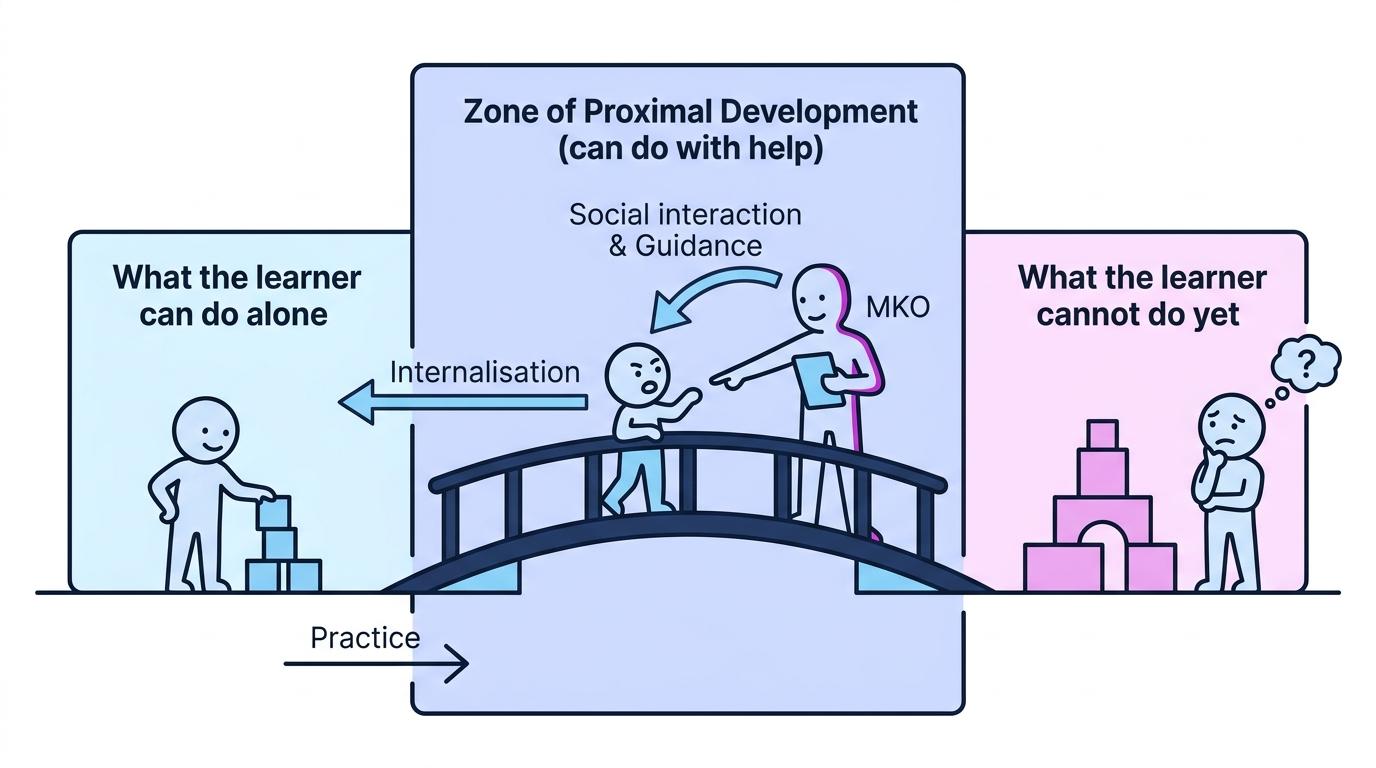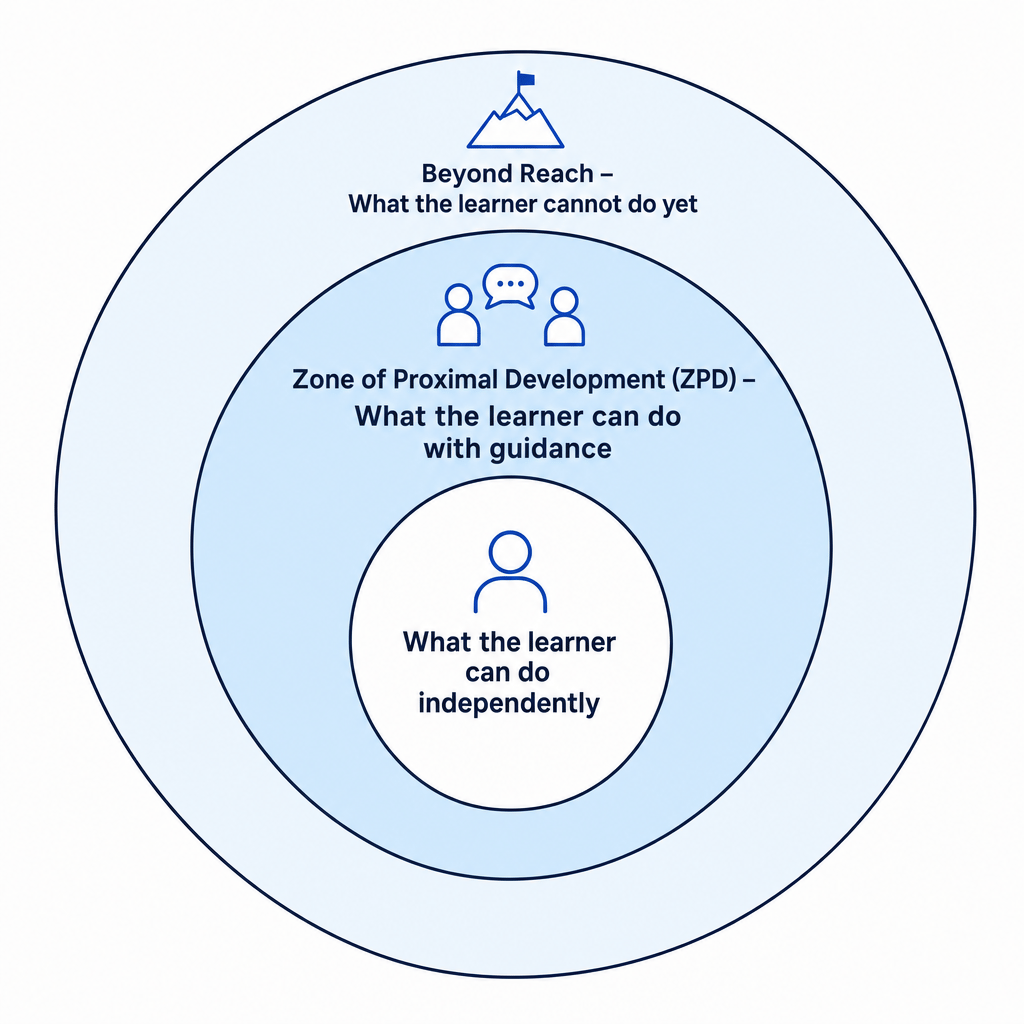
Crossing the gap
Imagine a river. On your side is everything you know. On the far side is an advanced concept you can't reach by jumping alone. The ZPD is the bridge. The MKO is the person holding your hand as you walk across it. Once you cross, that new concept becomes part of "your side of the river", and the ZPD shifts further outwards.
Scaffolding
To help a child cross their ZPD, the MKO uses a process called scaffolding.
Who invented scaffolding?
Many students write "Vygotsky proposed the concept of scaffolding." He didn't! Vygotsky died young in 1934 and never used the term. The term "scaffolding" was introduced later by Jerome Bruner (and Wood & Ross in 1976) to describe how MKOs guide learners through Vygotsky's ZPD. Examiners look for this distinction!
Scaffolding
The changing level of support provided over the course of a teaching session. The MKO adjusts the amount of guidance to fit the learner's current performance, gradually withdrawing support as the learner becomes more competent.
Just like physical scaffolding is erected to support a building while it's being constructed and then taken away once the building can stand on its own, cognitive scaffolding is removed once the child grasps the concept.
Wood, Bruner, and Ross (1976) – Features of Scaffolding
Wood et al. identified several specific strategies MKOs use to scaffold a child:
- Recruitment: Engaging the learner's interest in the task.
- Reduction of degrees of freedom: Simplifying the task by reducing the number of steps required to reach a solution (e.g., hiding half the puzzle pieces so the child isn't overwhelmed).
- Direction maintenance: Keeping the learner motivated and on track.
- Marking critical features: Highlighting the most important parts of the task.
- Demonstration: Showing the learner how to do it so they can imitate.
As the learner's ability increases, the level of help provided decreases from highly specific instructions to vague hints.
Identifying scaffolding in practice (AO2)
Imagine an exam question describes a mother teaching her 5-year-old to tie his shoelaces. Let's break down how she scaffolds his learning through the ZPD.
- Identify the MKO and the ZPD: The mother is the MKO. The ZPD is the gap between the child's current ability (e.g., putting shoes on, but leaving laces loose) and the goal (tying a neat bow).
- Identify high-level support (early stage): The mother might use demonstration, slowly tying her own shoe while the child watches, and physically guiding his hands to cross the laces.
- Identify reducing support (middle stage): As he gets the hang of crossing the laces, she reduces support by just pointing (marking critical features) or giving verbal cues like "make the bunny ear".
- Identify withdrawal of support (final stage): Eventually, she just says, "Remember to tie your shoes!" before leaving the house. The scaffolding is fully removed; the skill has been internalized.
Evaluating Vygotsky's Theory (AO3)
When writing an essay on Vygotsky, you need to weigh up the strengths and limitations of his theory, often by comparing it to Piaget's.
Strengths
- Strong empirical support for scaffolding: Research supports the idea that adult guidance improves learning. Wood and Middleton (1975) observed 4-year-olds interacting with their mothers while building a wooden puzzle (a task too difficult to do alone). They found that mothers who varied their strategy according to how the child was doing (i.e., scaffolding) were the most successful at helping the child learn.
- Real-world application in education: Vygotsky's ideas have revolutionized teaching. Unlike Piaget's idea of discovery learning (where the teacher steps back), Vygotskian classrooms involve peer tutoring, teaching assistants, and guided collaborative work. Evidence shows this works: Keer and Verhaeghe (2005) found that 7-year-olds tutored by 10-year-olds progressed further in reading than a control group who only had whole-class teaching.
Limitations
- Ignores biological factors: Vygotsky assumed the processes of learning are largely the same across all species and heavily emphasized culture. By doing so, he severely underplayed the role of biological maturation. Piaget's stage theory, which argues that certain cognitive limits are biologically set (e.g., a 2-year-old simply doesn't have the brain development to grasp abstract algebra, no matter how good the scaffolding is), provides a strong counter-argument.
- Individual differences in learning styles: Vygotsky's theory assumes that all children learn best through social interaction. However, this may not be true for everyone. Some children (perhaps depending on personality traits like introversion, or neurodivergence like autism) may learn better through independent, solitary exploration rather than collaborative work.
Comparing Piaget and Vygotsky
If an essay asks you to discuss Vygotsky, use Piaget as your AO3 evaluation.
- Piaget: Cognitive development is driven by biological maturation and independent discovery (stages). Language is just a reflection of thought.
- Vygotsky: Cognitive development is driven by culture, social interaction, and instruction (continuous). Language is the tool that shapes thought.
In the exam
- Be precise with terminology: Use "Zone of Proximal Development", "More Knowledgeable Other", and "Scaffolding" accurately. Examiners reward the correct use of these technical terms.
- Attribute scaffolding correctly: Remember that while scaffolding is the practical application of Vygotsky's ZPD, the term was coined by Wood, Bruner and Ross. Mentioning this shows excellent wider knowledge.
- Link AO2 explicitly to the ZPD: In application scenarios, don't just say "the teacher helps the student". Say "the teacher acts as the MKO to guide the student through their ZPD by gradually withdrawing scaffolding."
- Structure your AO3 points: Use a PEEL structure (Point, Evidence, Explain, Link). E.g., Point: Vygotsky has strong application to education. Evidence: Keer and Verhaeghe (peer tutoring). Explain: This shows that MKOs accelerate learning. Link: Therefore, the theory has high ecological validity and real-world utility.
Check yourself
- Who or what is a More Knowledgeable Other (MKO), and must it always be an adult?
- How would you define the Zone of Proximal Development (ZPD) in one sentence?
- Which researcher(s) introduced the concept of scaffolding?
- What is one major criticism of Vygotsky's theory when compared to Piaget's?