What you'll learn
- Why Baillargeon argued that infants know more about the physical world than Piaget believed.
- How violation of expectation research uses infants’ looking time.
- Key evidence from Baillargeon’s drawbridge and occlusion studies.
- Strengths, limitations, ethics, and exam evaluation points for AO3.
The starting point: do babies understand hidden objects?
Baillargeon’s work sits in the broader topic of cognition and development: how thinking, reasoning, and understanding change as children grow.
A key issue is whether very young infants understand that objects still exist when they cannot see them. Piaget argued that this ability develops gradually during the sensorimotor stage, from birth to around 2 years. He suggested that babies younger than about 8 months generally lack object permanence because they do not search for hidden objects.
Baillargeon disagreed. She argued that Piaget’s tasks may have underestimated infants because searching for an object requires more than understanding. It also requires motor control, memory, attention, and the ability to coordinate actions.
Object permanence
Object permanence is the understanding that objects continue to exist even when they are hidden from view.
Baillargeon’s main claim
Baillargeon argued that infants have early knowledge of the physical world, including object permanence, but they may not be able to show it through actions like reaching or searching.
Knowledge of the physical world
Baillargeon’s explanation is often linked to a nativist view. A nativist explanation says that some abilities or expectations are present from birth, or develop very early because of built-in cognitive structures.
This does not mean babies have adult-like scientific knowledge. Instead, Baillargeon suggested that infants have early, basic expectations about how objects behave.
These include:
- Objects continue to exist when hidden.
- Solid objects cannot pass through each other.
- Objects usually move along continuous paths, rather than disappearing and reappearing.
- Objects need appropriate support, otherwise they fall.
- Hidden objects keep properties such as size, height, and location.
Physical reasoning
Physical reasoning is the ability to make expectations about how objects behave in the physical world, such as whether they can pass through barriers or remain hidden behind screens.
A useful way to think about Baillargeon’s view is that infants have a “starter kit” for understanding objects. This early knowledge becomes more detailed with experience.
The competence-performance distinction
A very important idea for this topic is the difference between what an infant knows and what an infant can show.
Competence means the underlying ability or knowledge. Performance means how well someone can demonstrate that ability in a particular task.
Piaget often used search tasks. For example, he might hide a toy under a cloth and see whether the infant reaches for it. If the infant does not search, Piaget interpreted this as a lack of object permanence.
Baillargeon argued that this conclusion may be too strong. The infant might understand that the object still exists but fail to search because the task is difficult.
Applying the competence-performance distinction
A 5-month-old sees a toy hidden behind a screen but does not reach for it.
- Identify what the task requires: the infant must remember the toy, plan a reaching action, coordinate movement, and maybe overcome distraction.
- Separate knowledge from action: failing to reach could show poor performance rather than lack of competence.
- Apply Baillargeon’s explanation: the infant may still expect the toy to exist behind the screen, even if they cannot demonstrate this by searching.
Violation of expectation research
Baillargeon used a method called violation of expectation. This is a research technique where infants are shown events that are either physically possible or physically impossible. Researchers then measure how long the infant looks at each event.
The logic is simple: if infants look longer at an impossible event, it suggests the event violated an expectation they already had.
Violation of expectation
Violation of expectation is a research method where infants are shown possible and impossible events, and longer looking time is interpreted as evidence that the infant found the event surprising or unexpected.
In these studies, the independent variable is what the researcher changes, such as whether the event is possible or impossible. The dependent variable is what the researcher measures, usually looking time.
A related term is habituation. This means that the infant is repeatedly shown the same event until they become less interested and look for a shorter time. Then the test events are introduced.
Habituation
Habituation is when a response decreases after repeated exposure to the same stimulus, such as an infant looking less at a familiar display.
Do not overclaim from looking time
Avoid writing that Baillargeon “proved” babies were surprised. Longer looking time is interpreted as surprise or violated expectation, but this interpretation can be challenged.
Baillargeon, Spelke and Wasserman (1985): the drawbridge study
One of Baillargeon’s most famous studies was the drawbridge study by Baillargeon, Spelke and Wasserman (1985).
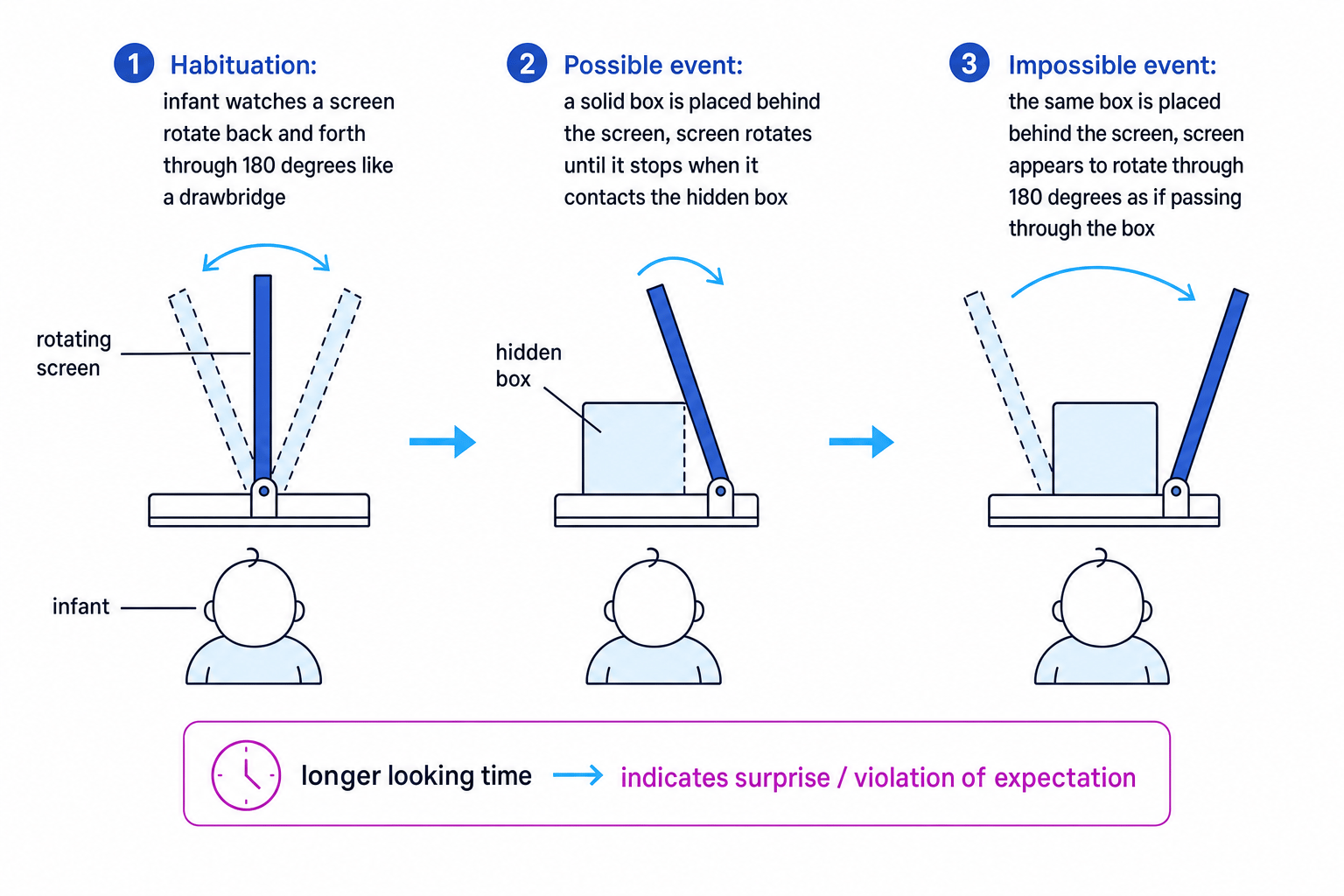
The participants were around 5 months old. First, they were habituated to a screen rotating backwards and forwards like a drawbridge.
Then a box was placed behind the screen. Infants saw two types of test event:
- Possible event: the screen rotated backwards but stopped when it reached the hidden box.
- Impossible event: the screen appeared to rotate all the way back through the space where the hidden box should have been.
Infants looked longer at the impossible event. Baillargeon interpreted this as evidence that they expected the box to continue existing behind the screen and expected the solid screen not to pass through it.
So, this study suggests early understanding of both:
- Object permanence, because the infant represents the hidden box.
- Solidity, because the infant expects two solid objects not to occupy the same space.
Interpreting looking-time results
Imagine infants looked for an average of 8.4 seconds at the possible event and 12.2 seconds at the impossible event.
- Identify the key comparison: the physical setup is similar, but one event obeys physical rules and the other appears to break them.
- Compare the looking times: 12.2−8.4=3.812.2 - 8.4 = 3.812.2−8.4=3.8, so infants looked longer at the impossible event.
- Apply the violation of expectation logic: longer looking suggests the impossible event conflicted with the infants’ expectation that the hidden box still existed.
- Add caution: this supports Baillargeon’s interpretation, but you would still need controls and statistical testing before making a strong conclusion.
Baillargeon and Graber (1987): the rabbit study
Baillargeon and Graber (1987) used another violation of expectation task involving a rabbit moving behind a screen with a window in it.
Infants saw either a tall rabbit or a short rabbit move behind the screen. If the tall rabbit passed behind the screen, it should have appeared in the window. The short rabbit would be too short to appear.
The key impossible event was when the tall rabbit passed behind the screen but did not appear in the window. Infants looked longer at this event.
This suggests infants were not just thinking “an object exists somewhere”. They seemed to represent something about the object’s height and expected it to be visible through the window.
Beyond simple object permanence
Baillargeon’s research suggests infants may represent hidden objects in quite detailed ways, including features such as size, height, and location.
How Baillargeon challenges Piaget
Piaget’s evidence suggested that young infants lack object permanence because they do not search for hidden objects. Baillargeon’s evidence suggests infants may understand hidden objects much earlier.
A balanced exam answer should not simply say “Piaget was wrong”. A better answer is:
- Piaget may have measured infants’ ability to act on knowledge.
- Baillargeon measured infants’ ability to look longer at unexpected events.
- These tasks may tap different aspects of cognition.
Piaget’s tasks are more demanding because infants must coordinate reaching, remember the hiding place, and sometimes inhibit a previous response. For example, in the A-not-B error, infants search in the first hiding place even after seeing the object moved to a second hiding place.
Baillargeon’s tasks reduce these performance demands, but they introduce a different issue: researchers must interpret what looking time really means.
AO3: strengths of Baillargeon’s research
It avoids motor demands
A major strength is that violation of expectation research does not require infants to reach, crawl, or search. This makes it suitable for very young infants.
This is important because poor motor control could make babies seem less cognitively advanced than they really are. Baillargeon’s method therefore gives a fairer test of early understanding.
It uses controlled procedures
Baillargeon’s studies were highly controlled laboratory experiments. The possible and impossible events were carefully designed to be similar, except for the key physical violation.
This helps establish cause and effect: if the impossible event leads to longer looking, it may be because the event violates the infant’s physical expectations.
Researchers can also record looking time and use more than one observer. This can improve reliability, which means the consistency of measurement.
It has changed developmental psychology
Baillargeon’s work has had a major theoretical impact. It encouraged psychologists to investigate infants’ early cognitive abilities using non-verbal methods.
It also has practical value because it reminds adults that infants may understand more than they can express. This can influence how caregivers, educators, and researchers think about early development.
AO3: limitations and criticisms
Looking time is ambiguous
The biggest criticism is that longer looking time may not always mean surprise. Infants might look longer because an event is more visually interesting, unusual, complex, or novel.
For example, an impossible event may involve more movement or seem more attention-grabbing. If so, the infant’s longer looking might not reflect object permanence at all.
Evaluation phrase
A strong AO3 sentence is: “The validity of violation of expectation research depends on whether looking time genuinely measures cognitive surprise rather than perceptual preference.”
The method may overestimate infant knowledge
Baillargeon’s conclusions can sound as if infants have a full, adult-like understanding of objects. However, their knowledge may be more limited and implicit.
An infant might detect that something is odd without being able to reason consciously about hidden objects. So, it is safer to say Baillargeon found evidence for early expectations about the physical world, not complete adult understanding.
Sample and practical issues
Infant research often involves small samples because babies may become tired, distressed, distracted, or fussy. Some infants may be excluded if they do not complete the task.
This can reduce generalisability if the final sample only includes infants who are especially calm or attentive.
There can also be observer bias if researchers know which condition is possible or impossible. This is why blind coding, where observers do not know the condition or hypothesis, is important.
Artificial situations
The drawbridge and rabbit studies are clever, but they are artificial. Infants do not usually see screens apparently rotating through boxes in everyday life.
This does not make the studies useless, but it does mean we should be cautious when applying the findings to natural infant behaviour.
Ethical considerations
Baillargeon’s research is generally low risk, but infant studies still raise ethical issues.
Parents or guardians must give informed consent because infants cannot consent for themselves. Researchers should stop the study if the infant becomes distressed, protecting them from harm.
There should also be a right to withdraw, confidentiality for any video recordings, and a debrief for parents afterwards. If parents are not told the full aim beforehand to avoid demand characteristics, this mild deception should be justified and explained later.
In the exam
- For AO1, define violation of expectation and outline one named study, such as Baillargeon, Spelke and Wasserman (1985).
- For AO2, link the scenario to hidden objects, possible versus impossible events, and longer looking time.
- For AO3, balance strengths such as reduced motor demands with limitations such as the ambiguous meaning of looking time.
Check yourself
- Why did Baillargeon argue that Piaget underestimated young infants?
- What does longer looking time mean in violation of expectation research, and why is this interpretation criticised?
- In the drawbridge study, which physical principles were infants thought to understand?
