What you'll learn
- How Piaget explains children’s thinking using schemas, assimilation, accommodation and equilibration.
- The four stages of intellectual development and what children can typically do at each stage.
- Key Piagetian ideas: object permanence, conservation, egocentrism and class inclusion.
- How to evaluate Piaget using supporting and contradictory evidence for A-Level essays.
The big picture: children as active thinkers
Piaget argued that children are not just “less knowledgeable adults”. Instead, they think in qualitatively different ways at different ages. His theory is often called a constructivist theory because it says children actively construct knowledge by exploring the world.
Cognitive development
Cognitive development means the development of mental processes such as thinking, reasoning, memory, problem-solving and understanding the world.
For Piaget, development happens through two linked ideas:
- Children build and modify schemas.
- Children move through a fixed sequence of stages of intellectual development.
Piaget in one sentence
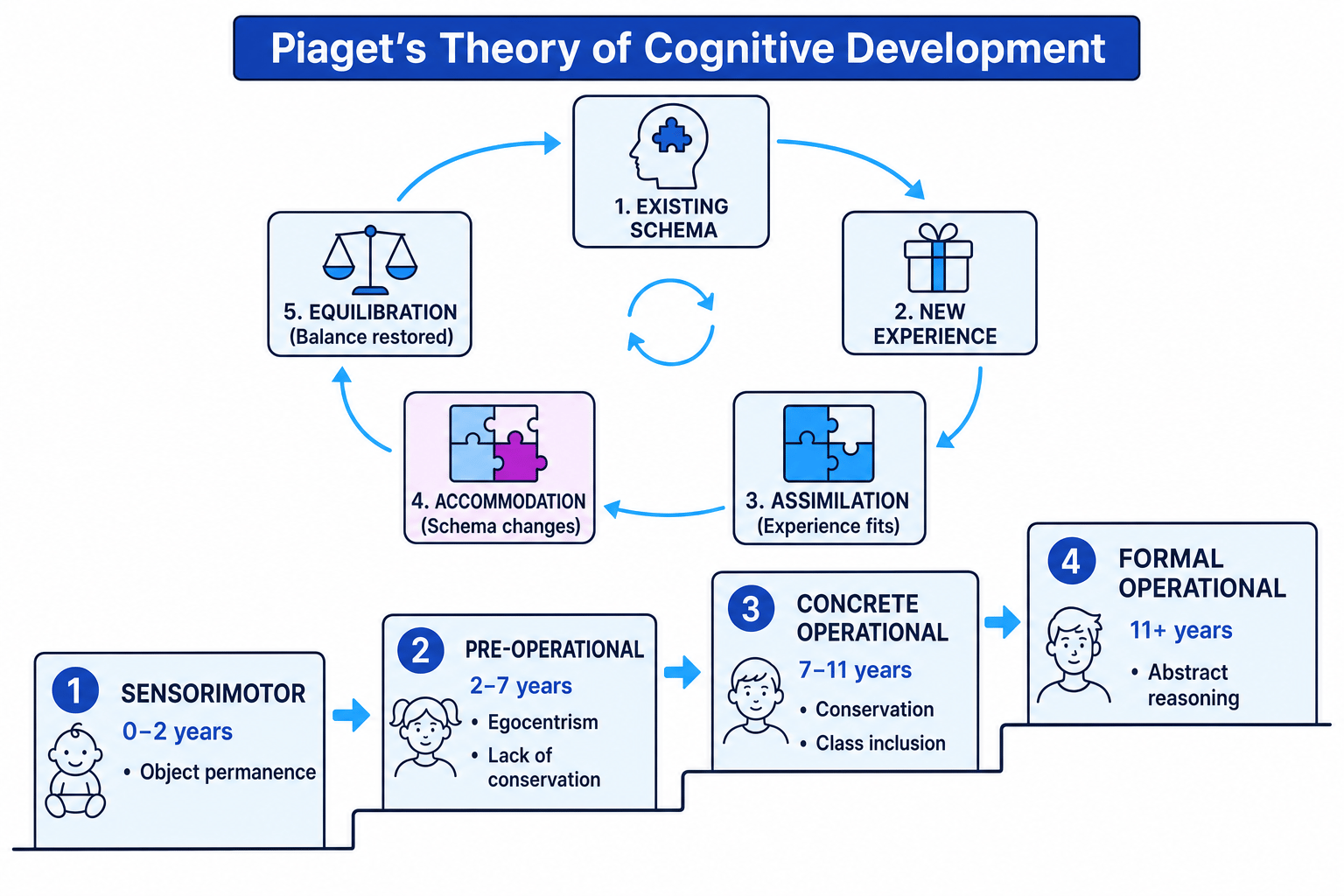
Children actively adapt their mental understanding of the world, and this produces stage-like changes in how they think.
Schemas: the building blocks of thinking
Schema
A schema is a mental framework or organised packet of knowledge that helps a child understand and respond to the world.
Very young babies have simple schemas, such as a sucking schema or grasping schema. As children grow, schemas become more complex: for example, a child may develop a schema for “dog”, “school”, “birthday party” or “sharing”.
Schemas guide expectations. If a child has a “restaurant schema”, they may expect to sit down, order food, eat, and then pay.
Assimilation, accommodation and equilibration
Piaget believed learning happens when children meet new experiences and try to fit them into what they already know.
Assimilation
Assimilation happens when a child understands a new experience using an existing schema.
For example, a toddler may see a cow and call it “dog” because they already have a schema for four-legged animals.
Accommodation
Accommodation happens when a child changes an existing schema or creates a new one because the new experience does not fit.
The toddler may then learn that cows are different from dogs, so they adjust their animal schemas.
Equilibration
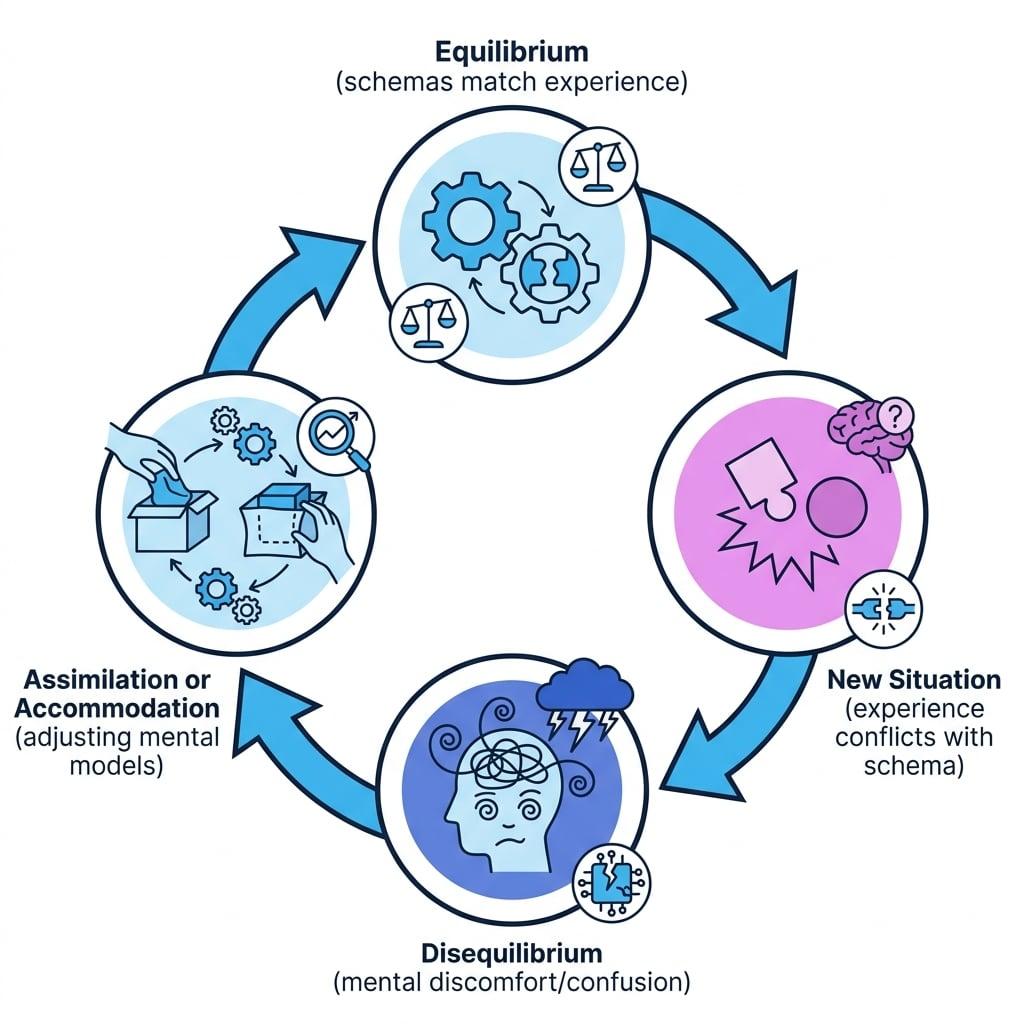
Equilibration is the process of restoring mental balance after a child’s existing schemas are challenged by new information.
Piaget thought children prefer equilibrium, meaning their schemas make sense of the world. When something does not fit, this creates disequilibrium. The child then uses assimilation or accommodation to regain equilibrium.
Assimilation or accommodation
A child who knows the word “bird” sees a butterfly and calls it a bird.
- The child applies an existing schema: “small thing that flies” is treated as a bird, so this is assimilation.
- An adult explains that butterflies have insect bodies and wings, but they are not birds. The child’s original “bird” schema no longer explains the experience properly.
- The child creates a new “butterfly” schema and changes the “bird” schema to include features such as feathers and beaks. This is accommodation.
- The child can now correctly identify both birds and butterflies, so equilibration has occurred.
Assimilation vs accommodation
Do not write that assimilation and accommodation are the same. Assimilation means the experience is fitted into an existing schema; accommodation means the schema itself changes.
Stages of intellectual development
Stage
A stage is a broad period of development in which children show a particular type of thinking. Piaget believed the stages occur in the same order for all children.
Piaget’s stages are invariant, meaning the order does not change. A child cannot skip from the sensorimotor stage straight to the formal operational stage. However, the exact ages are approximate.
| Stage | Approximate age | Main features |
|---|---|---|
| Sensorimotor | 0–2 years | Learning through senses and actions; development of object permanence |
| Pre-operational | 2–7 years | Symbolic thought and language, but egocentrism, lack of conservation and class inclusion errors |
| Concrete operational | 7–11 years | Logical thinking about physical objects; conservation and class inclusion improve |
| Formal operational | 11+ years | Abstract, hypothetical and scientific reasoning |
Remembering the stages
Sensorimotor = senses and movement. Pre-operational = before logical operations. Concrete operational = logical thinking with concrete examples. Formal operational = formal, abstract reasoning.
Sensorimotor stage: object permanence
In the sensorimotor stage, babies learn mainly through direct sensory experience and physical action. They look, touch, suck, grasp, crawl and explore.
Object permanence
Object permanence is the understanding that objects continue to exist even when they cannot be seen, heard or touched.
Piaget studied this by hiding toys under blankets. Very young infants often did not search for the toy, which Piaget interpreted as evidence that they did not yet understand the object still existed.
By around 8 months, babies begin to search for hidden objects, although full object permanence develops gradually.
Pre-operational stage: symbolic thought, egocentrism and conservation errors
In the pre-operational stage, children develop symbolic thought, meaning they can use words, images and pretend play to represent things. For example, a banana may become a “telephone” in play.
However, Piaget argued that pre-operational children still struggle with logical mental operations.
Egocentrism
Egocentrism
Egocentrism is difficulty seeing the world from another person’s point of view.
This does not mean the child is selfish. It means they may assume others see, know or feel the same things they do.
Piaget and Inhelder (1956) tested egocentrism using the Three Mountains Task. A child sat in front of a model of three mountains and was asked to choose what a doll on the other side would see. Younger children often chose their own view, suggesting egocentrism.
Egocentrism is not selfishness
In Psychology, egocentrism is a cognitive limitation, not a personality flaw. It is about perspective-taking, not being rude or uncaring.
Conservation
Conservation
Conservation is the understanding that quantity stays the same even when appearance changes, as long as nothing is added or taken away.
Piaget tested conservation using tasks such as:
- Number: two equal rows of counters, then one row is spread out.
- Liquid: equal liquid in identical glasses, then one is poured into a taller, thinner glass.
- Mass: two equal balls of clay, then one is flattened.
Pre-operational children often focus on one obvious feature, such as height or length. This is called centration. They also struggle with reversibility, which is the ability to mentally reverse an action.
Explaining a conservation error
A child sees two identical glasses with the same amount of juice. One glass is poured into a taller, thinner glass. The child says the tall glass has more juice.
- The child focuses on the height of the liquid, so their thinking shows centration.
- The child does not mentally reverse the pouring action and imagine the juice going back into the original glass, so they lack reversibility.
- Because they believe the amount changed when only the appearance changed, they have not yet achieved conservation of liquid.
- This pattern is typical of the pre-operational stage, usually around 2–7 years.
Class inclusion
Class inclusion
Class inclusion is the understanding that a category can include smaller subcategories.
For example, if a child is shown seven daisies and three roses, and asked “Are there more daisies or more flowers?”, a pre-operational child may say “more daisies”. They focus on the visible subcategory and fail to understand that both daisies and roses are included in the larger class “flowers”.
Concrete operational stage: logical thinking about real objects
In the concrete operational stage, children can carry out operations, which are logical mental actions. They can conserve, classify and understand reversibility more successfully.
They can also decentre, meaning they can consider more than one feature of a situation at once. For example, in a conservation task, they can think about both height and width.
However, their reasoning is still mainly concrete. They find it easier to reason about real objects and familiar situations than abstract ideas.
Formal operational stage: abstract reasoning
In the formal operational stage, children and adolescents can think more abstractly. They can reason about possibilities, hypotheses and ideas that are not directly in front of them.
For example, they may be able to solve “what if?” problems, understand metaphors, or reason scientifically by testing variables systematically.
Identifying the stage from behaviour
A child can correctly say that roses are flowers and daisies are flowers, but struggles with an abstract logic puzzle using made-up symbols.
- Correctly understanding that roses and daisies are both part of the wider category “flowers” shows class inclusion.
- This suggests the child is beyond the pre-operational stage and is likely using concrete operational thinking.
- The difficulty with made-up symbolic logic suggests they may not yet be consistently using formal operational abstract reasoning.
- The best stage judgement is therefore concrete operational, especially if the child is around 7–11 years old.
AO3 evaluation: strengths and limitations
Strength: Piaget changed how people viewed children
Before Piaget, children were often seen as simply knowing less than adults. Piaget showed that children may think in different ways, not just less developed ways. This has been extremely influential in developmental psychology and education.
His theory encouraged child-centred education, where teachers consider a child’s developmental readiness and use active discovery learning.
Strength: useful real-world applications in education
Piaget’s theory supports teaching with concrete materials for younger children. For example, children in the concrete operational stage may benefit from counters, blocks, diagrams and practical demonstrations before moving to abstract written problems.
This is a useful application because it links psychological theory to classroom practice.
Weakness: Piaget may have underestimated children
Later research suggests children can succeed earlier than Piaget claimed if tasks are made clearer and more familiar.
Hughes (1975) criticised the Three Mountains Task as confusing and artificial. In his policeman doll study, children had to hide a doll from two policemen. Many younger children succeeded, suggesting they were less egocentric than Piaget believed.
McGarrigle and Donaldson (1974) also challenged Piaget’s conservation findings. In the “naughty teddy” version, a teddy accidentally messed up a row of counters. More children conserved number compared with Piaget’s original task, suggesting the original may have been affected by demand characteristics.
Rose and Blank (1974) argued that asking the same question twice in conservation tasks may make children think their first answer was wrong. When children were asked only once, they performed better.
Weakness: evidence against a rigid stage theory
Piaget suggested children move through broad stages, but development may be more gradual and uneven. A child might conserve number before liquid, or reason logically in a familiar task but not an unfamiliar one.
Cross-cultural evidence also challenges fixed ages. Dasen (1994) found that Aboriginal Australian children developed some spatial skills earlier than expected but conservation skills later, suggesting culture and experience affect development.
This means Piaget’s stages may describe a general pattern, but they are not always universal in timing.
Weakness: methodological issues
Piaget often used small samples, including observations of his own children, especially in early work such as Piaget (1952). This raises concerns about generalisability and researcher bias.
Some tasks also used language that younger children may not have fully understood. If a child fails a task, it may reflect memory, language or attention demands rather than the absence of a cognitive ability.
Ethical considerations in child research
Research with children needs extra care. Studies should involve parental consent, child assent where possible, the right to withdraw, protection from distress or embarrassment, confidentiality, and debriefing. For example, children should not be made to feel “wrong” or unintelligent if they fail a task.
Balanced judgement
Piaget’s theory is highly influential and useful, but later research suggests children’s abilities are often more advanced, more context-dependent and more culturally influenced than Piaget proposed.
In the exam
- For AO1, define the key terms clearly: schema, assimilation, accommodation, equilibration, and the four stages.
- For AO2, apply the correct stage to the behaviour in the scenario, using evidence such as object permanence, conservation, egocentrism or class inclusion.
- For AO3, balance Piaget’s influence and educational applications against evidence that his tasks underestimated children, such as Hughes (1975), McGarrigle and Donaldson (1974), and Rose and Blank (1974).
Check yourself
- What is the difference between assimilation and accommodation?
- Why might a pre-operational child fail a conservation task?
- How do later studies challenge Piaget’s claim that young children are egocentric?