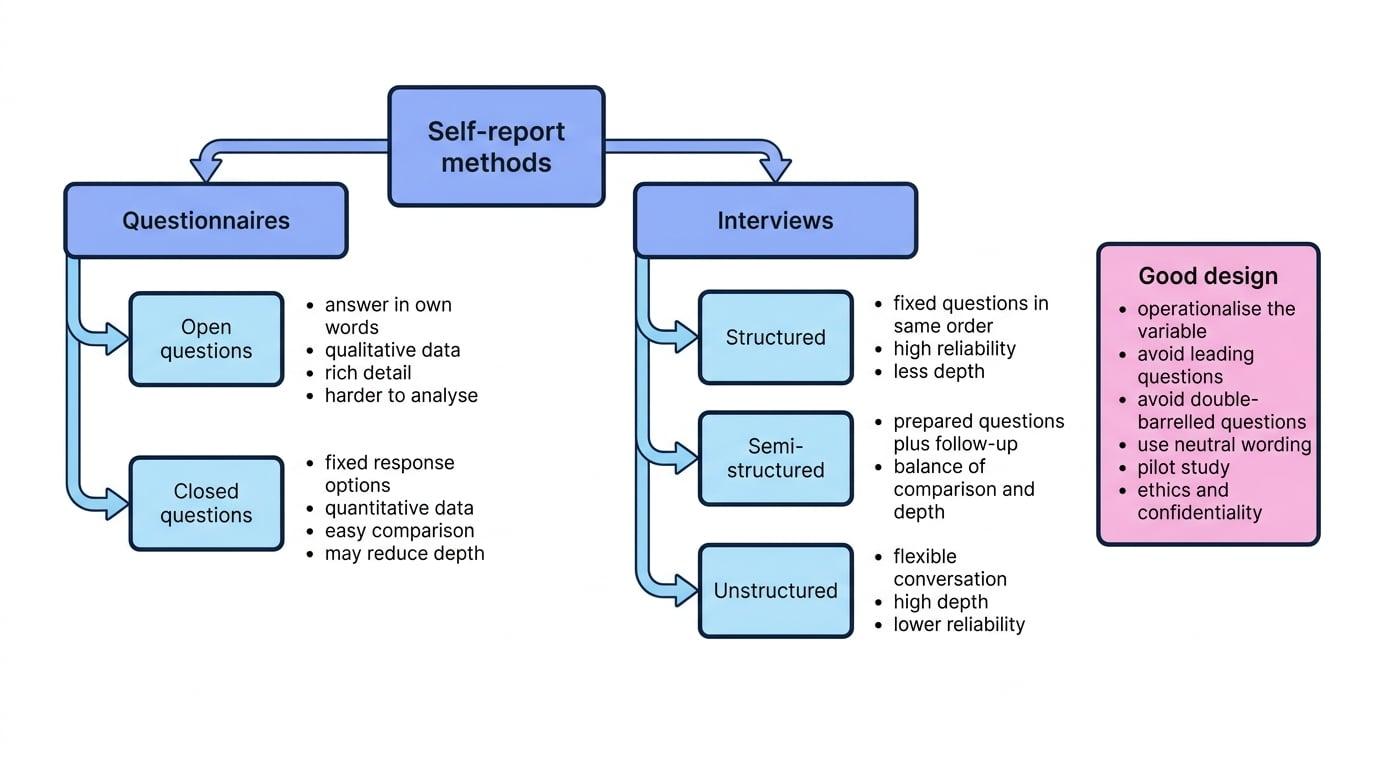
What you'll learn
- How questionnaires and interviews are used as self-report methods in psychological research.
- How to design open and closed questions that avoid bias.
- How structured, semi-structured and unstructured interviews differ.
- How to evaluate questionnaire and interview methods for AO3: reliability, validity, ethics and practicality.
Self-report methods: the starting point
AQA places questionnaire and interview design within scientific processes, because psychologists need ways to collect data that are systematic, ethical and suited to the research aim.
Self-report method
A self-report method is a research method where participants provide information about themselves, usually by answering questions about their thoughts, feelings, attitudes or behaviours.
Questionnaires and interviews are both self-report methods. They are useful because many psychological variables, such as anxiety, prejudice, stress or attachment experiences, cannot be directly observed easily.
The big challenge is that participants may not always give accurate answers. They may misunderstand the question, forget details, or answer in a way that makes them look good.
The core issue
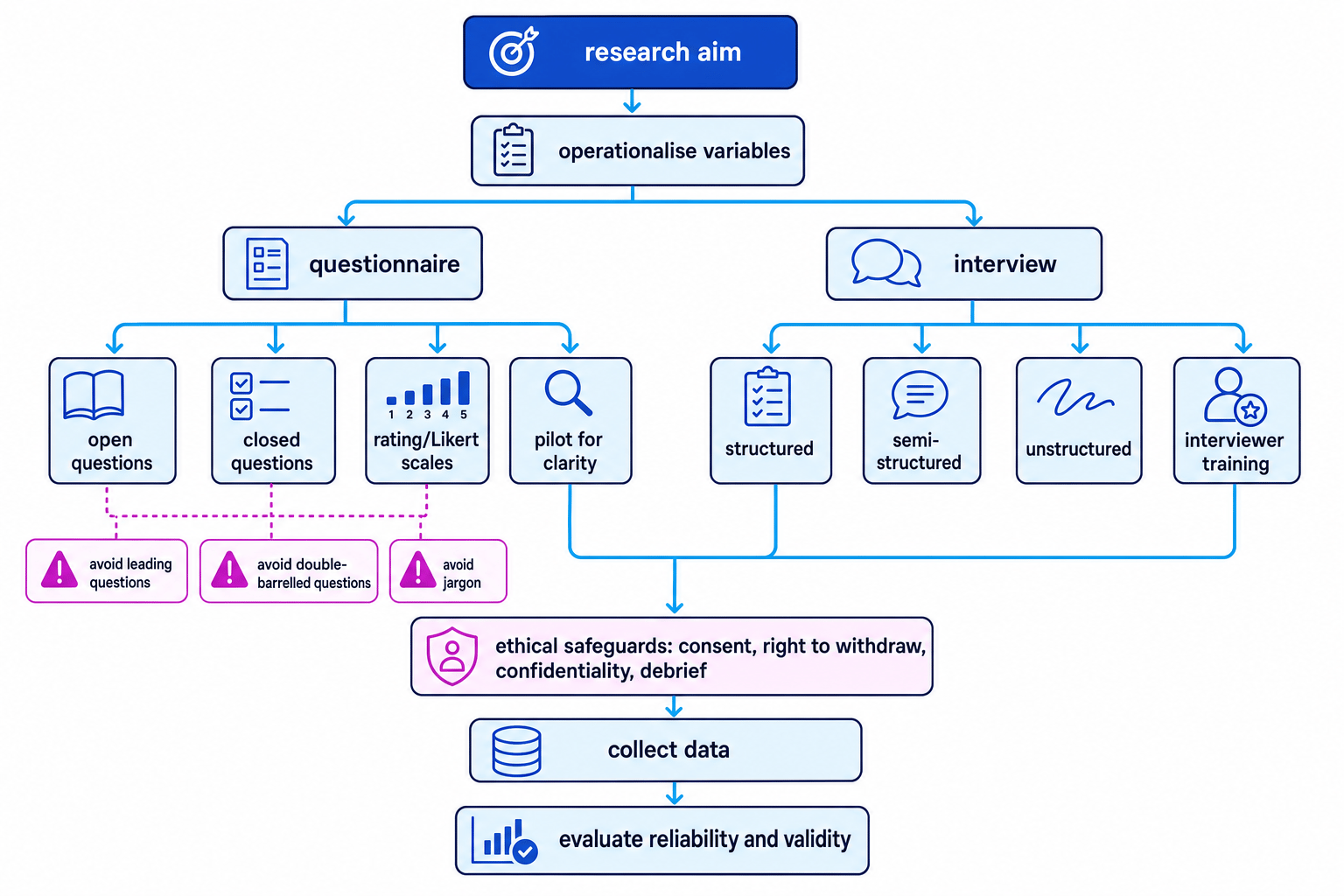
Good questionnaire and interview design is about turning a research aim into clear, unbiased questions that collect valid and reliable data.
A helpful overall design process looks like this:
Questionnaires
Questionnaire
A questionnaire is a set of written questions that participants answer, usually independently, either on paper or online.
Questionnaires are commonly used to collect data from large numbers of people. They can measure attitudes, behaviours, symptoms, experiences or preferences.
For example, a researcher studying exam stress might give students a questionnaire asking how often they revise, how anxious they feel before exams, and what coping strategies they use.
Operationalising what you want to measure
Operationalisation
Operationalisation means defining a psychological variable in a measurable way.
Before writing questions, the researcher must decide exactly what they mean by the concept they are studying.
For example, “stress” is too vague by itself. It could be operationalised as:
- self-rated stress on a 1–10 scale
- number of stress symptoms reported in the past week
- score on a standardised stress questionnaire
- frequency of stress-related behaviours, such as sleep disruption
If the variable is not operationalised clearly, the questionnaire may not measure what it is supposed to measure.
Operationalising exam stress
A researcher wants to investigate whether Year 13 students experience high exam stress.
- Identify the broad concept: the researcher is interested in exam stress, which is not directly measurable as a single object.
- Choose observable or reportable indicators: stress could be shown through worry, sleep disruption, irritability, physical symptoms or avoidance of revision.
- Turn the indicators into measurable items: the researcher could ask, “In the past week, how often have you had difficulty sleeping because of exams?”
- Decide how responses will be recorded: a closed scale such as “never / rarely / sometimes / often / always” would allow students’ answers to be compared.
Open and closed questions
Open questions
Open question
An open question allows participants to answer in their own words rather than choosing from fixed options.
Example: “How do you feel before an important exam?”
Open questions produce qualitative data, meaning descriptive, non-numerical information. They are useful when researchers want depth, detail and unexpected answers.
Strengths of open questions:
- They can produce rich, detailed responses.
- Participants are not forced into categories that may not fit them.
- They can increase validity because participants explain their own experiences.
Limitations of open questions:
- They are harder and slower to analyse.
- Different researchers may interpret answers differently.
- They can be difficult to compare across participants.
Closed questions
Closed question
A closed question gives participants a fixed set of response options to choose from.
Example: “How often do you feel nervous before exams? Never / rarely / sometimes / often / always.”
Closed questions usually produce quantitative data, meaning numerical data or data that can easily be counted.
Types of closed questions include:
- Dichotomous questions: two possible answers, such as yes/no.
- Multiple-choice questions: several fixed options.
- Rating scales: participants choose a number or category to show intensity.
- Likert scales: participants state their level of agreement, such as “strongly disagree” to “strongly agree.”
Strengths of closed questions:
- They are quick for participants to answer.
- They are easy to analyse statistically.
- They improve reliability because every participant answers the same item.
Limitations of closed questions:
- They may oversimplify complex experiences.
- Participants may be forced to choose an option that does not really fit.
- Poorly chosen response categories can reduce validity.
Open or closed?
Use open questions when you want depth and explanation. Use closed questions when you want easy comparison, summaries and statistical analysis.
Writing good questionnaire items
A good questionnaire item should be clear, neutral and focused on one issue at a time.
Avoid leading questions
Leading question
A leading question is worded in a way that pushes the participant towards a particular answer.
For example, “Don’t you agree that social media damages teenagers’ mental health?” encourages agreement.
This matters in psychology because question wording can affect responses. Loftus and Palmer (1974) showed that wording influenced eyewitness memory estimates: participants gave different speed estimates depending on whether cars were described as “smashed” or “hit”. Ethically, studies using deception or hidden aims should include informed consent where possible, protection from harm, the right to withdraw and a debrief.
Avoid double-barrelled questions
Double-barrelled question
A double-barrelled question asks about two things at once, making it unclear which part the participant is answering.
Example: “Do you feel anxious and tired before exams?”
A participant might feel anxious but not tired, so one answer cannot represent their experience properly.
Avoid jargon and double negatives
Jargon means technical language that participants may not understand. A question should match the participant group’s age, reading level and background.
A double negative is a question with two negative parts, such as “Do you disagree that students should not revise late?” These are confusing and can reduce accuracy.
Avoid socially desirable wording
Social desirability bias
Social desirability bias occurs when participants give answers that make them look better, more acceptable or more socially approved.
For example, students may under-report cheating, drug use or prejudice because they do not want to seem dishonest or immoral.
Researchers can reduce this by making questionnaires anonymous, using neutral wording, and reminding participants that there are no “right” answers.
Confusing anonymity and confidentiality
Anonymity means the researcher cannot identify who gave which response. Confidentiality means the researcher may know participants’ identities but will not reveal their data publicly.
Improving a flawed questionnaire item
A researcher writes: “Do you agree that lazy students who use their phones in lessons get worse grades and annoy teachers?”
- Identify the bias: the word “lazy” is emotionally loaded and encourages a judgemental response.
- Separate the issues: the item asks about phone use, grades and annoying teachers, so it is double-barrelled or even triple-barrelled.
- Rewrite neutrally: one improved item could be, “How often do you use your phone for non-lesson activities during class?”
- Choose suitable response options: a closed scale such as “never / rarely / sometimes / often / very often” would make answers easy to compare.
- Add a separate item if needed: academic performance should be measured with a different question, such as “What was your most recent test grade?”
Questionnaire construction: practical design decisions
A well-designed questionnaire usually includes:
- a short introduction explaining the purpose of the research
- informed consent information
- clear instructions
- simple and neutral questions
- a logical order, usually starting with less sensitive questions
- a mix of open and closed questions if both depth and comparison are needed
- demographic questions only if they are relevant
- a debrief at the end
Pilot study
A pilot study is a small trial run carried out before the main study to check whether the materials and procedure work properly.
A pilot questionnaire might reveal that participants misunderstand a question, skip an item, or find the response options too limited. The researcher can then improve the questionnaire before collecting the main data.
Interviews
Interview
An interview is a self-report method where a researcher asks participants questions verbally and records their answers.
Interviews can gather more detail than questionnaires because the interviewer can ask follow-up questions. They are often useful for sensitive, complex or personal topics, such as mental health, family relationships or experiences of therapy.
However, interviews are more time-consuming, and the interviewer may influence the participant’s answers.
Types of interview
Structured interviews
Structured interview
A structured interview uses a fixed set of pre-written questions asked in the same order to every participant.
Structured interviews are highly standardised. This improves reliability because each participant receives the same questions.
They are easier to compare and analyse, especially if many questions are closed. However, they may lack depth because the interviewer cannot freely explore interesting responses.
Unstructured interviews
Unstructured interview
An unstructured interview has no fixed list of questions; instead, the conversation develops naturally around the research topic.
Unstructured interviews can produce rich, detailed qualitative data. They may increase validity because participants can express what matters to them.
However, they are difficult to replicate, harder to analyse, and more vulnerable to interviewer effects.
Semi-structured interviews
Semi-structured interview
A semi-structured interview uses some prepared questions but allows the interviewer to ask follow-up questions when useful.
This is often a good compromise. It provides enough structure for comparison but enough flexibility for depth.
Designing an interview
A researcher should prepare an interview schedule, which is a planned list of questions, prompts and instructions for the interviewer.
Good interview design involves:
- choosing structured, semi-structured or unstructured format
- beginning with easier, non-threatening questions
- using neutral wording
- avoiding leading prompts
- training interviewers to respond consistently
- deciding whether to audio-record and transcribe answers
- protecting confidentiality
- allowing participants to skip questions or withdraw
Interviewer effects
Interviewer effects occur when the interviewer’s characteristics or behaviour influence the participant’s responses.
For example, participants may give different answers depending on the interviewer’s age, gender, tone of voice, facial expressions or reactions.
Choosing an interview design
A researcher wants to study how students cope with panic before exams.
- Consider sensitivity: panic is personal and emotional, so participants may need space to explain their experiences in their own words.
- Consider comparability: the researcher still needs to compare answers across students, so a completely unstructured interview may be too difficult to analyse.
- Choose the design: a semi-structured interview is suitable because it includes core questions for all participants plus follow-up questions.
- Plan ethical safeguards: the researcher should gain informed consent, remind students they can skip questions, protect confidentiality, and provide support information if the interview causes distress.
Evaluating questionnaires and interviews
Reliability
Reliability
Reliability means consistency. A reliable method produces similar results when repeated in the same conditions.
Questionnaires can be reliable because every participant receives the same questions. Structured interviews can also be reliable for the same reason.
Unstructured interviews may be less reliable because each interview is different. If qualitative answers are coded into categories, researchers may check inter-rater reliability, meaning whether different researchers code the same responses in the same way.
Validity
Validity
Validity means whether a method measures what it claims to measure.
A questionnaire may be reliable but not valid. For example, a stress questionnaire might consistently measure how willing students are to admit stress, rather than their actual stress level.
Validity can be reduced by:
- leading questions
- social desirability bias
- demand characteristics, where participants guess the aim and change behaviour
- unclear wording
- limited response options
- poor operationalisation
Interviews can improve validity when participants explain their answers in detail. However, interviewer effects and social pressure can still reduce validity.
Practical issues
Questionnaires are usually cheap, quick and easy to distribute to large samples, especially online. This can improve generalisability if the sample is broad.
Interviews are slower and require trained interviewers, transcription and more detailed analysis. However, they may be better for exploring complex topics in depth.
Ethical issues
Ethics are especially important when self-report methods ask about sensitive issues.
Researchers should consider:
- informed consent: participants know what they are agreeing to
- deception: avoid misleading participants unless justified
- right to withdraw: participants can leave and remove their data
- protection from harm: avoid unnecessary distress
- confidentiality: personal data should be protected
- debrief: participants should be told the true aim and given support if needed
AO3 balance
Questionnaires tend to be stronger for large-scale, standardised data. Interviews tend to be stronger for depth and meaning. Neither is automatically “better”; it depends on the research aim.
In the exam
- Link design choices to the aim: explain why open, closed, structured or semi-structured questions suit the scenario.
- Use precise AO3 language: mention reliability, validity, social desirability bias, interviewer effects and ethical safeguards where relevant.
- When asked to improve a question, identify the flaw first, then rewrite it in neutral, clear wording with suitable response options.
Check yourself
- What is the difference between an open question and a closed question?
- Why might a semi-structured interview be better than a structured interview for a sensitive topic?
- How could social desirability bias reduce the validity of questionnaire data?