What you'll learn
- How social exchange theory explains relationships using rewards, costs and comparisons.
- Why equity theory says fairness matters more than simple “profit”.
- How Rusbult’s investment model predicts commitment using satisfaction, alternatives and investment.
- How Duck’s phase model describes the process of relationship breakdown.
Big picture: what are these theories trying to explain?
In AQA Relationships, these theories focus on why romantic relationships continue, become strained, or end. Most of them assume that people evaluate relationships in some way, even if not as a cold, conscious calculation.
AO1, AO2 and AO3
AO1 is accurate description of the theory. AO2 is applying it to a scenario. AO3 is evaluation: evidence, limitations, methods, ethics and real-world usefulness.
The first three theories are often called economic theories because they treat relationships a little like exchanges: people put things in, get things out, and judge whether the relationship is worthwhile. Duck’s model is different: it describes the stages of breakdown once a relationship is deteriorating.
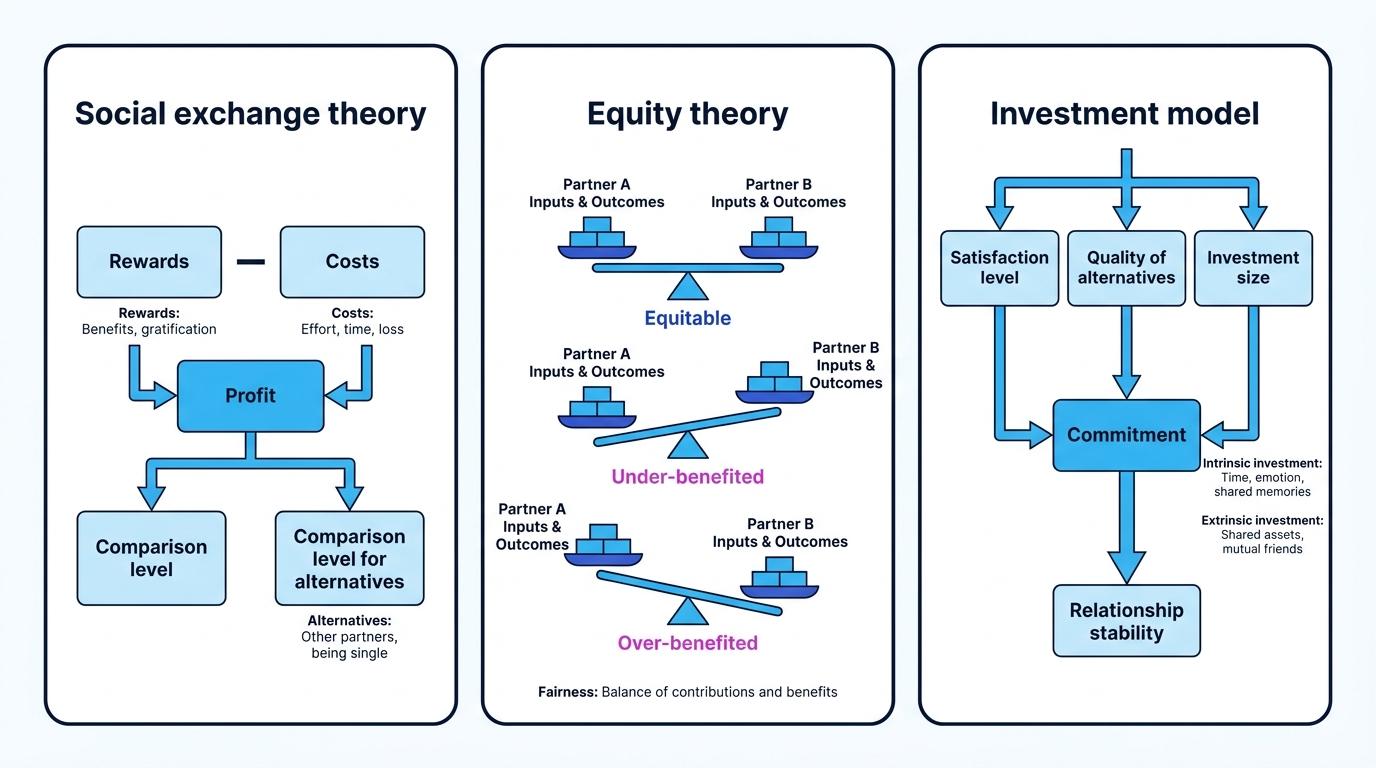
Here is the basic structure of the three main relationship-maintenance theories.
Social exchange theory
AO1: rewards, costs and profit
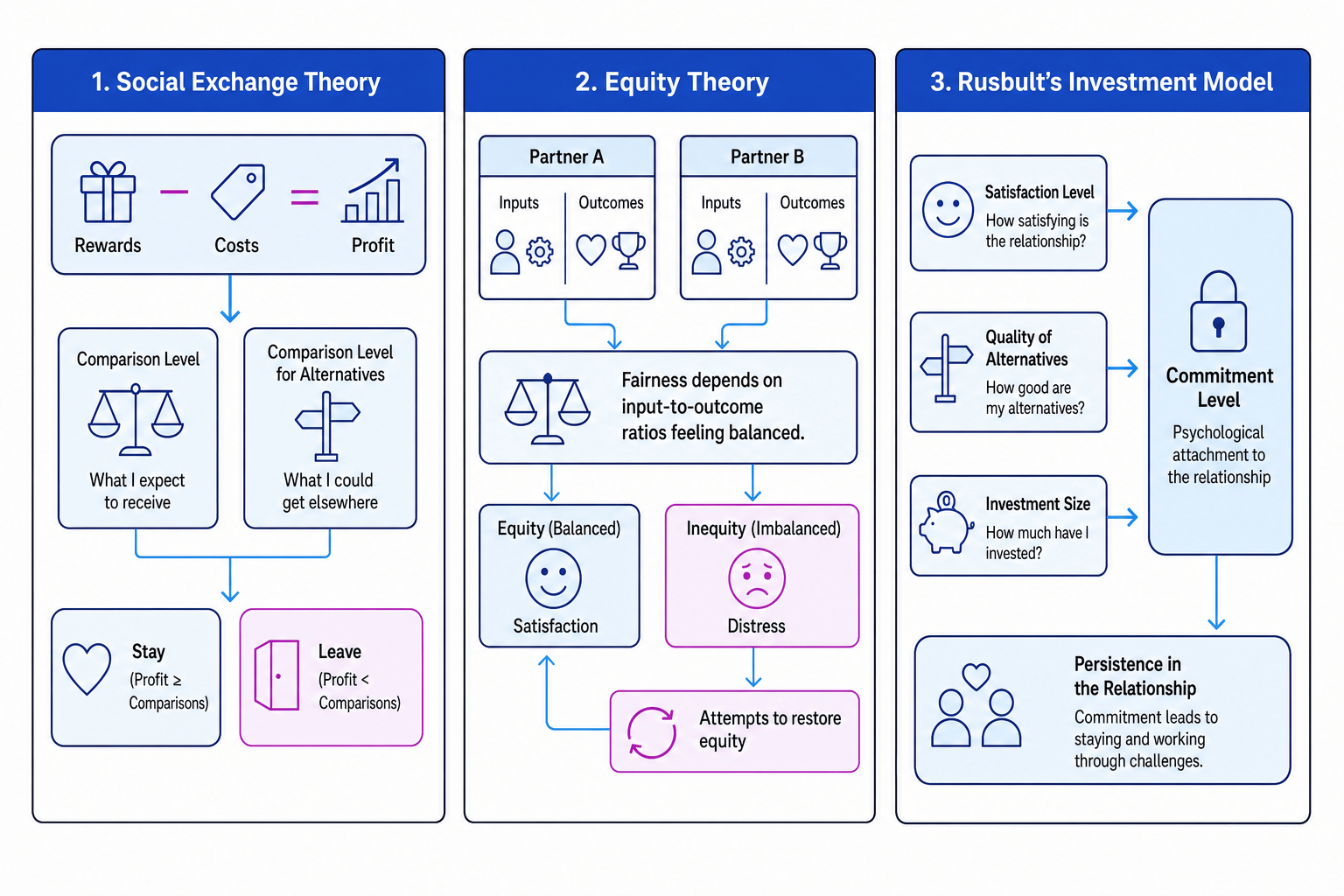
Social exchange theory, proposed by Thibaut and Kelley (1959), argues that romantic relationships are maintained when the rewards outweigh the costs.
Rewards and costs
Rewards are positive outcomes from a relationship, such as affection, support, sex, companionship or status. Costs are negative outcomes, such as arguments, stress, time, money or lost independence.
The theory says people assess the profit of a relationship: rewards minus costs. If the relationship feels rewarding overall, it is more likely to continue.
However, people do not judge profit in isolation. They compare the relationship with two standards:
- Comparison level: what you believe you deserve in a relationship, based on past experiences, social norms and self-esteem.
- Comparison level for alternatives: whether another relationship, or being single, seems more rewarding than the current relationship.
So, someone may stay in a relationship with some costs if they still see it as better than their alternatives.
Stages in social exchange theory
Thibaut and Kelley also described relationship development as moving through stages:
- Sampling: exploring possible rewards and costs in different relationships.
- Bargaining: negotiating how the relationship works.
- Commitment: the relationship becomes more stable and predictable.
- Institutionalisation: patterns become established, almost like “rules” for the couple.
Applying comparison levels
Aisha’s partner is affectionate and supportive, but they argue often. She has recently become close to someone else who seems calmer and more reliable.
- Aisha’s current relationship has clear rewards — affection and support — but also costs — frequent arguments.
- If Aisha’s comparison level is high because she expects calm communication, the arguments may make the current relationship feel unsatisfactory.
- If the alternative person seems to offer similar rewards with fewer costs, Aisha’s comparison level for alternatives may be higher than her current outcome.
- Social exchange theory would predict that Aisha becomes more likely to consider leaving, because the current relationship compares badly with her alternatives.
AO3: evaluating social exchange theory
A strength is that it explains everyday relationship decisions in a clear way. People often do talk about whether a relationship is “worth it”, especially when they feel unhappy.
However, the theory can be criticised for being reductionist, meaning it oversimplifies complex emotional behaviour. Romantic relationships involve love, loyalty, shared history and moral values, not just rewards and costs.
Another weakness is that much supporting evidence uses self-report methods, such as questionnaires and interviews. These are useful for accessing private feelings, but they can be affected by social desirability bias, where people give answers that make them look reasonable or kind.
There is also a cause-and-effect problem. If a study finds that dissatisfied partners report more costs, we cannot be sure whether costs caused dissatisfaction or whether dissatisfaction made people notice costs more. This is a limitation of correlational research, where variables are measured but not directly manipulated.
Making social exchange theory too conscious
Do not write as if people literally sit down with a calculator before deciding whether to love someone. The theory is about perceived rewards, costs and comparisons, which may be partly unconscious.
Ethically, research into romantic satisfaction must protect participants’ privacy. Researchers need informed consent, confidentiality, the right to withdraw and careful debriefing, because discussing relationship problems may cause distress.
Equity theory
AO1: fairness, not equality
Equity theory, associated with Walster et al. (1978), argues that relationship satisfaction depends on fairness.
Equity
Equity means each partner’s outcomes are fair relative to their inputs. It does not mean both partners contribute exactly the same things.
An input is what someone puts into the relationship, such as time, emotional support, money, childcare, loyalty or sacrifices. An outcome is what they receive, such as affection, practical help, security, status or intimacy.
A relationship is equitable when both partners feel that their input-to-outcome balance is fair. If one partner feels under-benefited, they may feel anger or resentment. If one partner feels over-benefited, they may feel guilt or discomfort.
People may restore equity by changing their inputs, changing outcomes, changing their perception of the situation, or ending the relationship.
Identifying equity rather than equality
Maya earns more money and pays most of the rent. Her partner Sam does more housework, gives emotional support and organises family responsibilities.
- The relationship is not necessarily unequal just because Maya pays more money; money is only one type of input.
- Sam’s housework, emotional labour and organisation are also inputs, so the overall balance must be judged across several areas.
- If both Maya and Sam feel their outcomes are fair relative to their inputs, equity theory would predict satisfaction.
- If Maya feels she gives far more than she receives, she may feel under-benefited and try to restore equity, for example by asking Sam to contribute differently.
AO3: evaluating equity theory
A strength is research support. Sprecher (2001) found that perceived equity was linked to relationship satisfaction in romantic couples. People who felt under-benefited tended to be less satisfied.
However, the evidence is often based on self-report questionnaires. This raises issues of honesty, memory accuracy and social desirability. It is also usually correlational, so it cannot prove that inequity causes dissatisfaction.
Equity theory may be culturally biased. In individualistic cultures, where personal choice and individual fairness are emphasised, equity may strongly affect satisfaction. In more collectivist cultures, where family duty and group harmony are emphasised, people may be more willing to accept unequal contributions if the relationship fulfils wider social obligations.
The key difference from social exchange theory
Social exchange theory focuses on whether the relationship is profitable for the individual. Equity theory focuses on whether the relationship feels fair for both partners.
A useful evaluation point is that “fairness” is subjective. Two couples could have the same division of labour, but one couple may see it as fair while another sees it as unfair.
Rusbult’s investment model
AO1: why commitment matters
Rusbult’s investment model explains relationship stability through commitment.
Commitment
Commitment is a person’s intention and psychological attachment to continue a relationship over time.
According to Rusbult (1980; 1983), commitment depends on three factors:
- Satisfaction level: how rewarding the relationship is compared with its costs.
- Quality of alternatives: how attractive the best available alternative seems, including another partner or being single.
- Investment size: resources attached to the relationship that would be lost if it ended.
Investments can be intrinsic, meaning directly put into the relationship, such as time, effort and emotional disclosure. They can also be extrinsic, meaning external resources now connected to the relationship, such as shared friends, a house, children, pets or savings.
The model predicts that commitment is highest when satisfaction is high, alternatives are poor, and investments are large. Importantly, it can also explain why someone might stay in an unsatisfying relationship: they may have few alternatives and many investments.
Predicting commitment from the investment model
Leo is unhappy in his relationship, but he shares a flat, friendship group and pet with his partner. He also feels he has few realistic alternatives.
- Leo’s satisfaction level is low, which reduces commitment because the relationship is not currently rewarding.
- His quality of alternatives is also low, which increases commitment because leaving does not seem to offer a better option.
- His investment size is high because ending the relationship would risk losing shared housing, friendships and the pet.
- The model would predict that Leo may remain committed despite low satisfaction, because poor alternatives and high investment keep him tied to the relationship.
AO3: evaluating the investment model
A major strength is strong research support. Le and Agnew (2003) carried out a meta-analysis of 52 studies and found that satisfaction, alternatives and investment predicted commitment, and commitment predicted relationship stability. A meta-analysis combines findings from many studies, which can give a more reliable overall picture.
The model also has real-world application. Rusbult and Martz (1995) studied women in shelters who had experienced abusive relationships. They found that some women returned to abusive partners when investment was high and alternatives were poor, even though satisfaction was low. This supports the idea that commitment is not always based on happiness.
Ethically, this kind of research is very sensitive. Participants may be vulnerable, so researchers must ensure informed consent, confidentiality, right to withdraw, protection from harm, debriefing and access to support services.
A limitation is that the model can still seem rather economic. It may underplay emotions such as fear, trauma, hope, religious beliefs or pressure from family. It predicts commitment well, but it may not fully explain the lived experience of staying or leaving.
Duck’s phase model of relationship breakdown
AO1: breakdown as a process
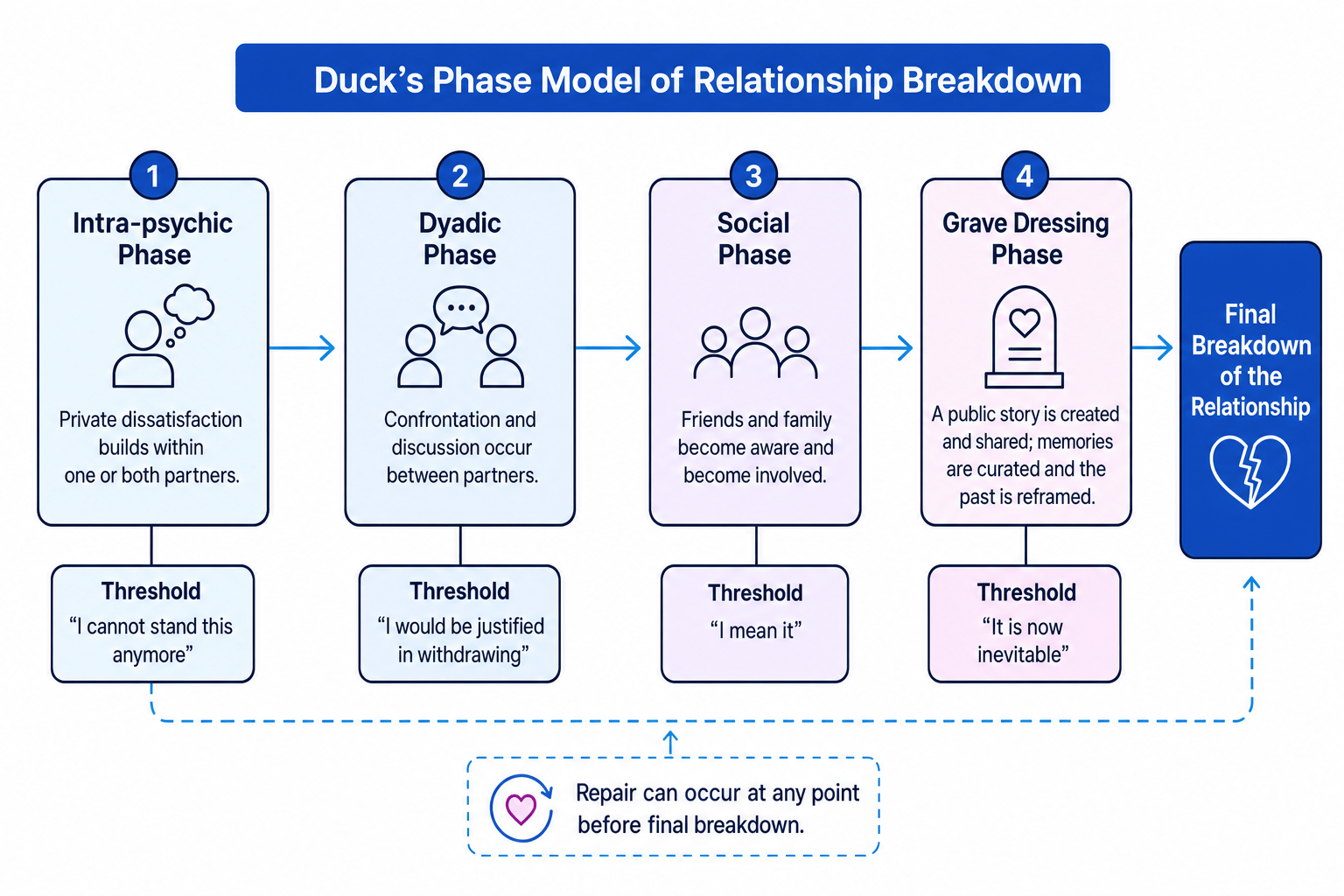
Duck’s phase model, proposed by Duck (1982) and later developed with Rollie and Duck (2006), describes relationship breakdown as a sequence of phases. It is not just one sudden event.
Phase 1: intra-psychic phase
The intra-psychic phase happens inside the person’s mind. One partner privately focuses on dissatisfaction and thinks about the relationship’s problems.
The threshold for moving on is often described as: “I can’t stand this anymore.”
Phase 2: dyadic phase
The dyadic phase involves the two partners. Dissatisfaction is now discussed openly, often through confrontation, arguments, negotiation or attempts to repair the relationship.
The threshold is: “I would be justified in withdrawing.”
Phase 3: social phase
The social phase happens when the breakdown becomes public. Friends, family and wider social networks become involved. People may seek support, take sides or offer advice.
The threshold is: “I mean it.”
Phase 4: grave dressing phase
The grave dressing phase involves creating a story about why the relationship ended. This helps each person protect their reputation, make sense of the breakup and prepare for future relationships.
The threshold is: “It is now inevitable.”
Placing behaviour into Duck’s phases
Nina has privately felt unhappy for months. She then tells her partner she wants to talk seriously. A week later, she tells friends they are separating. Afterwards, she explains that the relationship ended because they “wanted different futures”.
- Nina’s private unhappiness belongs to the intra-psychic phase because the dissatisfaction is mainly internal.
- The serious conversation with her partner belongs to the dyadic phase because the problem is now between the two partners.
- Telling friends belongs to the social phase because the breakup has entered the wider social network.
- Explaining the breakup as “different futures” belongs to the grave dressing phase because Nina is creating a public account of what happened.
AO3: evaluating Duck’s model
A strength is that the model recognises the social nature of breakups. Relationship breakdown affects friends, families and public identity, not just the two partners.
It also has practical application. Relationship counselling can target different phases: private dissatisfaction may need early communication, the dyadic phase may need conflict-resolution skills, and the grave dressing phase may need support with closure and self-esteem.
Research such as Tashiro and Frazier (2003) found that students often reported both distress and personal growth after breakups. This supports the idea that people construct meanings after a relationship ends.
However, the model is mainly descriptive. A descriptive model outlines what tends to happen, but it does not always predict exactly which relationships will break down or why one couple repairs the relationship while another separates.
There are also methodological issues. Breakup research often relies on retrospective self-report, meaning people describe events after they happened. Memories may be biased, especially because the grave dressing phase involves rewriting the story of the relationship.
Evaluation shortcut
For Duck’s model, a strong AO3 paragraph can use: social realism, counselling application, then retrospective bias.
Ethically, studying breakups can involve emotional harm. Researchers should avoid unnecessary deception, allow withdrawal, keep data confidential, debrief participants and provide support information if discussing the breakup causes distress.
Comparing the theories
| Theory | Main focus | Best used to explain |
|---|---|---|
| Social exchange theory | Rewards, costs and comparisons | Why someone stays if the relationship feels profitable |
| Equity theory | Fairness between inputs and outcomes | Why unfairness causes dissatisfaction |
| Investment model | Satisfaction, alternatives and investment leading to commitment | Why people remain committed, even when unhappy |
| Duck’s phase model | Stages of relationship breakdown | How a breakup unfolds over time |
In the exam
- Start essays with clear AO1 definitions: name the theory, researcher and core concepts.
- For AO2, apply the exact terms to the scenario: rewards, costs, equity, alternatives, investment or phase.
- For AO3, use evidence plus a clear judgement: explain whether the study supports the theory, then add a methodological or ethical issue.
Check yourself
- How is the comparison level different from the comparison level for alternatives?
- Why can an unequal relationship still be equitable?
- Which phase of Duck’s model involves friends and family becoming aware of the breakup?