What you'll learn
- How self-disclosure can create intimacy and increase romantic attraction.
- Why physical attractiveness can matter, including the halo effect and the matching hypothesis.
- How filter theory explains partner choice through social demography, similarity and complementarity.
- How to build AO1, AO2 and AO3 points for essay-style answers.
The big picture: attraction is not just “chemistry”
In A-Level Psychology, romantic attraction means the psychological processes that make someone more likely to want a romantic relationship with another person. Attraction is not explained by one factor alone. Instead, different factors may matter at different stages: for example, appearance may affect first impressions, while self-disclosure may matter more as people get to know each other.
Attraction is probabilistic
These theories do not claim that everyone chooses partners in the same way. They explain factors that make attraction more or less likely, not guaranteed.
Self-disclosure
Self-disclosure
Self-disclosure means revealing personal information about yourself to another person. This can include thoughts, feelings, experiences, hopes, fears and private opinions.
Self-disclosure is important because romantic relationships usually involve increasing intimacy, meaning emotional closeness and trust.
Altman and Taylor’s social penetration theory (1973) argues that relationships develop as self-disclosure becomes broader and deeper:
- Breadth means the range of topics discussed.
- Depth means how personal or emotionally significant the information is.
Early conversations might have high breadth but low depth: music, hobbies, school, films. Later conversations may become deeper: family worries, insecurities, future goals or painful experiences.
Self-disclosure also tends to be reciprocal, meaning one person’s disclosure encourages the other person to disclose in return. This can create trust because both people are taking a similar emotional risk.
Applying self-disclosure to a relationship scenario
Mia and Sam have been messaging for a few weeks. Mia tells Sam about feeling anxious before exams. Sam responds supportively and shares that he also worries about disappointing his parents.
- Mia’s disclosure is relatively deep because it involves private feelings rather than surface-level facts.
- Sam’s response shows reciprocity because he shares a similarly personal concern rather than changing the subject.
- Because Sam responds supportively, Mia may perceive him as trustworthy and understanding, increasing attraction and intimacy.
Evaluation of self-disclosure
A strength is supporting research. Sprecher and Hendrick (2004) found that couples who reported greater self-disclosure also tended to report higher relationship satisfaction. Ethically, research like this needs informed consent, confidentiality and the right to withdraw because participants discuss private relationship information.
Laurenceau et al. (1998) used diary methods and found that self-disclosure was linked to intimacy, especially when the partner was seen as responsive and understanding. This is useful because diary methods can capture everyday relationship experiences. However, participants still need protection from harm, debriefing and secure handling of personal data.
A weakness is that much of the evidence is correlational. If self-disclosure and satisfaction are linked, this does not prove self-disclosure causes attraction. It may be that already-happy couples feel safer disclosing.
There are also cultural issues. Tang et al. (2013) found differences between American and Chinese participants in the amount and type of self-disclosure, although disclosure was linked to satisfaction in both groups. This suggests the theory may apply across cultures, but the “right” level of disclosure may vary. Ethical concerns include respecting cultural sensitivity and avoiding pressure to reveal personal information.
Self-disclosure is not just talking a lot
Do not write that “more self-disclosure always means more attraction”. The disclosure needs to be appropriate, gradual and reciprocated. Oversharing too early can reduce attraction.
Physical attractiveness
Physical attractiveness refers to how appealing someone’s appearance is judged to be. It can influence attraction strongly at the beginning of a relationship, especially when people have limited information about each other.
One reason is the halo effect. This is a cognitive bias where one positive feature leads us to assume other positive qualities. In attraction, someone who is physically attractive may also be judged as kinder, more sociable or more successful, even without evidence.
Dion, Berscheid and Walster (1972) found that physically attractive people were rated as having more socially desirable personalities and better life outcomes. This supports the “what is beautiful is good” stereotype. Ethical issues include using photographs with permission, avoiding harm from appearance-based judgements, confidentiality and proper debriefing.
Using the halo effect to explain first impressions
Alex sees Jordan’s dating profile. Jordan has an attractive profile photo but only a short biography. Alex assumes Jordan is confident, friendly and exciting.
- Alex has limited actual information, so appearance becomes a powerful cue.
- The halo effect means Alex generalises from one positive feature, physical attractiveness, to other assumed traits.
- This could increase initial attraction, even though Alex’s judgement may not be accurate.
The matching hypothesis
Matching hypothesis
The matching hypothesis suggests that people are more likely to form romantic relationships with partners who are similar to them in physical attractiveness.
Walster et al. (1966) argued that people do not simply pursue the most attractive partner available. Instead, they make a realistic judgement about who is likely to accept them. Matching may therefore reduce the risk of rejection.
However, the original Walster et al. (1966) “computer dance” study found that physical attractiveness was the strongest predictor of liking, while similarity in attractiveness was not strongly supported. The study involved some deception because participants believed they had been matched by computer compatibility when they were actually randomly paired, so ethical issues include informed consent, debriefing, right to withdraw and protection from embarrassment or self-esteem harm.
Murstein (1972) provided more support for matching by finding that real couples tended to be similar in rated physical attractiveness. Ethical safeguards would include consent from the couples and photograph raters, confidentiality, and sensitivity because appearance ratings can be personally upsetting.
A challenge comes from online dating research. Taylor et al. (2011) found that users often tried to contact the most physically attractive people, regardless of their own attractiveness. This questions whether people always “match” realistically. With online data, researchers must consider privacy, anonymisation, consent and secure data storage.
Matching is not the same as attitude similarity
The matching hypothesis is about similarity in physical attractiveness. It is not the same as having similar values, beliefs or interests.
Filter theory
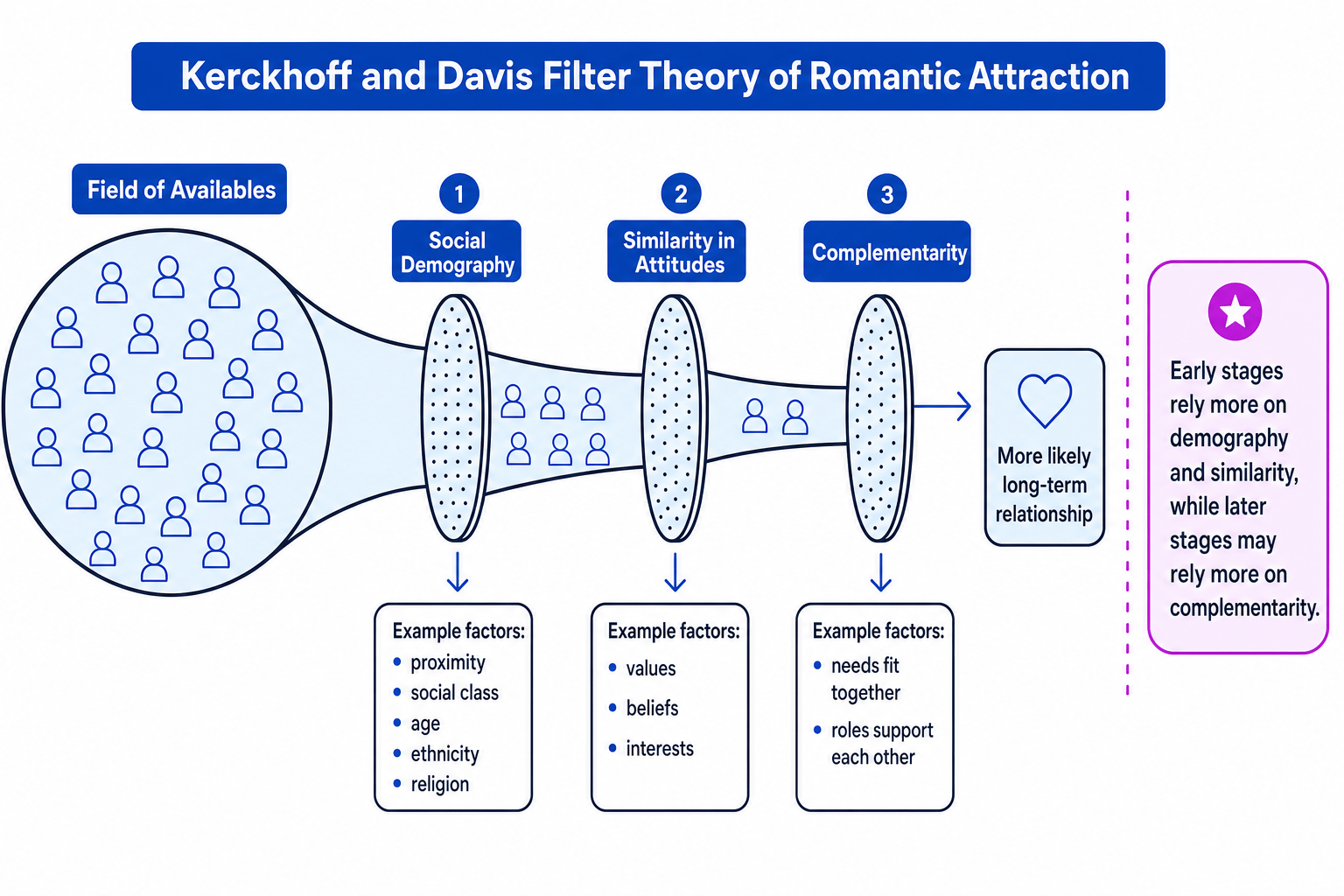
Kerckhoff and Davis (1962) proposed filter theory, which explains attraction as a process of narrowing down possible partners.
Filter theory
A filter is a factor that reduces the number of potential romantic partners by making some people more likely, and others less likely, to be considered suitable.
A useful way to picture filter theory is as a narrowing process: a large pool of possible partners becomes smaller as different filters operate.
Filter 1: social demography
Social demography means social characteristics that influence who you are likely to meet. These include geographical location, age, education, social class, religion and ethnicity.
This filter creates a field of availables: people who are realistically available to you because you are likely to encounter them. For example, you are more likely to meet someone at your school, university, workplace or local area than someone living far away.
Filter 2: similarity in attitudes
Similarity in attitudes means sharing beliefs, values and opinions. This might include views about family, politics, religion, lifestyle or ambitions.
Kerckhoff and Davis suggested that similarity is especially important in the early stages of a relationship because it encourages validation. If someone agrees with your values, you may feel understood and supported.
Filter 3: complementarity
Complementarity means partners’ needs or roles fit together in a way that benefits the relationship. This does not simply mean “opposites attract”. It means each person provides something the other values.
For example, one partner may enjoy planning and organising, while the other appreciates structure and contributes emotional calm. Their traits work together rather than clash.
Applying filter theory to partner choice
Nina and Omar meet at college, discover they have similar views about future careers, and later find that Nina enjoys organising social plans while Omar is good at calming conflict.
- Their shared college environment shows the social demography filter because it makes them available to each other.
- Their similar career values show similarity in attitudes, which may increase attraction during early dating.
- Their different but compatible roles show complementarity, which may help the relationship feel balanced later on.
Evaluation of filter theory
Kerckhoff and Davis (1962) studied student couples and found that similarity in attitudes was more important for couples who had been together for less than 18 months, while complementarity was more important for longer-term couples. This supports the idea that different filters matter at different stages. Ethically, researchers needed consent, confidentiality, right to withdraw and care when asking about personal relationships.
A strength is that the research was longitudinal, meaning couples were studied over time. This is useful because romantic relationships develop, so a one-off snapshot may miss changes.
A weakness is limited population validity. The sample was mainly young American student couples in the 1960s, so findings may not generalise well to older adults, LGBTQ+ relationships, arranged marriages or modern online dating.
Another weakness is that filter theory may be too neat and stage-like. In real life, filters can overlap. For example, online dating can reduce the importance of geographical proximity but increase filtering by age, education, photos or stated values.
A strong AO3 comparison
You can evaluate filter theory by saying it explains who becomes available, while self-disclosure explains how intimacy grows once interaction begins. That comparison shows you understand how the explanations differ.
Pulling the factors together
In an essay, avoid treating these as completely separate forces. They often interact.
For example, physical attractiveness may create the first opportunity for contact. Social demography may determine whether two people meet often enough for a relationship to develop. Similar attitudes may make early conversations rewarding. Self-disclosure may deepen intimacy. Complementarity may become more important as the couple faces everyday demands.
This is why AQA questions often reward answers that explain stage of relationship: initial attraction is not always driven by the same factors as longer-term romantic commitment.
In the exam
- Define the factor clearly, then explain the psychological mechanism: for example, reciprocity for self-disclosure or realistic partner choice for matching.
- Apply scenario details precisely: link appearance to halo effect, shared values to attitude similarity, and role fit to complementarity.
- For AO3, use research evidence plus one clear issue such as correlation, sample bias, temporal validity, ethics or online dating changing partner choice.
Check yourself
- How can reciprocal self-disclosure increase attraction without “more disclosure is always better”?
- How is the matching hypothesis different from the halo effect?
- In filter theory, why might complementarity matter later than social demography?
