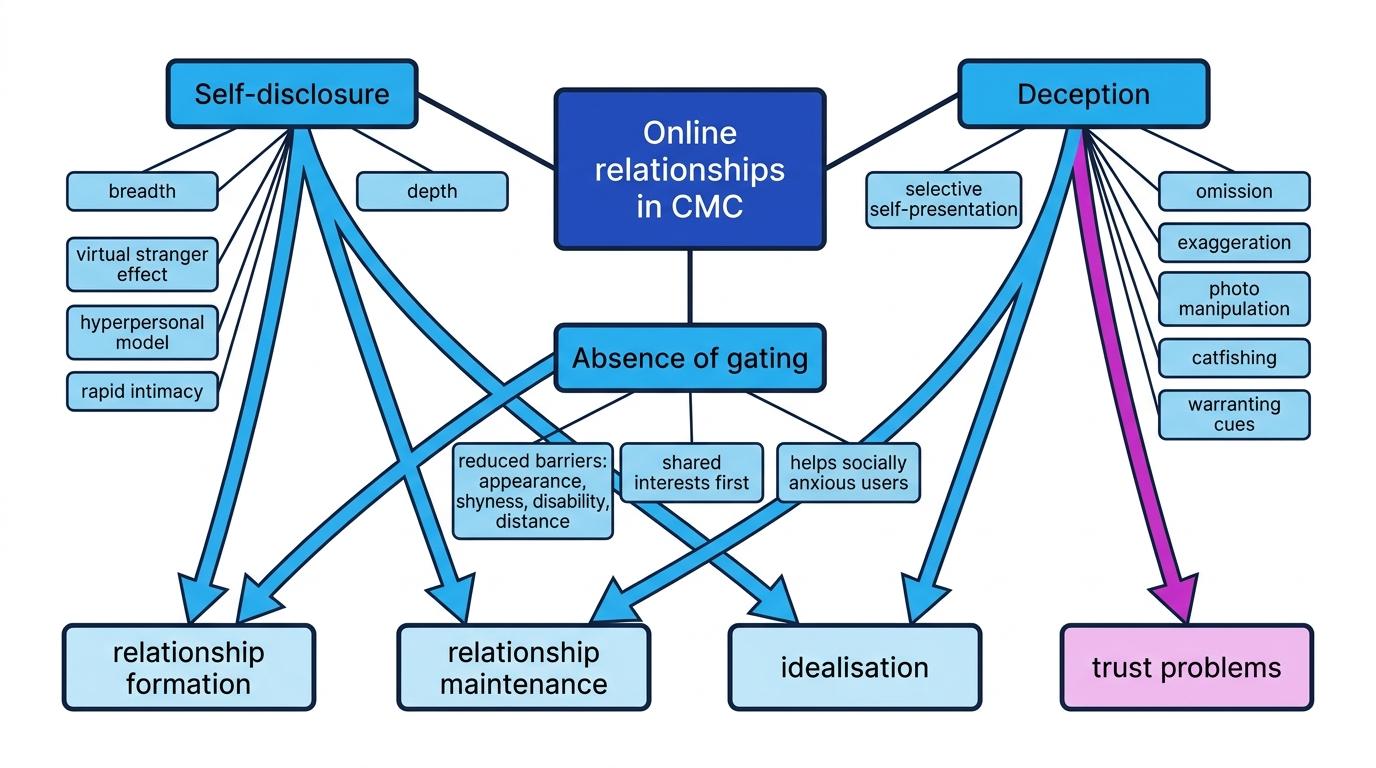
What you'll learn
- How self-disclosure can happen differently online compared with face-to-face relationships.
- Why online communication can increase opportunities for deception and selective self-presentation.
- How the absence of gating can help some people form relationships they might struggle to form offline.
- How to evaluate these ideas using studies, methodological issues, ethics and real-world applications.
Starting point: what makes online relationships different?
Online relationships are relationships that are formed, maintained or developed through digital communication, such as messaging, social media, gaming communities, forums or dating apps.
Computer-mediated communication
Computer-mediated communication, often shortened to CMC, means communication that happens through digital technology rather than direct face-to-face interaction.
A key comparison is with face-to-face relationships, where people usually receive lots of social cues. Social cues are the extra signals that help us interpret meaning, such as facial expression, eye contact, tone of voice, body language and appearance.
Online communication may reduce some of these cues, especially in text-based settings. It can also be asynchronous, meaning people do not have to respond immediately. This gives users time to edit, choose what to reveal and manage how they come across.
The map below shows the three big ideas in this topic and how they may affect relationship formation, maintenance and breakdown.
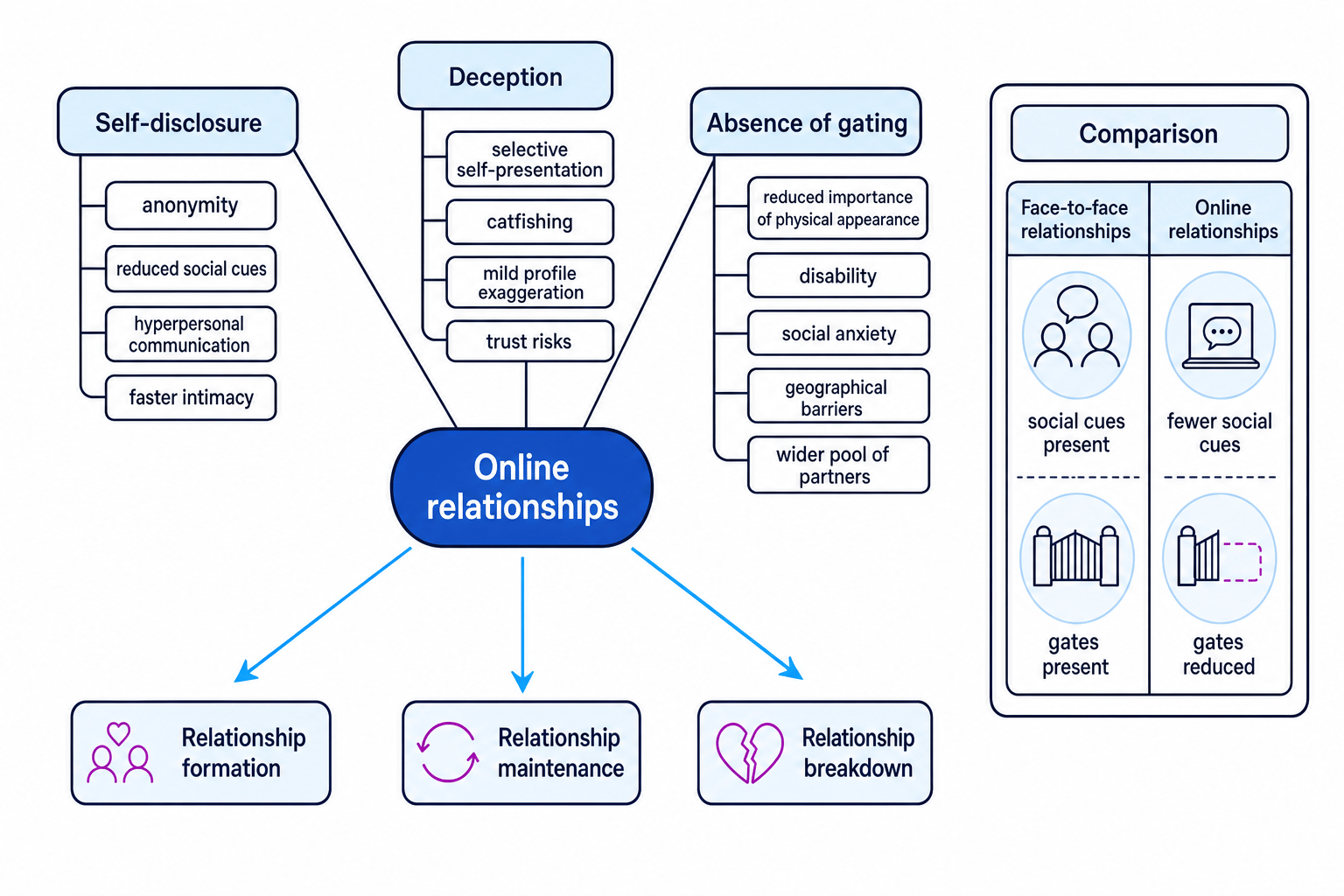
The big picture
Online relationships are not automatically “better” or “worse” than face-to-face relationships. The important issue is how online features change disclosure, identity and access to potential partners.
Self-disclosure
Self-disclosure
Self-disclosure means revealing personal information about yourself to another person, such as your thoughts, feelings, fears, values or private experiences.
Self-disclosure is important in relationship development because intimacy usually grows when people gradually reveal more personal information and receive supportive disclosure in return.
Altman and Taylor’s social penetration theory (1973) argued that relationships deepen through increasing breadth and depth of self-disclosure. Breadth means the range of topics discussed. Depth means how personal or emotionally meaningful the information is.
Why might self-disclosure be higher online?
Some online settings make people feel less exposed. If you are not physically in front of someone, it may feel easier to reveal embarrassing or emotional details. This is sometimes linked to the virtual stranger effect, where people disclose more to someone online because they feel safer and less judged.
Walther’s hyperpersonal model (1996) suggests that CMC can become unusually intimate because users can carefully manage their messages. The sender can edit their self-presentation, while the receiver may idealise the sender because there are fewer contradictory cues.
This can create rapid closeness. However, it can also create unrealistic expectations if each person is responding partly to an idealised version of the other.
Research support
Joinson (2001) found that participants communicating by computer showed higher levels of self-disclosure than those communicating face-to-face. This supports the idea that online communication can reduce embarrassment and increase openness.
Tidwell and Walther (2002) found that people in online interactions used more direct and intimate questions than people in face-to-face interactions, again supporting the idea that online relationships can become personal quickly.
Valkenburg and Peter (2007) found that online communication among adolescents could improve friendship quality, particularly when it encouraged self-disclosure.
Ethically, research on self-disclosure needs care because participants may reveal sensitive information. Researchers should gain informed consent, protect confidentiality, allow the right to withdraw and debrief participants if the true aims of the study were not fully explained.
Applying self-disclosure to fast online intimacy
- A student says two people have only messaged for a week but already share family problems and insecurities. This suggests high depth of self-disclosure, because they are sharing emotionally personal information.
- The hyperpersonal model would explain this by pointing to online features: they can edit replies, avoid immediate embarrassment and feel less judged without face-to-face cues.
- A balanced conclusion is that the relationship may feel intimate very quickly, but the intimacy could be partly based on idealisation if each person has limited information about the other.
Evaluation of self-disclosure
One strength is that there is research support from controlled studies such as Joinson (2001), which makes it easier to compare online and face-to-face communication. This supports the claim that online settings can increase disclosure.
However, some early research may lack historical validity. Older CMC was often text-only and anonymous, while modern online relationships may involve video calls, voice notes, tagged photos and linked social media profiles. This means reduced cues may be less relevant in some modern online contexts.
Another limitation is that online self-disclosure is affected by individual differences. For example, shy or socially anxious people may benefit more from online disclosure than confident people who already find face-to-face communication easy.
Self-disclosure is not just “talking a lot”
In essays, do not define self-disclosure as simply frequent communication. It specifically means revealing personal or private information, especially information with emotional depth.
Use of deception
Deception
Deception means deliberately giving false or misleading information. In online relationships this might involve lying about age, appearance, relationship status, interests or identity.
Online communication can make deception easier because people can control what others see. They can choose photos, edit messages, leave out important information or create a completely false identity.
A useful distinction is between selective self-presentation and deception. Selective self-presentation means emphasising your best qualities and downplaying less attractive details. This happens offline too, for example through clothing, humour or make-up. Deception goes further because the information is actively false or misleading.
Types of deception online
Common forms include:
- Omission: leaving out important information, such as already being in a relationship.
- Exaggeration: making traits seem better than they are, such as overstating confidence or lifestyle.
- Photo manipulation: using edited, filtered or outdated images.
- Catfishing: creating a false identity to form a relationship with someone.
Research evidence
Toma, Hancock and Ellison (2008) found that many online daters gave inaccurate information about features such as height, weight or age, but the lies were usually small. This suggests people may deceive strategically while still trying to remain believable.
Cornwell and Lundgren (2001) found greater misrepresentation in online romantic relationships than offline ones. This supports the idea that online anonymity and lack of immediate verification can increase deception.
However, people who expect to meet face-to-face may be less likely to tell extreme lies, because obvious deception could be discovered later and damage trust.
Ethically, deception research can be sensitive. If researchers study dating profiles or private messages, confidentiality is crucial. Participants should not be identifiable, and researchers should gain consent wherever possible. If public online data is used, psychologists still need to consider whether users reasonably expected privacy.
Distinguishing deception from selective self-presentation
- If someone chooses a flattering profile photo and mentions their best hobbies, this is mainly selective self-presentation, because the information may be true but carefully curated.
- If they use a photo from ten years ago and claim to be single when they are married, this becomes deception, because the information is misleading and relevant to trust.
- The likely relationship effect is different: selective presentation may be normal early impression management, but deception can damage commitment if discovered.
Evaluation of deception
A strength is that deception research has real-world relevance. It can inform online dating safety, identity verification, scam prevention and advice about meeting online contacts safely.
A limitation is that self-report studies may underestimate deception because people may not admit to lying. Profile analysis may also be difficult because researchers need accurate offline information to check whether a profile is truthful.
Another issue is that the “online equals deception” view can be exaggerated. Many lies in dating profiles are minor and similar to offline impression management. Also, modern platforms often include warranting cues, which are clues that are harder for the user to manipulate, such as tagged photos, mutual friends, comments from others or linked accounts.
Balanced evaluation phrase
A strong AO3 point is: online settings may increase opportunities for deception, but the desire to appear trustworthy and the possibility of later face-to-face meetings can limit how extreme the deception becomes.
Absence of gating
Gating
A gate is a barrier that might prevent a relationship from forming, such as physical appearance, social anxiety, disability, shyness, speech difficulties, social status or geographical distance.
The absence of gating means that online relationships can develop without some of the barriers that operate in face-to-face settings.
For example, in face-to-face interaction, someone may be judged quickly on appearance or confidence. Online, especially in text-based communities, people may get to know each other through shared interests, humour, values or emotional support before appearance becomes important.
This can be especially useful for people who feel excluded or anxious in offline social situations.
Research evidence
McKenna and Bargh (1999) argued that the internet can help people express aspects of the self that they may hide offline, especially if they belong to stigmatised groups. Online communities may therefore support identity, belonging and relationship formation.
Bargh, McKenna and Fitzsimons (2002) found that people may express their “true self” more easily online than in face-to-face settings. This supports the idea that reduced gating can encourage more authentic communication for some people.
Baker and Oswald (2010) found that shy individuals benefited from online communication, as it helped them form and maintain relationships. This supports the idea that removing face-to-face pressure can improve access to social connection.
Ethically, research involving socially anxious people, disabled people or stigmatised groups must pay close attention to protection from harm and confidentiality. Participants may be discussing vulnerable identities, so anonymity and careful debriefing are especially important.
Explaining absence of gating in context
- If a person with severe social anxiety avoids parties but joins an online gaming community, the relevant gate is the anxiety that blocks face-to-face interaction.
- Online communication reduces this gate because the person can type, take time to respond and interact around a shared interest rather than immediate social performance.
- The likely outcome is greater opportunity for relationship formation, although the gate may partly return if the relationship later moves to video calls or face-to-face meetings.
Evaluation of absence of gating
One strength is that absence of gating has positive real-world implications. Online spaces can increase social inclusion for people who experience prejudice, disability, anxiety or geographical isolation.
Another strength is that it explains why some online relationships can be meaningful and stable. Rather than being “less real”, they may allow people to connect on personality and shared values first.
However, gates are not always absent online. Many dating apps still prioritise appearance through profile photos. New gates can also appear, such as digital literacy, access to technology, algorithmic filtering and confidence in written communication.
A further limitation is that online communication may delay rather than remove gates. If a couple eventually meets face-to-face, appearance, disability, social confidence or other offline factors may become relevant again.
Absence of gating does not mean no judgement
Online relationships can reduce certain barriers, but people still judge each other online through photos, writing style, response speed, follower count, interests and social media activity.
Pulling the ideas together
These three concepts often interact.
Self-disclosure can increase because people feel safer online. Deception can increase because people have more control over identity. Absence of gating can help relationships begin because certain offline barriers are reduced.
A strong essay should avoid making online relationships sound one-dimensional. Online communication can be freeing, intimate and inclusive, but it can also involve idealisation, misrepresentation and trust problems.
Best overall judgement
Online relationships are shaped by the balance between freedom and uncertainty: people may disclose more and face fewer barriers, but they may also have less reliable information about who the other person really is.
In the exam
- Define the key term early: self-disclosure, deception or gating. Then link it directly to online communication rather than writing generally about relationships.
- Use named evidence accurately, such as Joinson (2001) for self-disclosure, Toma et al. (2008) for deception, and McKenna and Bargh (1999) for absence of gating.
- For AO3, make balanced points: online relationships can increase intimacy and inclusion, but findings may depend on the platform, user characteristics and whether the relationship later moves offline.
Check yourself
- How does Walther’s hyperpersonal model explain rapid intimacy in online relationships?
- What is the difference between selective self-presentation and deception?
- Why might absence of gating be especially helpful for a socially anxious person?