Schizophrenia is one of the most serious and widely misunderstood mental health disorders. It affects approximately 1% of the global population, typically developing in late adolescence or early adulthood.
In these notes, we will break down the clinical symptoms used to diagnose schizophrenia and investigate the massive clinical controversies surrounding how reliable and valid a diagnosis of schizophrenia actually is.
What you'll learn
- The crucial difference between positive and negative symptoms.
- The clinical definitions of hallucinations, delusions, avolition, and speech poverty.
- How major classification systems (DSM-5 and ICD-11) are used in diagnosis.
- The key issues undermining diagnosis: co-morbidity, symptom overlap, gender bias, and culture bias.
Classifying schizophrenia: The "rulebooks"
Before a clinician can diagnose schizophrenia, they must match a patient's symptoms to an official classification manual. There are two major classification manuals used globally:
- DSM-5 (Diagnostic and Statistical Manual of Mental Disorders, 5th Edition): Produced by the American Psychiatric Association (APA). It is primarily used in the USA.
- ICD-11 (International Classification of Diseases, 11th Edition): Produced by the World Health Organization (WHO). It is used globally, including across the UK NHS.
Historically, these manuals had different criteria (for instance, the older ICD-10 required two or more negative symptoms, while the DSM-5 required at least one positive symptom). Although they have become more aligned in recent revisions, these historical differences highlight that psychiatric diagnosis is a human-designed classification system rather than an absolute biological science.
Symptoms of schizophrenia
Psychiatrists divide the clinical characteristics of schizophrenia into two distinct categories: positive symptoms (excesses/additions to normal functioning) and negative symptoms (deficits/losses of normal functioning).
Positive Symptoms
Positive symptoms are atypical psychological experiences that represent an excess or distortion of normal functioning. They are "added" to a person's psychological state.
Negative Symptoms
Negative symptoms are those that reflect a reduction or loss of normal functions, such as emotional expression, speech, or goal-directed behavior. They are "taken away" from a person's psychological state.
Positive symptoms
1. Hallucinations
These are unusual sensory experiences that have no basis in reality, or distorted perceptions of real sensory stimuli.
- Auditory hallucinations are the most common (e.g., hearing voices that comment on your behavior, insult you, or give commands).
- Visual hallucinations involve seeing things that are not there (e.g., distorted faces or shadow figures).
- Tactile or olfactory hallucinations involve feeling things crawling on the skin or smelling things that others cannot.
2. Delusions
These are irrational, strongly held beliefs that are completely unsupported by reality. Even when presented with overwhelming contradictory evidence, the individual cannot let go of the belief. Common types include:
- Delusions of persecution: The belief that individuals, organizations (like the MI5), or demons are plotting to harm, spy on, or kill them.
- Delusions of grandeur: The belief that they are a highly important, famous, or religious figure (e.g., believing they are Jesus Christ or have special, magical powers).
- Delusions of control / passivity: The belief that their body or mind is being controlled by an external force, such as radio waves, aliens, or the government.
Negative symptoms
1. Avolition
This is a severe lack of energy, motivation, or drive to initiate and complete self-directed, purposeful activities.
Identifying Avolition
Avolition is not just "laziness." Nancy Andreasen (1982) identified three key signs of avolition:
- Poor hygiene and grooming.
- Lack of persistence in work or education.
- A general lack of physical energy (apathy).
2. Speech poverty (Alogia)
This is characterized by a significant reduction in the amount and quality of spoken language. It is often accompanied by slow or blocked thoughts.
- The individual may produce brief, empty, or highly repetitive responses.
- Note on DSM-5 vs. ICD: The DSM-5 emphasizes speech disorganization (where words scramble together, known as "word salad") as a positive symptom, while the ICD highlights speech poverty as a classic negative symptom.
Issues in diagnosis
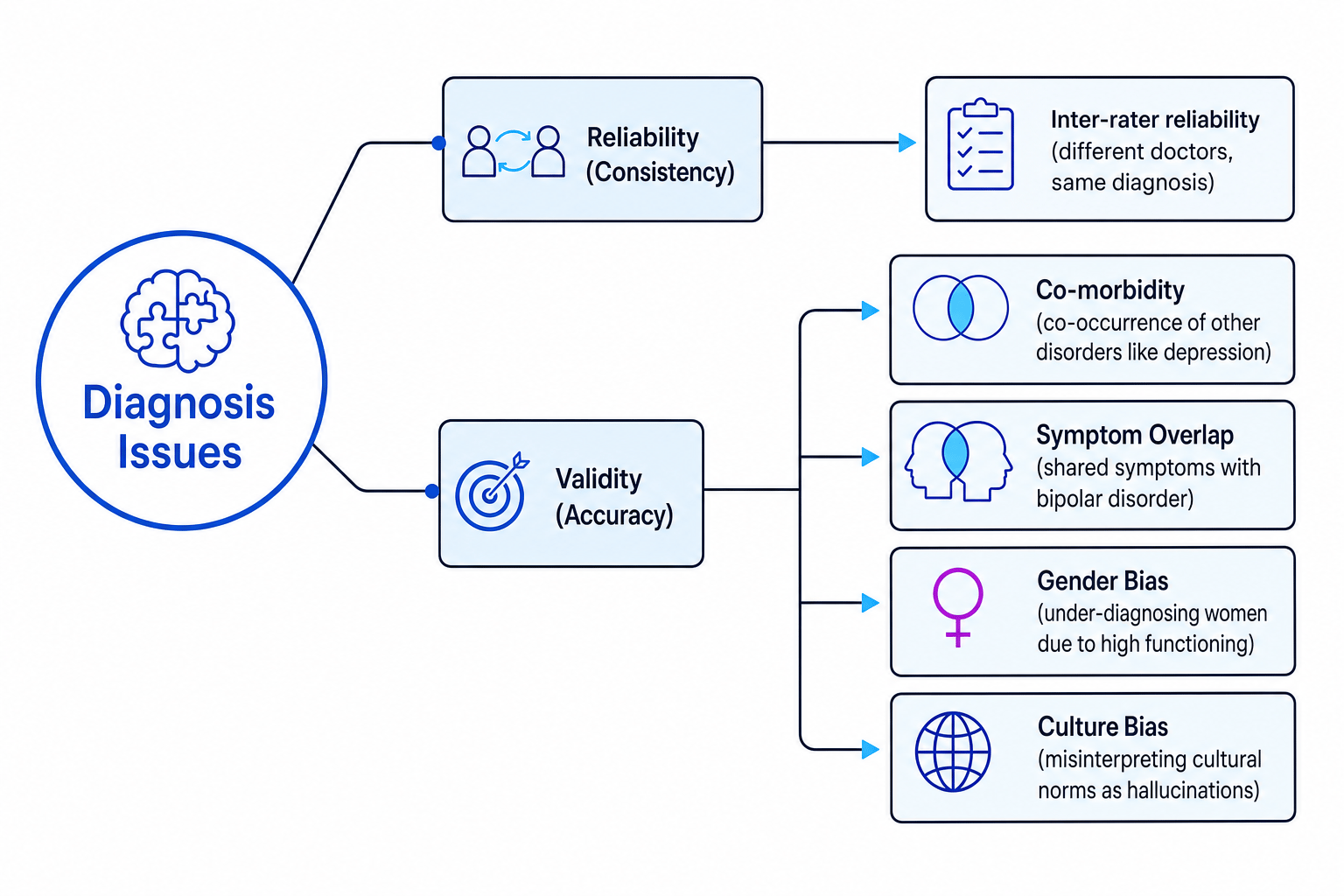
For a diagnosis to be useful, it must be both reliable (consistent across different doctors and time periods) and valid (accurately reflecting the true clinical picture of the patient).
Psychologists have identified major flaws in how schizophrenia is diagnosed.
1. Reliability issues
Reliability means consistency. In diagnosis, the most important form is inter-rater reliability: the extent to which two or more different clinicians, assessing the same patient independently, arrive at the exact same diagnosis.
Inter-rater reliability is measured using a statistical value called Kappa (kkk). A Kappa score of 1.01.01.0 indicates perfect agreement, whereas a score below 0.400.400.40 is generally considered poor.
- Evidence of poor reliability: Cheniaux et al. (2009) had two psychiatrists independently diagnose 100 patients using both DSM and ICD criteria.
- Psychiatrist A diagnosed 26 with schizophrenia under DSM and 44 under ICD.
- Psychiatrist B diagnosed 13 with schizophrenia under DSM and 24 under ICD.
- This massive discrepancy shows that diagnosis depends heavily on which clinician you see and which manual they use.
2. Validity issues
Validity means accuracy. Is schizophrenia actually a distinct, real physical/psychological disorder, and are we measuring it correctly? One key type is criterion validity: do different assessment systems arrive at the same diagnostic decision for the same patient? As the Cheniaux study shows, since ICD-11 and DSM-5 do not agree on who has schizophrenia, the diagnostic validity is highly questionable.
There are four specific validity issues you must master for your exam:
A. Co-morbidity
Co-morbidity refers to the clinical situation where a patient suffers from two or more distinct conditions at the same time.
Co-morbidity
Co-morbidity is the simultaneous presence of two or more independent clinical conditions in a single patient.
If a huge proportion of schizophrenia patients are also diagnosed with another disorder, it raises a validity question: Are these actually two separate conditions, or are they just one single, overarching disorder that we have misclassified?
- Key Evidence: Buckley et al. (2009) found that:
- 50% of schizophrenia patients also have co-morbid depression.
- 47% have co-morbid substance abuse.
- 29% have co-morbid post-traumatic stress disorder (PTSD).
- 23% have co-morbid OCD.
B. Symptom overlap
Symptom overlap occurs when different mental disorders share the exact same clinical characteristics.
For example, both Schizophrenia and Bipolar Disorder feature delusions (e.g., grandiose delusions during mania) and depression/loss of motivation (avolition).
Under DSM criteria, a patient showing these symptoms might be diagnosed with schizophrenia. Under ICD criteria, they might be diagnosed with bipolar disorder. This overlap makes it exceptionally difficult for clinicians to distinguish between the two, meaning the diagnosis lacks validity.
The 'Common Cold' vs. 'Flu' overlap
Imagine if medical science could not distinguish between the cold and the flu because they both involve a runny nose, cough, and fatigue (symptom overlap). We would struggle to treat them properly. This is the exact challenge psychiatrists face when trying to separate schizophrenia from bipolar disorder or major depression.
C. Gender bias
Gender bias occurs when the accuracy of a diagnosis is affected by the gender of the patient, due to stereotypical assumptions or clinical omissions by the psychiatrist.
- Key Evidence: Cotton et al. (2009) found that female schizophrenia patients often function better than male patients. They are more likely to maintain interpersonal relationships, remain in employment, and keep up with self-care.
- The Diagnostic Impact: Because female patients often possess better interpersonal functioning, they can mask their symptoms. Consequently, psychiatrists may under-diagnose women, mistakenly assuming they are simply dealing with milder depression or anxiety. This means the diagnostic system is biased against women by failing to detect their schizophrenia.
D. Culture bias
Culture bias occurs when diagnostic criteria are applied differently to individuals from different cultural backgrounds, often leading to over-diagnosis in minority groups.
- Key Evidence: People of African-Caribbean origin living in Western nations (like the UK or USA) are up to nine times more likely to be diagnosed with schizophrenia than white people. However, rates of schizophrenia in the West Indies are not unusually high, meaning this is not a genetic difference.
- The Diagnostic Impact: In many traditional African and Caribbean cultures, hearing voices or communicating with ancestors is viewed as a highly spiritual, positive experience rather than a pathology. However, a white, Western psychiatrist is likely to interpret these culturally normal experiences as auditory hallucinations, leading to over-diagnosis.
Applying your knowledge: A diagnostic dilemma
Let's look at how to analyze clinical scenarios to identify these diagnostic issues.
Analyzing clinical diagnosis
Scenario: David is a 24-year-old male who has been referred to a clinical psychologist. He reports hearing a voice that constantly tells him he is being watched by the police. He has also stopped washing, has lost his job due to a complete lack of motivation, and has been using cannabis daily to cope with feelings of intense sadness. The psychologist diagnoses David with Schizophrenia and Cannabis Use Disorder.
Task: Identify one positive symptom, one negative symptom, and one diagnostic issue present in this scenario.
Worked Solution:
- Identify the positive symptom: David reports hearing a voice telling him he is being watched. This is an auditory hallucination (hearing something that has no basis in reality) and a delusion of persecution (believing he is being watched by the police without evidence).
- Identify the negative symptom: David has stopped washing and has lost his job due to a complete lack of motivation. This matches the clinical definition of avolition (the reduction or loss of goal-directed behavior and self-care).
- Identify the diagnostic issue: David is diagnosed with both Schizophrenia and Cannabis Use Disorder, and has feelings of intense sadness. This is an example of co-morbidity (the co-occurrence of schizophrenia with substance abuse and depressive symptoms). This undermines the validity of his diagnosis, as it is unclear if his hallucinations are caused by schizophrenia, cannabis use, or a severe depressive episode.
Evaluation (AO3)
When writing an essay on the diagnosis and classification of schizophrenia, you must evaluate the reliability and validity of the diagnostic process.
1. The devastating real-world consequences of misdiagnosis
- Point: The lack of reliability and validity in diagnosis has massive real-world implications.
- Evidence/Explanation: If a patient is misdiagnosed with schizophrenia when they actually have bipolar disorder, they will be prescribed powerful antipsychotic medications. These drugs have severe physical side effects, such as tardive dyskinesia (involuntary facial grimacing).
- Counterpoint/Consequence: Conversely, if a woman is under-diagnosed due to gender bias, she misses out on early psychiatric intervention and support. This demonstrates that diagnostic issues are not just theoretical debates; they cause genuine physical and psychological harm.
2. The classic evidence of Rosenhan (1973)
- Point: The validity of psychiatric diagnosis was famously challenged by Rosenhan's "On Being Sane in Insane Places" study.
- Evidence/Explanation: Rosenhan sent eight "pseudo-patients" (mentally healthy researchers) to various psychiatric hospitals. They all complained of hearing a single, unfamiliar voice saying words like "empty", "hollow", and "thud".
- Findings: All eight were admitted, and seven were diagnosed with schizophrenia. Once inside, they behaved completely normally. However, staff interpreted their normal behaviors (such as writing notes in a diary) as symptoms of their illness ("writing behavior").
- Ethical Link & Validity: This study highlights a severe lack of diagnostic validity; psychiatrists could not reliably distinguish the "sane" from the "insane", and the label of schizophrenia created an unavoidable confirmation bias.
3. Culture bias is compounded by racial stereotyping
- Point: Culture bias is not just about misunderstanding spiritual experiences; it also involves systemic racial bias.
- Evidence/Explanation: Escobar (2012) pointed out that white, middle-class psychiatrists may feel more threatened by black, male patients showing distress.
- Consequence: This fear can cause clinicians to perceive a black patient's distress or anger as "aggression" or "paranoia" rather than a normal emotional reaction, leading to disproportionate rates of involuntary hospitalization and over-diagnosis.
Confusing Co-morbidity and Symptom Overlap
Students often mix these two terms up because they both involve multiple disorders.
- Co-morbidity is when a patient has two distinct conditions diagnosed at once (e.g., they have Schizophrenia and Depression).
- Symptom overlap is when two conditions share the same symptoms, making it hard to tell which condition the patient actually has (e.g., did they hear a voice because they have Bipolar or Schizophrenia?).
In the exam
- Be precise with positive vs. negative definitions: Don't use everyday language. Use the technical terms: excess of functioning for positive, deficit of functioning for negative.
- Memorize the key statistics: Being able to cite Buckley's co-morbidity rates (e.g., 50% depression) or Cheniaux's reliability figures will elevate your essay into the top mark band (Level 4, AO1/AO3).
- Use the "So What?" chain of reasoning for AO3: Don't just define culture bias or gender bias. Explain why it matters. For example: Culture bias →\rightarrow→ over-diagnosis of African-Caribbean patients →\rightarrow→ leads to inappropriate treatment, social stigma, and institutional distrust.
Check yourself
- Can you explain the difference between a delusion of grandeur and a delusion of persecution?
- Why does high interpersonal functioning in women lead to gender bias in the diagnosis of schizophrenia?
- If Psychiatrist A diagnoses a patient with schizophrenia but Psychiatrist B diagnoses them with bipolar disorder using the same symptom sheet, which diagnostic quality has been violated?
