Welcome to the topic of social cognition! While Piaget and Vygotsky focused largely on how children understand the physical world (like volume, mass, and logic), social cognition looks at how we make sense of the people around us.
What you'll learn:
- Selman's levels of perspective-taking: How children gradually learn to step into someone else's shoes.
- Theory of Mind (ToM): What it means to understand that other people have different beliefs from our own, explored through the famous Sally-Anne study.
- The Mirror Neuron System: The biological mechanism that might explain empathy, imitation, and how we "mirror" the actions of others in our brains.
1. Selman's Levels of Perspective-Taking
Social Cognition
Social cognition refers to the mental processes we use to make sense of the social world around us. It involves how we process, store, and apply information about other people and social situations.
Robert Selman (1980) agreed with Piaget that cognitive development happens in stages, but he argued that taking another person's perspective is a specific, separate skill. To measure this, Selman used social dilemmas.
The most famous is the "Holly and the kitten" dilemma: Holly, an 8-year-old girl, promises her father she will stop climbing trees after a fall. Later, she sees her friend's kitten stuck in a tree. She is the only one who can climb well enough to save it. Children are asked questions like, "Will Holly's father be angry if she climbs the tree?"
Based on children's answers, Selman proposed a five-stage model of perspective-taking development:
The Five Stages
- Stage 0: Socially egocentric (3–6 years) The child cannot distinguish between their own emotions and those of others. They might say Holly's father won't be angry because they think saving the kitten is the right thing to do, assuming the father feels exactly the same way.
- Stage 1: Social information role-taking (6–8 years) Children now understand that people can have different perspectives, but they assume this is only because people have different information. For example, they might say the father won't be angry if Holly shows him the kitten (giving him new information).
- Stage 2: Self-reflective role-taking (8–10 years) Children can now fully "step into another person's shoes" and view their own thoughts and actions from someone else's perspective. However, they can only consider one perspective at a time.
- Stage 3: Mutual role-taking (10–12 years) The child can look at a situation from the perspective of a neutral, third-party observer. They can consider Holly's and her father's perspectives simultaneously and see how they interact.
- Stage 4: Social and conventional system role-taking (12+ years) Young people realise that simply understanding another's perspective isn't always enough to resolve a conflict. They understand that perspectives are influenced by broader societal values (e.g., the moral duty to treat animals humanely versus the duty to obey parents).
Deducing a child's perspective-taking stage
In an exam, you might be given a quote from a child in a scenario and asked to identify their stage. Here is how you walk through that reasoning:
Scenario: Sam's mum told him not to eat any cake before the party. Sam's little sister accidentally drops her slice on the floor and starts crying, so Sam gives her a piece of the forbidden cake. Question: A child is asked what Sam's mum will think, and replies: "Mum will be angry because she doesn't know the sister dropped her slice."
- Analyse the child's assumption about knowledge: The child explicitly points out that the mum lacks certain information ("doesn't know the sister dropped her slice").
- Check for simultaneous perspectives: The child is not assessing the moral weight of the rule versus the sister's sadness from a neutral third-party viewpoint (which would be Stage 3).
- Match to Selman's criteria: Recognising that different perspectives arise purely because of different access to information is the defining characteristic of Stage 1 (Social information role-taking).
Evaluating Selman's Theory
- Strength (Longitudinal evidence): Gurucharri and Selman (1982) followed up with children from the original study five years later. They found that the children had progressed through the stages in the exact order predicted, providing strong evidence that these stages are a universal developmental sequence.
- Weakness (Reductionist): Selman focuses entirely on cognitive reasoning. He ignores the role of emotional factors like empathy, and environmental factors like family climate and parenting style, which deeply influence how children handle social dilemmas.
2. Theory of Mind (ToM)
While perspective-taking is about seeing a situation from someone else's viewpoint, Theory of Mind (ToM) is about understanding what is actually inside someone else's head.
Theory of Mind (ToM)
Theory of Mind is our personal, intuitive understanding that other people have their own beliefs, desires, intentions, and emotions that are different from our own.
Intentional Reasoning in Toddlers
ToM begins to develop very early. Meltzoff (1988) showed 18-month-old toddlers adults struggling to put beads into a jar (they kept dropping them). When given the beads, the toddlers didn't copy the clumsy dropping; they put the beads successfully into the jar. They understood the adult's intention, showing an early form of ToM.
False Belief Tasks: The Sally-Anne Study
The definitive test for ToM in older children is the false belief task. This tests whether a child can understand that someone else can hold a belief that the child knows to be untrue.
The most famous example is the Sally-Anne study conducted by Baron-Cohen, Leslie and Frith (1985).
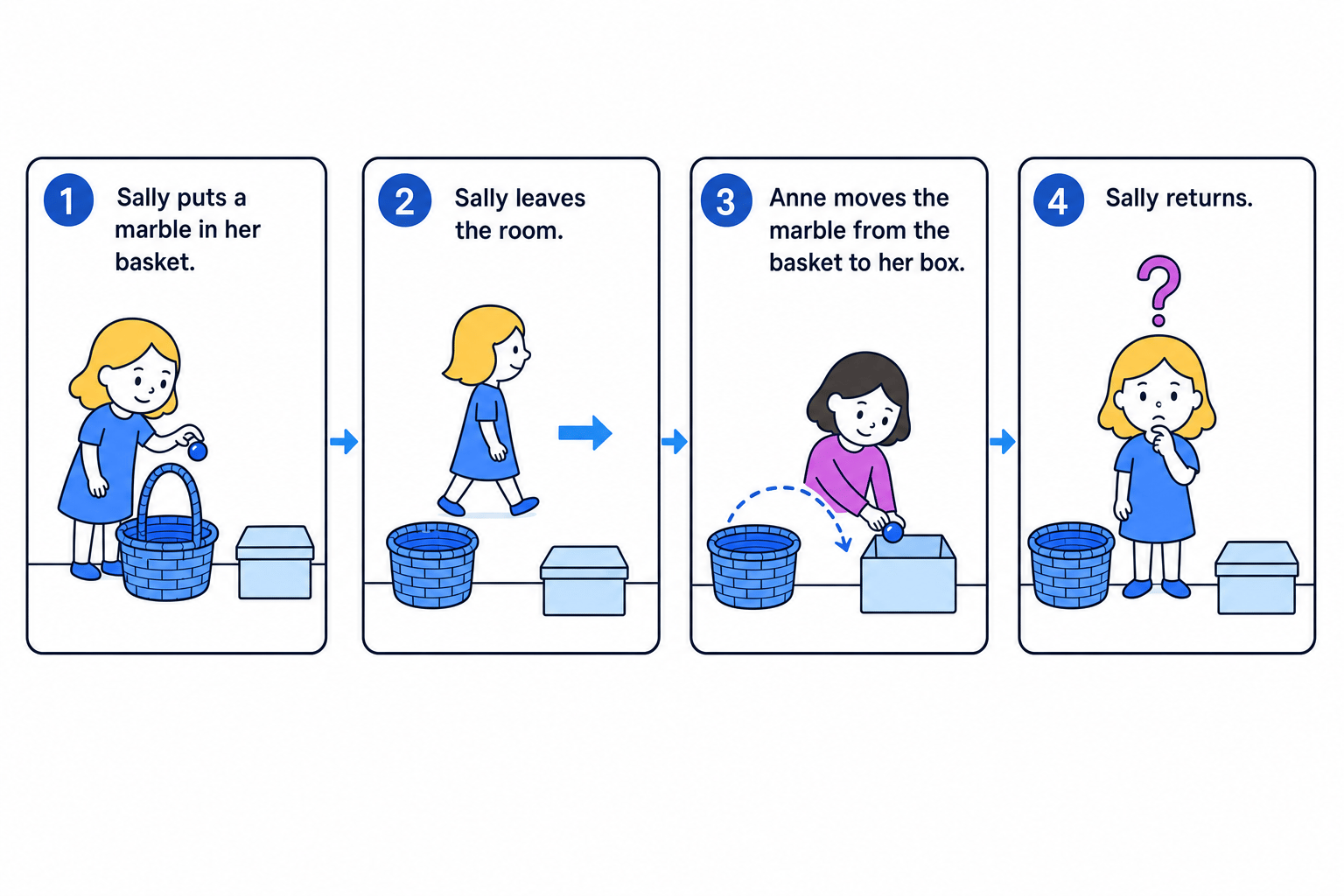
The Procedure: Children are told a story using two dolls, Sally and Anne.
- Sally puts her marble in her basket and leaves the room.
- Naughty Anne takes the marble and moves it into her box.
- Sally returns. The child is asked the crucial "Belief Question": "Where will Sally look for her marble?"
The Findings: To pass, the child must say "the basket", recognising that Sally holds a false belief about where the marble is.
- 85% of neurotypical children and children with Down's syndrome answered correctly.
- Only 20% of children with Autism Spectrum Disorder (ASD) answered correctly. Most autistic children pointed to the box, assuming Sally knew what they knew.
This led Baron-Cohen to propose the mind-blindness hypothesis: the idea that the core deficit in autism is an inability to develop a complete Theory of Mind.
Testing ToM in Older Individuals: The Eyes Task
Because many older autistic adults easily pass the Sally-Anne task (often using logical reasoning rather than intuitive ToM), Baron-Cohen developed the "Reading the Mind in the Eyes" task. Participants are shown cropped photos of just a person's eyes and asked to select the emotion the person is feeling. Autistic adults consistently score lower on this task than neurotypical adults.
Evaluating Theory of Mind
Confusing ToM with Perspective-Taking
Students often mix up Selman's perspective-taking and ToM. Remember: Perspective-taking is understanding how someone sees a situation (often a conflict). Theory of Mind is simply recognising that another person has different mental states (beliefs/knowledge) at all.
- Weakness (Validity of False Belief Tasks): Passing the Sally-Anne task requires strong visual memory and language skills. A child might fail the task because they forgot the story or didn't understand the phrasing of the question, not because they lack a Theory of Mind.
- Weakness (ASD explanation is incomplete): While ToM explains the social and communicative difficulties in autism, it fails to explain the non-social symptoms, such as highly specific intense interests, repetitive behaviours, or sensory sensitivities.
3. The Mirror Neuron System (MNS)
In the 1990s, a team of researchers led by Giacomo Rizzolatti accidentally made one of the biggest neurobiological discoveries of the century while studying the motor cortex of macaque monkeys.
They found that certain neurons fired when a monkey reached for a peanut. Astonishingly, those exact same neurons also fired when the monkey simply watched a researcher reach for the peanut. The brain was "mirroring" the observed action as if the monkey was doing it itself.
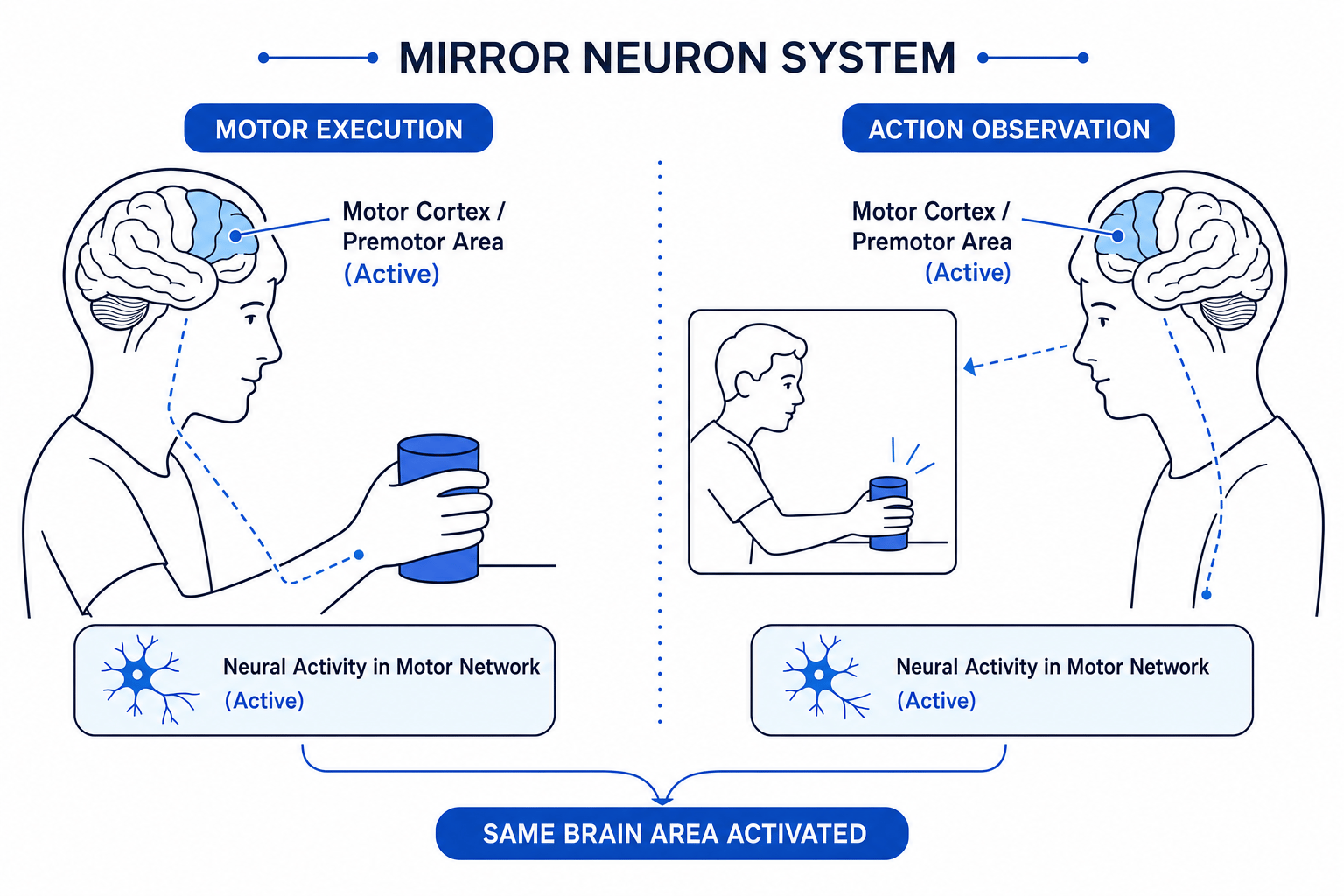
The Role of the MNS in Social Cognition
Mirror neurons are believed to be the biological foundation of social cognition. Instead of having to logically deduce what someone else is doing or feeling, our mirror neurons let us simulate it instantly in our own brains.
- Understanding Intentions: Mirror neurons don't just fire for the physical action; they fire based on the goal of the action (e.g., reaching for a cup to drink vs. reaching for it to clear the table).
- Empathy: If you see someone stub their toe, your face winces. This is your mirror neuron system simulating their pain in your own neural pathways, allowing you to intuitively feel what they feel.
The "Broken Mirror" Theory of Autism
Ramachandran and Oberman (2006) proposed the "broken mirror" theory. They suggested that neurological deficits in the mirror neuron system prevent a child from imitating and understanding others, which in turn leads to the development of social difficulties and "mind-blindness" seen in ASD.
Evaluating the Mirror Neuron System
- Weakness (Measurement issues in humans): We cannot ethically implant electrodes into human brains to measure individual mirror neurons like we can with monkeys. Most human evidence comes from fMRI scans. However, fMRI measures changes in blood flow across millions of neurons at once; it cannot prove that the exact same individual cell is firing for both execution and observation.
- Mixed Evidence for the Broken Mirror Theory: Some brain scanning studies show reduced activity in the MNS areas of autistic individuals when observing emotional faces. However, a large review by Hamilton (2013) found highly inconsistent results, suggesting that the MNS in autistic individuals might not be "broken", but just responds differently depending on the context.
Summary of Social Cognition
The development of social cognition can be viewed through different lenses: Selman maps out the cognitive stages of perspective-taking, Theory of Mind focuses on understanding false beliefs (the Sally-Anne study), and the Mirror Neuron System provides the underlying biological hardware that allows us to simulate others' actions and feelings.
In the exam
- Be specific with studies: When evaluating ToM, explicitly mention Baron-Cohen's (1985) Sally-Anne task results (20% vs 85%) to secure higher AO3 marks.
- Link biology to behaviour: If an essay asks about the MNS, don't just describe the brain areas. Explicitly link the firing of mirror neurons to social outcomes like empathy, imitation, and intention-reading.
- Contrast the theories: A great way to boost your evaluation marks is to contrast these approaches. For example, point out that while ToM and Selman offer cognitive descriptions of how thinking changes, the MNS theory offers a biological mechanism for why it happens.
Check yourself
- Can you name and briefly describe Selman's Stage 0 and Stage 4?
- What is the crucial "Belief Question" in the Sally-Anne task, and what answer indicates a functioning Theory of Mind?
- What was Rizzolatti measuring in monkeys when he discovered mirror neurons?
- What does the "broken mirror" theory suggest about Autism Spectrum Disorder?
