What you'll learn
- How genetic factors may increase vulnerability to schizophrenia.
- How the dopamine hypothesis explains positive and negative symptoms.
- What neural correlates are, and how brain differences are linked to symptoms.
- How to evaluate biological explanations using AO3 points such as evidence, causality, reductionism and ethics.
Starting point: what is a biological explanation?
A biological explanation explains behaviour and mental disorder in terms of physical processes in the body, especially the brain, nervous system, genes and neurotransmitters.
For schizophrenia, biological explanations focus on:
- Genetics — inherited vulnerability.
- Neurochemistry — especially dopamine activity.
- Neural correlates — brain structures or brain activity associated with symptoms.
Schizophrenia includes positive symptoms, which are additional experiences such as hallucinations and delusions, and negative symptoms, which involve loss of normal functioning such as avolition, speech poverty or flat affect.
Biological explanation
A biological explanation for schizophrenia suggests that the disorder is partly caused by physical factors such as inherited genes, abnormal neurotransmitter activity, or differences in brain structure and functioning.
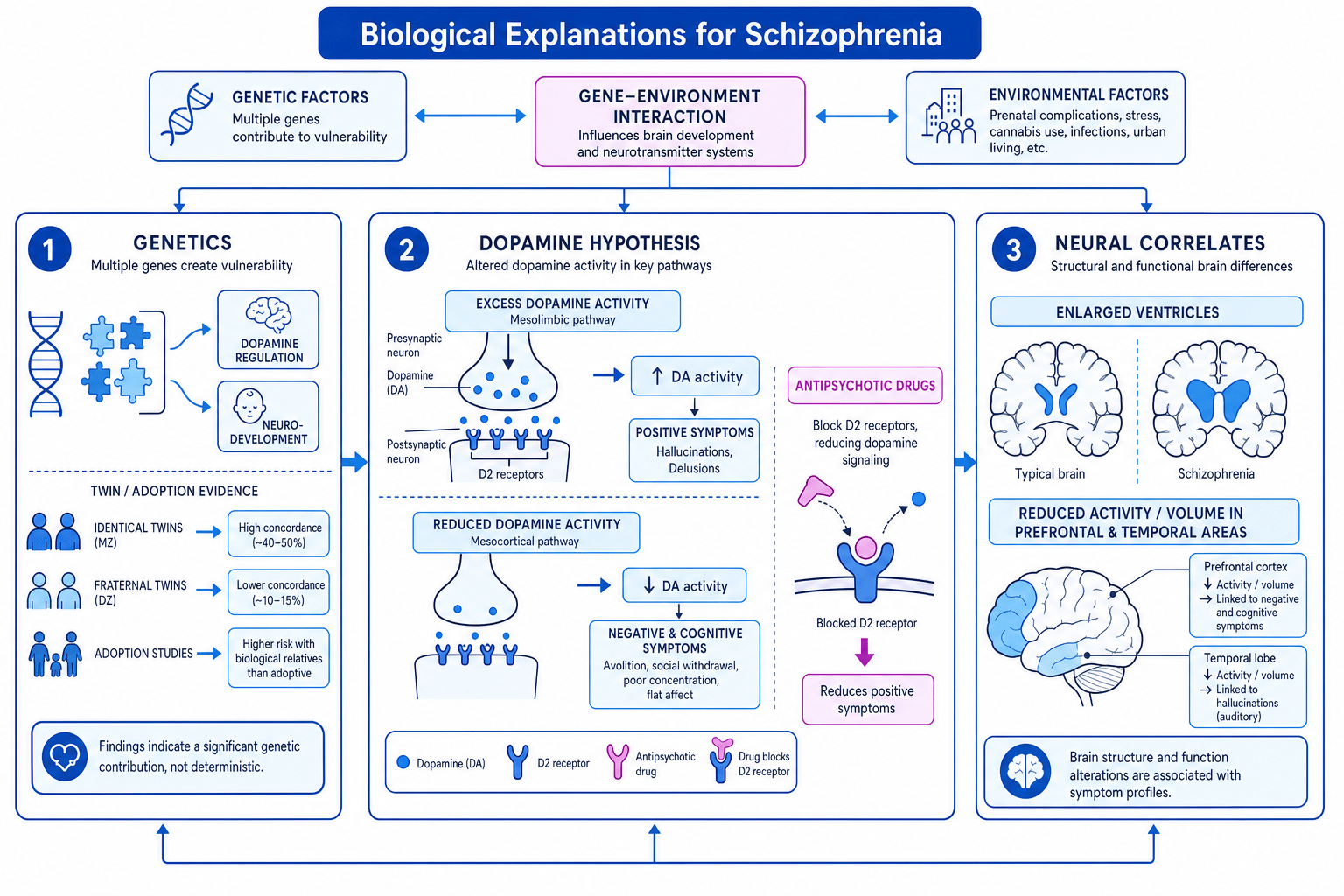
The three biological ideas fit together: genes may create vulnerability, this may affect brain development and neurotransmitter systems, and these brain differences may be linked to particular symptoms.
Genetics: vulnerability, not destiny
A gene is a section of DNA that influences a characteristic. In schizophrenia, researchers do not think there is one “schizophrenia gene”. Instead, schizophrenia is thought to be polygenic, meaning many genes each make a small contribution to risk.
It is also aetiologically heterogeneous, meaning different combinations of genes and environmental factors may lead to similar symptoms in different people.
Genetic vulnerability
Genetic explanations suggest that people can inherit a vulnerability to schizophrenia, but genes do not guarantee that someone will develop the disorder.
Family, twin and adoption evidence
One important type of evidence comes from concordance rates. A concordance rate is the percentage chance that two people who share genes, such as twins, both have the same disorder.
Gottesman (1991) found that schizophrenia risk increases as genetic relatedness increases. For example, the lifetime risk is about 1% in the general population, but much higher for close relatives. Identical twins, who share 100% of their genes, have much higher concordance than non-identical twins, who share around 50% of their genes.
Twin evidence supports a genetic contribution, but it also shows that schizophrenia is not purely genetic. If genes were the only cause, identical twin concordance would be 100%, and it is not.
Adoption studies help separate genes from family environment. Tienari et al. (2004) studied Finnish adoptees whose biological mothers had schizophrenia. The highest risk was found in children with genetic vulnerability who were also raised in disturbed adoptive family environments. This supports a gene-environment interaction, where genetic risk may only develop into schizophrenia under certain environmental conditions.
Large genetic studies also support the genetic explanation. Ripke et al. (2014), in a genome-wide association study, identified 108 separate genetic variations associated with increased risk of schizophrenia, including genes involved in dopamine functioning.
Interpreting concordance evidence
-
Compare the genetic similarity of the two groups: identical twins share 100% of their genes, while non-identical twins share about 50%.
-
Compare the concordance rates: if identical twins show a much higher concordance rate than non-identical twins, this suggests genes are involved.
-
Check whether concordance is 100%: because identical twins do not always both develop schizophrenia, environmental factors must also play a role.
-
Reach a balanced conclusion: the evidence supports genetic vulnerability, not genetic determinism.
Evaluating the genetic explanation
A major strength is that there is strong evidence from several sources: family studies, twin studies, adoption studies and modern genome-wide research. This means the genetic explanation is supported by a wide evidence base, not just one method.
However, twin studies can be criticised because identical twins may share more similar environments than non-identical twins. This is called the equal environments assumption problem. If identical twins are treated more similarly, their higher concordance might partly reflect environmental similarity rather than only genetic similarity.
Adoption studies help with this problem because they separate biological relatives from rearing environment. However, adoption research involves sensitive personal data, so researchers must protect confidentiality, gain appropriate consent where possible, avoid stigmatising families, and debrief participants carefully.
Genes are not fate
Do not write that “schizophrenia is inherited” as if it is guaranteed. A better phrase is: genes increase vulnerability or risk, especially when combined with environmental stressors.
The dopamine hypothesis
A neurotransmitter is a chemical messenger that carries signals between neurons. Dopamine is a neurotransmitter involved in reward, motivation, attention and perception.
The dopamine hypothesis argues that schizophrenia is linked to abnormal dopamine activity in the brain.
The original dopamine hypothesis
The original version suggested that schizophrenia is caused by hyperdopaminergia, meaning too much dopamine activity, especially at D2 receptors. A receptor is a site on a neuron that receives a neurotransmitter signal.
This was mainly used to explain positive symptoms. For example, too much dopamine activity in the mesolimbic pathway, a brain pathway involved in reward and emotional salience, may cause ordinary events to feel unusually important or threatening. This could contribute to delusions or hallucinations.
The revised dopamine hypothesis
The modern version is more complex. It suggests that schizophrenia may involve:
- Excess dopamine activity in subcortical areas such as the mesolimbic pathway, linked to positive symptoms.
- Reduced dopamine activity in cortical areas such as the prefrontal cortex, linked to negative symptoms and cognitive problems.
This matters because negative symptoms, such as avolition, are not easily explained by simply saying “too much dopamine”.
Evidence for the dopamine hypothesis
Drug evidence supports the dopamine hypothesis. Many typical antipsychotic drugs work by blocking D2 receptors, reducing dopamine transmission. These drugs are often effective at reducing positive symptoms.
There is also evidence from dopamine agonists. Drugs such as amphetamines increase dopamine activity and can produce schizophrenia-like symptoms in some people, or worsen symptoms in people already diagnosed.
Brain-imaging research also supports dopamine involvement. For example, Howes et al. (2012) found evidence of increased dopamine synthesis in the striatum in people with schizophrenia.
Linking dopamine pathways to symptoms
-
Identify the symptom type: hallucinations and delusions are positive symptoms because they are additional experiences.
-
Link the symptom to the pathway: positive symptoms are commonly linked to excess dopamine activity in the mesolimbic pathway.
-
Apply drug evidence: if D2-blocking antipsychotics reduce hallucinations, this supports the idea that dopamine activity is involved.
-
Add a limitation: this does not prove dopamine is the original cause, because drug effectiveness only shows that dopamine is part of the symptom system.
Evaluating the dopamine hypothesis
A strength is its real-world application. The dopamine hypothesis helped develop antipsychotic medication, which can reduce distressing positive symptoms and allow some people to live more independently.
However, the explanation may be too simple. Not all patients respond well to dopamine-blocking drugs, and some effective atypical antipsychotics, such as clozapine, also affect serotonin and glutamate systems. This suggests schizophrenia is not only a dopamine disorder.
Another weakness is the problem of cause and effect. Abnormal dopamine activity may cause symptoms, but it might also be a consequence of schizophrenia, stress, medication, or long-term brain changes.
Dopamine AO3 shortcut
A strong evaluation paragraph can say: drug evidence supports dopamine involvement, but does not prove dopamine is the original cause of schizophrenia.
Neural correlates
A neural correlate is a brain structure or pattern of brain activity that is associated with a particular experience or behaviour.
Neural correlate
A neural correlate of schizophrenia is a measurable brain difference that is linked to the disorder or to specific symptoms, such as hallucinations or avolition.
Neural correlates are usually studied using brain-scanning methods such as MRI or fMRI. These methods can show differences in brain structure or activity.
Brain structure and functioning
Some people with schizophrenia show enlarged ventricles. Ventricles are fluid-filled spaces in the brain. Enlarged ventricles may suggest loss of brain tissue in nearby areas, although this is not found in every patient.
The prefrontal cortex, an area involved in planning, decision-making and self-control, is often linked to negative symptoms and cognitive difficulties. Reduced activity in this area is sometimes called hypofrontality.
Juckel et al. (2006) found that reduced activity in the ventral striatum, an area involved in reward and motivation, was associated with negative symptoms. This is relevant because avolition involves reduced motivation.
Auditory hallucinations have been linked to areas involved in speech and hearing. Allen et al. (2007) found differences in areas such as the superior temporal gyrus and anterior cingulate cortex in people experiencing auditory hallucinations.
Using a neural correlate in AO2
-
Identify the behaviour in the scenario: if a person shows avolition, the key symptom is reduced motivation.
-
Link it to a brain area: reduced activity in the ventral striatum may be relevant because this area is involved in reward and motivation.
-
Use cautious language: say the brain difference is associated with avolition, not that it definitely causes it.
Evaluating neural correlates
A strength is that brain-scanning evidence is scientific and objective. It allows researchers to measure brain structure and functioning rather than relying only on self-report.
However, neural correlates are correlational. If a person with schizophrenia has reduced activity in a brain area, this does not prove the brain difference caused the disorder. It could be a result of schizophrenia, medication, stress, or long-term social isolation.
There are also methodological issues. Some studies use small samples, and patients may differ in symptom profile, medication history and duration of illness. This makes it difficult to identify one clear “schizophrenic brain pattern”.
Ethically, brain-imaging and genetic research must protect participants from harm. Researchers need informed consent, confidentiality, the right to withdraw, and careful debriefing, especially because findings could increase anxiety or stigma.
Overall evaluation of biological explanations
Biological explanations are useful because they are supported by scientific evidence and have led to effective treatments, especially drug therapies. They also help reduce blame by showing that schizophrenia is not a personal weakness.
But they can be biologically reductionist, meaning they may oversimplify schizophrenia by focusing on genes, neurotransmitters and brain structures while underplaying psychological and social factors.
The best conclusion is interactionist: biological factors create vulnerability, but environmental stressors often influence whether symptoms develop and how severe they become.
In the exam
-
For AO1, cover all three areas clearly: genetics, dopamine, and neural correlates. Use key terms such as polygenic, D2 receptors and neural correlate.
-
For AO3, avoid saying research “proves” the explanation. Use cautious evaluation: concordance is not 100%, drug evidence is indirect, and neural correlates are correlational.
-
For AO2, link the symptom in the stem to the correct mechanism: positive symptoms to excess mesolimbic dopamine, negative symptoms to reduced cortical/ventral striatum activity or genetic vulnerability.
Check yourself
- Why does identical twin concordance below 100% weaken a purely genetic explanation?
- How does the revised dopamine hypothesis explain both positive and negative symptoms?
- Why are neural correlates useful evidence, but not proof of causation?
