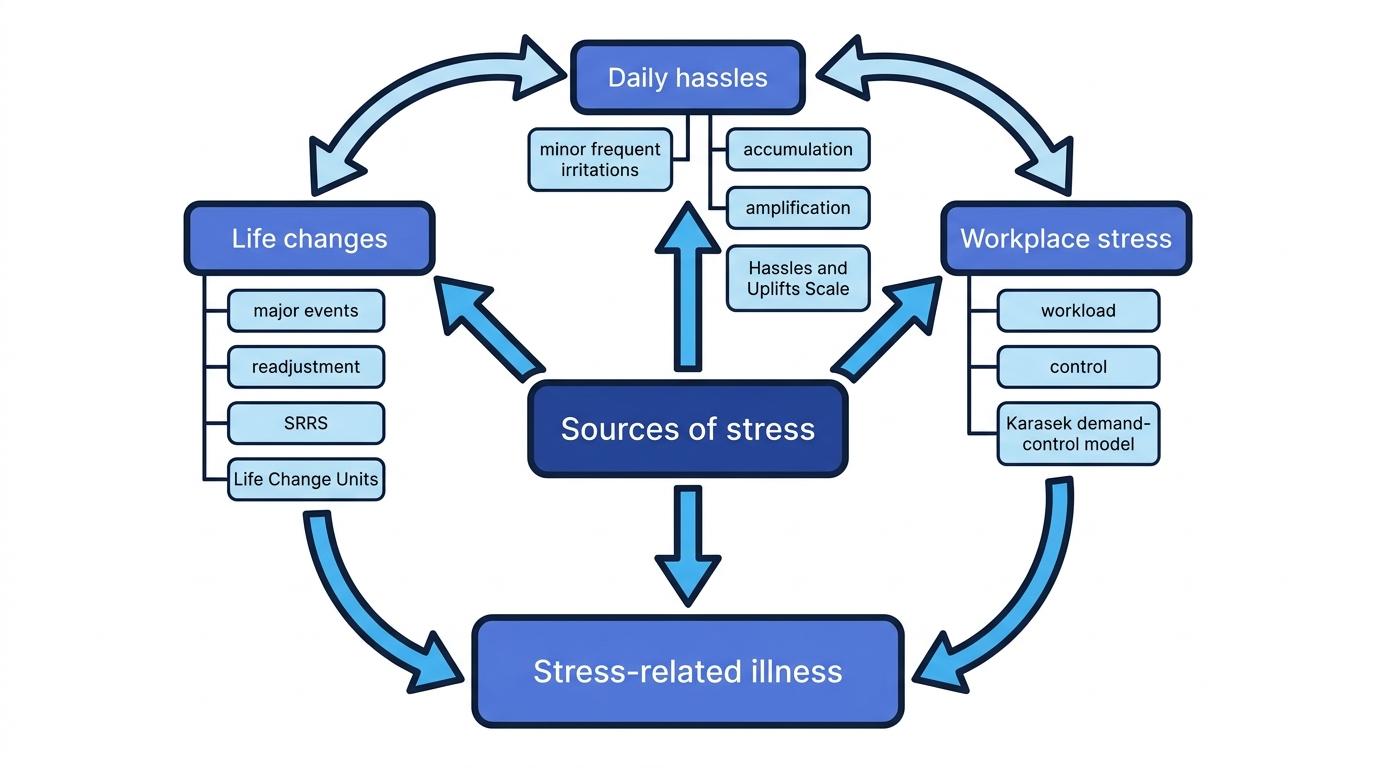
What you'll learn
- How life changes and daily hassles can act as stressors.
- How psychologists measure these sources using the SRRS and Hassles and Uplifts Scale.
- Why workload and control are key factors in workplace stress.
- How to evaluate the research for AO3, including methods, causality, ethics, and real-world applications.
Starting point: what is a source of stress?
A source of stress is something in a person’s environment or life situation that places demands on them. These demands may be physical, emotional, social, or cognitive. In A-Level Psychology, you need to know three main sources: life changes, daily hassles, and workplace stress.
Stressor
A stressor is any event, situation, or demand that is perceived as challenging, threatening, or beyond a person’s coping resources.
The key word is perceived. Two people may face the same situation but experience different levels of stress depending on personality, coping style, social support, previous experience, and control.
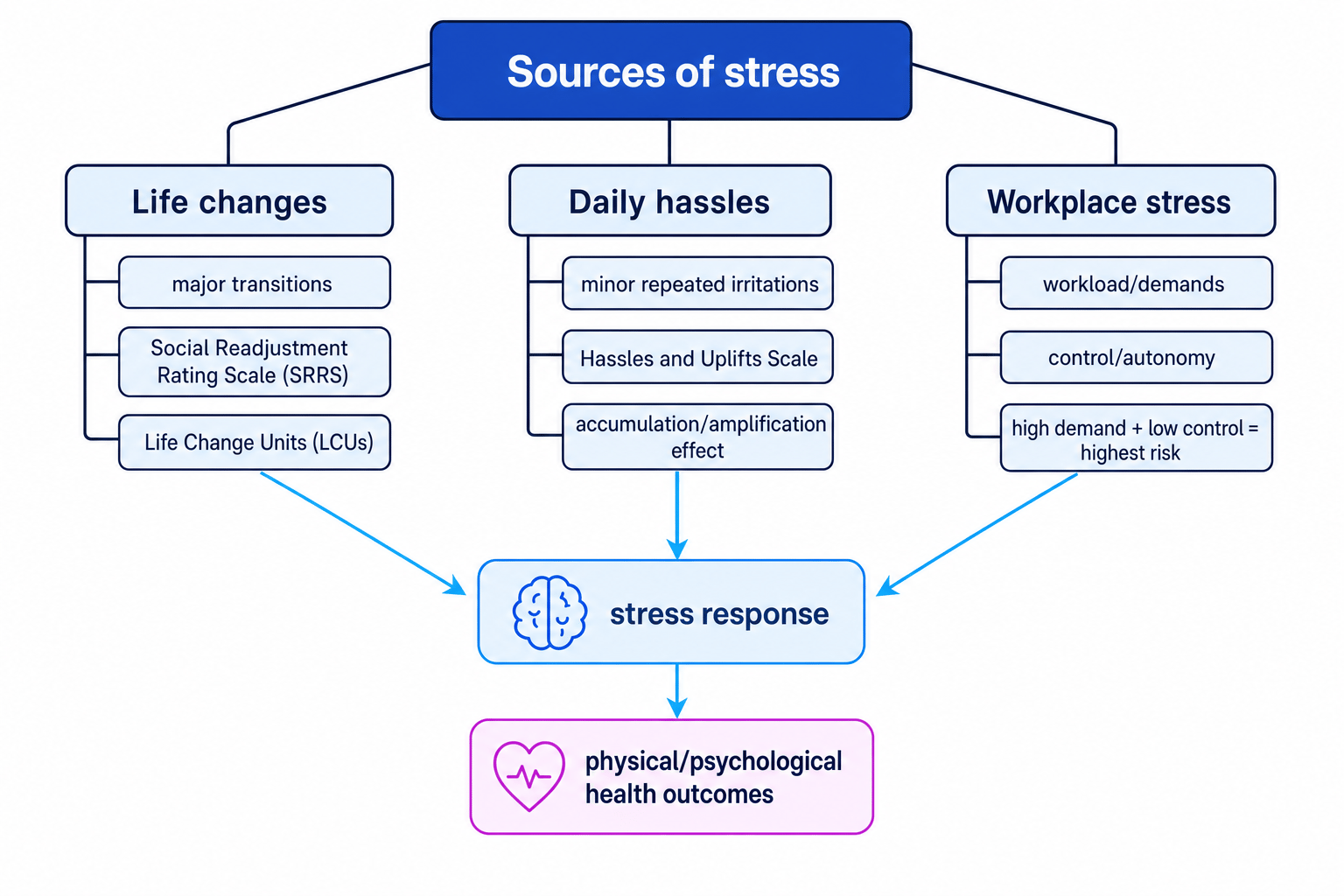
This overview shows how the three sources fit together.
Life changes
What are life changes?
Life changes are major events that require a person to make significant adjustments. These can be negative, such as divorce or bereavement, but they can also be positive, such as marriage, moving house, starting university, or getting a promotion.
Life changes
Life changes are significant events that disrupt normal routines and require psychological or behavioural adjustment.
The idea is not simply that “bad things cause stress”. Instead, stress comes from the readjustment needed. Even a positive event can be demanding because it changes routines, relationships, responsibilities, or identity.
The Social Readjustment Rating Scale
Holmes and Rahe (1967) developed the Social Readjustment Rating Scale, usually shortened to SRRS. It lists 43 life events, each given a score called Life Change Units.
Social Readjustment Rating Scale
The SRRS is a questionnaire that measures stress by adding up the Life Change Unit scores for major life events experienced over a period of time.
For example, death of a spouse has a very high score, divorce is also high, and smaller but still disruptive events, such as holidays or Christmas, have lower scores. A person’s total score is used to estimate their risk of stress-related illness.
Holmes and Rahe argued that the higher the total number of Life Change Units, the greater the risk of illness because the person has had to make more adjustments.
Research support: Rahe et al. (1970)
Rahe et al. (1970) studied around 2500 US Navy personnel. Participants completed the SRRS, and their health records were then checked over the following months. The researchers found a positive correlation between life-change scores and later illness.
This supports the idea that life changes can predict stress-related health problems.
Evaluation of life changes research
A strength of Rahe et al. is that the study was prospective: life-change scores were collected before later illness was measured. This is better than asking people who are already ill to remember past stress, because memory can be biased.
However, the relationship is correlational. Life changes and illness may be linked, but we cannot be sure life changes directly caused illness. Other variables, such as personality, social support, health behaviours, or existing physical vulnerability, may explain the relationship.
Another issue is individual differences. The SRRS gives the same score to each event for everyone, but people do not experience events in the same way. Starting a new school might be exciting for one student but overwhelming for another.
There is also a problem with mixing positive and negative events. The SRRS assumes that readjustment itself is stressful, but many positive changes may be less harmful if they are chosen, supported, or meaningful.
Ethically, SRRS research involves personal life and health information. Researchers need informed consent, confidentiality, the right to withdraw, and careful debriefing, especially because participants may become anxious if told their score suggests increased illness risk.
Assuming all life changes are negative
In this topic, life changes include positive events too. The stress comes from adjustment, not just unpleasantness.
Daily hassles
What are daily hassles?
Daily hassles are small, everyday irritations or demands. Examples include traffic, losing keys, noisy neighbours, arguments, deadlines, crowded public transport, or constant phone notifications.
Daily hassles
Daily hassles are minor, frequent, everyday problems that can accumulate and contribute to stress.
A single hassle may not seem serious. The problem is that hassles are often repeated, unpredictable, and close to everyday functioning. This means they can keep the stress response going.
Accumulation and amplification
Daily hassles may affect stress in two main ways.
How daily hassles build stress
Daily hassles can cause stress through an accumulation effect, where lots of minor irritations build up, and an amplification effect, where hassles make existing major life stress feel worse.
For example, moving house is a life change. But the stress may be intensified by daily hassles such as lost paperwork, delays, arguments with family, or unreliable transport.
Measuring daily hassles
Kanner et al. (1981) developed the Hassles and Uplifts Scale. It asks people to report everyday irritations and positive daily experiences.
Uplifts
Uplifts are small positive daily experiences, such as receiving praise, enjoying a meal, or spending time with friends, that may help reduce stress.
Kanner et al. found that daily hassles were a better predictor of psychological symptoms than major life events. DeLongis et al. (1982) also found that hassles were linked to health problems, suggesting daily stressors may be especially important because they are frequent and close to everyday life.
Ethically, this research relies on self-reporting private experiences and wellbeing. Researchers should protect confidentiality, allow withdrawal, and debrief participants because reflecting on stress may be upsetting.
Classifying stressors in a scenario
A student has recently moved to a new town, started a different sixth form, keeps missing the bus, and is arguing with a sibling about sharing a room.
- The move and new sixth form are life changes because they are major transitions requiring readjustment to routines, relationships, and identity.
- Missing the bus and repeated arguments are daily hassles because they are smaller, frequent irritations that interfere with everyday functioning.
- The situation shows amplification because the daily hassles may make the larger life changes feel more stressful.
- A strong AO2 answer would explain that stress is likely to be higher if the student perceives these demands as exceeding their coping resources.
Evaluation of daily hassles research
A strength of daily hassles research is ecological validity. Daily hassles are realistic and common, so the findings apply well to everyday stress.
Daily hassles may also explain why some people become stressed even without major life events. This makes the explanation useful for interventions: reducing small irritations, improving routines, and increasing uplifts may protect wellbeing.
However, much of this research uses self-report methods. People may forget hassles, exaggerate them, or report more hassles when they are already in a low mood. This creates a problem of mood-congruent recall, where current mood affects what someone remembers.
There is also a causality problem. Do hassles cause poor health, or do people with poor health experience and report more hassles? For example, someone who is tired or unwell may find ordinary tasks more irritating.
Life changes vs daily hassles
A quick distinction: life changes disrupt your life structure, while daily hassles irritate your daily routine.
Workplace stress
Workplace stress is stress caused by features of a person’s job. The AQA specification focuses especially on workload and control.
Workload
What is workload?
Workload means the amount and difficulty of work a person has to do. It can include time pressure, responsibility, emotional demands, long hours, or tasks that are too difficult.
Workload
Workload refers to the quantity, pace, difficulty, and emotional demands of work placed on an employee.
High workload can become stressful when demands exceed coping resources. For example, a nurse managing too many patients, a teacher with heavy marking and behaviour issues, or a student balancing revision, part-time work, and family responsibilities may experience chronic stress.
Research support: Johansson et al. (1978)
Johansson et al. (1978) studied workers in a Swedish sawmill. One group had high-risk jobs: their work was machine-paced, repetitive, isolated, and carried high responsibility for productivity. A lower-risk group had less demanding roles.
The high-risk group showed higher levels of stress-related hormones and more stress-related illness. This supports the idea that demanding work conditions can produce physiological and psychological stress.
This study has good ecological validity because it took place in a real workplace. It also used biological measures, which are less open to demand characteristics than questionnaires.
However, it was a quasi-experiment with a small sample, so cause and effect are difficult to establish. The groups may have differed in ways other than workload, such as personality, health, pay, or social support. It is also hard to separate workload from other factors such as isolation and lack of control.
Ethically, workplace research must be especially careful with confidentiality. Employees may worry that health or stress data could affect their job. Researchers should gain informed consent, protect anonymity, allow withdrawal, and make sure employers cannot identify or penalise individuals.
Control
What is control?
Control means how much influence a worker has over their tasks, pace, schedule, methods, and decisions.
Workplace control
Workplace control is the degree of autonomy an employee has over how, when, and in what order they complete their work.
Low control can be stressful because it creates a feeling of helplessness. Even high workload may be more manageable if the person has choice, flexibility, and involvement in decisions.
Karasek’s demand-control model
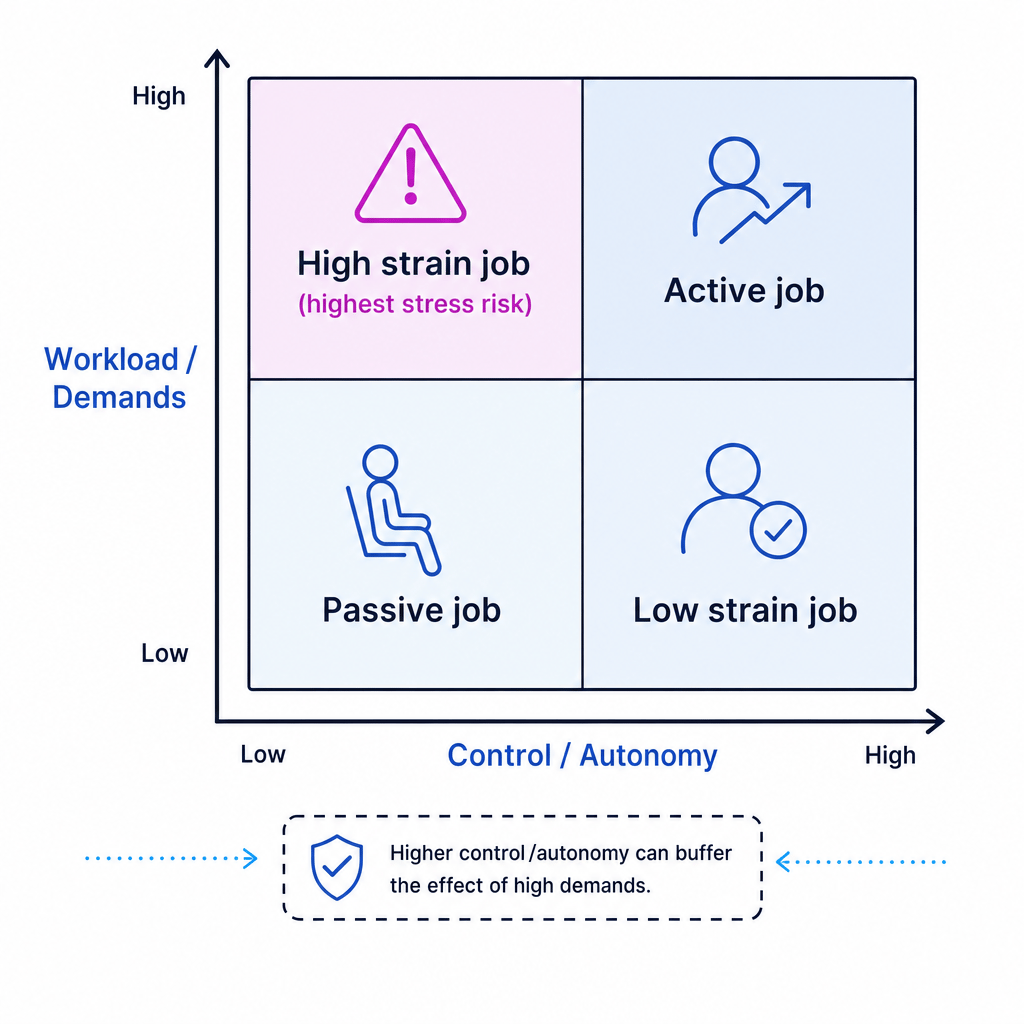
Karasek (1979) proposed that job stress is highest when demands are high and control is low. This is called a high-strain job.
The model is useful because it shows that workload alone is not the whole story. Control can buffer the effects of high demands.
Applying the demand-control model
A call-centre worker handles constant calls, has strict scripts, timed toilet breaks, and no say over targets.
- The job has high demands because the worker faces constant calls, time pressure, and performance targets.
- The job has low control because scripts, breaks, and targets are imposed with little autonomy.
- According to Karasek’s model, this combination creates a high-strain job, so stress risk is likely to be high.
- An intervention should not only reduce workload; it could also increase control, for example by allowing flexible breaks or worker input into targets.
Research support: Marmot et al. (1997)
Marmot et al. (1997), as part of the Whitehall II research, studied British civil servants and found that low job control was associated with increased risk of stress-related illness, including coronary heart disease. Lower-grade employees tended to have less control, which may help explain social differences in health.
A major strength is the large sample and real-world relevance. The findings have practical applications for job design, such as giving employees more autonomy, flexible working, and involvement in decisions.
However, the research is still largely correlational. Low control may contribute to illness, but illness, social class, lifestyle, or job insecurity may also be involved. Self-report measures of control may also be affected by personality or mood.
Ethically, large workplace studies must ensure confidentiality, especially when linking job role, health records, and status. Participants should know what data is being collected, how it will be used, and that they can withdraw without consequences.
Workplace stress in one sentence
Workplace stress is most likely when demands are high, workload is heavy, and the worker has little control over how to manage those demands.
Comparing the sources
Life changes, daily hassles, and workplace stress are not separate in real life. They often overlap.
For example, losing a job is a life change. Searching for work may create daily hassles, such as forms, interviews, money worries, and travel problems. A new job may then create workplace stress if workload is high and control is low.
For essays, a strong answer makes this interaction clear rather than treating each source as completely isolated.
Writing only AO1
For this topic, don’t just describe the SRRS or workplace studies. Add AO3: correlation issues, individual differences, self-report bias, ethics, and real-world applications.
In the exam
- Start by defining the source of stress clearly, then link it to adjustment, frequency, workload, or control.
- Use named research accurately: Holmes and Rahe for life changes, Kanner or DeLongis for daily hassles, Johansson or Marmot for workplace stress.
- For AO3, make your evaluation specific: say why correlation, self-report, small samples, confidentiality, or individual differences affect the conclusion.
Check yourself
- How is a life change different from a daily hassle?
- Why might daily hassles sometimes predict stress better than major life events?
- According to Karasek’s model, why is high workload most stressful when control is low?