What you'll learn
- How psychologists measure stress using self-report scales and physiological measures.
- How the Social Readjustment Rating Scale and the Hassles and Uplifts Scale work.
- How skin conductance response measures stress-related bodily arousal.
- How to evaluate these methods for AO3: validity, reliability, ethics, and real-world usefulness.
Why measuring stress is tricky
Stress is not just “how busy someone is”. It involves both the stressor and the person’s response to it.
Stress
Stress is a psychological and physiological response that occurs when a person perceives that the demands placed on them exceed their ability to cope.
A stressor is the event or situation that places demands on the individual, such as exams, divorce, noise, illness, or financial worries.
To measure stress, psychologists need to operationalise it. This means turning an abstract idea, like “feeling under pressure”, into something measurable, such as a questionnaire score, heart rate, cortisol level, or skin conductance response.
The measurement problem
Stress has both subjective features, such as appraisal and emotion, and biological features, such as sympathetic nervous system arousal. This is why no single stress measure is perfect.
Two broad ways to measure stress
Psychologists commonly use:
- Self-report scales — people answer questions about stressful events or daily experiences.
- Physiological measures — researchers record bodily responses linked to stress arousal.
Self-report scale
A self-report scale is a questionnaire or rating scale where participants provide information about their own experiences, feelings, or behaviours.
Physiological measure
A physiological measure records bodily activity, such as sweat gland activity, heart rate, blood pressure, or cortisol levels.
Self-reports can capture how stressful a person thinks something is. Physiological measures can capture bodily arousal without relying on memory or honesty. However, both have limitations.
The Social Readjustment Rating Scale
The Social Readjustment Rating Scale, often shortened to SRRS, was developed by Holmes and Rahe (1967).
It is based on the idea that major life events cause stress because they require a person to adjust or readjust their life.
Life event
A life event is a significant change in a person’s life that requires psychological or practical adjustment, such as divorce, bereavement, pregnancy, retirement, or changing job.
How Holmes and Rahe developed the SRRS
Holmes and Rahe asked participants to rate the amount of readjustment required by different life events. They created a list of 43 events, each given a score called a Life Change Unit.
Life Change Unit
A Life Change Unit, or LCU, is the numerical score assigned to a life event on the SRRS, representing how much readjustment that event is assumed to require.
For example:
- Death of a spouse = 100 LCUs
- Divorce = 73 LCUs
- Marriage = 50 LCUs
- Pregnancy = 40 LCUs
- Christmas = 12 LCUs
- Minor violation of the law = 11 LCUs
To use the SRRS, a person identifies which life events they have experienced over a set time period, often the last 12 months. The LCUs are added together to produce a total stress score.
Higher scores are assumed to mean greater risk of stress-related illness. As a rough guide, a score over 300 is usually described as high risk.
Calculating an SRRS score
A student has experienced parental divorce, a change in school responsibilities, a holiday, and a minor violation of the law during the past year.
- Match each event to its LCU value: divorce = 73, change in responsibilities = 29, holiday = 13, minor violation of the law = 11.
- Add the LCU values together: 73+29+13+11=12673 + 29 + 13 + 11 = 12673+29+13+11=126.
- Compare the total with the risk bands: 126 is below 150, so the SRRS would suggest relatively lower risk of stress-related illness compared with someone scoring above 300.
- Interpret cautiously: the score does not prove the student is not stressed, because it ignores personal appraisal, coping resources, and daily hassles.
Supporting evidence for the SRRS
A key supporting study is Rahe et al. (1970). US Navy personnel completed the SRRS before going on a tour of duty. Their illness records were then checked during the following months.
Rahe et al. found a positive relationship between SRRS scores and later illness. This supports the predictive validity of the SRRS because higher life event scores were associated with greater risk of illness.
Predictive validity
Predictive validity is the extent to which a measure successfully predicts a future outcome, such as whether a high stress score predicts later illness.
Evaluating the SRRS
A strength of the SRRS is that it is standardised. Everyone responds to the same list of events, and the same LCU values are used. This makes it easy to compare people and conduct large-scale research.
It is also quick to complete and gives a simple numerical score, which is useful in research settings.
However, the SRRS has important validity problems. It assumes that the same event has the same stress value for everyone. For example, retirement might be stressful for one person but a relief for another. Marriage is rated as stressful, but for many people it may also be positive and socially supported.
Treating LCUs as personal truth
Do not write as if an LCU score proves how stressed someone actually feels. The SRRS measures assumed readjustment, not the person’s individual appraisal of the event.
Another issue is recall bias. People may forget events, misremember when they happened, or report them differently depending on their current mood.
The SRRS is also correlational. A relationship between life events and illness does not prove that life events caused illness. In some cases, illness may cause life changes, such as job loss or relationship strain.
Ethically, SRRS research can ask about upsetting topics such as bereavement, divorce, or illness. Researchers need informed consent, confidentiality, the right to withdraw, and appropriate debriefing or support if distress is triggered.
The Hassles and Uplifts Scale
The Hassles and Uplifts Scale was developed by Kanner et al. (1981).
This scale takes a different approach from the SRRS. Instead of focusing on major life events, it focuses on the small, repeated experiences of everyday life.
Daily hassle
A daily hassle is a minor but irritating or demanding everyday experience, such as traffic, losing things, arguments, noise, money worries, or too much work.
Uplift
An uplift is a small positive everyday experience that may improve mood or reduce the impact of stress, such as receiving praise, relaxing, sleeping well, or spending time with friends.
How the scale works
Participants indicate which hassles and uplifts they have experienced, usually over a recent time period. They may also rate how severe or important each one was.
Examples of hassles include:
- Concerns about weight
- Too many responsibilities
- Misplacing things
- Financial worries
- Problems with transport
Examples of uplifts include:
- Getting enough sleep
- Completing a task
- Positive social contact
- Enjoyable leisure time
The scale can produce a total hassle score, a total uplift score, or separate measures of frequency and intensity.
Choosing between SRRS and hassles
Maya has not experienced any major life events this year, but she reports constant commuting delays, noisy neighbours, coursework deadlines, and regular arguments at home.
- Decide what kind of stressor is being described: Maya’s stressors are repeated everyday irritations rather than major life changes.
- Select the better measure: the Hassles and Uplifts Scale is more appropriate than the SRRS because it is designed to capture frequent minor stressors.
- Interpret the pattern: if Maya has a high hassle score and few uplifts, this suggests a high ongoing stress burden, even though her SRRS score might be low.
- Avoid overclaiming: the scale indicates perceived daily stress, but it does not by itself diagnose illness or prove a biological stress response.
Evidence for hassles
Kanner et al. (1981) found that daily hassles were associated with psychological symptoms. Research by DeLongis et al. (1982) also suggested that daily hassles can be a better predictor of health problems than major life events.
This makes sense because hassles are often chronic. A single large event may pass, but repeated daily irritations can continuously drain coping resources.
Why hassles matter
Daily hassles may be more damaging than major life events because they are frequent, cumulative, and closely tied to the person’s everyday environment.
Evaluating the Hassles and Uplifts Scale
A major strength is ecological validity. The scale measures ordinary experiences that genuinely make up daily life, such as work demands, transport, money, relationships, and sleep.
It also recognises that positive experiences can buffer stress. This is more realistic than treating all life changes as equally negative.
However, the scale is still subjective. People in a negative mood may report more hassles, not necessarily because they have more hassles, but because they perceive events more negatively. This creates a potential problem of confounding between stress, mood, and reporting style.
Confounding variable
A confounding variable is an uncontrolled factor that may affect the results, making it difficult to know what caused the outcome.
The Hassles and Uplifts Scale can also be time-consuming if it includes many items. Participants may become bored, rush their answers, or respond in a socially desirable way.
Like the SRRS, it relies on self-report, so it is affected by honesty, memory, interpretation, and demand characteristics.
Comparing the two self-report scales
The SRRS and Hassles and Uplifts Scale both turn stress into a numerical score, but they measure different things.
| Feature | SRRS | Hassles and Uplifts Scale |
|---|---|---|
| Main focus | Major life events | Everyday irritations and positives |
| Key idea | Change causes stress | Repeated minor stressors accumulate |
| Strength | Simple and standardised | More sensitive to daily life |
| Limitation | Ignores personal appraisal | Strongly affected by mood and subjectivity |
| Best for | Broad life-event research | Ongoing everyday stress |
Quick comparison
If the scenario describes divorce, bereavement, moving house, or retirement, think SRRS. If it describes traffic, deadlines, arguments, noise, or money worries, think Hassles and Uplifts.
Physiological measures of stress
Self-report measures ask people to describe stress. Physiological measures record what the body is doing.
Stress often activates the sympathetic nervous system, the branch of the autonomic nervous system involved in arousal and fight-or-flight responses.
Sympathetic nervous system
The sympathetic nervous system is the part of the autonomic nervous system that prepares the body for action by increasing arousal, for example by raising heart rate and activating sweat glands.
Physiological measures used in stress research may include:
- Heart rate
- Blood pressure
- Cortisol levels
- Skin conductance response
The AQA specification specifically names skin conductance response, so you should know this one especially well.
Skin conductance response
Skin conductance response, often shortened to SCR, is a measure of changes in the skin’s ability to conduct electricity.
Skin conductance response
A skin conductance response is a brief increase in the electrical conductance of the skin, usually caused by sweat gland activity linked to sympathetic nervous system arousal.
When a person becomes physiologically aroused, sweat glands become more active. Sweat contains salts and water, which make the skin conduct electricity more easily. Electrodes placed on the fingers or palm can detect this change.
SCR is also sometimes called galvanic skin response or electrodermal activity.
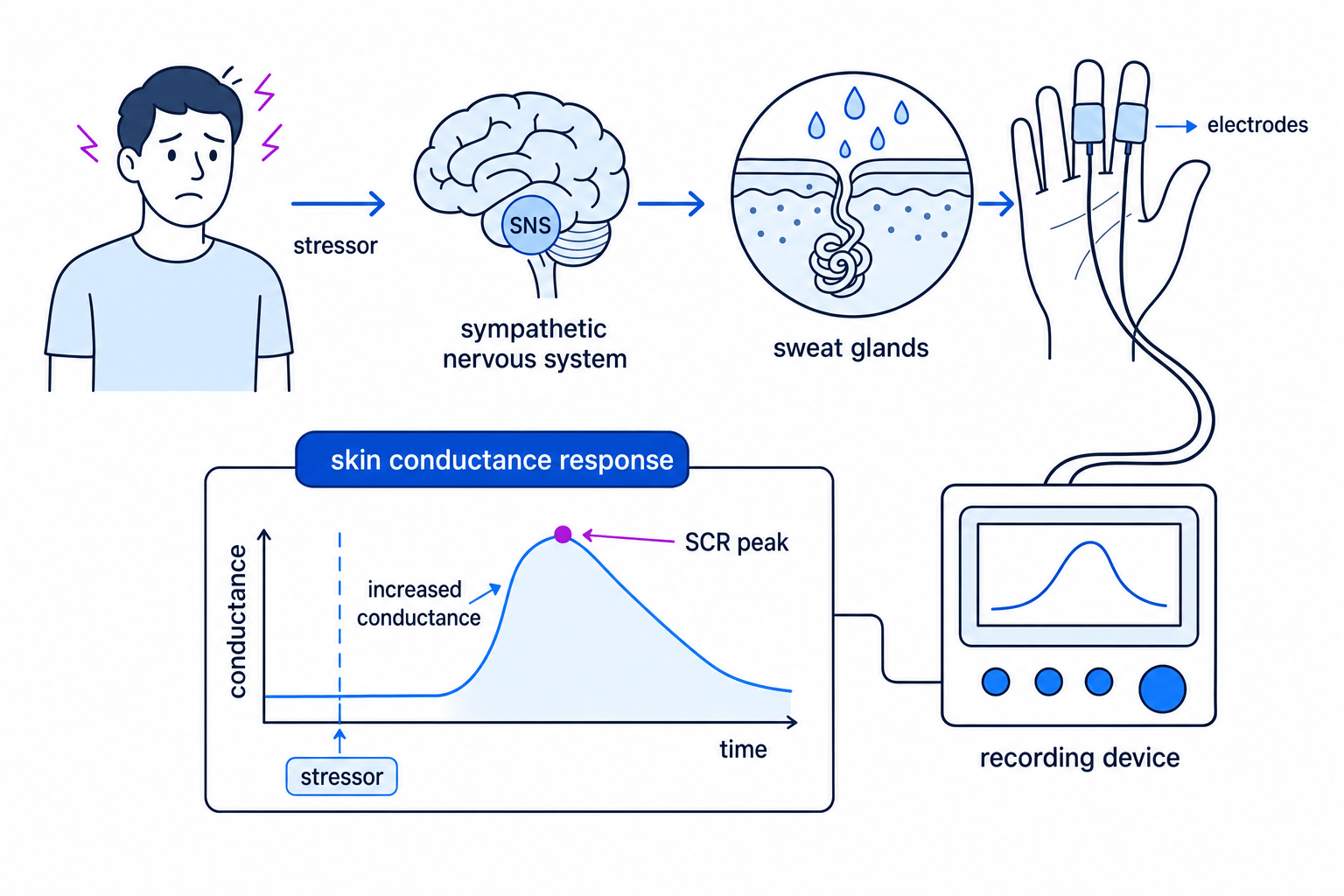
How SCR is measured
A typical SCR procedure involves:
- Attaching electrodes to the participant’s fingers or palm.
- Recording a baseline level of skin conductance.
- Presenting a stimulus or task.
- Measuring the change in conductance after the stimulus.
Researchers may examine the size of the SCR peak, how quickly it occurs, and how long it takes to return to baseline.
Interpreting an SCR trace
A participant sits quietly while baseline skin conductance is recorded. They are then given a difficult mental arithmetic task, and the graph shows a sharp rise in conductance.
- Compare the trace before and after the task: a stable baseline followed by a clear rise suggests a response to the task.
- Link the response to physiology: increased conductance indicates greater sweat gland activity, which is controlled by sympathetic nervous system arousal.
- Interpret the psychological meaning carefully: the task may have produced stress, but SCR only shows arousal, not the exact emotion.
- Check alternative explanations: movement, room temperature, caffeine, excitement, or anxiety about the equipment could also affect the reading.
Evaluating SCR and other physiological measures
A strength of SCR is that it is more objective than self-report. It does not depend on the participant remembering events or admitting that they feel stressed.
It also has good temporal sensitivity. SCR can detect rapid changes in arousal soon after a stimulus, making it useful in laboratory studies.
However, SCR is not a pure measure of stress. It measures arousal, and arousal can be caused by many things: fear, excitement, embarrassment, physical movement, temperature, or even caffeine.
Physiological does not mean stress-specific
Do not write that SCR directly measures stress. It measures sympathetic arousal, which may be linked to stress but can also occur for other reasons.
Another limitation is individual differences. Some people naturally sweat more than others, and medication, health conditions, age, and hydration can affect readings.
Researchers must standardise the procedure carefully. Electrode placement, baseline period, room temperature, task instructions, and participant movement all need to be controlled.
SCR can also feel unnatural. Being attached to equipment in a laboratory may itself increase stress, reducing ecological validity.
Ethical issues include informed consent, protection from harm, confidentiality of physiological data, and the right to withdraw. If the study deliberately induces stress, participants should be fully debriefed and monitored for distress.
So which measure is best?
There is no perfect measure of stress.
Self-report scales are useful because stress depends heavily on personal appraisal. If someone says an event is stressful, that matters psychologically.
Physiological measures are useful because stress also involves bodily arousal. They can reveal responses that participants may not notice or may not want to report.
The strongest research often uses triangulation.
Triangulation
Triangulation means using more than one method to measure the same thing, so the strengths of one method can compensate for the weaknesses of another.
For example, a researcher might use the Hassles and Uplifts Scale to measure daily stress and SCR during a standardised task to measure physiological arousal. If both measures suggest high stress, the conclusion is stronger.
Best overall approach
For AO3, the safest judgement is that self-report and physiological measures are complementary. Self-reports capture perceived stress, while physiological measures capture arousal.
In the exam
- For AO1, name the measure clearly and describe how it produces a score or reading.
- For AO2, match the measure to the scenario: major life events suggest SRRS, daily irritations suggest Hassles and Uplifts, bodily arousal suggests SCR.
- For AO3, evaluate validity carefully: ask whether the method really measures stress, or whether it measures life change, perceived hassle, or general arousal.
- When discussing studies, include ethical points such as consent, confidentiality, right to withdraw, protection from harm, and debriefing.
- Use a balanced conclusion: no measure is perfect, so combining methods usually gives a fuller picture.
Check yourself
- Why might the SRRS give the same score to two people who actually experience very different levels of stress?
- How do daily hassles differ from major life events as sources of stress?
- Why is skin conductance response better described as a measure of arousal rather than a direct measure of stress?
