What you'll learn
- How stress can affect physical illness through immunosuppression and cardiovascular disorders.
- How the SAM pathway and HPA axis link psychological stress to biological changes.
- Key research evidence, including Kiecolt-Glaser et al., Cohen et al., and work on stress and heart disease.
- How to evaluate this topic for AO3: causation, methodology, ethics, and real-world applications.
The starting point: what is stress?
Stress
Stress is a state of physiological and psychological tension that occurs when a person perceives that the demands placed on them exceed their ability to cope.
A stressor is the thing causing the stress, such as exams, bereavement, work pressure, illness, caring responsibilities, or conflict.
Stress is not always harmful. Short-term stress can help you respond quickly and perform well. The bigger health problem is usually chronic stress, meaning stress that is intense, repeated, or long-lasting.
Acute versus chronic stress
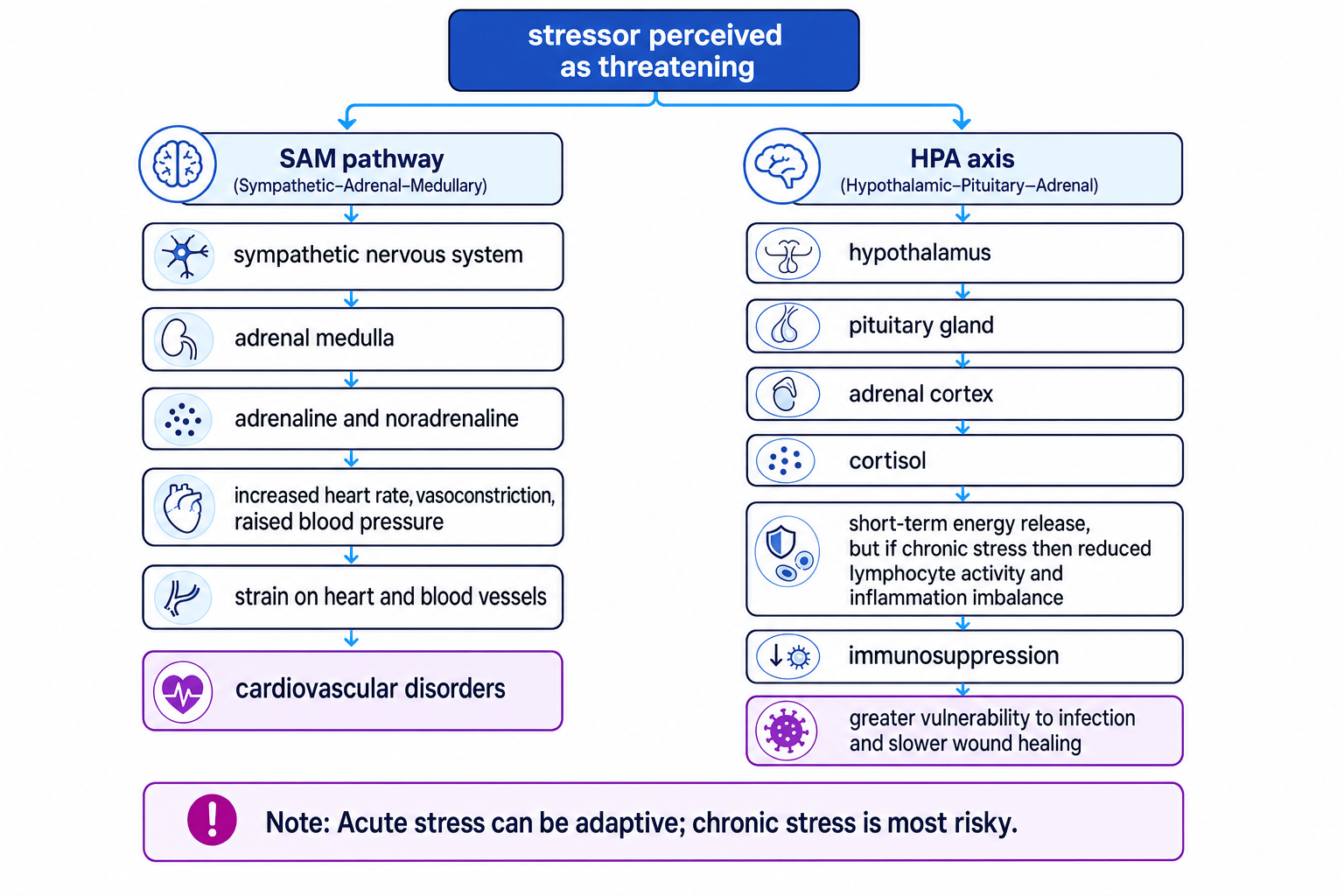
Short-term stress can be adaptive, but chronic stress keeps biological stress systems switched on for too long, increasing the risk of illness.
The body’s two main stress pathways
When you perceive a threat, the body responds mainly through two systems.
The SAM pathway
SAM pathway
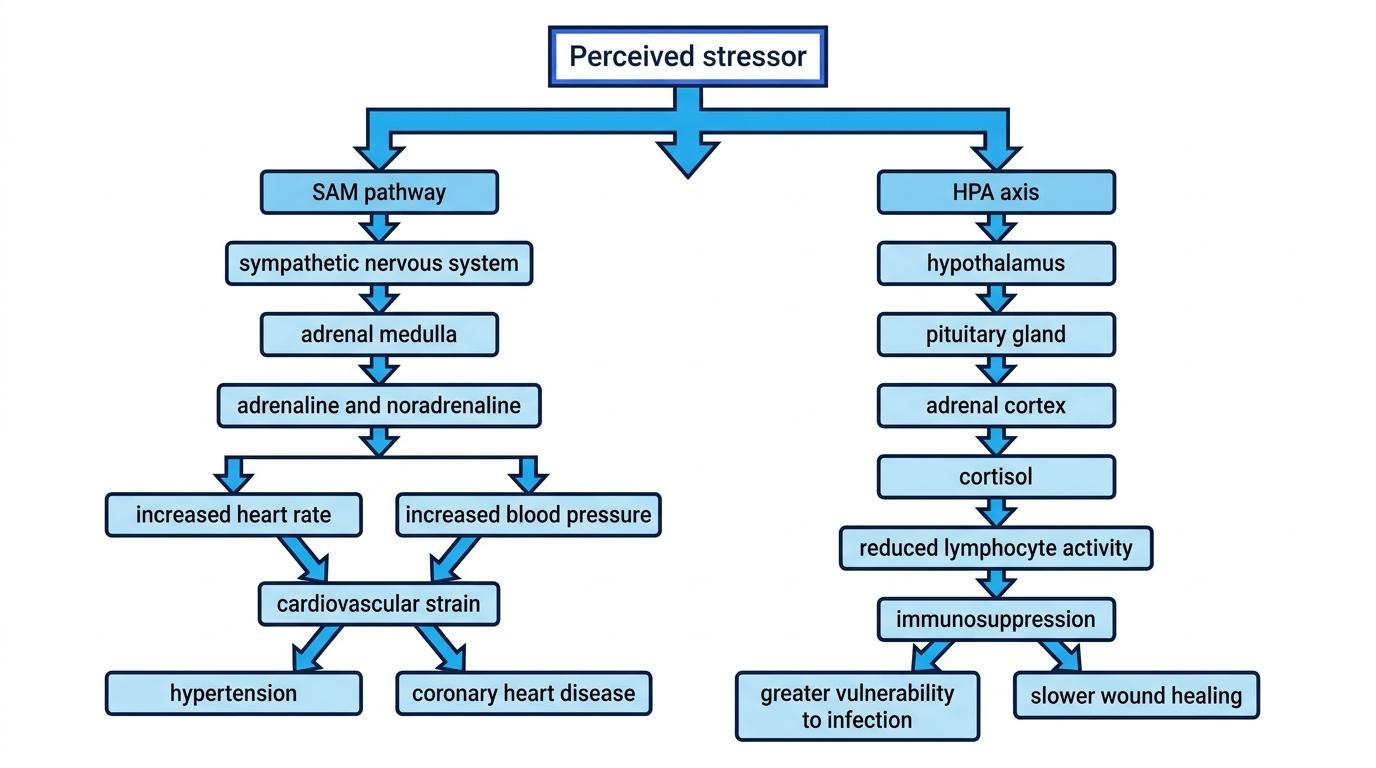
The SAM pathway stands for the sympathomedullary pathway. It involves the sympathetic nervous system activating the adrenal medulla, which releases adrenaline and noradrenaline.
The SAM pathway is fast. It prepares the body for fight or flight by increasing heart rate, raising blood pressure, and redirecting energy to the muscles.
The HPA axis
HPA axis
The HPA axis stands for the hypothalamic-pituitary-adrenal axis. It is a slower stress response in which the hypothalamus and pituitary gland stimulate the adrenal cortex to release cortisol.
Cortisol is a stress hormone that helps release energy. In the short term, this is useful. In the long term, high cortisol can disrupt immune functioning and contribute to illness.
Stress and immunosuppression
Immunosuppression
Immunosuppression is a reduction in the effectiveness of the immune system, making the body less able to fight infection and repair damage.
Your immune system protects you against pathogens such as bacteria and viruses. Important immune cells include lymphocytes, which are white blood cells involved in identifying and destroying harmful cells.
There are different types of lymphocyte:
- B cells produce antibodies.
- T cells help destroy infected cells and coordinate immune responses.
- Natural killer cells attack virus-infected cells and tumour cells.
Chronic stress can reduce immune activity. One reason is that prolonged cortisol exposure can reduce lymphocyte production and activity. This may make people more vulnerable to infections, slower to heal wounds, or less able to fight disease.
Stress and immunity
Stress does not “cause” every illness directly. A more precise answer is that chronic stress can weaken aspects of immune functioning, which may increase vulnerability to illness.
Applying immunosuppression to a scenario
A student has been caring for an ill parent for several months. They report getting frequent colds and a cut on their hand is taking longer than usual to heal.
- Identify the type of stress: this is chronic stress because the pressure has continued for months, rather than being a brief one-off stressor.
- Link it to the HPA axis: chronic stress is likely to involve prolonged activation of the HPA axis and continued cortisol release.
- Apply the biological effect: high cortisol over time may reduce lymphocyte activity and disrupt normal immune responses.
- Explain the illness outcome: reduced immune effectiveness could make colds more likely and slow wound healing.
Evidence for stress affecting the immune system
Kiecolt-Glaser et al. (1984): exam stress and immune function
Kiecolt-Glaser et al. (1984) studied medical students around exam time. Blood samples were taken before exams and during exams to measure natural killer cell activity.
They found that natural killer cell activity was lower during the exam period. Students who reported higher stress, loneliness, or stressful life events tended to show weaker immune responses.
This supports the idea that real-life stress can be linked to immunosuppression.
Cohen et al. (1993): stress and the common cold
Cohen et al. (1993) studied volunteers who completed stress measures and were then exposed to a cold virus under controlled conditions. Participants with higher stress scores were more likely to develop a cold.
This is strong evidence because the researchers could control exposure to the virus more carefully than in ordinary daily life.
Kiecolt-Glaser et al. (1995): carers and wound healing
Kiecolt-Glaser et al. (1995) compared women caring for relatives with Alzheimer’s disease with a control group. Small wounds were created and monitored. The carers’ wounds took longer to heal, suggesting chronic stress can slow tissue repair.
Saying stress always weakens immunity
Acute stress can sometimes temporarily enhance certain immune responses. The safest exam phrasing is that chronic stress is associated with immunosuppression, especially when stress is severe or prolonged.
Evaluation of immunosuppression research
Strength: biological measures
Many studies use objective biological measures, such as blood samples, natural killer cell activity, or wound healing. This improves scientific credibility because the outcome is not just based on self-report.
Strength: real-world relevance
Studies using exam stress or caring stress have ecological validity because these are genuine stressors. This helps explain everyday illness patterns, such as why people may become ill after prolonged pressure.
Limitation: correlation and confounding variables
Much of the evidence is correlational. For example, exam stress and reduced immune function may be linked, but other factors could also contribute, such as poor sleep, caffeine use, diet, alcohol, or reduced exercise.
This means you should be cautious about writing that stress “proves” illness is caused by stress.
Limitation: individual differences
Not everyone responds to stress in the same way. Social support, coping style, personality, age, health behaviours, and existing health conditions can all affect whether stress leads to illness.
Ethical considerations
Stress research can raise ethical issues. Studies that expose participants to viruses or create wounds must involve informed consent, medical screening, the right to withdraw, protection from harm, confidentiality, and careful debriefing.
Stress and cardiovascular disorders
Cardiovascular disorders
Cardiovascular disorders are illnesses affecting the heart and blood vessels, such as hypertension, coronary heart disease, heart attacks, and strokes.
Stress can affect the cardiovascular system through repeated activation of the SAM pathway. Adrenaline and noradrenaline increase heart rate and blood pressure. If this happens repeatedly, it can place strain on the heart and blood vessels.
Over time, chronic stress may contribute to:
- Hypertension: persistently high blood pressure.
- Atherosclerosis: build-up of fatty plaques in artery walls.
- Coronary heart disease: reduced blood flow to the heart due to narrowed coronary arteries.
- Increased risk of heart attack or stroke.
Stress may also increase cardiovascular risk indirectly. When stressed, some people smoke more, drink more alcohol, sleep less, eat less healthily, or exercise less.
Two routes to cardiovascular illness
Stress may affect heart health directly through physiological arousal and indirectly through unhealthy coping behaviours.
Linking workplace stress to cardiovascular risk
A manager has high workload, little control over decisions, sleeps badly, and often feels tense. Their blood pressure has become persistently high.
- Identify the relevant stressor: high workload combined with low control suggests chronic workplace stress.
- Link to the SAM pathway: repeated stress activates the sympathetic nervous system, leading to adrenaline and noradrenaline release.
- Apply the cardiovascular effect: these hormones increase heart rate and cause blood vessels to narrow, raising blood pressure.
- Add the indirect route: poor sleep and possible unhealthy coping behaviours may further increase cardiovascular risk.
Evidence for stress and cardiovascular disorders
Friedman and Rosenman (1959/1974): Type A behaviour and heart disease
Friedman and Rosenman studied the link between Type A behaviour pattern and coronary heart disease. Type A behaviour includes competitiveness, impatience, hostility, and time urgency.
In the Western Collaborative Group Study, over 3,000 men were followed for several years. Those classified as Type A were more likely to develop coronary heart disease than Type B participants.
This suggests that stress-related personality patterns may increase cardiovascular risk.
Work stress and heart disease
Research on occupational stress has also linked stressful jobs to cardiovascular problems. For example, studies influenced by the job strain model suggest that jobs with high demands and low control are particularly stressful and may increase risk of coronary heart disease.
Large-scale longitudinal studies are useful here because they can track stress and health outcomes over time, giving stronger evidence than a one-off snapshot.
Evaluation of cardiovascular research
Strength: longitudinal evidence
Longitudinal studies follow people over time, so they can show that stress exposure came before later cardiovascular illness. This is stronger than simply measuring stress and illness at the same moment.
Limitation: lifestyle confounds
People under chronic stress may also smoke, drink alcohol, sleep poorly, or have less time for exercise. These behaviours can independently increase cardiovascular risk, so stress may not be the only cause.
Limitation: Type A is too broad
Later research suggests that not all parts of Type A behaviour are equally risky. Hostility may be more important than competitiveness or time urgency. This weakens simple claims that “Type A causes heart disease”.
Limitation: gender and cultural bias
Some early heart disease research used mainly male samples, especially working men. This means findings may not generalise fully to women or to people in different cultures or work patterns.
Real-world applications
If stress contributes to illness, then stress management may improve health. Interventions could include workplace changes, relaxation training, cognitive behavioural strategies, exercise, and improving social support.
However, there is an important ethical issue: focusing only on individual coping can blame the person for illness. Sometimes the stressor is structural, such as poverty, unsafe work, discrimination, or caring burden. Good applications should consider both individual and social causes.
Pulling AO1, AO2 and AO3 together
For an essay on this topic, a strong structure is:
- Describe the biological pathway: HPA axis, cortisol, immune suppression, SAM pathway, blood pressure.
- Apply it to illness: infection, slower wound healing, hypertension, coronary heart disease.
- Use evidence: Kiecolt-Glaser et al., Cohen et al., Friedman and Rosenman, workplace stress research.
- Evaluate carefully: biological measures are strong, but causation is difficult because of confounding variables and individual differences.
Precise wording
Instead of writing “stress causes illness”, write: chronic stress can increase vulnerability to illness by affecting immune and cardiovascular functioning. That is more accurate and more exam-friendly.
In the exam
- Separate the two illness routes clearly: immunosuppression for infection/wound healing, and cardiovascular disorders for blood pressure, heart disease, and blood vessels.
- Use named studies as evidence, but always add a judgement: for example, “This supports the link, although the correlational design means other factors such as sleep may be involved.”
- Avoid deterministic language. Say stress increases risk or is associated with vulnerability, rather than claiming stress directly causes every illness.
Check yourself
- How does chronic activation of the HPA axis affect immune functioning?
- What is the difference between direct and indirect effects of stress on cardiovascular illness?
- Why is it difficult to prove that stress causes illness in human research?