What you'll learn
- What socially sensitive research means in A-Level Psychology.
- How to distinguish ethical issues from wider ethical implications.
- How to apply Sieber and Stanley’s framework to research examples.
- How to evaluate socially sensitive research for AO3 essays.
The basic idea: research can affect real people
Psychological research does not stay neatly inside a textbook. Findings can influence how people see themselves, how society treats certain groups, and how governments design laws or policies.
That is especially important when research is about topics such as:
- intelligence
- gender
- race and ethnicity
- sexuality
- mental illness
- offending behaviour
- parenting and attachment
- genetic explanations of behaviour
These areas are not “off limits”, but they need extra care because findings may be misunderstood, exaggerated, or used to justify discrimination.
Socially sensitive research
Socially sensitive research is psychological research that has potential social consequences for the people studied, the group they belong to, or society more widely.
Ethical issues vs ethical implications
You already know the main ethical issues in psychological research: informed consent, deception, right to withdraw, protection from harm, confidentiality, and debriefing.
These are mainly about how participants are treated during the research.
Ethical implications are broader. They are about the possible consequences of the research after it is conducted, such as whether findings could affect public policy, reinforce stereotypes, or change how a group is treated.
Ethical issues vs ethical implications
Ethical issues are about the conduct of the study; ethical implications are about the wider effects of the findings on individuals, groups, and society.
For example, Milgram’s obedience study (1963) raised ethical issues because participants were deceived and experienced distress. By contrast, research into genetic influences on criminal behaviour may raise ethical implications because findings could affect how offenders are judged, treated, or labelled.
Why social sensitivity matters in psychology
Psychology often investigates human differences. That can be useful, but it can also be risky.
If research claims that one group is “less intelligent”, “more aggressive”, or “less emotionally stable”, people may treat the finding as a fact about every member of that group. This can lead to stereotyping, where people make fixed assumptions about a whole group.
It can also lead to discrimination, where people are treated unfairly because of their group membership.
Thinking sensitive means forbidden
Socially sensitive research is not automatically unethical. The key issue is whether psychologists design, interpret, and communicate the research responsibly.
Sieber and Stanley’s framework
Sieber and Stanley (1988) suggested that researchers should think carefully about social sensitivity at several stages of the research process. This is useful for AO1 description and AO2 application because it gives you a clear structure.
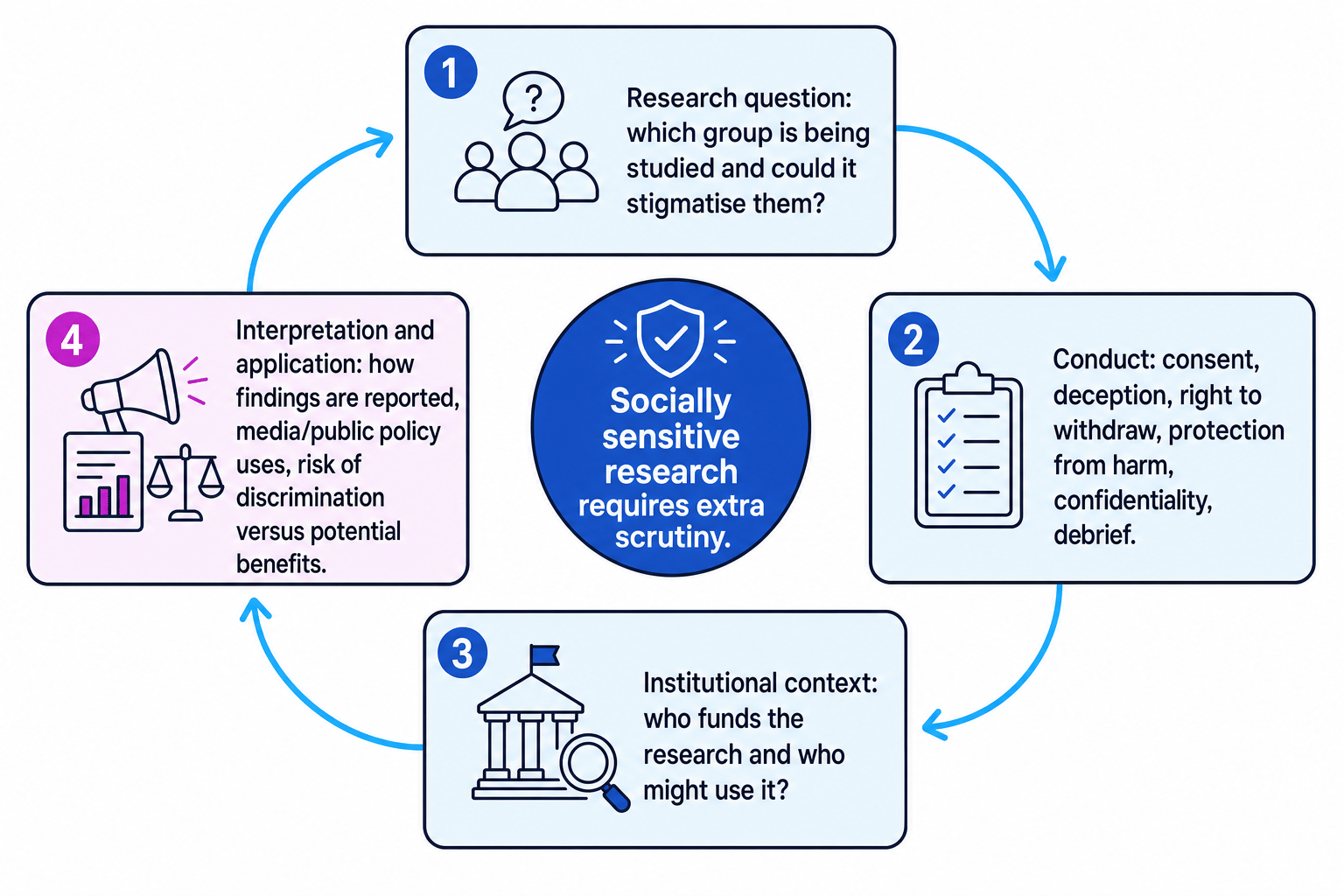
1. The research question
The research question is what the study is trying to find out. Some questions are sensitive because they imply there may be a problem with a particular group.
For example, asking “Are children of working mothers more likely to be emotionally damaged?” frames working mothers as a possible cause of harm. That does not mean the question can never be asked, but it needs very careful wording and interpretation.
2. The conduct of research
The conduct of research means how the study is actually carried out. Researchers must consider the usual ethical protections:
- informed consent: participants understand what they are agreeing to
- deception: participants are not misled unless clearly justified
- right to withdraw: participants can leave without penalty
- protection from harm: physical and psychological harm are avoided
- confidentiality: personal data is protected
- debrief: participants are informed afterwards and supported if needed
In socially sensitive research, confidentiality is especially important because disclosure could harm someone’s reputation, employment, relationships, or safety.
3. The institutional context
The institutional context means who is funding or supporting the research, and why.
Research funded by a government, police force, school system, prison service, or private company may have real-world policy consequences. For example, research on offender profiling could be used to guide policing, while research on intelligence testing could influence school placement.
This does not make the research wrong, but it does mean psychologists should ask: “Who might use these findings, and for what purpose?”
4. Interpretation and application
Interpretation means what researchers claim their findings show. Application means how the findings are used in the real world.
This is where socially sensitive research can become dangerous. A careful finding such as “there is a small average group difference in this sample” may be reported by the media as “Group X is naturally worse at Y”. That leap is not scientifically justified.
Use the four-stage structure
For essays, a simple structure is: question, conduct, context, application. This helps you avoid writing only about consent and deception.
Applying social sensitivity to a research proposal
A researcher wants to investigate whether a genetic marker is associated with aggression in young offenders.
-
Identify the affected group. The obvious group is young offenders, but the research could also affect families who share the genetic marker and wider groups who are already stereotyped as “criminal”.
-
Check the research question. If the question is worded as “Do criminals have an aggression gene?”, it is highly deterministic and stigmatising. A better question would investigate whether one genetic factor is associated with aggression alongside environmental influences.
-
Assess the conduct. Participants may be vulnerable because they are young and involved with the justice system, so informed consent, parental or guardian consent where appropriate, confidentiality, and the right to withdraw need particular care.
-
Consider institutional context. If the research is funded by a prison service or government department, findings might influence sentencing, rehabilitation, or risk assessment. That increases the need for scrutiny.
-
Evaluate interpretation and application. The researcher should avoid claiming that genes “cause” offending on their own. A responsible conclusion would emphasise interaction between biological, psychological, and social factors.
Examples of socially sensitive research
Bowlby and maternal deprivation
Bowlby’s work on attachment, including his maternal deprivation theory and later attachment theory (Bowlby, 1969), argued that early emotional bonds are important for later development. His ideas were influential in childcare, hospital visiting policies, and thinking about the importance of stable caregiving.
However, Bowlby’s work has been criticised as socially sensitive because it was sometimes interpreted as blaming mothers for children’s later problems. It also supported a social expectation that mothers should stay at home, especially in the post-war period.
This shows how research can have both positive and negative implications. It helped improve awareness of children’s emotional needs, but it may also have reinforced gender roles and guilt for working mothers.
Research into intelligence
Research into intelligence is one of the clearest examples of socially sensitive psychology.
Twin studies, such as those associated with Burt’s work on intelligence, have been used to argue that intelligence is strongly inherited. Later concerns about Burt’s methods and data raised serious questions about validity. This matters because invalid socially sensitive research can still influence education policy and public attitudes.
Herrnstein and Murray’s The Bell Curve (1994) argued that intelligence has a genetic component and discussed group differences. The work was controversial because it risked supporting racist or class-based assumptions, even if the authors presented it as scientific debate.
Validity is an ethical issue here
In socially sensitive research, poor validity is not just a methodological weakness. If flawed findings influence policy or prejudice, the research can cause real social harm.
Rosenhan and psychiatric diagnosis
Rosenhan’s study “On Being Sane in Insane Places” (1973) challenged the reliability of psychiatric diagnosis. Pseudopatients gained admission to psychiatric hospitals by reporting hearing voices, then behaved normally once admitted.
The study raised ethical issues because hospital staff were deceived, and real institutions were criticised. It also had socially sensitive implications because it affected public trust in psychiatric diagnosis.
However, it had a positive side too: it encouraged debate about labelling, institutionalisation, and the treatment of patients.
Loftus and eyewitness testimony
Loftus and Palmer (1974) showed that leading questions can affect memory reports. This has socially sensitive implications because eyewitness testimony can influence whether someone is convicted or acquitted.
The research could make juries more cautious about witness evidence, which is beneficial. But it could also be used to undermine genuine witnesses if applied too broadly.
Evaluating socially sensitive research
Strength: it can benefit society
A major argument in favour of socially sensitive research is that avoiding difficult topics may be more harmful than studying them.
For example, research into mental illness can reduce stigma if it improves understanding and treatment. Research into eyewitness testimony has helped improve police interviewing. Research into attachment has improved childcare practices.
So, socially sensitive research can produce important real-world applications.
Limitation: findings can be misused
The biggest danger is that findings may be used to justify prejudice or unfair policies.
For instance, research into intelligence or criminality may be presented as evidence that some groups are naturally inferior or dangerous. This is especially risky when findings are deterministic, meaning they imply behaviour is fixed and unavoidable.
Limitation: the media may oversimplify
Psychological research is often complex and cautious. Media reporting may remove that caution.
A study might find a small association between two variables, but headlines may imply a direct cause. This is particularly damaging when the topic involves race, gender, sexuality, mental illness, or offending.
Turning group averages into individual claims
A finding about an average difference between groups does not tell you what any one individual is like. Avoid writing as if every person in a group fits the research finding.
Strength: ethical guidelines reduce risk
Modern research is reviewed by ethics committees. In the UK, psychologists are guided by professional codes such as the British Psychological Society’s principles of respect, competence, responsibility, and integrity.
Ethics committees can require:
- clearer consent procedures
- stronger confidentiality protections
- less harmful methods
- careful debriefing
- sensitive wording of participant information
- plans for responsible publication
This does not remove all risk, but it makes harm less likely.
Limitation: consequences are hard to predict
Even careful researchers cannot fully control how findings are later used. A study may be responsible in its original form but distorted by politicians, journalists, pressure groups, or social media.
This means psychologists need to think beyond the lab and consider public communication as part of ethical responsibility.
How to write about this in essays
For AO1, define socially sensitive research and describe Sieber and Stanley’s framework.
For AO2, apply the idea to a named study or scenario. Good examples include Bowlby’s attachment research, intelligence research, Rosenhan’s study, or research into criminal behaviour.
For AO3, evaluate both sides. Do not simply say “it is bad because it is sensitive”. A strong answer explains that sensitive research can cause harm, but it can also challenge prejudice, improve policy, and help vulnerable groups.
In the exam
-
Separate ethical issues from ethical implications. Consent and debrief are useful, but social sensitivity is mainly about wider consequences.
-
Use named examples. Bowlby, Rosenhan, Loftus and Palmer, Burt, or Herrnstein and Murray can make your answer specific.
-
Give a balanced judgement. Explain both the risk of misuse and the value of conducting sensitive research carefully.
Check yourself
- What is the difference between an ethical issue and an ethical implication?
- How could Bowlby’s attachment research be seen as socially sensitive?
- Why might invalid research be especially harmful when the topic is socially sensitive?
