What you'll learn
- What idiographic and nomothetic approaches mean in psychological investigation.
- How each approach affects research aims, methods, data and conclusions.
- How to apply the approaches to studies and scenarios.
- How to evaluate both approaches for AO3 essays.
The big idea: two ways to investigate people
Psychologists often face a choice: should they study one person in depth, or study lots of people to find patterns?
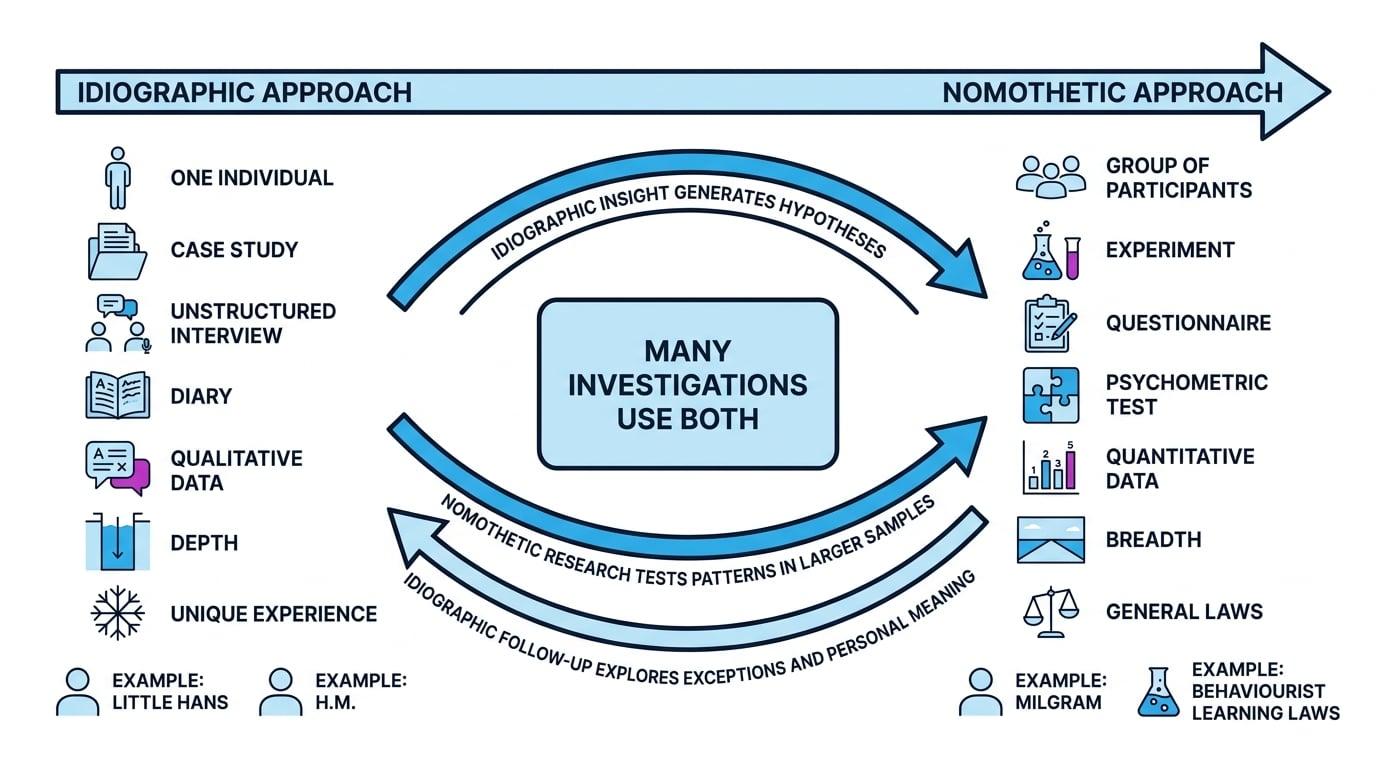
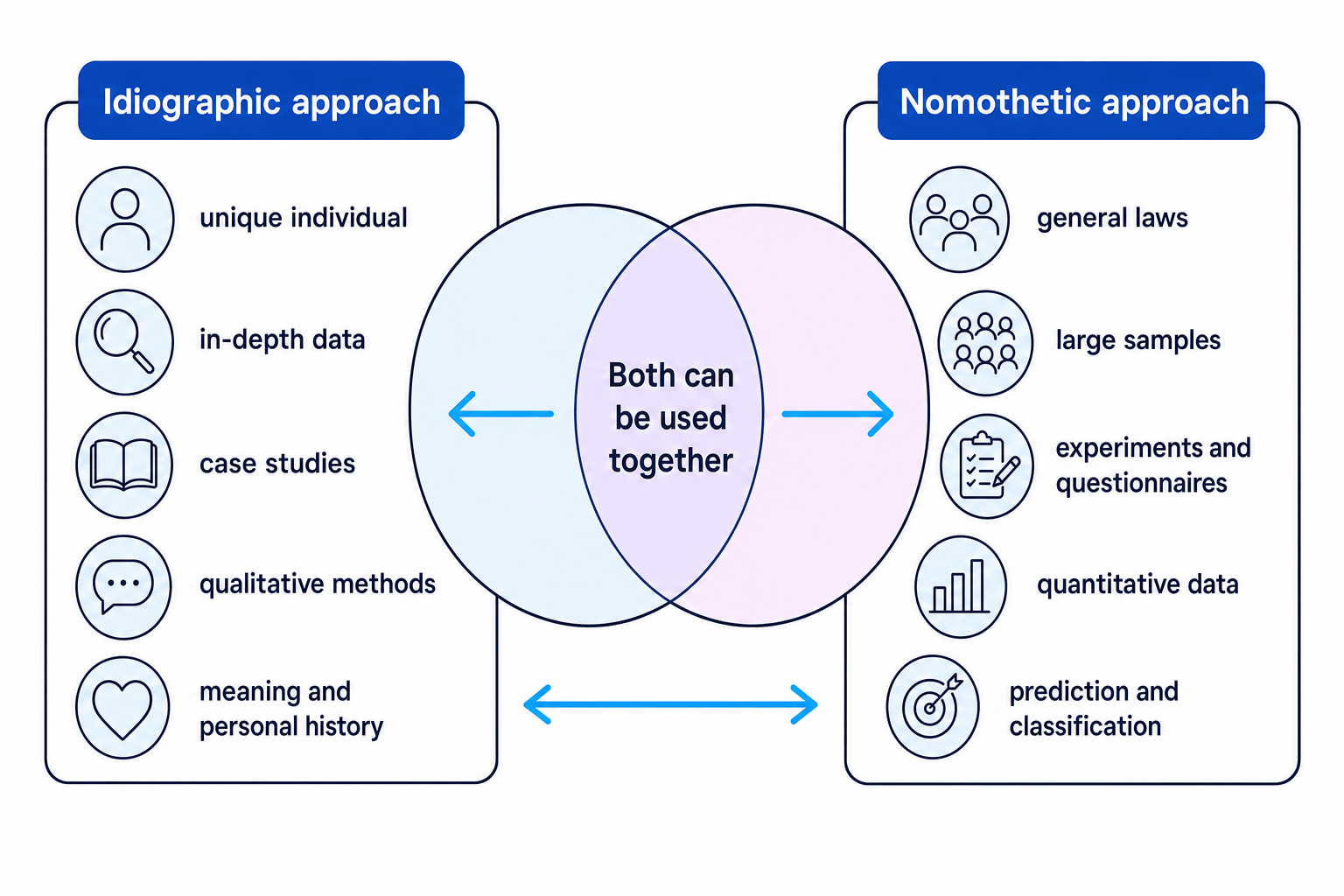
The idiographic approach focuses on the unique individual. The nomothetic approach looks for general laws that apply to groups of people.
They are best seen as a continuum, not a strict either-or choice. Many good investigations use both.
Before the approaches: key research terms
A psychological investigation is any systematic attempt to study behaviour or mental processes, such as memory, attachment, obedience, abnormality or aggression.
Research approach
A research approach is a broad way of asking questions, collecting evidence and explaining behaviour. It shapes what counts as “good” evidence.
Some important research terms:
- Qualitative data means non-numerical data, such as interview answers, diaries or case notes.
- Quantitative data means numerical data, such as test scores, percentages or questionnaire ratings.
- A sample is the group of participants studied.
- Generalisation means applying findings from a sample to a wider population.
- Reliability means consistency, for example whether a study can be repeated with similar results.
- Validity means whether a study measures what it claims to measure.
- Operationalisation means turning an abstract idea into something measurable, such as measuring “obedience” by the highest shock level reached in Milgram’s study.
The idiographic approach
Idiographic approach
The idiographic approach studies individuals in depth, aiming to understand their unique experiences, personal meanings and life history.
“Idiographic” comes from the idea of what is personal or private. Instead of asking, “What do people generally do?”, an idiographic psychologist asks, “What is happening for this particular person?”
Typical idiographic methods
Idiographic research often uses:
- Case studies: detailed investigations of one person, family, institution or small group.
- Unstructured interviews: flexible interviews where answers can be explored in depth.
- Diaries or personal documents: records of someone’s thoughts or experiences.
- Qualitative analysis: looking for themes and meanings in rich, detailed data.
Case study
A case study is an in-depth investigation of one individual or small group, often using several sources of evidence such as interviews, observations and records.
Examples in psychology
The idiographic approach is common in the psychodynamic approach, which explains behaviour through unconscious conflicts and early experiences. Freud’s case study of Little Hans (1909) is a classic example. Freud used detailed reports about one child’s phobia of horses to develop ideas about childhood anxiety and the Oedipus complex.
It is also linked to the humanistic approach, associated with Rogers and Maslow, because humanistic psychologists focus on personal growth, free will and subjective experience.
Another useful example is the case of H.M., studied by Scoville and Milner (1957). H.M. had severe memory difficulties after brain surgery, and his case helped psychologists understand differences between short-term and long-term memory. This was idiographic because the research began with one unusual individual, but it later influenced more general theories of memory.
Idiographic headline
The idiographic approach gives you depth: it tries to understand the whole person rather than reducing them to an average score.
The nomothetic approach
Nomothetic approach
The nomothetic approach studies groups of people to identify general laws, patterns or principles of behaviour.
“Nomothetic” comes from the idea of law-making. In psychology, these are usually not absolute laws like in physics. They are often probabilistic, meaning they describe what is likely to happen for many people, not what must happen for every individual.
Typical nomothetic methods
Nomothetic research often uses:
- Experiments, where variables are controlled to test cause and effect.
- Questionnaires or psychometric tests, where many people complete the same standardised measure.
- Large samples, so findings are more likely to represent a wider population.
- Statistical analysis, to judge whether patterns are meaningful. In A-Level Psychology, a common convention is that results are significant if p<0.05p < 0.05p<0.05.
Standardised procedure
A standardised procedure is a research procedure that is kept the same for all participants, making results easier to compare and replicate.
Three forms of nomothetic laws
Nomothetic psychology often tries to produce three kinds of general knowledge:
-
Classification
People are placed into categories. For example, diagnostic manuals such as the DSM and ICD classify mental disorders. -
Principles of behaviour
Researchers identify general rules, such as the idea that reinforcement increases the likelihood of behaviour in operant conditioning. -
Dimensions of difference
People are measured on a scale, such as intelligence scores, personality traits or anxiety levels.
Examples in psychology
The behaviourist approach is strongly nomothetic because it searches for general laws of learning, such as classical and operant conditioning.
The biological approach is also often nomothetic because it studies general influences such as genes, neurotransmitters and brain structures.
Milgram’s obedience study (1963) is a good nomothetic example. He used a standardised procedure and measured obedience quantitatively by recording how far participants went on the shock generator. This allowed Milgram to make broader claims about situational factors affecting obedience.
Nomothetic headline
The nomothetic approach gives you breadth: it aims to predict, classify and explain behaviour across many people.
Applying the distinction to a scenario
Applying the approaches to a scenario
A psychologist is studying phobias. They interview one person, Maya, for several hours about her childhood experiences with dogs. They also give a standardised dog-phobia questionnaire to 300 people and compare average scores.
-
The long interview with Maya is idiographic because the psychologist is exploring one individual’s personal history, meanings and unique experience of fear.
-
The questionnaire with 300 people is nomothetic because the same measure is used across a large sample, allowing the psychologist to compare scores and look for general patterns.
-
The two parts could work together: Maya’s interview might suggest possible causes of phobias, while the questionnaire data could test whether those causes are common in a wider group.
-
A balanced evaluation would say the interview may have high depth and personal validity, but low generalisability, while the questionnaire may be reliable and generalisable, but may miss important individual details.
Idiographic evaluation
Strengths
The idiographic approach provides rich, detailed data. This is useful when behaviour is complex, rare or personally meaningful. For example, H.M.’s case gave psychologists detailed insight into memory that would have been difficult to gain from a large survey alone.
It can also have strong ecological validity, meaning the findings may reflect real-life experience more closely than artificial laboratory tasks.
Idiographic research is useful for generating hypotheses. A case study can suggest ideas that later nomothetic research tests with larger samples.
Limitations
A major weakness is limited generalisability. If a theory is based on one person, it may not apply to others. Freud’s Little Hans case, for example, involved one child and relied heavily on reports from Hans’s father, so it is difficult to know whether Freud’s conclusions apply more widely.
Idiographic research can also be more subjective. The researcher may interpret the data in a biased way, especially when using interviews or case notes.
It may be difficult to replicate because each person’s life history is unique. This can reduce reliability.
Assuming idiographic means unscientific
Idiographic research is not automatically “bad science”. It can be systematic, careful and evidence-based. The issue is that its findings are usually harder to generalise.
Nomothetic evaluation
Strengths
The nomothetic approach is often seen as more scientific because it uses standardised procedures, controlled methods and statistical analysis. This makes studies easier to replicate.
It allows psychologists to make predictions. For example, if research shows that certain reinforcement schedules affect behaviour in predictable ways, this can be applied in education, therapy or behaviour management.
It also supports real-world applications. Diagnostic categories, personality tests and evidence-based therapies all depend partly on nomothetic research.
Limitations
A key weakness is that nomothetic research may ignore the whole person. Reducing someone to a score or category can miss their personal meaning, culture, history and context.
It can also lead to false universals. A false universal is a conclusion that is assumed to apply to everyone, even though the research sample may be limited by culture, gender, age or social background.
Diagnostic classification is a useful example. Systems such as the DSM aim to classify disorders reliably, but critics argue they may oversimplify people’s distress. Rosenhan’s study (1973), where pseudopatients were admitted to psychiatric hospitals, challenged the validity of psychiatric diagnosis. Ethically, Rosenhan’s study involved deception of hospital staff and raised issues around consent, although the pseudopatients themselves were protected and hospital identities were anonymised.
Saying nomothetic means everyone is the same
Nomothetic research does not claim every person behaves identically. It looks for patterns across groups, while accepting that individuals vary.
Ethical considerations
Ethics matter in both approaches, but the risks can look different.
In idiographic case studies, confidentiality is especially important because detailed life histories can make people identifiable even if names are changed. Researchers must consider informed consent, right to withdraw, protection from harm and debriefing. With H.M., for example, researchers used anonymity, but his severe memory problems raise questions about ongoing consent.
In nomothetic experiments, large samples can make anonymity easier, but there may be other ethical risks. Milgram (1963) involved deception, psychological stress and concerns about the right to withdraw, although participants were debriefed afterwards.
Ethics link for essays
When evaluating either approach, add a precise ethics point: what harm or risk is created by this method, and how could researchers reduce it?
A balanced view: you often need both
The strongest answer is usually not “idiographic is better” or “nomothetic is better”. They answer different questions.
Idiographic research is best when you want depth, meaning and individual detail. Nomothetic research is best when you want prediction, comparison and general laws.
A common pattern in psychology is:
- Idiographic research discovers an interesting individual case or pattern.
- Nomothetic research tests whether that pattern applies to larger groups.
- Idiographic follow-up explores exceptions and individual differences.
Best overall conclusion
Idiographic and nomothetic approaches are complementary: psychology needs both personal depth and generalisable evidence.
Writing about this topic in essays
For AO1, define both approaches clearly and link them to methods. For AO2, apply the approach to the scenario or study named in the question. For AO3, compare strengths and weaknesses rather than evaluating each one separately in isolation.
Good comparison phrases include:
- “In contrast, the nomothetic approach…”
- “However, the idiographic approach may offer…”
- “This suggests the two approaches are complementary because…”
- “A limitation of applying a general law to this case is…”
In the exam
-
Start by defining both terms: idiographic means in-depth study of individuals; nomothetic means seeking general laws from groups.
-
Use method words accurately: idiographic often links to case studies and qualitative data, while nomothetic often links to experiments, questionnaires and quantitative data.
-
For AO3, compare directly: depth versus generalisability, validity versus reliability, individual meaning versus prediction and classification.
Check yourself
- How would you explain the difference between idiographic and nomothetic approaches in one sentence?
- Why might Freud’s Little Hans case be considered idiographic?
- What is one strength and one limitation of using nomothetic research to classify mental disorders?