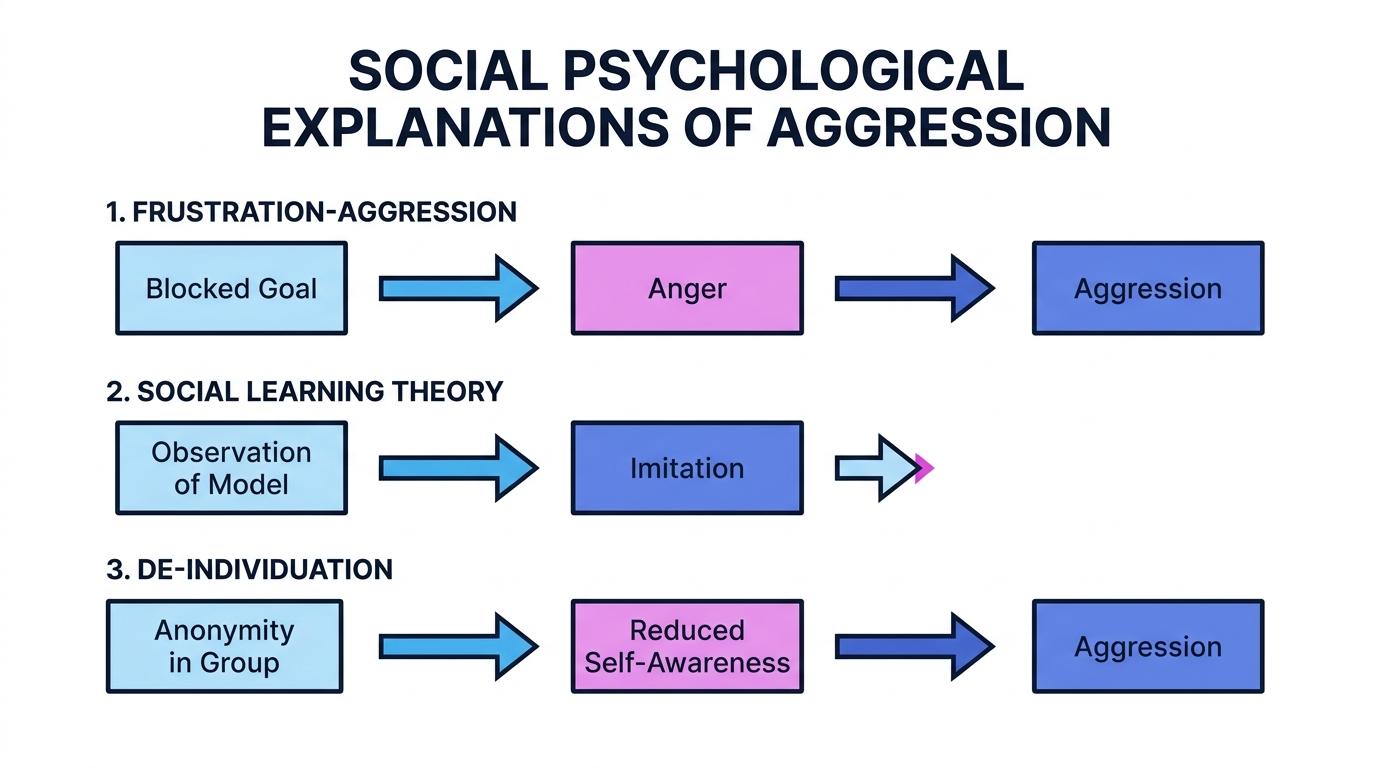
What you'll learn
- How frustration, social learning, and de-individuation can explain human aggression.
- Key studies such as Dollard et al. (1939), Bandura et al. (1961), and Zimbardo (1969).
- How to apply each theory to scenarios for AO2 and evaluate it for AO3.
- Common exam traps, especially confusing the three explanations.
Big picture: what counts as a social explanation?
A social psychological explanation looks for the causes of behaviour in a person’s social environment: other people, group situations, social rewards, social norms, and immediate triggers.
Aggression
Aggression is behaviour intended to harm another person who is motivated to avoid that harm. It can be physical, verbal, direct, indirect, impulsive, or planned.
In this topic, you are not trying to explain aggression mainly through genes, hormones, brain structures, or evolution. Instead, you are asking: what is happening in the social situation that makes aggression more likely?
Keep the three pathways separate as you revise:
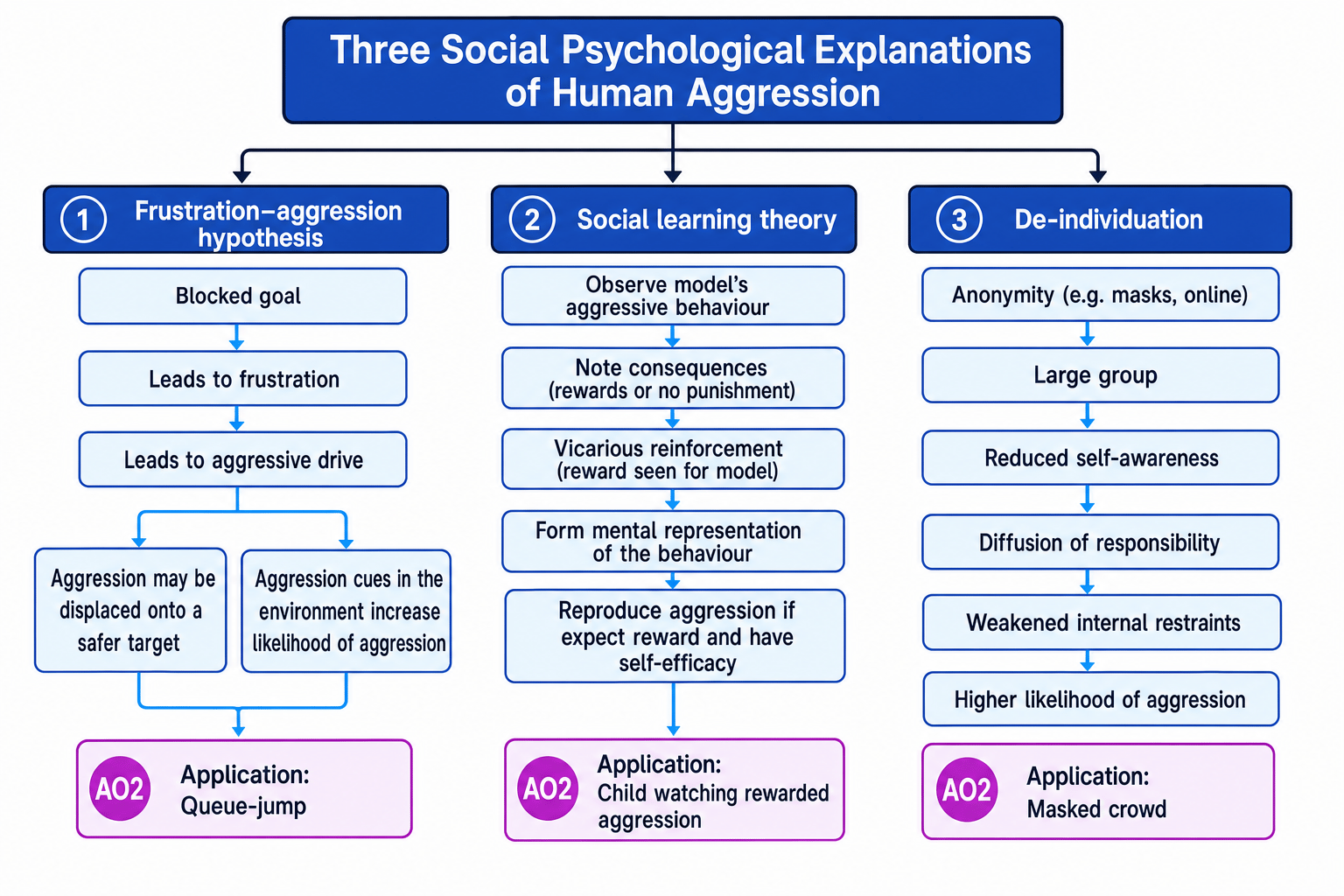
Quick comparison
Think of the three explanations like this: frustration-aggression explains a trigger, social learning theory explains how aggressive behaviour is acquired, and de-individuation explains why normal restraints may weaken in groups.
Frustration-aggression hypothesis
The frustration-aggression hypothesis was proposed by Dollard et al. (1939). It argued that frustration always leads to some form of aggression, and that aggression is always caused by frustration.
Frustration
Frustration is the unpleasant emotional state that occurs when a person is blocked from achieving a goal.
For example, if someone is prevented from getting home, winning a game, gaining respect, or getting something they feel entitled to, this may create frustration.
Dollard et al. suggested that frustration produces an aggressive drive: an internal pressure or motivation to behave aggressively. If the person cannot aggress against the real source of frustration, aggression may be displaced onto a safer or more available target.
Displacement
Displacement is redirecting aggression away from the actual source of frustration and towards a substitute target, usually because the real target is too powerful, absent, or risky to confront.
Later, Berkowitz (1989) revised the theory. He argued that frustration does not automatically cause aggression. Instead, frustration creates anger or negative affect, which makes aggression more likely if there are suitable aggression cues in the environment.
An aggression cue is something associated with aggression, such as a weapon, threatening language, or a hostile facial expression.
Frustration-aggression in one sentence
Blocked goals can create anger, which increases the likelihood of aggression, especially when the situation contains cues that make aggression seem possible or acceptable.
Applying frustration-aggression to displacement
Scenario: Liam is unfairly criticised by his manager at work. He says nothing at the time, but later goes home and shouts aggressively at his younger brother.
-
Identify the blocked goal: Liam wanted to be treated fairly and maintain status at work, but this goal was blocked by the manager’s criticism.
-
Link the blocked goal to frustration: the unfair criticism creates frustration and anger, increasing Liam’s aggressive drive.
-
Explain why the aggression is not aimed at the real source: the manager has power over Liam, so direct aggression could risk punishment or job loss.
-
Apply displacement: Liam redirects the aggression onto his younger brother, who is a safer and more available target.
AO3 evaluation of frustration-aggression
A strength is that the theory has supporting evidence. Berkowitz and LePage (1967) found that angered participants gave more electric shocks to another person when weapons were present than when neutral objects were present. This supports the idea that aggression cues can increase aggressive behaviour.
There is also real-world support. Harris (1974) found that people reacted more aggressively when someone pushed into a queue close to the front, where their goal was nearer. This supports the link between goal-blocking and aggression.
However, the original version is too deterministic. Not every frustration leads to aggression: people may cry, withdraw, problem-solve, or seek social support. Also, not all aggression follows frustration. Instrumental aggression, meaning aggression used as a means to achieve another goal, may be planned rather than emotionally triggered.
Another weakness is the mixed evidence for catharsis. Catharsis is the idea that releasing aggression reduces aggressive drive. Research such as Bushman (2002) suggests that “venting” anger can actually increase later aggression, so the hydraulic “release” idea is questionable.
There are also ethical and methodological issues. Shock-based laboratory studies often involve deception, limited fully informed consent, and potential emotional distress. Researchers must protect participants from harm, allow the right to withdraw, maintain confidentiality, and debrief them afterwards. Field studies of queue-jumping have higher ecological validity but often lack prior consent.
Social learning theory and aggression
Social learning theory, associated with Bandura (1977), argues that people can learn behaviours by observing others. This is especially important for aggression because children and adults may learn aggressive acts without being directly rewarded themselves.
Social learning theory
Social learning theory says behaviour is learned through observing and imitating role models, especially when those models are rewarded or not punished.
A model is a person whose behaviour is observed and may be copied. Imitation means copying the model’s behaviour. Vicarious reinforcement occurs when an observer sees someone else being rewarded, making the observer more likely to copy that behaviour.
Bandura also argued that learning involves mediational processes, which are mental processes between observing and performing behaviour. These include:
- Attention: noticing the aggressive behaviour.
- Retention: remembering what happened.
- Reproduction: being physically or socially able to copy it.
- Motivation: expecting a reward or benefit from copying it.
A child is more likely to imitate a model they identify with. Identification means seeing the model as similar, attractive, powerful, high-status, or worth copying.
Social learning in one sentence
Aggression can be learned by watching aggressive models, especially when their behaviour appears rewarded, successful, or consequence-free.
The classic evidence comes from Bandura, Ross and Ross (1961). Children watched an adult behave aggressively towards a Bobo doll. Later, children who had seen the aggressive model showed more imitative aggression than children in non-aggressive or control conditions. Boys showed more physical aggression, and children were more likely to imitate same-sex models.
Bandura’s later work on vicarious reinforcement showed that children were less likely to perform aggressive behaviour if they had seen the model punished, but they could still reproduce it when offered an incentive. This suggests they had learned the behaviour even if they did not immediately perform it.
Applying social learning theory to family aggression
Scenario: A younger child sees an older sibling threaten others and get what they want. The younger child later starts using threats at school.
-
Identify the model: the older sibling is a role model because they are familiar, older, and possibly high-status to the younger child.
-
Analyse the consequence: the sibling gets what they want, so the younger child observes vicarious reinforcement.
-
Apply mediational processes: the younger child pays attention, remembers the threatening behaviour, can reproduce the words or actions, and is motivated by the expected reward.
-
Predict the behaviour: social learning theory would predict imitation of aggression, especially if the child expects similar rewards and little punishment.
AO3 evaluation of social learning theory
A major strength is strong experimental support. Bandura et al. controlled the environment carefully, making it easier to show a cause-and-effect relationship between observing aggression and later imitation.
The theory also has useful real-world applications. It helps explain why aggressive behaviour may be transmitted through families, peer groups, gangs, or media. It suggests interventions such as rewarding non-aggressive behaviour, reducing exposure to aggressive models, and showing clear negative consequences for aggression.
However, the Bobo doll studies may lack ecological validity. A Bobo doll is designed to be hit, so children may have believed aggression was expected. This raises the issue of demand characteristics, where participants change their behaviour because they guess the aim of the study.
There are also ethical concerns. The children were exposed to aggressive adult behaviour and may have experienced distress or learned aggressive actions. Researchers needed parental consent, protection from harm, and debriefing. Modern ethical standards would require careful justification.
A further limitation is that social learning theory may underplay biological factors and individual differences. Not everyone exposed to aggressive models becomes aggressive. Temperament, self-control, family relationships, culture, and biological factors may affect whether observed aggression is copied.
De-individuation
De-individuation is an explanation for aggression in crowds or anonymous situations. It suggests that when people feel less personally identifiable, they may feel less accountable for their actions.
De-individuation
De-individuation is a psychological state in which people lose some sense of personal identity and self-awareness, often because they are anonymous or part of a group.
Key factors include:
- Anonymity: not being easily identified, such as wearing a mask or being online.
- Reduced self-awareness: paying less attention to personal values and standards.
- Diffusion of responsibility: feeling less personally responsible because responsibility is spread across a group.
- Weakened internal restraints: reduced guilt, fear, or concern about social judgement.
This can increase aggression because the person feels less likely to be blamed, punished, or personally evaluated.
De-individuation in one sentence
Anonymity and group membership can reduce self-awareness and accountability, making aggression more likely if the situation encourages it.
Zimbardo (1969) tested this using female participants who delivered electric shocks. Some wore hoods and were not named, making them more anonymous. Others were identifiable and wore name tags. The anonymous participants gave longer shocks, supporting the link between anonymity and aggression.
Other evidence comes from Diener et al. (1976), who studied children trick-or-treating. Children who were anonymous and in groups were more likely to steal extra sweets or money. Mullen (1986) found that larger lynch mobs were associated with more savage killings, suggesting that group size and anonymity can intensify aggression.
Applying de-individuation to crowd aggression
Scenario: During a football match, a group of masked fans begins throwing objects and chanting threats.
-
Identify anonymity: masks and the large crowd make each individual harder to identify.
-
Link to diffusion of responsibility: each fan may feel that blame is spread across the group rather than attached to them personally.
-
Explain reduced restraint: because they feel less visible and less accountable, normal concerns about guilt, punishment, or social judgement weaken.
-
Add the role of group norms: if the group atmosphere supports hostility, de-individuation makes aggressive behaviour more likely.
AO3 evaluation of de-individuation
A strength is that de-individuation explains forms of aggression that happen in crowds, gangs, riots, online abuse, and masked groups. It has practical applications: increasing accountability through CCTV, visible names, moderation, or clear group rules may reduce aggression.
However, the theory does not always predict aggression. Johnson and Downing (1979) found that anonymity did not automatically increase aggression; behaviour depended on the group cues. Participants dressed in nurse-like clothing were less aggressive, suggesting that anonymity can increase conformity to pro-social norms too.
This links to social identity theory, especially work by Reicher et al. (1995). They argued that people in crowds do not simply “lose themselves”. Instead, they may shift from personal identity to group identity. Crowd behaviour depends on the norms of that group. This is an important challenge to the simple de-individuation explanation.
Methodologically, some evidence is correlational. For example, Mullen’s lynch mob research cannot prove that group size caused brutality; other factors may have been involved. Shock studies also raise ethical issues, including deception, potential distress, and the need for careful debriefing.
Do not overuse de-individuation
Do not describe every example of group aggression as de-individuation. You need to show anonymity, reduced self-awareness, diffusion of responsibility, or weakened personal accountability.
Bringing the explanations together
In essays, you can compare the explanations directly.
Frustration-aggression is strongest when aggression follows a blocked goal. Social learning theory is strongest when aggression has clearly been learned from models. De-individuation is strongest when aggression happens in anonymous group situations.
They can also work together. For example, a person may be frustrated after a defeat, have learned aggressive chants from peers, and then become de-individuated in a masked crowd. A good answer can acknowledge that human aggression is usually multi-causal.
In the exam
-
For AO1, explain the chain of reasoning clearly: trigger or learning process or group process, then link it to aggression.
-
For AO2, use the details of the scenario rather than just naming the theory. Point to the blocked goal, observed reward, anonymity, or group norm.
-
For AO3, use evidence plus a judgement: say whether the study supports, challenges, or limits the explanation.
Check yourself
- How does Berkowitz’s revised frustration-aggression theory differ from Dollard et al.’s original version?
- Why is vicarious reinforcement important in social learning theory?
- Why might de-individuation lead to pro-social behaviour in some groups rather than aggression?