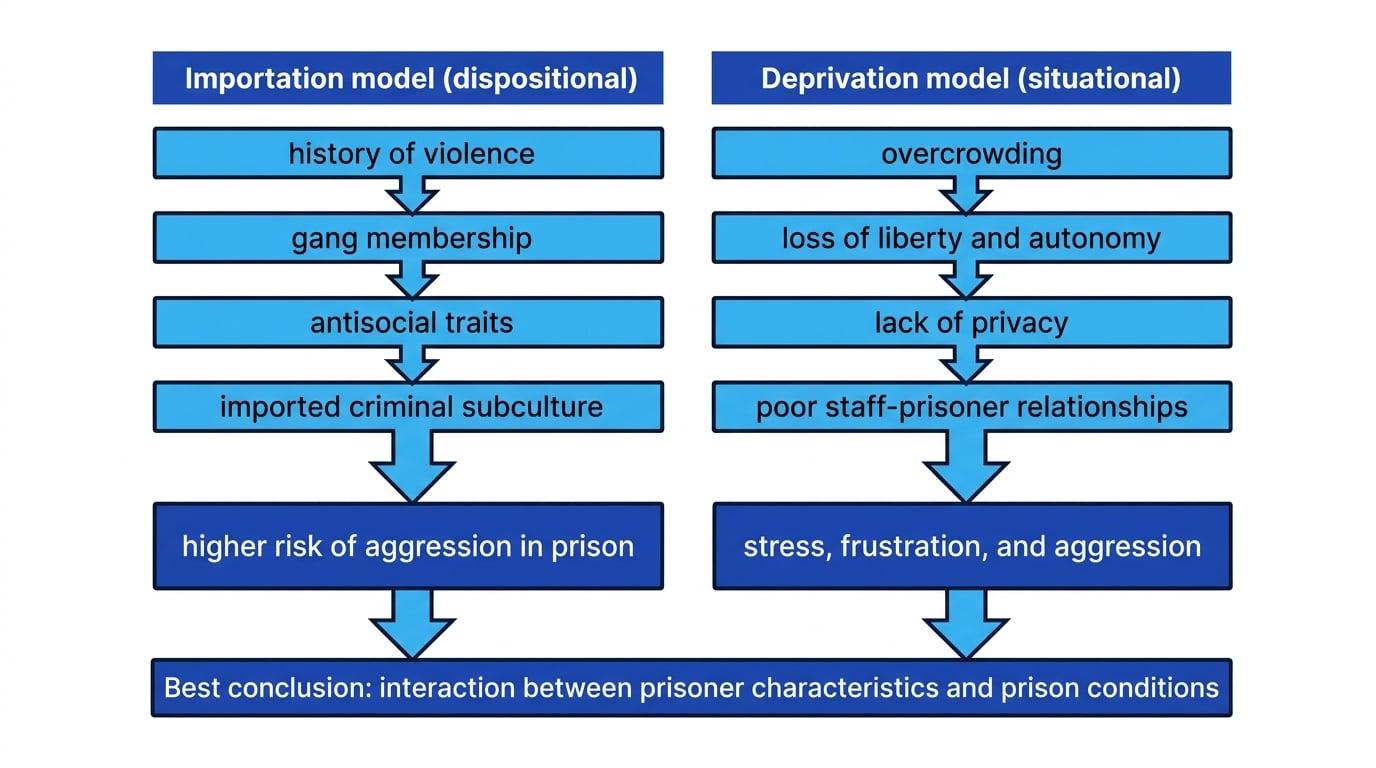
What you'll learn
- What institutional aggression means in the prison context.
- How dispositional explanations explain aggression through prisoner characteristics.
- How situational explanations explain aggression through the prison environment.
- How to evaluate both explanations using research evidence, ethics, and applications.
Starting point: what is institutional aggression?
Institutional aggression
Institutional aggression is aggressive behaviour that occurs within an institution, such as a prison, hospital, school, or workplace. In this topic, you focus on prisons, so examples include prisoner-on-prisoner assaults, prisoner-on-staff violence, intimidation, bullying, and riots.
In AQA Psychology, this topic is not just about “why people are aggressive”. It is about why aggression may become more likely inside a prison setting.
Prisons are unusual social environments: people are locked in, autonomy is restricted, privacy is limited, and status can be very important. But prisoners also enter prison with different personalities, histories, values, and experiences. This gives us two broad explanations:
- Dispositional explanations: aggression comes from characteristics of the person.
- Situational explanations: aggression comes from features of the environment.
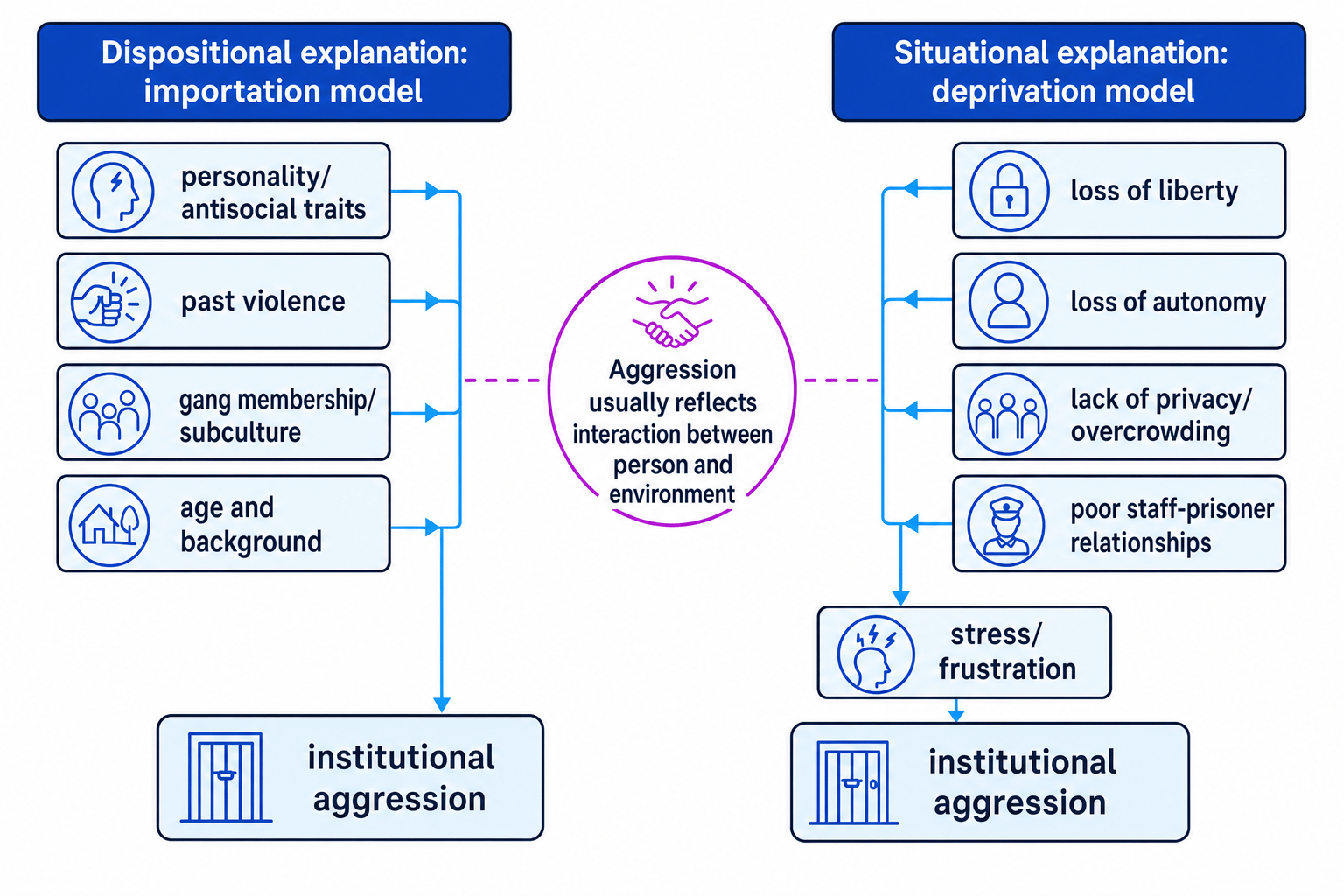
The big debate
For essays, think of this as a person versus situation debate. The best answers often argue that prison aggression is likely to result from an interaction between the prisoner’s background and the conditions of the prison.
Dispositional explanation: the importation model
Dispositional explanation
A dispositional explanation explains behaviour in terms of internal characteristics of the individual, such as personality, attitudes, past experiences, values, or biological tendencies.
The main dispositional explanation of institutional aggression is the importation model.
Importation model
The importation model, proposed by Irwin and Cressey (1962), argues that prisoners “import” their existing traits, values, experiences, and social norms into prison. Aggression in prison reflects characteristics prisoners already had before imprisonment.
According to this model, prisons do not create aggression from nothing. Instead, some prisoners enter with risk factors that make aggression more likely, such as:
- a history of violence
- gang membership
- antisocial personality traits
- poor impulse control
- substance abuse histories
- traumatic childhood experiences
- attitudes that value toughness, revenge, or dominance
In this view, aggression can be a way of maintaining status or continuing a violent lifestyle that already existed outside prison.
Prison subcultures
Prison subculture
A prison subculture is a set of norms, values, and informal rules shared by prisoners. These may include expectations about loyalty, masculinity, retaliation, and not cooperating with staff.
Irwin and Cressey suggested that some prisoners bring criminal subcultures into prison. For example, a gang member may continue to follow gang rules inside prison, including using violence to protect reputation or enforce loyalty.
Applying the importation model
A young prisoner with a long history of violent offending joins other gang members on a prison wing and attacks another inmate after a disagreement.
- Identify the relevant personal factors: the prisoner’s previous violence, age, and gang involvement all existed before the prison incident.
- Apply the model: the importation model would argue that these pre-existing characteristics were brought into prison and shaped the prisoner’s behaviour.
- Link to aggression: the attack may be explained as a continuation of a violent subculture where aggression is used to gain status or defend reputation.
Research support for the importation model
A strength of the importation model is that there is research linking prisoner characteristics to institutional aggression.
DeLisi et al. (2011) studied juvenile offenders in secure confinement and found that inmates with histories of childhood trauma, high anger, and antisocial traits were more likely to be involved in institutional misconduct. This supports the idea that aggression can be predicted by imported characteristics.
Camp and Gaes (2005) also found evidence that individual characteristics were important predictors of misconduct. Their research is useful because it suggests aggression is not simply caused by the prison environment; some prisoners remain more aggressive than others even when they are in similar settings.
Harer and Steffensmeier (1996) found that variables such as age, criminal history, and background were related to prison misconduct. Younger prisoners and those with more serious criminal histories tended to show higher levels of aggression.
Evaluation of the importation model
One strength is its real-world application. If certain prisoner characteristics predict aggression, prisons can use risk assessments, anger management programmes, mental health support, and gang-management strategies to reduce violence.
However, a limitation is that dispositional explanations can become deterministic.
Determinism
Determinism is the idea that behaviour is caused by factors beyond a person’s free choice, such as personality, biology, or past experience.
If we say a prisoner is aggressive because of their background or traits, we may overlook their ability to change. There is also a risk of labelling prisoners as “naturally violent”, especially if risk assessments are biased.
Overstating dispositional evidence
Do not write that the importation model says prison conditions do not matter. It says prisoner characteristics are important, but a strong essay can still argue that those characteristics may be triggered or intensified by the prison environment.
A further issue is that much evidence is correlational. A correlation means two variables are related, but one does not necessarily cause the other. For example, if prisoners with violent histories commit more assaults, this supports the importation model, but it does not prove that past violence directly caused the prison aggression. Other factors, such as harsher treatment by staff or placement in higher-security wings, may also contribute.
Situational explanation: the deprivation model
Situational explanation
A situational explanation explains behaviour in terms of external factors in the environment, such as social conditions, rules, crowding, roles, or levels of stress.
The main situational explanation of prison aggression is the deprivation model.
Deprivation model
The deprivation model argues that aggression is caused by the stressful and restrictive conditions of prison life. Prisoners experience “pains of imprisonment”, which can produce frustration, anger, and violence.
This explanation is linked to Sykes (1958), who described the pains of imprisonment. These include:
- loss of liberty: prisoners cannot leave and have little control over daily life
- loss of autonomy: routines, meals, movement, and choices are controlled by staff
- loss of privacy: prisoners may be watched, searched, or forced to share space
- loss of goods and services: access to possessions and comforts is restricted
- loss of security: prisoners may feel threatened by other inmates
These deprivations can increase stress and frustration. Aggression may then become a response to the environment, especially if prisoners feel powerless or disrespected.
Applying the deprivation model
A normally calm prisoner becomes aggressive after being moved to an overcrowded wing where he has little privacy, poor access to showers, and frequent conflict with staff.
- Identify the situational pressures: overcrowding, lack of privacy, poor conditions, and tense staff-prisoner relationships are features of the prison environment.
- Apply the model: the deprivation model would argue that these conditions create stress and frustration.
- Link to aggression: the prisoner’s aggression is explained as a reaction to the restrictive prison setting rather than simply as a result of his personality.
Research support for the deprivation model
A strength of the deprivation model is that some studies show prison conditions are linked to aggression.
McCorkle et al. (1995) found that prison overcrowding, lack of privacy, and poor prison management were associated with higher levels of assault. This supports the view that features of the prison environment can increase institutional aggression.
Steiner (2009) analysed data from many US prisons and found that both individual factors and prison-level factors predicted inmate misconduct. This is useful because it supports the idea that situational factors matter, but it also suggests that deprivation alone is not the full explanation.
Zimbardo (1973) is sometimes used as supporting evidence for situational explanations because the Stanford prison simulation showed how quickly ordinary participants appeared to conform to prisoner and guard roles. However, this was a simulation rather than a real prison, and it is more directly linked to social roles than to prison aggression specifically.
Evaluation of the deprivation model
One strength is that the deprivation model has clear real-world applications. If prison aggression is caused partly by conditions, then violence may be reduced by improving staff training, reducing overcrowding, increasing purposeful activity, improving mental health support, and giving prisoners more legitimate control over daily life.
A limitation is that not all prisoners become aggressive in deprived conditions. Two prisoners may experience the same overcrowded wing, but only one becomes violent. This suggests that situational explanations may be incomplete unless they consider individual differences too.
Another limitation is that some studies rely on official records of assaults or misconduct. These may not capture all aggression. Some incidents go unreported because prisoners fear retaliation or do not trust staff. Therefore, official statistics may underestimate the true level of aggression.
Evaluation shortcut
A strong AO3 point is to say: deprivation explains why a prison may become aggressive overall, while importation explains why some prisoners are more aggressive than others within the same prison.
Ethical issues in prison research
Research in prisons raises special ethical concerns because prisoners are a vulnerable group.
Vulnerable group
A vulnerable group is a group of participants who may have reduced power, freedom, or ability to give fully voluntary consent.
Important ethical issues include:
- Consent: prisoners may feel pressured to take part if they think it will affect staff treatment or parole decisions.
- Right to withdraw: prisoners must know they can leave a study without punishment.
- Confidentiality: data about aggression, gangs, or mental health must be protected.
- Protection from harm: interviews about trauma or violence may cause distress.
- Deception and debriefing: if deception is used, researchers must explain the true purpose afterwards.
Zimbardo’s Stanford prison study is especially controversial ethically. Participants experienced distress, the study ended early, and the boundaries between simulation and reality became blurred. This limits how comfortably it can be used as evidence, even though it is memorable.
Comparing the two explanations
The two explanations are often presented separately, but they are not mutually exclusive.
A prisoner may import aggressive values into prison, but those values may only lead to violence when triggered by deprivation, threat, or frustration. For example, a gang-involved prisoner may be especially likely to respond violently in an overcrowded wing where status is constantly challenged.
Interactionist conclusion
The most balanced conclusion is that prison aggression is best explained by an interaction between dispositional factors and situational pressures.
This is why Steiner’s findings are useful: they suggest that both prisoner characteristics and prison conditions predict misconduct. For essay writing, this helps you avoid a simplistic “one explanation is right, the other is wrong” answer.
AO2: applying explanations to scenarios
In exam scenarios, look for whether the stem points you towards the prisoner’s background or the prison environment.
Dispositional clues might include:
- “history of violence”
- “gang member”
- “antisocial traits”
- “poor impulse control”
- “violent upbringing”
Situational clues might include:
- “overcrowded wing”
- “limited privacy”
- “harsh rules”
- “poor staff relationships”
- “lack of activities”
- “loss of privileges”
Ignoring the stem
If a scenario describes both a violent background and harsh prison conditions, do not choose only one explanation. You can apply both and then argue that the aggression results from an interaction.
Quick essay structure
For a 16-mark essay, you could organise your answer like this:
- Define institutional aggression and introduce the person-versus-situation debate.
- Explain the importation model with Irwin and Cressey (1962).
- Support or challenge it using DeLisi et al. (2011), Camp and Gaes (2005), or Harer and Steffensmeier (1996).
- Explain the deprivation model using Sykes’ pains of imprisonment.
- Support or challenge it using McCorkle et al. (1995), Steiner (2009), or Zimbardo (1973) carefully.
- Finish with an interactionist conclusion.
In the exam
- Use the terms importation model and deprivation model explicitly, and link them to dispositional and situational explanations.
- For AO3, avoid listing studies; explain whether each study supports, challenges, or limits the explanation.
- End with a balanced judgement: prison aggression is usually best explained by both prisoner characteristics and prison conditions working together.
Check yourself
- How does the importation model explain aggression in prisons?
- What are Sykes’ “pains of imprisonment”, and how might they lead to aggression?
- Why is an interactionist explanation often stronger than choosing only dispositional or situational factors?