In this topic, we look at aggression through a biological lens. Rather than seeing aggression purely as a learned behavior, ethological and evolutionary theorists argue that aggression has deep biological roots designed to help organisms survive, reproduce, and protect their genes.
What you'll learn
- How animals use ritualistic aggression and hardwired neural loops to survive without destroying their own species.
- The mechanics of Innate Releasing Mechanisms (IRMs) and Fixed Action Patterns (FAPs).
- How evolutionary pressures—such as paternity uncertainty, cuckoldry, and mate retention—explain modern human aggression.
- How to critically evaluate both theories using research evidence, ethical debates, and cultural counter-arguments.
1. The Ethological Explanation of Aggression
Ethology
Ethology is the scientific study of animal behavior in natural environments. Ethologists study behaviors from an evolutionary perspective, asking how a specific behavior helps an animal survive and reproduce in the wild.
The ethological explanation argues that aggression is innate (instinctive and genetically hardwired) and adaptive (beneficial for survival).
The Adaptive Functions of Aggression
According to Konrad Lorenz, aggression serves several key evolutionary purposes:
- Resource Distribution: Aggression disperses individuals across a wider territory, reducing competition for food and nesting sites.
- Dominance Hierarchies: Fighting establishes social hierarchies, giving dominant individuals preferential access to resources (food, mates).
- Selection of the Fittest: Aggressive encounters ensure that only the strongest, healthiest individuals reproduce, passing on their superior genes to the next generation.
Ritualistic Aggression
If aggression always resulted in death, species would quickly become extinct. Lorenz noted that aggressive encounters between animals of the same species (intra-species) are rarely fatal. Instead, they are highly ritualistic.
Animals use displays of strength—such as baring teeth, growling, chest-beating, or changes in posture—to assess an opponent's strength without engaging in physical combat. If one animal backs down, it performs a appeasement display (e.g., a wolf exposing its vulnerable neck to the victor). This signals defeat, instantly stops the winner's aggressive behavior, and prevents serious injury or death.
2. Innate Releasing Mechanisms and Fixed Action Patterns
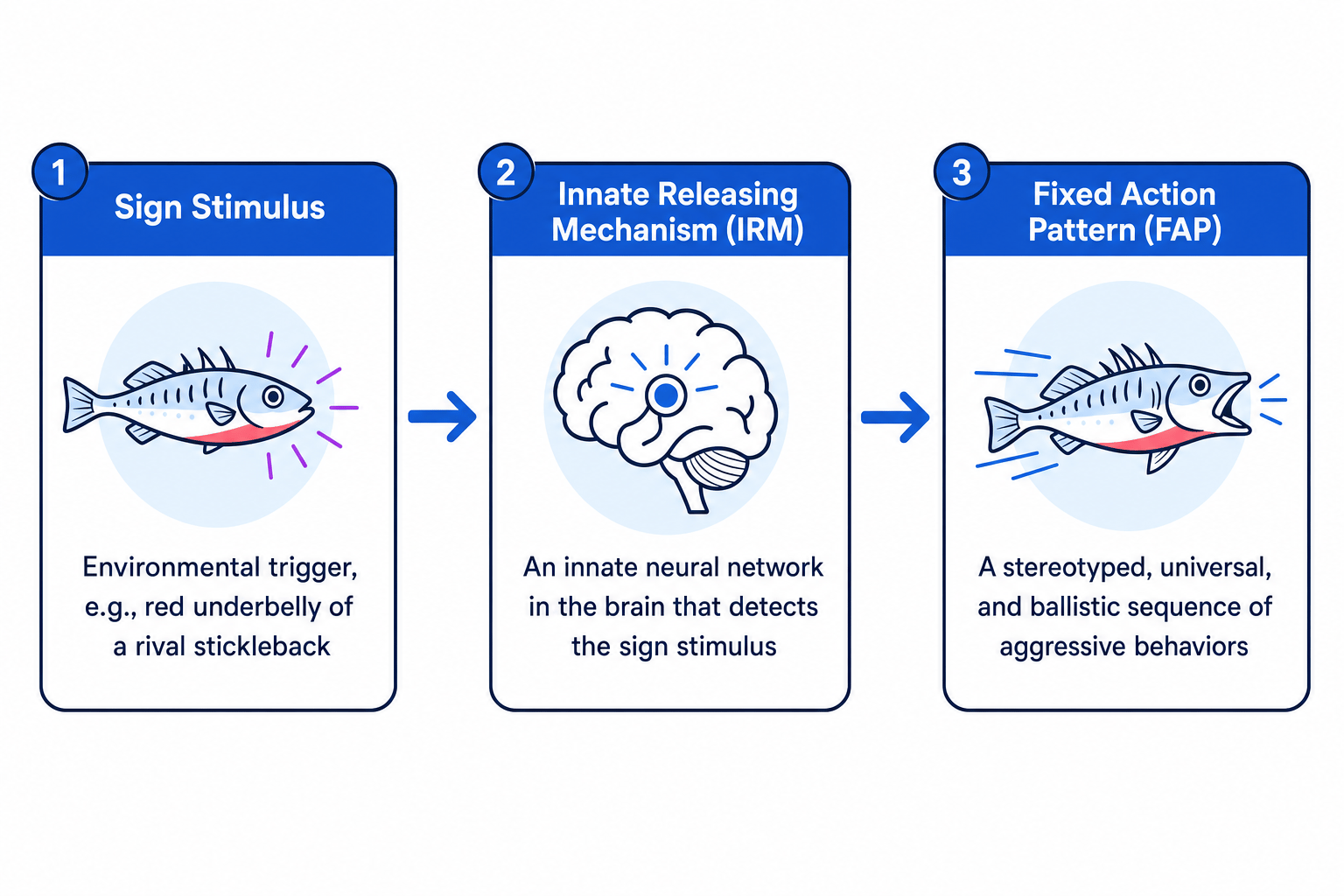
Ethologists argue that aggression is executed via a hardwired biological "circuit board." When a specific trigger in the environment is detected, a pre-programmed sequence of aggressive behaviors is automatically released.
Innate Releasing Mechanism (IRM)
An Innate Releasing Mechanism (IRM) is a built-in neural network or circuit in the brain. It is activated by a specific external stimulus, which in turn triggers a predetermined sequence of behaviors.
Fixed Action Pattern (FAP)
A Fixed Action Pattern (FAP) is the pre-programmed, stereotyped sequence of behaviors initiated by an IRM. Once triggered, a FAP must be carried out to completion.
According to ethologist Stephen Lea (1984), FAPs have five key structural characteristics:
- Stereotyped: The behavior always follows the same rigid, unvarying sequence of movements.
- Universal: The behavior is identical in all members of the species.
- Independent of individual experience: It is completely innate and does not have to be learned.
- Ballistic: Once the sequence starts, it cannot be stopped or altered, even if the environment changes.
- Specific trigger: It is only activated by a highly specific cue, known as a sign stimulus (or "releaser").
Key Study: Tinbergen (1951)
Niko Tinbergen investigated these concepts using male three-spined sticklebacks (a type of fish).
- Context: During the breeding season, male sticklebacks develop a bright red underbelly and become highly territorial.
- Method: Tinbergen presented the sticklebacks with wooden models of varying shapes. Some models looked realistic but lacked a red underside. Others were highly unrealistic wooden blocks but had a bright red underside.
- Findings: The male sticklebacks did not attack the realistic fish without the red belly. However, they aggressively attacked every single model that had a red underside—no matter how unrealistic the model looked.
- Conclusion: The red underbelly acted as a sign stimulus. This stimulus was processed by the stickleback's IRM, which automatically triggered the FAP (the aggressive attacking sequence). Because the behavior was ballistic, they continued to attack even when the model looked nothing like a real fish.
3. Evolutionary Explanations of Human Aggression
While ethology focuses on broad animal patterns, evolutionary psychologists apply these survival concepts specifically to humans. They argue that our brains evolved during the Environment of Evolutionary Adaptedness (EEA). Behaviors that helped our ancestors survive and reproduce thousands of years ago have been preserved through natural selection.
Evolutionary Pressures and Aggression
In the EEA, aggressive behavior was highly adaptive for:
- Acquiring valuable resources (food, shelter, land).
- Protecting resources and family members from rival groups.
- Elevating social status within the tribe, making the individual a more attractive mate.
Sexual Jealousy, Cuckoldry, and Mate Retention
In evolutionary psychology, male aggression is often explained as a response to paternity uncertainty and the threat of cuckoldry.
Unlike females, males can never be 100% certain that offspring are biologically theirs. If a female partner is unfaithful, the male faces the risk of cuckoldry—unwittingly raising another man's child. This is an evolutionary disaster, as the male invests his limited resources into passing on a rival’s genes rather than his own.
To prevent cuckoldry, males evolved sexual jealousy as an emotional motivator to drive mate retention strategies.
Mate Retention Strategies
Mate retention strategies are behaviors designed to prevent a partner from straying, thereby reducing the risk of cuckoldry. These can escalate into physical aggression.
Wilson and Daly (1996) identified two main types of mate retention strategies:
- Direct Guarding: Monitoring the partner's behavior, movements, and social interactions (e.g., checking their phone, following them, insisting on driving them everywhere).
- Negative Inducements: Using threats, emotional blackmail, or violence to prevent them from leaving (e.g., saying "I'll kill myself if you leave" or "If I see you talk to him, you'll regret it").
Key Study: Shackelford et al. (2005)
Shackelford et al. investigated the link between mate retention and aggression in a correlational study.
- Sample: 136213621362 heterosexual couples (men and women) in committed relationships.
- Method: Men completed the Mate Retention Inventory (MRI), which assessed how often they used direct guarding or negative inducements. Women completed the Partner Abuse Questionnaire (PAQ), reporting the level of physical violence they experienced.
- Findings: Researchers found a strong, positive correlation (p<0.05p < 0.05p<0.05) between males' use of mate retention strategies and females' experience of physical violence.
- Conclusion: This supports the evolutionary link between sexual jealousy, mate retention behaviors, and physical aggression.
Correlation vs. Causation
Studies like Shackelford et al. are correlational, meaning we cannot conclude that mate retention strategies caused the physical violence. A third variable, such as high trait impulsivity or alcohol consumption, could be causing both behaviors. Make sure to point this out in your AO3 essays!
4. Applying Evolutionary Explanations
In your exams, you may be asked to apply these evolutionary concepts to a scenario where a character displays jealous or aggressive behavior.
Applying evolutionary theory to relationship conflict
Scenario: Daniel is incredibly suspicious of his girlfriend, Sarah. He regularly demands to look through her messages and gets angry if she spends time with male coworkers. Last week, after seeing Sarah talking to another man, Daniel yelled at her in public and later pushed her during an argument.
Question: Explain Daniel's behavior using evolutionary explanations of human aggression. (4 marks)
How to answer:
- Identify the core evolutionary driver: State that Daniel's behavior is driven by evolutionary adaptation designed to prevent cuckoldry and secure his paternity certainty.
- Link his monitoring behavior to mate retention: Explain that demanding to look through Sarah's messages and isolating her from male coworkers are examples of direct guarding, which is a form of mate retention strategy.
- Link his verbal threat to negative inducements: Explain that yelling at her in public acts as a negative inducement—a form of public humiliation and threat to deter her from future infidelity.
- Explain the physical aggression: Conclude that his physical push is an escalation of these mate retention tactics, where aggression is deployed as an adaptive response to defend his status as a mate and ensure his genetic investment is not compromised.
5. Evaluation (AO3)
Evaluating ethological and evolutionary explanations requires balancing biological arguments with social, cultural, and methodological counterpoints.
Evaluation of the Ethological Explanation
- Supporting Evidence (Biological Basis): Ethology assumes aggression is innate. This is supported by modern genetic research. For example, Brunner et al. (1993) studied a Dutch family with a history of extreme violence and found they possessed a mutated MAOA gene ("the warrior gene"), which leads to high neurotransmitter levels and hyper-reactivity. This confirms there is an innate, biological blueprint underlying human aggression.
- Contradictory Evidence (FAPs are not completely fixed): Human and animal behaviors are more flexible than Lorenz claimed. Psychologists have found that environmental factors can modify FAPs. For instance, early experiences can alter how an animal responds to a sign stimulus. Because of this, modern ethologists prefer the term "behavior patterns" over "fixed action patterns" to reflect this flexibility.
- The Problem of Extrapolation: A major limitation of ethological studies (like Tinbergen's sticklebacks) is the issue of animal-to-human generalization. Humans have a highly developed prefrontal cortex, which allows us to exercise conscious cognitive control and override impulsive biological urges. We do not act in ballistic, stereotyped sequences; therefore, animal models of aggression are too simplistic to explain complex human violence.
Evaluation of the Evolutionary Explanation
- Practical Applications (Real-World Utility): Understanding the link between mate retention strategies and physical violence can help protect vulnerable individuals. If friends, family, or social workers recognize early warning signs of direct guarding (e.g., checking phone records, isolating a partner), they can intervene before the behavior escalates into physical domestic abuse.
- Cultural Differences (A major counter-argument): If aggression were purely an evolutionary adaptation hardwired into the human genome, we would expect it to be universal. However, massive cultural differences exist. For example, the !Kung San people of the Kalahari desert have incredibly low levels of aggression; conflict is actively avoided, and aggression leads to social exclusion. In contrast, the Yanomamö tribe of Venezuela and Brazil value aggression highly as a way to gain status. This variation suggests aggression is heavily mediated by cultural and social learning rather than pure evolution.
- Methodological Issues (Self-Report Bias): Much of the research supporting evolutionary theories of human aggression (such as Shackelford et al.) relies on self-report questionnaires. Participants may show social desirability bias (men underreporting their violent behavior, or women hiding abuse due to fear or shame), making the data less valid.
The Danger of Biological Determinism
By arguing that aggression is an "adaptive, evolved mechanism to ensure survival," evolutionary explanations risk justifying violent behavior. This is biologically deterministic. In legal contexts, this line of reasoning could be misused to argue that domestic violence or sexual jealousy are "natural" and therefore uncontrollable impulses.
In the exam
- Keep FAPs and IRMs separate: Do not confuse the two. Remember: the IRM is the internal biological processor (the "lock"), the sign stimulus is the key, and the FAP is the resulting physical behavior sequence.
- Be specific with evolutionary terms: When writing about evolutionary explanations, use precise terms like paternity uncertainty, cuckoldry, mate retention strategies, direct guarding, and negative inducements. Refrain from generic statements like "men fight because they want to survive."
- Use cultural counter-arguments for high AO3 marks: Explicitly contrasting the !Kung San and Yanomamö cultures is a fantastic way to argue that evolutionary theories fail to account for social constructs and environmental influences.
Check yourself
- Can you list and explain the five structural characteristics of Fixed Action Patterns (FAPs) identified by Stephen Lea?
- How did Niko Tinbergen's stickleback experiment demonstrate the existence of a "sign stimulus"?
- Why do evolutionary psychologists argue that paternity uncertainty leads to male-on-female domestic aggression?
