Welcome to your study notes on the Social Learning Theory (SLT) of gender development. While biological explanations suggest our gender identity is a direct result of chromosomes and hormones, SLT points in the opposite direction: nurture.
According to this perspective, gender is not something we are born with, but rather a set of behaviours, attitudes, and expectations that we learn from our social environment.
What you'll learn
- How children acquire gender-typed behaviours through observation, imitation, and reinforcement.
- The vital cognitive mediational processes that lie between observing a gendered behaviour and reproducing it.
- How external social forces—specifically culture and the media—influence and reinforce gender roles.
- How to critically evaluate SLT as an explanation for gender development.
1. Core Principles: How is Gender Learned?
The Social Learning Theory, championed by Albert Bandura, suggests that children learn gender-appropriate behaviours by observing and interacting with others.
Unlike traditional behaviourism (which relies only on direct learning through trial and error), SLT proposes that learning can occur both directly and indirectly.
The Nurture Assumption
In SLT, a child is born as a relatively "blank slate" (tabula rasa) regarding gender. They develop their gender identity by internalising external cues from parents, peers, teachers, and media figures.
Direct Reinforcement
When a child displays a behaviour that aligns with traditional gender expectations, they are often directly rewarded. For example, a young girl might be praised for playing gently with a doll ("What a sweet, caring girl you are!"). Conversely, gender-nonconforming behaviour may be met with passive disapproval or direct punishment (e.g., a boy being told "Boys don't cry" when he hurts himself).
Through these experiences, children learn to repeat rewarded behaviours and avoid punished ones.
Indirect (Vicarious) Reinforcement
Children do not need to experience rewards or punishments personally to learn. They learn vicariously by watching the consequences of other people's actions.
Vicarious Reinforcement
Learning that occurs by observing the consequences of another person's (a model's) behaviour. If the model is rewarded for a gender-typed behaviour, the observing child is highly likely to imitate it. If the model is punished, the child is likely to avoid repeating it.
Observation and Imitation
Children observe "models" in their environment. A model could be a parent, a sibling, a teacher, a peer, or even a fictional character on television.
When a child copies a model's behaviour, this is known as imitation. Imitation is not random; children are far more likely to imitate models who are:
- The same sex as themselves.
- Prestigious, attractive, or perceived as powerful.
- Friendly and warm.
Identification
Before imitation occurs, a child must identify with a model.
Identification
The process by which a child associates themselves with a specific role model because they possess qualities the child finds attractive or wishes to possess. The child perceives themselves as being "like" the model, which drives them to adopt the model's behaviours, values, and attitudes.
2. Cognitive Mediational Processes
What makes SLT unique compared to radical behaviourism is its inclusion of cognitive processes. Bandura argued that humans do not passively respond to environmental stimuli; we think about what we observe.
Between observing a behaviour (stimulus) and deciding to repeat it (response), there are four cognitive mediational processes:
- Attention: The child must notice and pay active attention to the model's gender-typed behaviour (e.g., a boy watching his father use a drill).
- Retention: The child must store this observation in their memory as a mental representation so they can recall it later.
- Motor Reproduction: The child must be physically capable of replicating the behaviour. A toddler might watch their mother drive a car, but they lack the physical capability to reproduce it.
- Motivation: The child must want to perform the behaviour. This is heavily influenced by the expectation of reinforcement (either direct or vicarious).
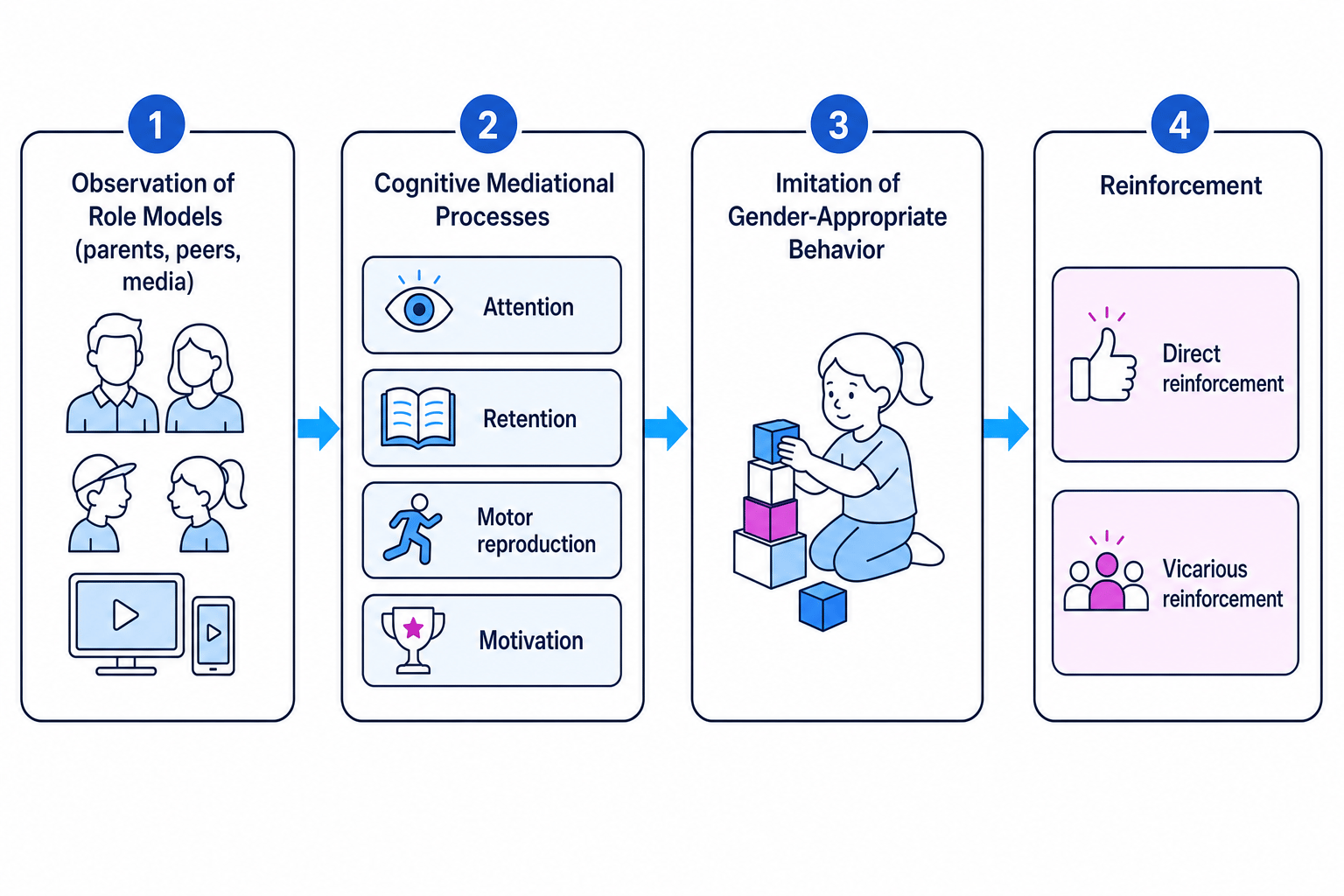
Remembering the Mediational Processes
To easily recall these four cognitive steps in your exam, use the acronym ARMM:
- A - Attention
- R - Retention
- M - Motor Reproduction
- M - Motivation
3. Applying SLT to Scenarios
In your A-Level Psychology exam, you will often be given a short case study (AO2) and asked to explain a child's gendered behaviour using Social Learning Theory. Let's look at how to construct a high-scoring, systematic response.
Applying SLT concepts to a scenario
Scenario:
Four-year-old Toby is watching his older brother, Oscar, play a video game. When Oscar wins, their father claps, smiles, and says, "Well done Oscar, you're a strong competitor!" Later that afternoon, Toby is seen playing the same game, aggressively hitting the buttons and shouting, "I'm a strong competitor!" while looking at his father.
How to structure your application:
- Identify the role model and state why they are influential: Toby's model is his older brother, Oscar. Oscar is an effective model because he is the same sex as Toby, older, and holds status in Toby's eyes. This fosters identification.
- Explain the role of vicarious reinforcement: Toby observes Oscar receiving positive praise (clapping, smiling, and verbal reinforcement) from their father. Because Oscar is rewarded, Toby experiences vicarious reinforcement, which increases his motivation to replicate the behaviour.
- Trace the cognitive mediational processes (ARMM):
- Attention: Toby actively watches Oscar play.
- Retention: Toby stores the phrase "I'm a strong competitor" and the button-hitting actions in his memory.
- Motor Reproduction: Toby is physically capable of hitting buttons and shouting.
- Motivation: Toby is motivated to imitate the behaviour because he wants to receive the same praise from his father (direct reinforcement).
Confusing Vicarious and Direct Reinforcement
Ensure you keep these two terms distinct! Vicarious reinforcement occurs when the child observes someone else being rewarded. Direct reinforcement occurs when the child themselves is rewarded after performing the behaviour. Do not use them interchangeably in scenarios.
4. The Influence of Culture and Media
The specification explicitly requires you to understand how culture and media influence gender roles. Since SLT claims gender is learned from our environment, looking at different cultural expectations and media portrayals provides excellent real-world evidence.
The Influence of Culture
If gender roles are purely biological, they should be identical across all human societies. However, if gender roles vary across cultures, this supports the SLT view that gender is culturally transmitted (nurture).
- Mead (1935): Margaret Mead investigated several tribal societies in New Guinea:
- The Arapesh: Both men and women displayed gentle, cooperative, and sensitive behaviours (traits typically westernized as feminine).
- The Mundugumor: Both men and women were aggressive, hostile, and power-seeking (traits typically westernized as masculine).
- The Tchambuli: Gender roles were reversed compared to Western norms. Women were dominant, practical, and handled the food production, while men were emotionally dependent, artistic, and spent time grooming themselves.
- Conclusion: Gender roles are culturally determined rather than biologically fixed.
- Buss (1989): Conducted a cross-cultural study of mate preferences in 37 cultures. While some cultural differences existed, he found consistent patterns: men universally valued physical youth and attractiveness (signals of fertility), while women valued financial capacity and ambition (signals of resources). This suggests that while gender roles can be culturally fluid, some aspects of gender-typed behaviour may have an evolutionary/biological foundation.
The Influence of Media
The media provides children with clear, powerful gender stereotypes. Children who consume high amounts of media are exposed to models acting in traditional ways.
- Media Portrayals: Media traditionally depicts males as independent, ambitious, and professional, whereas females are often depicted as dependent, nurturing, and domestic.
- Williams (1986) - The "Notel" Study: This unique natural experiment took place in an isolated Canadian town nicknamed "Notel," which was about to receive television broadcasts for the first time. Researchers compared Notel to two neighbouring towns: "Unitel" (had one TV channel) and "Multitel" (had multiple channels).
- Before TV was introduced, children in Notel had much weaker gender-stereotyped views than children in the other two towns.
- Two years after TV was introduced to Notel, the children's attitudes had become significantly more gender-stereotyped, demonstrating the powerful role of TV models in shaping gender concepts.
5. Evaluation (AO3)
When writing an essay on the Social Learning Theory of gender, you must weigh its strengths and weaknesses.
Strengths
- Practical Application (Real-World Value): Because gender roles are learned, they can be unlearned. This theory has been used to encourage media producers to create non-stereotypical programmes (e.g., female characters who are scientists or male characters who are caregivers). This helps break down limiting gender barriers.
- Explains Cultural Flexibility: SLT easily explains why gender roles change over time and differ between societies. Biological theories struggle to explain why Western male roles have shifted towards domestic involvement over the past fifty years, whereas SLT points directly to changes in environmental reinforcement and media representation.
- Supporting Evidence for Media Influence: Studies like Williams (1986) and Smith and Lloyd (1978) support the power of social influences.
Smith and Lloyd (1978)
An observational study where mothers played with a 6-month-old baby dressed as either a boy or a girl. When dressed as a boy, mothers actively encouraged vigorous physical play and offered "masculine" toys (e.g., a hammer). When dressed as a girl, they were handled gently and offered "feminine" toys (e.g., a doll). This shows how early direct reinforcement and adult expectations shape gender development.
Weaknesses
- Underestimates Biological Factors: SLT largely ignores the influence of prenatal hormones (such as testosterone and oestrogen) and evolutionary adaptations. For instance, the famous case of David Reimer (a boy raised as a girl after a botched circumcision) showed that despite intense female socialization and reinforcement, he never adjusted to his assigned female gender identity, ultimately reverting to living as a male. This suggests biology plays a deeper role than SLT acknowledges.
- Does Not Explain Age-Related Changes: SLT assumes learning occurs at any point in childhood. It fails to explain why children's gender concepts change in structured, age-related stages (e.g., why a 3-year-old thinks changing their clothes changes their gender, whereas a 6-year-old understands gender remains constant). To explain this, we must look to cognitive developmental theories (like Kohlberg's theory or Gender Schema theory).
In the exam
- Differentiate SLT from Cognitive theories: Remember that SLT focuses on external social influences (parents, media, culture) driving gender development, while cognitive theories focus on the child's internal understanding of gender as they mature.
- Structure your AO3 systematically: When evaluating, explicitly state how a study (like Mead's or Williams's) supports or contradicts the core assumptions of SLT.
- Don't ignore the ethical issues: In studies like Bandura (1961) or Smith and Lloyd (1978), keep in mind the potential long-term impact on children of being manipulated into specific gender behaviors or exposed to aggressive models. Bring this up in your evaluation of research methods!
Check yourself
- Can you explain the difference between direct and vicarious reinforcement using a gender-related example?
- How does Margaret Mead's (1935) anthropological research support the nurture side of the nature-nurture debate in gender?
- Why does the case of David Reimer present a significant challenge to the Social Learning Theory of gender?
